Discover how 2D animation services help ecommerce brands create more ad creatives, improve campaign testing, and scale Meta Ads, TikTok Ads, and YouTube Ads.
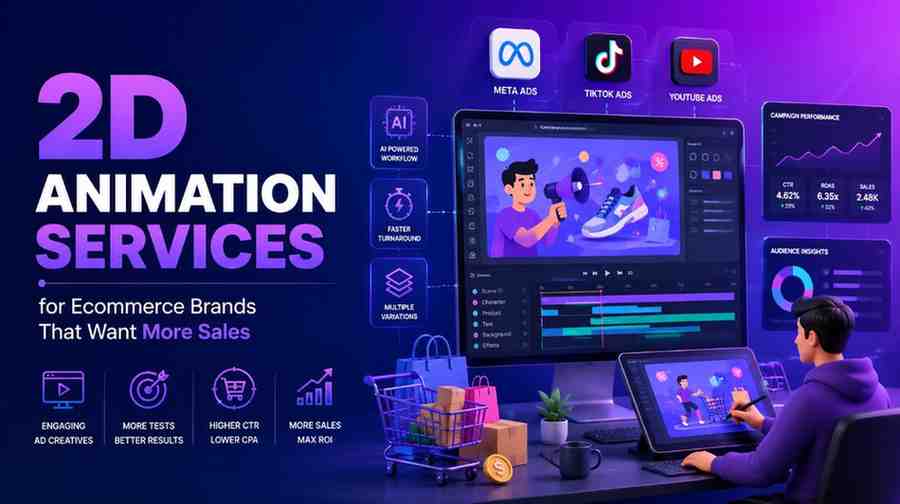
A few years ago, many brands viewed animation as something reserved for explainer videos, product demonstrations, or occasional brand campaigns. Today, the conversation looks very different. Advertising teams are under pressure to produce more creative assets than ever before, and that shift is causing many ecommerce brands to take another look at 2D animation services.
The reality is simple. Most paid social campaigns do not fail because targeting is broken. They struggle because creative performance declines over time. Audiences see the same message repeatedly, engagement drops, click-through rates decline, and customer acquisition costs begin to climb.
This challenge is especially visible across Meta Ads, TikTok Ads, and YouTube campaigns where creative freshness often influences performance more than small targeting adjustments.
As a result, many brands are investing in 2D animation services not as a branding exercise but as a practical advertising solution.
Animation offers flexibility that traditional production often cannot match. Marketing teams can quickly introduce new offers, highlight product benefits, test different messaging angles, and create multiple variations without organizing new photo shoots or video productions every time a campaign changes direction.
For ecommerce brands managing dozens or even hundreds of SKUs, this flexibility becomes particularly valuable. Instead of rebuilding creative assets from scratch, teams can adapt existing animated concepts to support new products, seasonal promotions, and audience-specific messaging.
Another factor driving demand is the increasing need for platform-specific creative. What works on TikTok may not work on Instagram Reels. What performs well as a YouTube pre-roll advertisement may need a completely different structure on Facebook.
2D animation services allow marketing teams to create customized versions of creative assets while maintaining visual consistency across channels.
Many brands also appreciate the ability to explain products more clearly through animation. Certain products involve features, workflows, or benefits that are difficult to communicate through static images alone. Animation helps simplify those messages in a way that feels engaging rather than overly technical.
The shift is not really about animation itself. It is about solving a larger advertising problem. Brands need more creative. They need it faster. And they need enough variation to continuously test new ideas without exhausting production resources.
That is why 2D animation services are becoming a larger part of the modern advertising mix.
The expectations surrounding 2D animation services have changed significantly.
A few years ago, many companies primarily cared about production quality. If an animation looked polished and aligned with brand guidelines, the project was considered successful.
Today, performance marketing teams evaluate creative through a different lens.
They want animation that supports customer acquisition goals.
They want animation that can be tested.
They want animation that can be adapted quickly when campaigns evolve.
For many ecommerce brands, the biggest question is no longer whether an animation looks good. The question is whether it helps generate measurable advertising results.
Marketing leaders often manage campaigns across multiple products, customer segments, and advertising platforms simultaneously. This creates a constant need for fresh creative concepts.
As a result, 2D animation services are increasingly expected to support creative testing frameworks rather than one-time content projects.
A media buyer running Meta Ads may want several versions of the same core message. One version may emphasize pricing. Another may focus on product outcomes. A third may highlight social proof. Animation provides a practical way to create those variations efficiently.
The same applies to TikTok campaigns where brands frequently test different hooks, storytelling approaches, and audience-specific messaging.
Another expectation involves speed.
Advertising teams often cannot wait months for creative production cycles. Product launches move quickly. Promotional calendars change. Competitors introduce new offers. Campaign performance shifts unexpectedly.
Modern 2D animation services must fit within these realities.
Teams increasingly expect creative partners to support rapid iteration and continuous testing rather than lengthy production timelines.
There is also growing demand for flexibility across campaign stages.
Top-of-funnel campaigns may require educational content designed to introduce a product category. Mid-funnel campaigns may focus on specific benefits or customer objections. Retargeting campaigns often require more direct and conversion-oriented messaging.
Animation needs to support all of these objectives.
One interesting change is that many performance marketers now evaluate creative production similarly to how they evaluate advertising spend. They want to understand output volume, testing capacity, and creative velocity.
That shift has changed how successful 2D animation services are delivered.
The focus is increasingly moving from individual projects toward ongoing creative systems that help brands generate a steady flow of new advertising assets.
One of the most common frustrations inside growing ecommerce brands is not media buying.
It is creative production.
Advertising teams frequently identify promising campaign opportunities but struggle to produce enough creative assets to test those opportunities effectively.
This problem becomes even more noticeable as brands scale.
A company spending a few thousand dollars per month on advertising can often operate with a relatively small creative library. A brand spending hundreds of thousands of dollars per month faces a very different reality.
Creative fatigue becomes more frequent.
Audience saturation increases.
Winning ads lose effectiveness faster.
New concepts must be tested continuously.
The demand for creative output grows significantly.
Unfortunately, traditional production workflows do not always scale efficiently.
Coordinating shoots, sourcing talent, managing revisions, scheduling production timelines, and generating multiple variations can consume substantial time and resources.
This is where 2D animation services can help reduce operational friction.
Animation allows brands to produce a larger volume of advertising creative without relying entirely on new live-action production every time a campaign requires fresh assets.
For example, an ecommerce company launching five new products may need dozens of creative variations across multiple platforms. Instead of creating separate production workflows for each product, animation can provide a more scalable approach to communicating product benefits, offers, and customer outcomes.
I might be wrong here, but many marketers still underestimate how much campaign performance is tied to creative production capacity rather than media buying tactics alone.
Some teams spend weeks debating targeting strategies while running the same creative concepts for months.
The results are often predictable.
Performance eventually declines because audiences stop responding to repetitive messaging.
Creative volume matters.
Creative variety matters.
Testing frequency matters.
A slightly awkward reality exists here. Great creative is important, but producing enough creative is often equally important.
The highest-performing advertising teams are rarely dependent on a single winning ad. They continuously introduce new concepts, test new messages, and explore different customer motivations.
That requires a production process capable of keeping pace with campaign demands.
2D animation services are increasingly becoming part of that process because they allow brands to generate more variations, support ongoing testing initiatives, and adapt creative strategies without creating unnecessary operational bottlenecks.
For many ecommerce brands, the challenge is no longer finding advertising opportunities.
The challenge is producing enough creative to take advantage of them.
One of the reasons brands continue investing in 2D animation services is that advertising platforms now demand a constant flow of new creative.
A creative concept that performs well on Meta Ads may begin losing efficiency after repeated exposure. TikTok audiences often respond differently from Instagram users. YouTube viewers may require more context before taking action.
The challenge is not simply creating one good advertisement.
The challenge is producing enough creative variations to remain competitive across multiple platforms at the same time.
This is where 2D animation services fit naturally into modern paid media operations.
For Meta Ads, animation can help communicate product benefits quickly within the first few seconds. Marketing teams often use animated creative to highlight promotions, explain features, showcase customer outcomes, or simplify complex products.
On TikTok, speed and attention are critical. Animated creative allows brands to test different hooks, visual styles, and storytelling approaches without rebuilding every asset from scratch.
YouTube campaigns present a slightly different situation. Viewers may spend more time with an advertisement, creating opportunities to explain products in greater detail. Animation can help maintain engagement while delivering more information than a typical short-form social ad.
Many ecommerce brands also use 2D animation services to maintain visual consistency across channels.
A product launch campaign may require:
Instead of creating separate visual systems for every platform, animation allows brands to adapt a core concept while maintaining consistent messaging.
The result is often a more efficient production workflow and a stronger connection between creative execution and media buying objectives.
The best advertising teams rarely think about channels in isolation. They think about how creative performs throughout the customer journey.
Animation helps support that broader strategy.
Most advertising teams talk about testing.
Fewer teams actually have enough creative production capacity to test consistently.
That gap becomes a major obstacle as brands scale.
A media buyer may identify ten different audience segments worth targeting. A growth marketer may uncover several customer pain points that deserve dedicated messaging. A founder may want to experiment with different product positioning strategies.
All of those opportunities require creative assets.
Without sufficient creative production, testing often becomes limited to minor copy adjustments rather than meaningful strategic experiments.
This is one area where 2D animation services create real business value.
Instead of producing a single advertisement, brands can develop multiple variations around a central concept.
For example, a skincare brand might test:
Creative Angle
Core Message
Problem Focused
Addressing a common skincare concern
Benefit Focused
Highlighting visible improvements
Educational
Explaining how ingredients work
Social Proof
Showing customer outcomes
Promotional
Emphasizing limited-time offers
Each variation can target a different customer motivation while maintaining overall brand consistency.
The same principle applies to audience testing.
Different customer groups often respond to different messaging priorities. New customers may need education. Returning customers may respond better to product updates or special offers.
Animation makes it easier to create these variations without dramatically increasing production complexity.
One ecommerce operator I worked with faced this exact challenge during a product expansion initiative. The company was launching several new product bundles while simultaneously scaling Meta Ads spend.
The media buying team had no shortage of ideas.
The problem was creative throughput.
Every new audience test required additional assets. Every new offer required supporting creative. Production delays began slowing campaign execution.
Once the team shifted toward a more scalable animated creative workflow, they were able to launch significantly more tests each month. Not every test succeeded. Many failed quickly.
That was actually the point.
The goal was not perfection.
The goal was learning faster than competitors.
Many ecommerce brands eventually face a creative challenge that becomes difficult to ignore.
Growth creates complexity.
A company that once advertised three products may now manage twenty. A catalog that originally contained a handful of SKUs may expand into multiple product lines, bundles, seasonal offers, and promotional campaigns.
Suddenly the creative workload becomes much larger than expected.
Each product requires its own messaging.
Each audience may need different positioning.
Each platform may require different creative formats.
The workload adds up quickly.
2D animation services help brands address this challenge by creating systems that scale more efficiently than many traditional production approaches.
Instead of treating every campaign as a completely new project, animation allows teams to build reusable creative frameworks.
Core visual assets can often be adapted across products.
Messaging can be updated.
Promotions can be swapped.
Product features can be highlighted differently depending on the audience.
This flexibility becomes especially useful during product launches.
Launch periods typically involve significant uncertainty. Teams are testing positioning, evaluating audience response, and gathering performance data.
Creative requirements change constantly.
Sometimes launch messaging works exactly as expected.
Sometimes it doesn't.
And sometimes the market responds to something nobody predicted.
That last situation happens more often than marketers like to admit.
Scalable animated creative gives brands the ability to react more quickly when these situations occur.
Instead of waiting for lengthy production cycles, teams can adjust messaging, develop new creative concepts, and continue testing without disrupting campaign momentum.
For brands managing large product catalogs, that flexibility often becomes a competitive advantage.
The conversation around AI in creative production tends to swing between extremes.
Some people believe AI will replace creative teams entirely.
Others dismiss its impact altogether.
Neither perspective reflects what many advertising teams are experiencing today.
What AI is actually changing is the economics of creative production.
Advertising platforms reward experimentation. Teams that test more concepts often generate more performance insights. The challenge has always been producing enough creative to support that level of testing.
Historically, creative production capacity was constrained by time, budget, and operational resources.
AI is beginning to reduce some of those constraints.
For 2D animation services, this shift is creating new opportunities.
Tasks that once required extensive manual production can often be completed more efficiently. Teams can generate variations faster. Iteration cycles can become shorter. Campaign adjustments can happen with less operational friction.
This does not eliminate the need for creative thinking.
Far from it.
A weak concept remains weak regardless of how quickly it is produced.
Strong messaging still matters.
Customer understanding still matters.
Strategic positioning still matters.
What AI changes is the speed at which creative ideas can move from concept to testing environment.
That distinction is important.
Many marketers assume AI's primary value comes from reducing costs.
Cost savings can certainly be part of the equation.
However, many growth-focused brands are more interested in increasing creative output than simply lowering production expenses.
If AI allows a team to test twice as many concepts within the same timeframe, the resulting performance insights may be more valuable than the direct production savings.
The economics become less about efficiency alone and more about learning velocity.
That shift is influencing how brands evaluate modern 2D animation services.
As creative demands continue growing across Meta Ads, TikTok Ads, and YouTube campaigns, many brands are searching for ways to increase output without expanding production bottlenecks.
This is where Brahvo AI focuses its approach.
Rather than treating creative production as a series of isolated projects, Brahvo AI helps brands develop scalable systems for generating advertising creative that supports ongoing testing and campaign optimization.
For ecommerce operators, this can be particularly valuable.
Advertising success increasingly depends on creative volume and testing frequency. Brands need enough assets to evaluate new offers, explore different customer motivations, support product launches, and maintain campaign freshness.
Brahvo AI combines AI-powered production capabilities with advertising-focused creative development to help brands produce more animated content without sacrificing execution speed.
The objective is not simply creating more content.
The objective is creating more opportunities to learn what resonates with customers.
Whether a brand is managing a growing product catalog, expanding advertising budgets, or launching new campaigns across multiple channels, the ability to increase creative throughput can have a meaningful impact on testing capacity.
Many teams discover that campaign scaling challenges are often creative challenges in disguise.
Media buyers may have additional budget available.
Growth marketers may identify new audience opportunities.
Founders may want to accelerate customer acquisition.
But without sufficient creative production, those opportunities remain difficult to fully capitalize on.
Brahvo AI helps address this gap by supporting the continuous flow of animated advertising assets needed to keep testing programs moving forward.
Because at a certain point, campaign growth is not limited by ideas.
It is limited by how quickly those ideas can become creative that reaches the market.
One of the biggest mistakes brands make when evaluating 2D animation services is focusing too heavily on surface-level metrics.
Views look impressive.
Engagement rates can be encouraging.
Video completion percentages may appear strong.
But none of those metrics automatically indicate business impact.
Most ecommerce brands are not investing in creative production simply to generate attention. They are investing because they want more customers, stronger advertising performance, and better revenue outcomes.
That changes how success should be measured.
For performance-focused brands, the real value of 2D animation services often appears deeper inside the advertising funnel.
Questions worth asking include:
These metrics are often far more meaningful than engagement numbers alone.
For example, an animated advertisement may generate fewer likes than another creative variation while simultaneously producing a lower cost per acquisition.
Which one actually matters more?
For most marketing leaders, the answer is obvious.
Another important measurement is creative output.
Many growing brands discover that the biggest benefit of 2D animation services is not a single winning advertisement.
It is the ability to produce more creative consistently.
The relationship between creative volume and campaign performance is becoming increasingly important across Meta Ads and TikTok Ads.
Teams that can test more concepts generally learn faster.
Teams that learn faster often identify winning messages earlier.
Those insights can compound over time.
A founder managing a seven-figure advertising budget may care less about whether a video receives thousands of reactions and more about whether the creative helped uncover a profitable audience segment.
That distinction matters.
Some of the most valuable creative assets are not the advertisements that immediately scale.
They are the advertisements that generate insights.
They reveal which messages resonate.
They uncover customer objections.
They highlight unexpected buying motivations.
Those discoveries often influence future campaigns long after the original creative stops running.
The strongest 2D animation services contribute to this broader learning process.
They help brands build a testing engine rather than simply producing individual assets.
And that business impact is often much larger than a dashboard full of engagement metrics.
Choosing 2D animation services is not really a production decision anymore.
For many ecommerce brands, it has become a growth decision.
The quality of creative production directly affects testing capacity, campaign agility, and customer acquisition performance.
Because of that, marketing leaders should evaluate potential partners through a performance lens rather than a purely creative one.
A useful starting question is simple:
Can they support ongoing creative testing?
Many providers can produce a beautiful animation.
Far fewer can support the continuous flow of creative variations needed for modern advertising environments.
Another important question involves production speed.
How quickly can new concepts move from idea to launch?
Advertising opportunities often have limited windows. Delayed creative frequently means delayed learning.
Marketing leaders should also evaluate scalability.
Can the creative process support multiple products?
Can it support multiple campaigns running simultaneously?
Can it adapt when advertising budgets increase?
These questions become increasingly important as brands grow.
It is also worth understanding how revisions and iteration are handled.
Creative testing depends on adaptation.
Campaign insights frequently lead to new messaging, new offers, and new audience strategies.
A rigid production process can slow that momentum.
Teams should also ask how AI is being incorporated into creative workflows.
Not because AI is a selling point by itself.
Because AI can influence production capacity, testing volume, and operational efficiency when applied correctly.
The goal is not automation for its own sake.
The goal is helping marketing teams generate more learning opportunities.
One question that is often overlooked is this:
Will this creative approach help us test more ideas next quarter than we can test today?
That may be the most important question of all.
Because advertising environments continue getting more competitive.
Customer acquisition costs continue changing.
Consumer attention continues fragmenting.
Winning campaigns rarely stay winning forever.
The brands that consistently grow are often the ones that learn faster than everyone else.
And learning faster usually starts with having enough creative in the market to discover what customers actually respond to.
That is the part many teams are still trying to figure out.