Scale video production with AI avatar services with customizable voice tones. See how Brahvo AI helps ecommerce brands create videos faster.
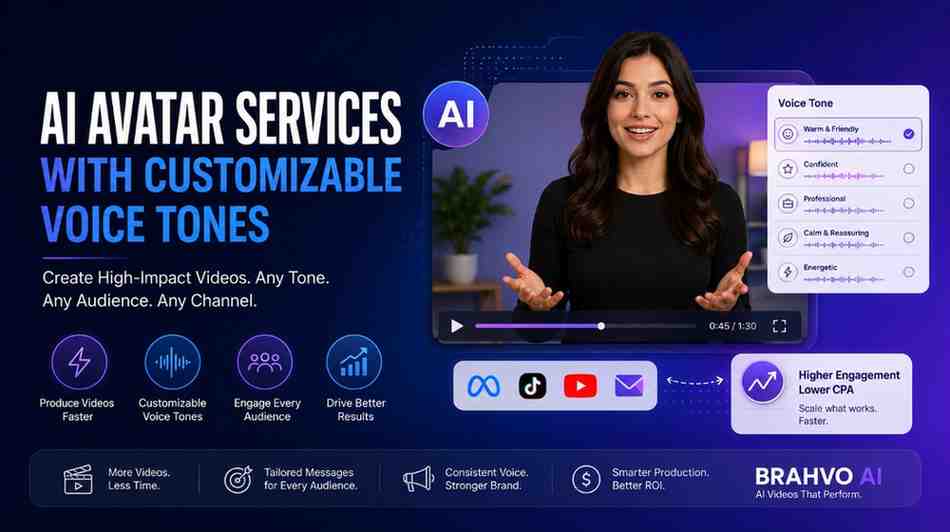
Most marketing teams are not struggling because they lack ideas. They're struggling because they can't turn those ideas into finished videos quickly enough.
A campaign launches with three ad variations, one creative performs well, and suddenly the paid media team wants ten more versions by the end of the week. The copy changes. The offer changes. The hook changes. The audience changes. Then someone asks for a version with a more conversational voice, another with a confident tone, and another that feels more premium. Traditional production simply isn't built for that pace.
That's one of the biggest reasons AI avatar services with customizable voice tones have become part of modern marketing operations rather than just another creative trend.
Video has become the default format across Meta Ads, TikTok Ads, YouTube, landing pages, product launches, and customer education. At the same time, brands are expected to produce more content than ever before while keeping production costs under control. Recording every update with human presenters is difficult when campaigns change weekly or even daily.
With AI avatar services with customizable voice tones, marketing teams can update scripts, adjust delivery styles, and create new video variations without restarting the entire production process. The same avatar can present a product with an energetic voice for social ads, a calm educational tone for onboarding content, or a more professional style for B2B presentations. That flexibility matters because different audiences respond to different styles of communication.
For ecommerce brands managing dozens or even hundreds of products, consistency is just as important as speed. Every video should sound like it belongs to the same company, even when different campaigns target different customer segments. Customizable voice tones help maintain that consistency while still allowing creative teams to experiment with messaging.
The growing use of AI generated video is also changing how performance marketers think about testing. Instead of asking whether they can afford to create another version, they're asking whether there's any reason not to test another angle. That shift can significantly increase testing velocity without putting additional pressure on production resources.
Modern marketing isn't slowing down. If anything, campaign cycles continue to get shorter. AI avatar services with customizable voice tones help brands keep pace by making video production more flexible, repeatable, and responsive to changing campaign needs.
Creative production has quietly become one of the biggest bottlenecks in paid advertising.
Media buyers often have budgets ready to scale, but they don't always have enough fresh creative to support that growth. Winning ads eventually lose momentum, customer acquisition costs begin climbing, and performance starts slipping because audiences have already seen the same videos multiple times.
This is especially common for ecommerce brands running continuous campaigns throughout the year. New product launches, seasonal promotions, limited time offers, bundle campaigns, and customer retention initiatives all compete for creative resources. Internal teams can quickly find themselves waiting on script approvals, filming schedules, editing timelines, and revision requests.
Managing multiple SKUs creates another layer of complexity.
A skincare brand, for example, might sell twenty different products with unique benefits, audiences, and promotional offers. Producing individual videos for every variation using traditional methods requires significant planning, coordination, and budget. Even small changes like updating pricing or replacing a headline can trigger another production cycle.
Agency communication can also slow things down. Feedback passes through account managers, creative teams, editors, and stakeholders before revisions are completed. Nobody is intentionally creating delays, but every approval stage adds time.
Performance marketing doesn't always wait.
A media buyer may identify a promising audience on Monday and want five new video concepts running by Wednesday. If production takes two weeks, that opportunity may already be gone.
This is where AI avatar services with customizable voice tones fit naturally into existing marketing workflows. Instead of treating every new video as a full production project, teams can focus on refining messaging while producing updated versions much faster.
I might be wrong here, but faster production alone isn't always the answer. Publishing more videos without improving messaging rarely fixes poor campaign performance. Strong creative strategy still matters. AI simply removes many of the production barriers that prevent marketers from testing those stronger ideas.
The conversation has shifted from "Can we make another video?" to "Which version should we test next?" That's a very different mindset.
Every paid social team eventually reaches the same point. They have more ideas than production capacity.
One campaign needs a shorter hook. Another needs a different opening for TikTok. Someone wants a more confident narrator for YouTube. Another stakeholder requests a softer tone for a product education video. None of these changes are particularly difficult on their own, but together they create an endless queue of production requests.
AI avatar services with customizable voice tones reduce much of that friction by separating creative experimentation from traditional filming schedules.
Instead of booking talent, preparing equipment, coordinating recording sessions, and editing every new version from scratch, marketing teams can update scripts, modify voice delivery, and generate fresh video assets much more efficiently. That allows creative teams to spend more time improving messaging rather than managing production logistics.
Consider a DTC supplement brand preparing for a nationwide promotion.
The paid media team wants to test six opening hooks across Meta Ads, four voice styles for different customer demographics, and separate versions for cold audiences and returning customers. Using conventional production, this project could require multiple recording sessions and several rounds of editing.
With AI avatar services with customizable voice tones, much of that creative variation becomes easier to produce. Teams can maintain the same brand presentation while adjusting delivery styles to better match different campaign objectives.
Brahvo AI helps simplify this process by giving marketing teams the flexibility to produce AI avatar videos with voice tones that align with different audiences, products, and advertising goals. Rather than rebuilding every asset from the beginning, teams can focus on continuous creative testing and faster campaign iteration.
That doesn't mean every campaign should generate dozens of versions automatically. Sometimes fewer, more thoughtful creative tests outperform large batches of average ads. Production speed is valuable only when it's paired with smart decision making.
Still, when campaigns move quickly, having the ability to create fresh video assets without traditional production delays gives ecommerce brands a practical advantage. Creative fatigue doesn't wait for filming schedules, and neither do paid media opportunities.
Customers rarely interact with a brand in just one place anymore.
They might first see a short video on Meta Ads, later watch a product demonstration on YouTube, receive an email introducing a new collection, and eventually land on a product page with another video explaining features. Every one of those touchpoints shapes how they perceive the brand.
When the messaging sounds different every time, trust can quietly erode. One video feels casual, another sounds overly formal, and a third has an entirely different presentation style. Individually, those differences may seem small. Together, they create an inconsistent customer experience.
This is where AI avatar services with customizable voice tones become much more than a production shortcut.
Instead of creating completely different presentations for every campaign, brands can establish a recognizable voice that carries across advertising, product education, onboarding, customer support content, and promotional announcements. The wording can change to match the campaign, but the overall personality remains familiar.
That consistency becomes even more valuable for ecommerce companies expanding their product catalogs. A brand selling fitness equipment, nutritional supplements, and accessories still wants customers to recognize the same personality across every video.
Voice tone also affects how information is received.
A limited time promotion may benefit from an energetic presentation that creates urgency. A warranty explanation usually works better with a calm and reassuring delivery. Product tutorials often need a slower, more instructional style. The goal is not to sound identical in every situation. The goal is to sound like the same brand adapting naturally to different conversations.
AI avatar services with customizable voice tones make those adjustments possible without rebuilding the creative process every time a campaign changes.
Marketing teams can develop internal voice guidelines just as they already create brand guidelines for colors, typography, and messaging. Once those standards are established, producing consistent video communication becomes much easier even when multiple campaigns are running simultaneously.
The result is a library of videos that feels connected instead of pieced together from unrelated productions.
Most ecommerce brands are not speaking to one customer.
They are speaking to first time buyers, repeat customers, high value shoppers, seasonal buyers, loyalty members, and people who abandoned their carts yesterday. Each audience has different motivations, different objections, and often responds to a different communication style.
That creates a difficult production problem.
Traditionally, changing the presentation meant bringing presenters back into the studio, recording new takes, editing updated footage, and waiting for approvals before launching another campaign.
With AI avatar services with customizable voice tones, personalization becomes much more practical.
Instead of recreating an entire video, teams can update scripts and adjust how the avatar delivers the message. One version may sound friendly and educational for customers discovering the brand for the first time. Another may use a more confident and direct voice for shoppers already familiar with the product line.
Imagine a home organization brand preparing separate campaigns.
One audience includes homeowners searching for storage solutions. Another consists of apartment renters with limited space. The products may overlap, but the messaging and delivery should feel different because the problems being solved are different.
The avatar doesn't need to change completely. The voice tone, emphasis, pacing, and script can evolve to match the audience while preserving the overall brand identity.
This flexibility also helps during seasonal campaigns.
Holiday promotions often call for a more energetic presentation. Product education after the purchase usually benefits from a calmer tone that focuses on clarity rather than urgency.
Small adjustments like these can make videos feel more relevant without requiring another production cycle.
And yes, sometimes the difference is surprisingly subtle.
Changing the pace of delivery or emphasizing different benefits can influence how customers interpret the exact same information.
Growth creates its own problems.
A brand that once advertised five products may eventually manage fifty. New bundles appear every month. Seasonal promotions rotate throughout the year. Customer acquisition campaigns run alongside retention campaigns. Then wholesale marketing enters the picture.
The creative workload expands much faster than most production teams expect.
One product rarely needs just one video anymore.
Marketing teams often need vertical versions for TikTok, square formats for social feeds, landscape edits for YouTube, shorter cuts for retargeting campaigns, product page videos, email content, and promotional assets for marketplace listings.
Now multiply that by dozens of products.
Production can quickly become the limiting factor instead of marketing strategy.
AI avatar services with customizable voice tones allow brands to scale video creation without increasing complexity at the same pace.
Rather than treating every campaign as an independent project, teams can build repeatable production workflows where messaging changes, offers change, and voice delivery changes while maintaining consistent creative quality.
A practical example makes this easier to picture.
A beauty brand launches twelve new products before the holiday season. Each product requires introductory videos, promotional advertisements, educational explainers, and remarketing assets. The media buying team also wants several creative variations because previous campaigns showed that fresh ads tend to outperform older creatives after a few weeks.
Producing all of those assets through traditional filming would demand weeks of scheduling and editing.
Using AI avatar services with customizable voice tones, the creative team can produce a much larger volume of campaign ready videos while keeping production aligned with advertising timelines instead of slowing them down.
It isn't about replacing creative thinking.
It's about making sure production capacity doesn't limit good marketing ideas.
Well. That matters more than people sometimes admit.
Media buyers usually pay close attention to audiences, budgets, placements, and bidding strategies.
Creative teams spend their time refining visuals, headlines, and messaging.
Voice delivery often receives less attention than it deserves.
Yet the way a message is delivered can influence whether someone keeps watching long enough to hear the offer.
That's one reason AI avatar services with customizable voice tones have become increasingly valuable for paid advertising.
Different platforms encourage different viewing behaviors.
TikTok users often expect a conversational presentation that feels natural and immediate. YouTube viewers may respond better to a more detailed explanation. Retargeting campaigns frequently benefit from a reassuring tone because the audience already knows the product.
Even within the same platform, audiences are different.
A premium product launch may require a polished presentation that communicates quality and expertise. A flash sale may perform better with a faster pace that creates urgency. Product demonstrations usually benefit from clear and measured delivery rather than excessive enthusiasm.
Voice customization also supports creative testing.
Instead of changing only headlines or visuals, marketers can evaluate whether different delivery styles produce stronger engagement, longer watch times, or higher conversion rates.
One ecommerce apparel company, for example, might test identical scripts with two different voice approaches. One version sounds energetic and promotional. The other feels conversational and educational. The winning variation may reveal insights that influence future campaigns beyond that single advertisement.
Of course, voice tone is only one part of performance.
A poor offer remains a poor offer regardless of how confidently it's presented.
Still, when creative teams have the flexibility to test both messaging and delivery, they gain another variable that can improve campaign optimization over time.
Most marketing teams don't need more ideas.
They need a faster way to turn approved ideas into campaign ready videos without creating production bottlenecks every single week.
That's where Brahvo AI focuses its efforts.
Brahvo AI provides AI avatar services with customizable voice tones that help ecommerce brands, DTC companies, performance marketers, and growing businesses produce professional AI avatar videos more efficiently. Instead of relying on repeated filming sessions for every campaign update, teams can adapt scripts, adjust presentation styles, and generate new creative assets that align with evolving marketing objectives.
This becomes especially valuable for brands managing ongoing advertising across Meta Ads, TikTok Ads, YouTube, ecommerce product pages, email campaigns, and customer education.
Rather than treating every creative request as a completely new production, teams can build flexible workflows that support continuous testing, frequent updates, and larger creative libraries without overwhelming internal resources.
Consider a realistic scenario.
An ecommerce company launches a weekend promotion after seeing inventory move slower than expected. The marketing team wants fresh videos highlighting a limited time discount, a bundled offer, and free shipping. At the same time, the paid media team requests separate versions for prospecting campaigns, remarketing audiences, and existing customers.
Under traditional production timelines, those requests could compete with other ongoing projects.
With Brahvo AI, producing multiple AI avatar videos with different scripts and customizable voice tones becomes a far more manageable process, allowing campaigns to respond more quickly to changing business priorities.
I might be wrong here, but not every business needs to create hundreds of videos each month.
Some companies are better served by producing fewer, higher quality creative concepts and testing them thoughtfully.
The difference is that Brahvo AI gives those businesses room to scale production whenever demand increases instead of rebuilding their entire creative process from scratch.
For marketing teams trying to balance speed, consistency, creative testing, and operational efficiency, that flexibility often becomes just as valuable as the videos themselves.
The quality has improved significantly, especially for business communication, product explainers, paid advertising, ecommerce videos, customer onboarding, and internal training. The most effective videos aren't trying to fool viewers into thinking they're watching a human. They focus on delivering clear messaging with professional presentation and consistent branding.
They can, but not by themselves.
Voice delivery influences how people experience a message. A conversational tone may work better for TikTok, while a more authoritative delivery could fit product demonstrations or B2B campaigns. The offer, creative concept, and audience targeting still matter far more than voice alone.
Not at all.
Smaller ecommerce brands often benefit because they have limited production resources. Instead of organizing frequent filming sessions, they can create new campaign assets much faster while keeping costs more predictable.
Probably not.
Many successful brands already combine human creators with AI generated content. UGC builds authenticity, while AI avatars help scale educational videos, promotional content, multilingual campaigns, and ongoing creative testing. Each serves a different purpose.
There isn't a universal answer.
Some high spending Meta Ads accounts refresh creatives every couple of weeks because performance changes quickly. Other businesses can run the same winning creative much longer. The right schedule depends on audience size, budget, campaign objectives, and how quickly creative fatigue appears.
Sometimes, but not always.
A single avatar can create strong brand recognition. However, businesses with multiple product categories or customer segments may benefit from using several avatars while maintaining consistent messaging and visual identity.
No.
Speed only creates opportunity. Strong campaign performance still depends on creative strategy, customer research, compelling offers, and continuous testing. Producing fifty average videos rarely beats producing ten thoughtful ones.
Brands managing multiple products, frequent promotions, seasonal campaigns, or ongoing paid advertising usually see the biggest operational improvements. Ecommerce companies, DTC brands, subscription businesses, and performance marketing teams often need more creative output than traditional production can comfortably support.
Most teams adapt faster than expected because the biggest change is usually in production rather than strategy. Marketing managers continue planning campaigns, copywriters still write scripts, and media buyers still test creatives. The workflow simply becomes more flexible.
Look beyond the avatar itself.
Think about whether the solution supports your campaign volume, brand consistency, creative testing process, voice flexibility, and long term production goals. A platform should fit naturally into your existing marketing workflow rather than forcing your team to build an entirely new one.
Video production isn't becoming less important.
If anything, every major marketing channel continues asking brands to create more video, more frequently, and for more audience segments than ever before. Product launches need fresh creatives. Paid social campaigns require continuous testing. Existing customers expect educational content after the purchase. New markets often require localized messaging.
The workload keeps growing.
For many businesses, AI avatar services with customizable voice tones offer a practical way to keep up with that demand without allowing production timelines to dictate marketing decisions. Instead of waiting for the next filming session, teams can respond faster when campaigns need new messaging, updated offers, or additional creative variations.
Brahvo AI is built around that reality. By helping ecommerce brands and performance marketing teams produce scalable AI avatar videos with customizable voice tones, it supports a workflow where creative ideas move into live campaigns with fewer production delays and greater consistency across channels.
That doesn't mean every business should replace traditional video production. Some campaigns still benefit from live talent, on location filming, or authentic customer stories. AI avatars work best as another production capability rather than the only one.
The brands that gain the most value are often the ones that view video as an ongoing business process instead of a one time project. They know creative testing never really stops. New offers appear. Winning ads wear out. Customer expectations change.
And that raises a question many marketing teams are already asking internally.
Six months from now, when your paid media team asks for twenty new video variations by Friday, will your current production process still keep up?