Scale ecommerce growth with animated explainer video production by Brahvo AI for better ads, product education, and higher conversions.
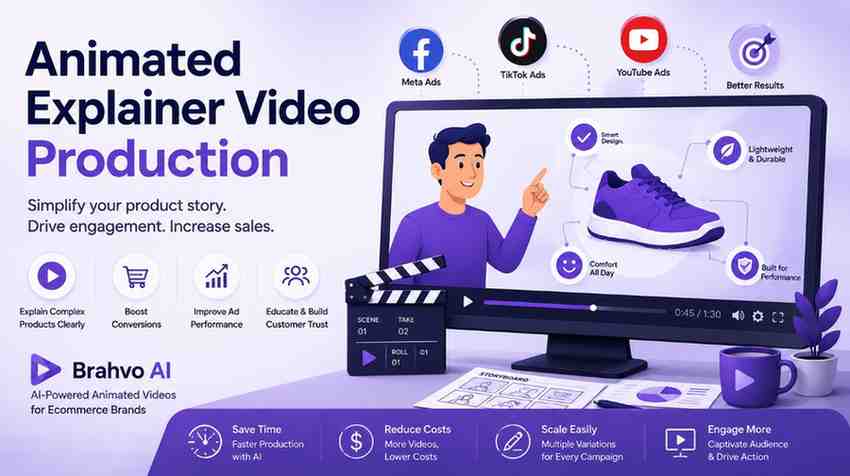
Most ecommerce teams aren't struggling because their products are bad. They're struggling because shoppers don't understand the value fast enough.
A visitor lands on a product page, scrolls for a few seconds, watches a few images, reads part of a description, and leaves. Not because the product isn't useful, but because explaining it through static content takes too much effort from the customer.
That problem becomes even more noticeable when brands sell innovative products, premium products, subscription services, or items with multiple features. A few product photos and bullet points rarely answer every question a buyer has before making a purchase.
This is where animated explainer video production has become an important part of the customer journey instead of just another marketing asset.
An animated explainer video can simplify complicated ideas into a short visual story that people understand within seconds. Instead of asking potential customers to read several paragraphs, brands can demonstrate how a product works, who it's for, and why it solves a real problem.
For ecommerce businesses managing dozens or even hundreds of SKUs, this clarity matters. Every unanswered question creates friction, and friction often leads to abandoned carts or higher customer acquisition costs because advertising budgets have to work harder to convince hesitant buyers.
Consumer attention has also changed dramatically over the last few years. People now spend most of their online time watching short-form videos across Meta, TikTok, YouTube, and other social platforms. They're naturally conditioned to consume information visually rather than through long product descriptions.
That shift has pushed animated explainer video production from a nice addition to a practical business necessity. Marketing teams are no longer creating videos simply because video performs well. They're creating them because customers increasingly expect products to be explained visually before they feel confident enough to purchase.
Brands launching new products benefit even more. A new category often requires education before persuasion. Animation gives marketers complete control over every scene, making it easier to explain concepts that would otherwise require expensive live action shoots or lengthy demonstrations.
For growing ecommerce companies, the challenge isn't just producing one great video. It's creating enough creative assets to support product launches, paid campaigns, landing pages, email marketing, and social media without slowing the marketing calendar.
That's one reason many performance marketing teams now view animated explainer video production as part of their overall creative infrastructure rather than an isolated branding project.
Many marketing teams measure advertising costs carefully, but fewer measure the hidden cost of confusion.
When customers don't immediately understand what a product does, several expensive problems begin to appear across the marketing funnel.
The first is reduced advertising efficiency.
A paid campaign may attract qualified traffic, yet visitors leave because the product feels difficult to understand. The media buying team often responds by adjusting audiences, testing new offers, or increasing budget, when the real issue is that the creative never explained the product clearly in the first place.
The second cost appears in conversion rates.
Imagine a skincare brand introducing a new device with multiple treatment modes. Product photos show the design beautifully, but buyers still wonder how it works, how often they should use it, and what results to expect. Those unanswered questions create hesitation.
A ninety second animated explainer video can answer all of those concerns before they become objections.
Support teams also experience the impact.
Questions that repeatedly arrive through email, live chat, or social media often point toward information gaps in the buying experience. If customers continually ask the same questions before purchasing, those answers probably belong inside visual content instead of customer support conversations.
There's another cost that isn't discussed often.
Marketing teams spend considerable time briefing designers, copywriters, paid media specialists, and agency partners about product positioning. Without a consistent visual explanation, different campaigns can communicate slightly different messages, creating inconsistency across channels.
A well planned animated explainer video production process helps establish one clear narrative that every campaign can build from.
This becomes especially valuable for brands expanding internationally or managing multiple customer segments. Different audiences may require different messaging, but the core explanation of the product should remain consistent.
Of course, animation isn't the answer for every product. I might be wrong here, but some simple consumer goods probably don't need an elaborate explainer. A straightforward demonstration may be enough.
The point is knowing when customers need education before they need persuasion.
That's where many ecommerce brands see the biggest improvement in both customer understanding and advertising efficiency.
Paid social has become far more creative driven than audience driven.
Targeting capabilities have evolved, privacy regulations have changed, and algorithms now rely heavily on creative performance to determine which ads continue receiving impressions at efficient costs.
That means creative teams face constant pressure to produce fresh concepts without sacrificing quality.
Animated explainer video production fits naturally into this environment because animation is flexible, adaptable, and relatively easy to update compared to traditional video production.
A single animation project can produce multiple variations for different placements.
Short edits can run on Meta Stories.
Vertical versions can support TikTok campaigns.
Longer educational edits can appear on YouTube or product landing pages.
Rather than rebuilding every asset from scratch, marketers can repurpose existing scenes while testing different hooks, calls to action, messaging angles, or audience-specific versions.
Consider a DTC home fitness brand preparing to launch a new product.
The paid media manager wants five different opening hooks.
The creative strategist wants separate versions for beginners and experienced users.
The ecommerce team needs a product page video.
Email marketing wants a launch animation.
Customer support requests a tutorial.
Without an efficient production workflow, that single product launch can create weeks of creative bottlenecks.
Animation makes those requests more manageable because individual scenes, characters, graphics, and messaging blocks can often be adjusted without reshooting an entire production.
One ecommerce company we worked with faced a similar situation while launching several related products during the same quarter. Instead of creating entirely separate visual systems for every campaign, they built a shared animation style that allowed the creative team to reuse visual assets across multiple launches. Production became faster, messaging stayed consistent, and paid campaigns had enough fresh creative to continue testing throughout the launch period.
That's the kind of operational improvement many teams overlook when evaluating animated explainer video production. The value isn't limited to a single finished video. It extends into faster campaign execution, more efficient creative testing, and better collaboration between marketing, creative, and performance teams.
As AI continues changing creative production, marketing leaders are also looking for ways to produce more personalized video variations without losing brand consistency. That balance between speed and quality is becoming increasingly important as ecommerce brands compete for customer attention across every major advertising platform.
One of the biggest mistakes ecommerce brands make is assuming customers care about features as much as they do.
Inside the company, the team has spent months refining materials, improving performance, and adding new functionality. Naturally, those details feel important. But a customer scrolling through social media for a few seconds isn't thinking about specifications. They're wondering one thing.
"How does this make my life easier?"
That shift in perspective changes how animated explainer video production should be approached.
Instead of listing features one after another, the strongest explainer videos build a simple story around a real problem. They show what happens before the product enters the picture, how the product changes the situation, and what life looks like afterward.
That doesn't require complicated storytelling. In fact, the simpler it is, the easier it is to remember.
Take a kitchen product designed to reduce meal preparation time. The product itself may include several thoughtful engineering improvements, but most buyers don't care about the mechanism until they understand the benefit. Showing someone rushing to prepare dinner after work communicates the value much faster than explaining every technical detail.
Animation makes this process easier because every scene can be built around the customer's experience rather than the physical product alone. It becomes possible to visualize concepts, workflows, invisible technology, or future outcomes that would be difficult to capture with traditional filming.
Another advantage is consistency.
When brands work with different creative teams, agencies, or freelance creators, messaging often changes slightly from one campaign to another. A carefully planned animated explainer video production process creates one visual narrative that can support paid advertising, product pages, sales presentations, email campaigns, onboarding materials, and customer education without reinventing the story every time.
There's also room for emotion.
Even highly technical products benefit from relatable situations. A customer doesn't need to become an expert in the product. They simply need enough confidence to believe it will solve the problem they're facing.
Sometimes the smallest story creates the biggest impact.
Creating one excellent video is rarely the challenge.
Creating twenty without slowing down the marketing team is where things become difficult.
Growing ecommerce brands constantly introduce new products, seasonal collections, promotional offers, limited editions, and advertising campaigns. Every launch creates demand for fresh creative across Meta Ads, TikTok Ads, YouTube campaigns, landing pages, email marketing, organic social media, and retail presentations.
Without a repeatable production process, creative requests pile up faster than they can be completed.
Marketing calendars begin slipping.
Media buyers delay campaign launches while waiting for assets.
Creative teams become overwhelmed with revisions.
Eventually, existing ads stay live longer than they should, contributing to creative fatigue and rising customer acquisition costs.
This is why animated explainer video production is increasingly viewed as an operational investment rather than a one time creative expense.
Animation allows brands to build reusable visual systems.
Characters can appear in future campaigns.
Scenes can be updated.
Voiceovers can change.
Product messaging can evolve without rebuilding every asset from scratch.
A consumer electronics company, for example, may launch several products that share similar technology. Instead of producing entirely new visual assets every quarter, the creative team can reuse design elements while updating product specific messaging. The result is faster production without sacrificing consistency.
This approach also helps paid media teams test more creative ideas.
Instead of waiting weeks for completely new videos, marketers can adjust introductions, product benefits, calls to action, audience messaging, or promotional offers while keeping the overall animation framework intact.
Not every campaign needs a completely different production.
Sometimes it only needs a different beginning.
Or a stronger ending.
That flexibility allows marketing teams to keep testing without exhausting production resources.
Artificial intelligence has changed creative production conversations across almost every marketing department.
Some teams expect AI to replace traditional production completely.
Others remain skeptical because they've seen generic outputs that feel robotic and disconnected from the brand.
The reality sits somewhere between those extremes.
AI works best when it removes repetitive production work while leaving creative thinking in human hands.
For animated explainer video production, that balance matters.
AI can accelerate scripting support, storyboard preparation, asset organization, voice exploration, localization, editing workflows, and production management. Those efficiencies reduce turnaround times and allow creative teams to spend more energy refining messaging instead of repeating manual tasks.
But speed alone doesn't create effective advertising.
Customers still respond to ideas that feel relevant, authentic, and easy to understand.
If every AI generated animation follows the same visual style, pacing, or storytelling formula, performance eventually declines because audiences notice the repetition.
I might be wrong here, but some marketers seem to believe faster production automatically produces better advertising. Experience usually says otherwise.
More creative options are valuable only if those options communicate something worth paying attention to.
Quality control still matters.
Brand guidelines still matter.
Customer psychology still matters.
And sometimes a sentence doesn't land quite right. That's okay because fixing it before launch is far easier than repairing an expensive campaign after thousands of dollars have already been spent on media.
The brands seeing the strongest results are typically using AI to increase creative capacity, not replace creative judgment.
As ecommerce businesses grow, creative production often becomes the bottleneck instead of media buying.
The paid media team has campaign ideas.
Product marketing has launch deadlines.
Sales wants updated presentations.
Customer success requests onboarding content.
Everyone needs video.
Keeping all of those requests moving without sacrificing quality is where Brahvo AI focuses its approach to animated explainer video production.
Rather than treating every project as an isolated assignment, Brahvo AI helps brands build production workflows that support ongoing marketing activity. That means creating animation systems that can be adapted for new campaigns, product launches, promotional events, customer education, and performance advertising without restarting the creative process each time.
This becomes particularly valuable for ecommerce brands managing large product catalogs or frequent product releases.
Instead of waiting through lengthy production cycles whenever messaging changes, marketing teams can refresh existing creative more efficiently while maintaining visual consistency across channels.
Another advantage is alignment between departments.
Creative strategists, designers, paid media specialists, ecommerce managers, and leadership teams often review the same project from different perspectives. Brahvo AI helps simplify collaboration by creating production workflows that reduce unnecessary revisions while keeping campaigns moving toward launch.
That doesn't eliminate feedback.
It simply makes feedback easier to manage.
The result is a creative process that supports faster campaign execution while giving marketing teams more opportunities to test messaging, introduce new offers, and expand advertising without constantly rebuilding assets from scratch.
For brands operating in competitive ecommerce categories, those time savings can translate into more testing cycles, quicker product launches, and a steadier flow of fresh creative throughout the year.
Many businesses still evaluate video performance using view counts alone.
Views certainly matter.
But they rarely explain whether the investment actually improved business outcomes.
The more useful question is what happened after people watched.
Did customers stay longer on the landing page?
Did product understanding improve?
Did fewer shoppers abandon their carts?
Did support teams receive fewer repetitive questions?
Did paid campaigns generate stronger click through rates or lower acquisition costs after introducing better creative?
Those are the conversations that make animated explainer video production valuable to decision makers.
Performance marketing teams also pay close attention to creative longevity.
A video that continues generating efficient advertising results over several months often provides more value than one that attracts impressive view counts during its first week before quickly losing effectiveness.
Testing velocity is another useful measurement.
If a marketing team can launch five creative variations instead of one, they learn faster which messaging resonates with different customer segments. That knowledge influences future campaigns, product positioning, and budget allocation.
Some brands also monitor internal efficiency.
How long does production take?
How many revision rounds are required?
How quickly can creative assets be adapted for new campaigns?
These operational improvements rarely appear inside traditional marketing reports, yet they directly affect how quickly a business can respond to changing market conditions.
The conversation around animated explainer video production is gradually shifting away from creating attractive videos toward creating marketing assets that improve the performance of the entire customer acquisition system.
And honestly, that's probably where the discussion should have been from the beginning.
How long should an animated explainer video be?
There isn't a universal answer because the right length depends on where the video will be used.
A paid social ad may only need 20 to 40 seconds to capture attention and communicate one clear benefit. A product page often performs better with a 60 to 90 second explanation, while onboarding or educational videos can run longer if customers are already engaged.
The goal isn't to fit a specific duration. It's to answer the customer's biggest questions before they lose interest.
Can animated explainer videos improve advertising performance?
They certainly can, but only when the message is clear.
Many brands assume the animation itself will improve results. In reality, the biggest performance gains usually come from explaining the product more effectively. When shoppers quickly understand the problem being solved, paid campaigns often see stronger engagement and better conversion opportunities.
Creative quality still matters just as much as visual quality.
Are animated videos only useful for complex products?
Not at all.
Complex products naturally benefit because animation simplifies technical ideas, but even straightforward consumer products can use animated explainer video production to highlight use cases, compare product options, introduce new collections, or communicate brand value in a way that feels more engaging than static content alone.
Sometimes a simple product still needs a compelling story.
How often should ecommerce brands update their explainer videos?
It depends on how frequently products, offers, or customer messaging change.
Brands launching seasonal promotions, limited editions, or new product lines often refresh creative much more frequently than businesses selling evergreen products.
The advantage of animated explainer video production is that many updates can be made without rebuilding every scene from the beginning.
Does animation replace UGC or live action video?
Usually, no.
Each format serves a different purpose.
UGC often builds authenticity through real customer experiences.
Live action showcases physical products in realistic environments.
Animation excels at simplifying ideas, visualizing concepts, explaining processes, and presenting information that cameras cannot easily capture.
The strongest ecommerce strategies often combine multiple creative formats rather than depending on only one.
How does animation help media buyers test more creative concepts?
Animation allows creative teams to modify messaging, hooks, calls to action, visual sequences, and audience specific versions much faster than organizing repeated live action productions.
That flexibility gives paid media teams more opportunities to test different creative angles before increasing advertising budgets.
More testing usually leads to better decision making.
Will AI reduce creative quality?
Only if speed becomes the only priority.
AI can shorten production timelines, automate repetitive work, and simplify revisions. But successful animated explainer video production still depends on thoughtful storytelling, clear messaging, and creative direction.
Technology supports the process.
It doesn't replace good ideas.
How does Brahvo AI support growing ecommerce brands?
Brahvo AI helps marketing teams produce scalable animated explainer video production for product launches, advertising campaigns, ecommerce websites, customer education, and ongoing creative testing.
Instead of creating isolated videos, the focus is on building production systems that help brands respond more quickly as products, campaigns, and marketing priorities evolve throughout the year.
What should businesses measure after launching an animated explainer video?
View count is only one indicator.
Many ecommerce teams pay closer attention to business metrics such as product page engagement, conversion rate, click through rate, customer acquisition cost, creative testing velocity, support ticket volume, and the speed at which new campaigns can be launched using existing creative assets.
Those measurements provide a much clearer picture of long term marketing value.
Is Animated Explainer Video Production the Right Long Term Investment for Your Brand?
If your business rarely launches products, has a simple sales process, and depends mostly on repeat customers, animated explainer video production may not become your highest priority immediately.
But many ecommerce brands don't operate under those conditions anymore.
Marketing teams are expected to launch campaigns faster, support more advertising channels, test fresh creative continuously, and explain increasingly competitive products with limited attention from potential customers.
That's where animation becomes more than a design project.
It becomes part of the marketing workflow.
It helps creative teams produce reusable assets.
It gives media buyers more variations to test.
It supports ecommerce managers launching new products.
It provides sales and customer success teams with consistent product explanations.
Over time, those operational advantages often become just as valuable as the finished videos themselves.
Of course, success isn't guaranteed simply because a brand invests in animated explainer video production. The strategy behind the creative still determines whether customers understand the message and whether advertising performance actually improves.
The businesses seeing the strongest results usually treat every explainer video as one piece of a much larger customer acquisition system rather than a standalone marketing asset.
As competition across Meta, TikTok, YouTube, and other paid channels continues to increase, producing more creative is only part of the challenge. Producing creative that explains products clearly, adapts quickly to new campaigns, and supports better marketing decisions over time may end up being the bigger advantage. And that's the question many growing ecommerce brands are weighing right now.