instructional video production companies help businesses educate customers, reduce returns, and simplify product training.
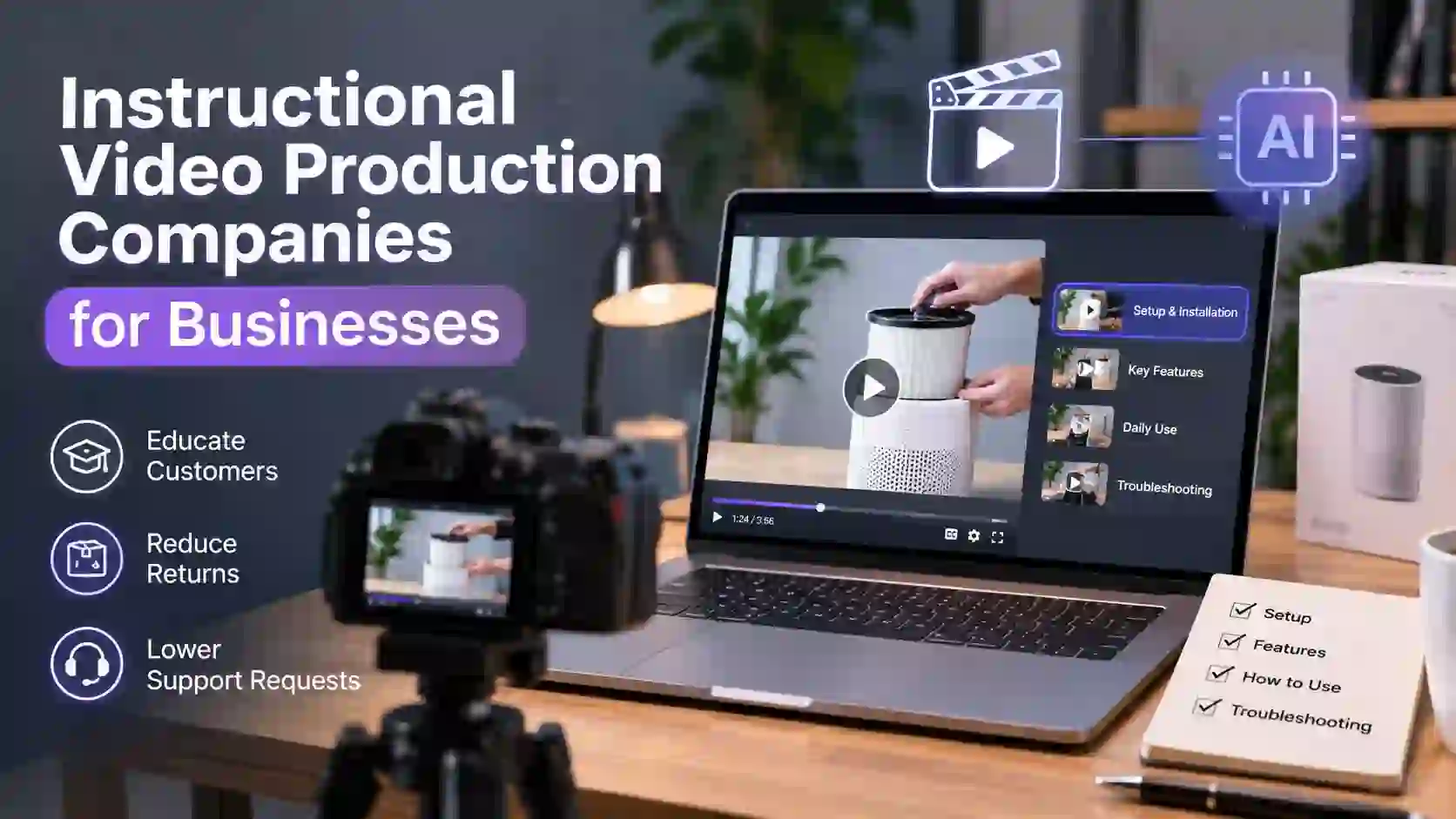
Customer education often receives less attention than advertising and customer acquisition. Marketing teams spend considerable time developing product campaigns, testing paid social creatives, and improving landing pages. However, the experience after a customer makes a purchase can be just as important.
Consider a DTC brand selling an electronic skincare device. The product has multiple settings, different usage modes, and specific cleaning instructions. A customer may understand the advertised benefits but still feel uncertain about using the device correctly.
A written instruction manual can explain the process, but it may not answer every practical question. An instructional video can show exactly where to press, how to adjust the settings, how long to use the device, and what to avoid.
That visual explanation removes much of the guesswork.
There are several reasons businesses are investing in instructional video production.
Not every video production company approaches customer education in the same way.
A general video production agency may focus on brand storytelling, commercial campaigns, promotional videos, or social media content. These formats usually aim to attract attention, communicate a message, or create an emotional response.
Instructional content has a different responsibility. It needs to help someone understand or complete something.
That difference affects nearly every production decision.
The purpose comes before the visual treatment
An instructional video begins with a specific learning objective.
For example, a company manufacturing smart thermostats might need a video explaining how customers connect the device to their home Wi-Fi network.
The objective is not to make the thermostat look impressive. The objective is to help customers complete the connection process correctly.
This changes the script, camera angles, visual references, pacing, and editing decisions.
Clear demonstrations matter more than dramatic visuals
Promotional videos can use fast editing, cinematic transitions, background music, and visually striking scenes.
Instructional videos need a different balance.
When explaining how to assemble a product, the viewer must be able to see the individual components and understand how they fit together. If the camera moves too quickly or an important action disappears between edits, the video becomes frustrating.
A production team working on instructional video production needs to understand when to slow down, when to show a close-up, and when to repeat an important action.
Scriptwriting requires practical product understanding
A good instructional script does not simply describe what a product does.
It anticipates where customers might become confused.
Suppose a company sells a portable espresso machine. Customers may need to understand how to fill the water reservoir, insert the coffee capsule, charge the battery, and clean the device after use.
A useful script addresses these actions in the order customers actually perform them.
Technical accuracy is equally important. If the production team misunderstands a product feature, even polished visuals can communicate incorrect instructions.
Different audiences require different explanations
A software company teaching experienced administrators how to configure an account will need a different video from a consumer brand explaining how to use a kitchen appliance.
The first audience may understand technical terminology. The second may prefer simple language and direct demonstrations.
Instructional video production companies need to consider the viewer's existing knowledge rather than assuming everyone understands the product.
The final video should be easy to maintain
Product features change. Software interfaces receive updates. Packaging gets redesigned. Product instructions sometimes need revision.
A production approach that allows individual scenes or sections to be updated can save considerable time.
For businesses producing multiple instructional videos, this is an important operational consideration. Replacing a single outdated section is often easier than recreating an entire video.
The real distinction is not simply the equipment or editing quality. It is the ability to turn product knowledge into an explanation that customers can follow without assistance.
Different products create different learning requirements. A customer buying a simple accessory may only need a 30-second demonstration, while someone purchasing an advanced electronic device may need several lessons.
US ecommerce brands should select video formats based on the questions customers actually ask.
Product setup and installation videos
These videos explain how to prepare a product for use.
They are particularly useful for furniture, electronics, fitness equipment, smart home devices, and products requiring assembly.
A furniture brand, for example, could create separate videos showing how to assemble a desk, install its storage attachments, and adjust its height.
Breaking the process into smaller lessons makes it easier for customers to find the exact information they need.
Step-by-step product demonstration videos
These videos show customers how to use a product's main functions.
A kitchen appliance company might demonstrate the operating controls, cooking settings, cleaning process, and safety features.
The video should follow the natural sequence of product use. Customers should not have to jump between unrelated sections to understand a basic task.
Feature explanation videos
Some products have features that are not immediately obvious.
A smart fitness device might track several types of activity, connect to a mobile application, and provide personalized performance information.
Individual feature videos can explain what each function does and how customers can access it.
This format also helps brands introduce secondary features after the initial purchase.
Troubleshooting and maintenance videos
Not every customer problem requires a complicated solution.
A video explaining how to reset a device, clean a filter, replace a component, or resolve a common connection issue can prevent unnecessary support requests.
Maintenance videos are particularly useful for products customers use repeatedly over several months or years.
Software onboarding and tutorial videos
SaaS companies and ecommerce brands selling connected products often need to explain digital processes.
These videos can demonstrate account creation, dashboard navigation, payment configuration, integrations, and advanced settings.
Screen recordings combined with voiceovers, captions, and visual highlights can make complicated interfaces easier to understand.
Comparison and product selection videos
Some instructional videos help customers choose the right product before purchasing.
A skincare company might explain the differences between several device models. A fitness equipment brand could demonstrate which resistance level suits different training requirements.
These videos support customer education while also addressing buying objections.
Short-form instructional videos for social media
Not every lesson needs to be several minutes long.
Short instructional videos can demonstrate one specific action, answer one question, or explain one feature.
Brands can use these videos on Instagram Reels, TikTok, YouTube Shorts, and product pages.
However, there is a practical limitation. Short videos work well when the task is simple. Compressing a complicated installation process into 20 seconds can create more confusion than clarity.
Producing instructional content for a growing ecommerce catalog can become expensive.
A brand managing 40 SKUs may need product demonstrations, setup instructions, troubleshooting videos, and feature explanations for several products. When new products launch regularly, the content requirement keeps increasing.
Traditional production can involve script development, filming schedules, location arrangements, product preparation, voice recording, editing, and revisions.
AI video production is changing how some of this work gets completed.
It does not eliminate the need for product knowledge or creative direction. It changes how production teams handle repeatable tasks and manage larger volumes of content.
Faster script and content preparation
AI-assisted workflows can help organize product information into video scripts.
For example, a brand can provide an approved product specification sheet, setup instructions, and a list of frequently asked customer questions. These materials can be used to prepare draft scripts for individual instructional videos.
A human reviewer still needs to verify technical details, product terminology, and the actual sequence of actions.
This distinction matters. A script that sounds convincing is not necessarily accurate.
AI avatars and voiceovers
AI avatars can present product information without requiring a person to appear on camera for every lesson.
They may work well for introductory explanations, basic onboarding, and certain informational videos.
AI-generated voiceovers can also help brands create narration in different tones and languages.
However, avatars are not always the right choice. If customers need to see how a physical product is assembled or operated, an actual product demonstration is usually more useful.
Faster editing and content variations
AI-assisted editing can help with repetitive production tasks such as creating caption versions, adjusting video formats, organizing scenes, and preparing multiple versions of approved content.
Consider a brand that wants one instructional video for its website, another for YouTube, and a shorter version for social media.
A structured production workflow can make these variations easier to prepare without recreating every asset from the beginning.
Producing content for multiple SKUs
This is where AI video production becomes particularly relevant to ecommerce businesses.
A brand selling 30 variations of a product may share the same basic usage instructions across its catalog. Only certain features, components, or specifications may differ.
AI-assisted production can help organize these variations and prepare separate content versions.
Still, every product-specific detail needs verification. Showing the wrong attachment or an outdated product interface can damage customer trust.
Controlling production costs
AI can reduce the time spent on certain repetitive production activities. But lower production costs do not automatically mean better instructional content.
Businesses still need accurate product references, script approvals, visual direction, editing, and quality checks.
A useful way to evaluate AI video production is to examine the total cost of producing and maintaining a library of videos rather than looking only at the cost of creating one video.
For instance, a DTC brand launching 12 products may find that AI-assisted workflows make it easier to prepare consistent introductory videos across its catalog. The savings become more meaningful when the same process is repeated for future launches.
I might be wrong here, but many businesses initially focus too much on how quickly AI can generate a video. The more important question is whether the video helps customers complete the task correctly.
Speed matters. Accuracy matters more.
Some products are difficult to explain because they combine several functions into one experience.
A customer purchasing a smart home security system, for example, may need to understand device installation, mobile application configuration, notification settings, camera positioning, and account permissions.
Explaining everything in one long video is rarely the best approach.
The better option is to divide the learning experience into manageable lessons.
Product returns are not always caused by poor quality. Sometimes customers simply do not understand how to use what they purchased.
This is particularly common with products that have multiple settings, installation requirements, accessories, or specific usage instructions. A customer might order a home fitness machine, struggle with assembly, and decide the product is defective when the actual issue is an incorrect setup.
For ecommerce businesses, these situations create unnecessary costs. The company handles return shipping, refunds, replacement requests, and customer support conversations. The customer also loses confidence in the purchase.
Instructional video production can address some of these problems before they turn into returns.
Address confusion before the product arrives
Customer education does not have to begin after delivery. Brands can introduce instructional videos on product pages to explain how products work before customers make a purchase.
For example, a DTC brand selling an advanced coffee machine could show the setup process, explain the available brewing options, and demonstrate the cleaning requirements.
This gives customers a realistic understanding of the product. Someone who expects a completely automatic machine may reconsider after seeing the actual process. That is not necessarily a lost sale. It may prevent a purchase that would eventually result in dissatisfaction.
Help customers during the first use
The first experience with a product can influence how customers perceive the entire brand.
A customer opening a new electronic device should not have to search through several pages of documentation to find the power button or understand the initial configuration.
A short setup video linked through a QR code on the packaging can make this process easier.
The same video can be included in a post-purchase email, allowing customers to access it before the product arrives.
Reduce repeated support conversations
Customer support teams can identify recurring questions and turn them into educational content.
Suppose a brand selling wireless security cameras receives frequent questions about connecting devices to a home network. Rather than answering every customer individually with the same instructions, the company can create a dedicated video showing the complete connection process.
Support representatives can share the video when responding to relevant queries.
This does not mean every customer will stop contacting support. Some connection problems may involve network compatibility or device faults. However, straightforward questions become easier to resolve.
Set realistic product expectations
Instructional videos can also explain product limitations.
A cordless vacuum manufacturer, for example, could demonstrate how different floor surfaces affect cleaning performance and explain the maintenance required for its filters.
Customers get a more realistic understanding of what the product can and cannot do.
There is an important distinction here. Videos should educate customers, not hide product limitations behind polished demonstrations. Overpromising can create more returns and negative reviews.
Connect video engagement with return reasons
Brands should examine whether customers who watch specific instructional videos experience fewer usage-related problems.
For example, if a particular product has a high return rate associated with installation difficulties, the company can introduce a clearer setup video and monitor subsequent return reasons.
It should compare similar customer groups and account for other changes, such as product updates or shipping issues.
A reduction in support tickets or returns is not automatically proof that video content caused the change. Still, this is a useful way to evaluate whether customer education is addressing an actual business problem.
Choosing a production partner involves more than reviewing a portfolio or comparing the price of individual videos.
A company might produce visually impressive commercial content but struggle with detailed product explanations. Another might understand instructional content but lack the production capacity required for a large ecommerce catalog.
Businesses should evaluate the production process against their actual customer education requirements.
Understanding of the product and its audience
The first requirement is the ability to understand what the product does and where customers might struggle.
A production team should be willing to review product documentation, specifications, existing support questions, and demonstrations.
For a healthcare equipment manufacturer, accuracy and clear operating instructions may be especially important. For a DTC beauty brand, the focus may be on application techniques, product combinations, and usage frequency.
The content should reflect the actual product and the knowledge level of its intended audience.
Script development and technical accuracy
Ask how scripts are developed and approved.
Does the production team work from verified product information? Can subject matter experts review the scripts? Are technical changes incorporated before final production?
These questions matter because an incorrect instruction can create customer dissatisfaction or even safety concerns.
Businesses should retain final approval over technical claims and product demonstrations.
Ability to produce different instructional formats
Your requirements may change as the business grows.
Initially, you might need five product demonstrations. Six months later, you may need onboarding videos, troubleshooting lessons, feature explanations, and short social media tutorials.
Evaluate whether the company can handle different content formats without making every project unnecessarily complicated.
AI production capabilities
AI-assisted workflows can be useful for businesses producing instructional videos regularly.
Ask which production activities can be supported through AI and which still require manual review or original footage.
For example, AI-generated voiceovers may be appropriate for basic explanations. However, a detailed assembly video should show the correct physical components and actions.
The production partner should understand these differences rather than treating every instructional project as an opportunity to generate synthetic visuals.
Revision policies and production timelines
Product education often requires input from several departments.
Marketing teams may approve the tone, product managers may check specifications, and customer support teams may identify missing instructions.
Ask how revisions are handled and what happens when technical information changes during production.
A clearly defined approval process helps prevent repeated delays.
Scalability across products and channels
A company with 10 products may have relatively simple production requirements. A brand with 100 SKUs needs a more organized approach.
Consider whether the production partner can maintain consistent terminology, visual standards, file organization, and video formats across multiple projects.
Also ask whether videos can be prepared for websites, YouTube, social media, email, and other customer communication channels.
Commercial value rather than video count
A low-cost package containing 50 videos is not necessarily better than a smaller collection of carefully developed lessons.
Evaluate the production partner based on accuracy, clarity, usefulness, revision requirements, and the amount of work required from your internal team.
The right production relationship should make customer education easier to manage, not create another operational burden.
Instructional content needs a different mindset from traditional advertising.
A promotional video may have a few seconds to capture attention. An instructional video needs to hold attention long enough for someone to understand and complete a task.
For Brahvo AI, the focus should be on using AI-assisted production methods to help businesses create practical video content without losing sight of the customer's actual learning requirements.
Beginning with the information customers need
The production process should start by identifying the product, the intended audience, and the specific information the video needs to communicate.
A business selling smart home accessories may have dozens of technical features to explain. However, its customers might initially need help with only three things: installation, mobile connectivity, and daily operation.
Prioritizing these requirements helps keep each video focused.
Brahvo AI can approach this process by organizing product information into individual content requirements before moving into production.
Using AI where it makes production more efficient
AI-assisted production can support script preparation, voiceovers, presenter-led content, editing, and the creation of different video versions.
For businesses with recurring instructional content requirements, these workflows can help reduce the time involved in preparing repetitive assets.
For example, an ecommerce company launching a new collection of personal care devices may need several introductory videos with a consistent presentation style.
A structured AI video production workflow can help prepare these assets while allowing product-specific information to remain distinct.
Maintaining clarity in visual communication
AI-generated visuals are not automatically suitable for instructional content.
When a customer needs to understand how a button works, where a component fits, or how a product should be assembled, the visual demonstration must be accurate.
The production process should use approved product references, appropriate footage, and clear visual explanations.
On-screen text, narration, close-ups, and scene sequencing should work together. The customer should not have to guess what is happening.
Creating content for different customer touchpoints
Instructional videos can serve several purposes throughout the customer journey.
Brahvo AI's production approach can account for different placements, including:
The same subject may require different editing depending on where the video appears.
A 90-second product tutorial might work well on a website but require a shorter version for a social media feed.
Keeping production consistent as businesses grow
An instructional video library needs consistency.
If a company releases new products every month, customers should not encounter completely different terminology, presentation styles, and explanation methods across its videos.
Brahvo AI can focus on repeatable AI-assisted production workflows that help businesses manage ongoing video requirements.
However, consistency should not mean making every video identical. A product installation video has different requirements from a software onboarding lesson.
The production process needs enough flexibility to reflect those differences.
Ultimately, instructional video production should help customers understand products with less effort. AI can assist with production speed and content variations, but the quality of the explanation remains the most important part.
A video receiving thousands of views does not necessarily mean it has helped the business.
For instructional content, views are only one part of the measurement process. The more important question is what customers do after watching.
A useful measurement approach connects video performance with customer behavior at different stages of the buying journey.
Before purchase: Product understanding and buying confidence
Product demonstration videos can help potential customers understand features, dimensions, setup requirements, and practical applications.
Businesses can examine:
For example, a brand selling adjustable standing desks might compare the performance of product pages with and without a detailed assembly demonstration.
The goal is to understand whether the video helps customers make more informed purchasing decisions.
Immediately after purchase: Setup and onboarding
The first few days after delivery are an important period for customer education.
Businesses can monitor how many customers access setup videos, how frequently they watch them, and whether they subsequently contact support about the same task.
If customers repeatedly stop watching at a particular step, that section may need clearer instructions.
Completion rate alone does not explain everything. Someone might finish a video and still fail to complete the process.
During product use: Support and troubleshooting
This stage provides some of the most useful information.
Brands can track support ticket categories, repeated product questions, troubleshooting video engagement, and the number of issues resolved through self-service content.
A useful metric is the percentage of relevant support issues resolved without requiring further assistance.
It should be measured carefully. A customer who watches a video and then contacts support may still have received some value from the content.
Long-term: Retention and customer satisfaction
For products requiring regular use, ongoing education can influence customer experience.
Businesses can monitor repeat purchase rates, subscription retention, product reviews, warranty inquiries, and customer satisfaction.
For example, a DTC brand selling a monthly personal care subscription might create educational videos explaining how to use different products included in each delivery.
It can then examine whether customers who engage with relevant educational content show different retention patterns.
That relationship does not establish causation, but it can help identify useful opportunities for further testing.
Understanding the financial impact
Businesses can also estimate the economic value of instructional content.
Consider a hypothetical US ecommerce company receiving 500 monthly support requests about product setup. If clearer instructional videos help resolve 100 of those requests without agent assistance, the company can estimate the staff time saved.
It can also examine whether the videos reduce avoidable returns or improve product page conversion rates.
A simple calculation could look like this:
Measurement
Example
Monthly setup-related support requests
500
Requests resolved through self-service content
100
Average handling time per request
8 minutes
Estimated support time saved
13.3 hours
These are illustrative figures, not actual business results.
The company would still need to account for video production costs, maintenance, customer behavior, and other factors before calculating its return on investment.
The most useful measurement system does not reward video production for publishing more content. It rewards content that solves identifiable customer problems.
1. What do instructional video production companies do?
Instructional video production companies create educational videos that explain products, demonstrate processes, and teach viewers how to complete specific tasks. Their work can include scripting, visual planning, filming, animation, AI-assisted production, editing, voiceovers, and final content delivery.
2. How do I choose the right instructional video production company?
Start by evaluating its experience with instructional content, script development, technical accuracy, production capabilities, revision policies, and ability to handle multiple projects. A strong portfolio should demonstrate clear explanations, not just attractive visuals.
3. Are instructional video production companies suitable for ecommerce brands?
Yes. Ecommerce brands use instructional videos for product demonstrations, installation, onboarding, maintenance, and troubleshooting. These videos are particularly useful for products with multiple features or specific usage requirements.
4. Can instructional videos be created using AI?
Yes. AI can support script preparation, voiceovers, avatars, editing, and content variations. However, technical instructions and physical product demonstrations need accurate references and human verification.
5. Should instructional videos include professional voiceovers?
Not necessarily. Some videos work well with natural narration, while others benefit from on-screen instructions and captions. The choice depends on the complexity of the subject and how customers will consume the content.
6. Can instructional videos help reduce product returns?
They can help prevent returns caused by incorrect setup, misunderstanding, or unrealistic product expectations. However, they cannot solve problems caused by defective products, shipping damage, or inaccurate product descriptions.
7. How many instructional videos should an ecommerce business produce?
There is no fixed number. Start with the products and processes generating the most customer confusion. Expand the library based on support questions, product launches, customer feedback, and recurring education requirements.
8. What is the difference between instructional video production and training video production?
Instructional videos generally explain how to perform a particular task or use a product. Training videos often cover broader learning objectives, such as employee onboarding, workplace procedures, or professional development. Their production methods can overlap.
9. Can Brahvo AI create instructional videos for different industries?
Brahvo AI's AI-assisted video production approach can support different business content requirements. Each project should account for its audience, subject complexity, technical accuracy, and the type of visual demonstration required.
10. Are instructional videos worth the investment for smaller ecommerce businesses?
They can be, particularly when a business repeatedly receives the same product questions. A small collection of useful setup and troubleshooting videos may provide more value than producing a large library before understanding what customers actually need.