Find the right social media video production company in USA for scalable creative testing, AI video production, and ecommerce advertising.
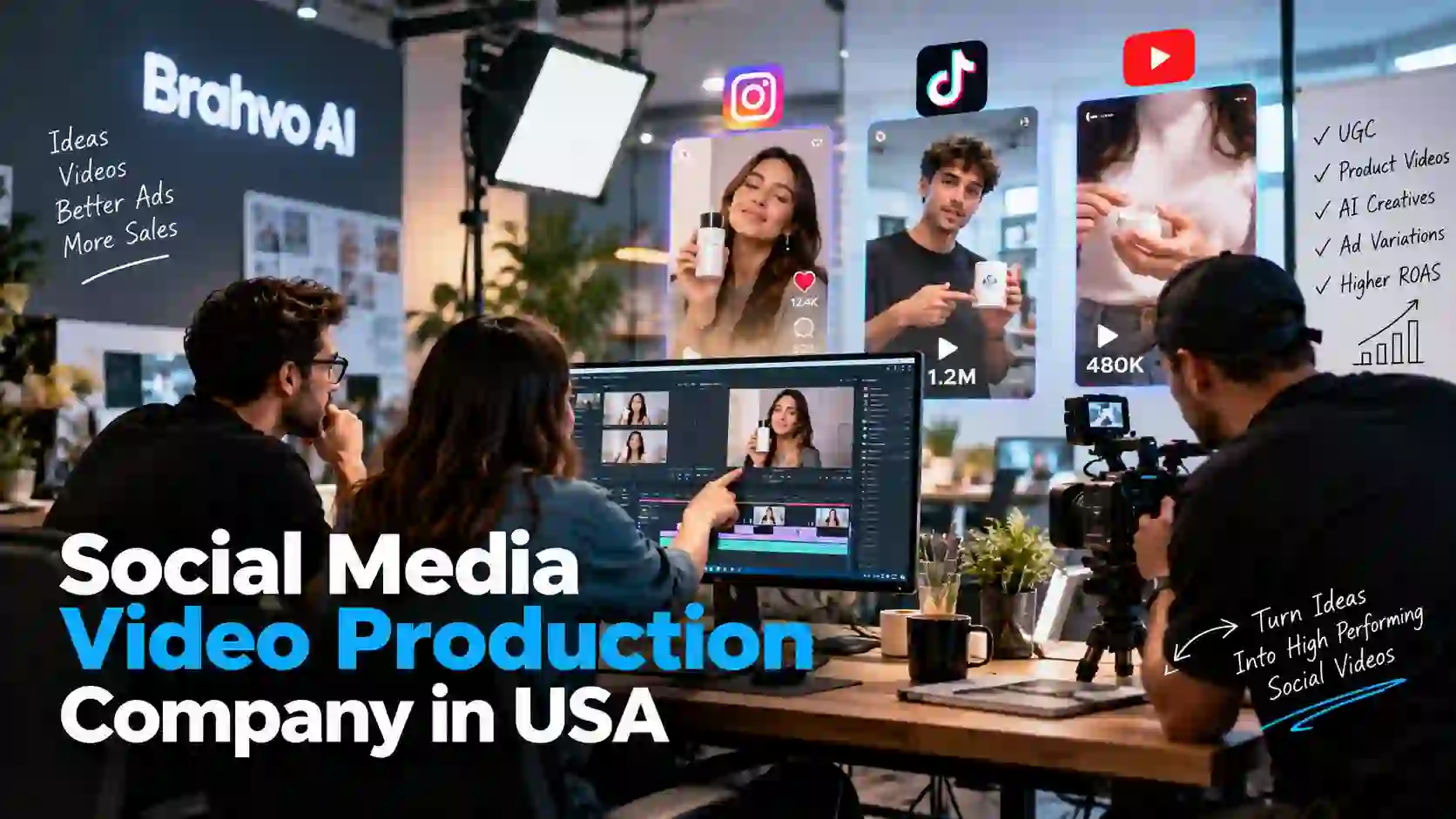
A lot of ecommerce teams do not have a creative problem. They have a creative capacity problem.
The media buyer knows what needs testing. The founder has a list of new product angles. The content team has footage sitting in folders. Someone has even written ten hooks for the next campaign.
Then two weeks pass, and only three usable videos actually make it into the ad account.
That gap has become a serious issue for US ecommerce and DTC brands. Paid social moves quickly, and creative fatigue can show up before a team has finished discussing the last batch of ads. A Meta campaign that performed well last month may start seeing higher acquisition costs simply because the same visual idea has been shown too many times.
TikTok creates a different kind of pressure. Content has to feel native, fast, and varied. A polished product commercial might work in one campaign but feel completely out of place in another. YouTube adds another layer because longer demonstrations, testimonials, explainers, and short form ads can all have different jobs.
This is where a social media video production company in USA becomes relevant. The requirement is not simply to make attractive videos. It is to help a brand produce enough useful creative to support an active paid media operation.
Consider a DTC skincare company spending heavily on Meta Ads. The team may already have a winning product video. Instead of producing another video that says essentially the same thing, the next production batch could explore a problem led opening, a customer objection, a product demonstration, a founder explanation, a comparison angle, and several different visual treatments.
The creative workload starts looking less like traditional video production and more like an ongoing testing operation.
That distinction matters.
A brand can have excellent production quality and still struggle with paid media if the creative pipeline is too slow. On the other hand, producing dozens of videos without a clear testing reason can waste money and bury the media team under mediocre variations.
The goal sits somewhere between those two extremes.
The phrase "video production" can mean very different things depending on who you ask.
For a traditional production team, it might mean planning a shoot, hiring talent, arranging locations, filming footage, editing the final video, and delivering a polished commercial.
For an ecommerce brand running paid social, the workflow is usually broader.
A social media video production company in USA may be involved in turning a marketing idea into multiple creative assets that can actually be tested across paid and organic channels.
That can include concept development, hooks, scripts, storyboards, product demonstrations, UGC style content, motion graphics, captions, AI generated scenes, voiceovers, editing, resizing, versioning, and creative iterations.
The useful part is not necessarily any one of these tasks. It is the connection between them.
Suppose a brand has identified that customers respond strongly to the message "you are using this product the wrong way." That single insight can become several pieces of creative.
One version could open with the mistake.
Another could demonstrate the correct method.
A third could use a customer style testimonial.
A fourth could show the product being used incorrectly before revealing the solution.
A fifth could use an AI generated visual to explain what is happening.
The underlying marketing idea remains connected, but the executions are different enough to produce useful learning.
This is especially important for brands with multiple SKUs. A team selling 30 products cannot treat every product launch as a completely separate production project. There needs to be a repeatable way to move from product information to usable social video without making every asset feel identical.
Brahvo AI approaches this kind of production with that reality in mind. AI video production can help create additional creative variations without requiring a full traditional shoot for every concept.
That does not mean AI should replace every piece of human filmed content.
It should not.
There are products where real demonstrations, physical texture, customer reactions, founder footage, or creator personality matter too much to fake convincingly. The better use of AI is often to expand what a team can produce around the footage and ideas it already has.
That might mean generating visual concepts, creating alternative scenes, producing different versions of a message, or adapting an idea for another audience.
The production partner has to understand the difference between making more videos and making more useful videos.
There is an easy assumption that more creative automatically means better advertising performance.
I might be wrong here, but I think that assumption causes plenty of wasted production budgets.
Volume matters because advertising platforms need enough creative variation for teams to learn what resonates. But 50 versions of the same video are not necessarily 50 meaningful tests.
Imagine a brand has one product demonstration video. The team changes the background, font, music, and caption and calls each version a new creative.
Technically, yes.
From a testing perspective, not really.
A stronger creative testing system changes the reason someone might stop scrolling or continue watching.
The hook could change.
The customer problem could change.
The proof could change.
The product benefit could change.
The emotional framing could change.
The pacing could change.
The person delivering the message could change.
This is particularly relevant to Meta Ads, where creative performance can influence how a media buyer thinks about budget allocation. If one concept consistently generates stronger engagement and conversion signals, the team has something worth exploring further.
TikTok can work differently because the creative often needs to feel more like content than an advertisement. A product that works well with direct response demonstrations may need a completely different treatment when the objective is to capture attention in a TikTok feed.
A social media video production company in USA can support this process by producing creative around specific testing hypotheses rather than simply delivering a fixed number of videos.
Here is a simple example.
A US apparel brand notices that its ads are getting clicks but not enough purchases. The media team suspects the issue is not the product or landing page. The videos are showing the product clearly, but they are not communicating why the product is different.
Instead of producing another polished product montage, the next batch could test:
Creative idea
Testing question
Customer problem hook
Does the problem create stronger attention?
Product demonstration
Does showing the use case increase intent?
Customer objection
Does addressing price or quality concerns help conversion?
Social proof
Does customer experience create more trust?
Founder explanation
Does a human explanation make the product feel more credible?
Now production has a reason behind it.
That is a much better conversation between the creative team and the media buyer.
The same principle applies when scaling winning campaigns. Once an angle starts working, the answer is not always to duplicate it endlessly. Sometimes the better move is to understand why it works and create adjacent variations.
Creative volume is useful when it creates more opportunities to learn.
It becomes expensive noise when nobody knows what each new video is supposed to prove.
AI video production has become interesting to ecommerce teams for a fairly practical reason.
Traditional production takes time.
If a brand wants ten different concepts, each with different scripts, actors, locations, product shots, and edits, the production schedule can become difficult to manage. That is not always a problem for a major campaign. It becomes a problem when the media team needs fresh creative every week.
AI can reduce some of that production friction.
A social media video production company in USA can use AI video workflows to experiment with concepts before committing resources to a larger production. It can also help create additional visual variations, voice treatments, scenes, transitions, and formats.
For example, a supplement brand might want to test whether customers respond better to a simple product explanation or a lifestyle based concept.
A traditional production approach could require two separate shoots.
An AI assisted workflow may allow the team to develop several concept directions first, identify the strongest creative idea, and then decide where higher production investment makes sense.
There is another useful application.
Sometimes the footage already exists.
A brand might have product footage, creator clips, customer testimonials, or founder recordings but not enough finished ads. AI assisted editing and production workflows can help turn those raw materials into different creative executions.
This is where AI becomes less about replacing production and more about increasing the number of ways a team can use what it already owns.
Still, there are limits.
AI generated people can look unnatural. Product details can become inconsistent. Certain industries need a level of visual accuracy that synthetic footage may not reliably deliver. A customer looking at a technical product may notice a strange detail that a marketing team missed completely.
For that reason, human review remains important.
The strongest workflow is rarely "generate everything with AI." It is usually a combination of real footage, human creative judgment, conventional editing, and AI where it genuinely saves time or expands the range of creative options.
And sometimes the simplest video wins anyway.
A clean product demonstration recorded on a phone can outperform an expensive production because the message is obvious within the first few seconds. That happens more often than teams like to admit.
One of the easiest mistakes for a brand to make is producing one video and then cutting it into three sizes.
The result technically fits Meta, TikTok, and YouTube.
But platform compatibility is not the same thing as platform relevance.
A person watching a TikTok video is not necessarily responding to the same opening that works in a Meta feed. YouTube viewers may accept more explanation, especially when they are already searching for information about a product. Meta can support a wide range of creative styles, but the opening still needs to earn attention quickly.
So the production process should start with the audience behaviour, not just the export settings.
For Meta Ads, a product benefit or customer problem may work well as the opening. The creative can then move into proof and a clear product demonstration.
For TikTok, the same product might be introduced through a creator style observation, a surprising use case, a customer reaction, or a quick problem and solution format.
For YouTube, there may be more room for explanation. A product demo, customer story, comparison, or educational sequence can develop without feeling rushed.
The core message can remain consistent.
The execution should not.
Take a hypothetical US home fitness brand launching a new recovery product. The central claim is simple: the product helps customers make recovery part of their routine.
The Meta version could start with the customer's problem and move quickly into the product.
The TikTok version could feel like a creator sharing a routine that changed after using the product.
The YouTube version could spend more time explaining how the product fits into a recovery routine and why the company designed it that way.
All three videos sell the same product.
They do not need to look like the same advertisement.
This is one reason the role of a social media video production company in USA has expanded beyond filming and editing. The production team needs to understand where the finished creative will be used and what the viewer is likely doing when they encounter it.
A paid media team might also need several versions of the same core concept. One could be six seconds long. Another could be 15 seconds. Another might be 30 seconds. A fourth could use a different opening because the first few seconds are the part being tested.
That does create more work.
But it is useful work when each version has a clear purpose.
For ecommerce brands, the bigger challenge is often not finding one great ad. It is building a creative system that can keep producing fresh, relevant ideas after that first winner starts losing momentum.
That is where production and paid media stop being separate conversations.
A DTC brand does not usually need more ideas. It needs a better way to turn ideas into tests.
A media buyer might say, "The product works, but the creative is getting tired." The creative team hears that and starts making new videos. Then the founder asks why the new videos look different but are not producing different results.
That usually comes back to the testing concept.
A hook is the first reason someone keeps watching. An angle is the broader way the product is positioned. The format is how that idea is presented.
Those three things can be changed independently.
For example, a premium kitchen product could use the angle of saving time. One hook might be, "Dinner takes longer because you are doing this first." Another could be, "This is the step I stopped doing after buying this." The format could be a creator demonstration, product closeup, customer testimonial, or simple text led video.
That creates genuine creative variation.
A social media video production company in USA can help a DTC team build these variations without treating every new video as a completely new production project.
The useful question is not "How many videos can we make?"
It is "How many meaningful creative hypotheses can we test this month?"
This distinction becomes especially important when customer acquisition costs rise. A brand might be tempted to immediately increase the ad budget on a campaign that is working. But if the campaign has only a handful of strong creatives, scaling spend can expose creative fatigue much faster.
Testing more hooks can give the media team more information about what earns attention.
Testing different angles can reveal what actually motivates customers.
Testing formats can show whether the message works better through a creator, demonstration, testimonial, voiceover, animation, or another presentation.
There is also a practical benefit when launching new products.
A new product has no established creative history. The team may not know which customer problem deserves the most attention. Rather than betting the entire launch on one polished commercial, a brand can start with several smaller creative directions.
One might work surprisingly well.
Another might generate clicks but weak conversion.
Another may barely get attention.
That information is useful before a large production budget is committed.
A good creative testing process does not try to make every video a winner. Some videos are there to tell the team what not to make again.
UGC has become a major part of ecommerce advertising because it can make a product feel easier to understand and less like a traditional commercial.
But UGC is not automatically better.
A creator talking about a product can work extremely well when personality, experience, or social proof matters. It can also fall flat when the creator does not feel credible for the product or when every competitor is using the same style.
Product videos have a different job.
They show how something works. They can highlight details, demonstrate features, answer questions, and remove uncertainty before purchase.
Brand content builds another layer. It can communicate why the company exists, what it believes, how a product was developed, or what makes the customer experience different.
AI creatives can sit around all of these formats rather than replacing them.
A practical content mix might look something like this:
Creative type
Where it can help
UGC
Trust, relatability, customer objections
Product video
Demonstrations, features, use cases
Brand content
Story, positioning, founder perspective
AI creative
Concept testing, visual variations, rapid production
Motion graphics
Product benefits, offers, explanations
The mix should depend on the product.
A fashion brand may get more value from creator content and lifestyle footage. A technical product may need more demonstrations. A beauty brand might rely heavily on UGC but still need closeup product footage for texture and application.
A social media video production company in USA needs to understand these differences before deciding how much content to produce in each format.
There is another issue that comes up with UGC.
Brands sometimes collect dozens of creator videos and assume they have solved the creative problem. They have not necessarily solved it. Raw creator footage still needs strong hooks, editing, pacing, captions, and a clear reason for the viewer to continue.
A creator saying, "I have been using this product for a few weeks" may be perfectly fine.
But the edit might become much stronger if the video gets to the actual customer problem immediately.
That is production judgment.
AI can help create variations around the same source material, but someone still needs to decide which variation is worth making.
For Brahvo AI, the opportunity is not to force every brand into one production style. It is to help ecommerce teams combine different creative inputs and produce enough variations to keep testing without making the workflow unnecessarily heavy.
The balance is important because audiences notice repetition.
If every ad uses the same UGC opening, same captions, same music, and same product shot, changing the creator's face will not magically make the creative feel new.
The first expectation should be simple: the production partner should understand the business problem behind the video.
If the media team says, "We need ten new ads," the conversation should not stop at ten scripts and ten exports.
Why ten?
Which products?
Which audience?
Which campaign?
What is already working?
What has become repetitive?
Are the new videos meant to test hooks, offers, product benefits, customer objections, or entirely new creative concepts?
Those questions can save a lot of production time.
A strong production workflow also needs clear communication. This sounds boring, but it becomes painful very quickly when an ecommerce brand has several products launching at once.
One team may be waiting for product information.
Another may be waiting for creator footage.
The media buyer may have changed the campaign direction.
The founder may suddenly want a new offer included.
If the production partner cannot absorb those changes without creating confusion, production starts becoming another bottleneck.
Turnaround time matters too, but speed should not be measured only by how quickly an editor can finish a video.
A video delivered in two days that needs three rounds of corrections is not necessarily faster than one delivered in four days and approved immediately.
The same applies to cost.
The cheapest individual video is not automatically the cheapest production system. If the brand needs 30 usable creatives every month, the important number is the total cost of producing and managing that creative volume.
US ecommerce teams should also ask how revisions are handled, how creative feedback is collected, how assets are organised, and whether the production process can handle multiple products at the same time.
This becomes particularly important for agencies managing several clients.
An agency may have a media buyer who knows exactly what needs testing but does not have enough internal production capacity. In that situation, the production partner becomes part of the agency's operating system.
That relationship works better when expectations are clear from the start.
There should be a shared understanding of what counts as a finished creative, how feedback is provided, which formats are required, and how quickly new concepts can move from idea to final asset.
And one more thing matters.
The production team should be comfortable hearing that an idea did not work.
Creative production can become emotionally attached to the work. Paid media cannot afford to be.
If a video looks beautiful but produces weak results, the useful response is to learn from it and move forward.
High volume does not have to mean making hundreds of random videos.
For Brahvo AI, the more useful approach is to connect production volume with creative variation.
That starts with understanding what the brand is trying to achieve. A product launch needs a different creative approach from a retargeting campaign. A mature product with strong customer awareness has different requirements from a new product nobody knows.
From there, creative ideas can be developed around different hooks, customer problems, benefits, objections, demonstrations, and visual approaches.
AI video production can then help expand those concepts into different executions.
For example, imagine a US DTC brand selling a personal care product. The team identifies four useful customer motivations.
Convenience.
Visible results.
Ease of use.
Confidence.
Instead of creating one general advertisement that mentions all four, production can explore separate creative directions around each motivation.
The convenience angle might use a fast routine based format.
The results angle might focus on customer experience and proof.
The ease of use angle could demonstrate the product.
The confidence angle might lean more heavily into UGC style storytelling.
The brand now has a collection of creative hypotheses rather than one advertisement trying to do everything.
This is where AI can make a meaningful difference.
It can help teams produce variations around an approved creative direction without treating every variation as a full production from scratch. Different openings, scenes, voice treatments, visual approaches, and edits can be explored more quickly.
But Brahvo AI's role should not be reduced to speed.
A faster bad idea is still a bad idea.
The important part is deciding what deserves production in the first place. Human creative judgment, product knowledge, customer understanding, and paid media feedback still matter.
The workflow also has to leave room for real footage.
If a founder has a strong story, use it.
If a creator has a genuine customer experience, use it.
If a product demonstration needs to be filmed for accuracy, film it.
AI works best when it adds production capacity without forcing the brand to abandon content that already feels authentic.
For a high volume social media operation, that flexibility can matter more than producing one impressive campaign every few months.
The real test is what happens when the media buyer comes back and says, "The winning angle is this one. Can we produce ten more variations without making them feel identical?"
That is when production systems get tested.
What does a social media video production company in USA do?
A social media video production company in USA creates video content specifically for platforms such as Meta, TikTok, and YouTube. Depending on the workflow, this can include concepts, scripts, UGC style content, product videos, AI video production, editing, variations, captions, and platform specific versions.
Why do ecommerce brands need so many social media videos?
Because paid media performance depends partly on having enough creative variety to test. When the same ads run repeatedly, audiences can become less responsive. New creative gives media teams more opportunities to test different hooks, messages, formats, and customer motivations.
Can AI video production replace UGC?
Not completely. Real creators can bring personality, credibility, and genuine product experience that synthetic content may not reproduce well. AI can be useful for expanding concepts and producing variations, but UGC still has an important place in many ecommerce campaigns.
How many videos should a DTC brand produce each month?
There is no universal number. A brand spending heavily across multiple paid channels may need significantly more creative than a small company running a limited campaign. The better starting point is the number of meaningful creative tests the media team can actually analyse and use.
Are AI generated videos suitable for Meta Ads?
They can be, depending on the product, concept, and execution. AI generated creative can be useful for certain visual concepts and variations. However, product accuracy, realism, disclosure considerations, and audience expectations still need to be considered.
Should the same video be used on TikTok and Meta?
It can be, but it does not always make sense. A video that performs well on Meta may need a different opening, pacing, framing, or creator style for TikTok. Repurposing is useful when the underlying creative works, but simple resizing is not always enough.
How can a production company help reduce creative fatigue?
By producing meaningful variations rather than cosmetic changes. New hooks, customer angles, formats, demonstrations, creators, and visual treatments can give the media team more options when existing ads begin losing effectiveness.
What should a brand provide to its production partner?
Useful inputs include product information, customer insights, existing winning ads, brand guidelines, campaign objectives, available footage, customer reviews, product images, and information about common objections. The more useful context the production team has, the less guesswork is involved.
Is high volume video production only useful for large ecommerce brands?
No. Smaller brands can benefit too, but the production model needs to match the budget and advertising volume. A smaller DTC company may need a handful of strong creative tests rather than a large monthly content pipeline.