Choose the right TV commercial video production company for high quality ads, AI video production, and digital campaign creative.
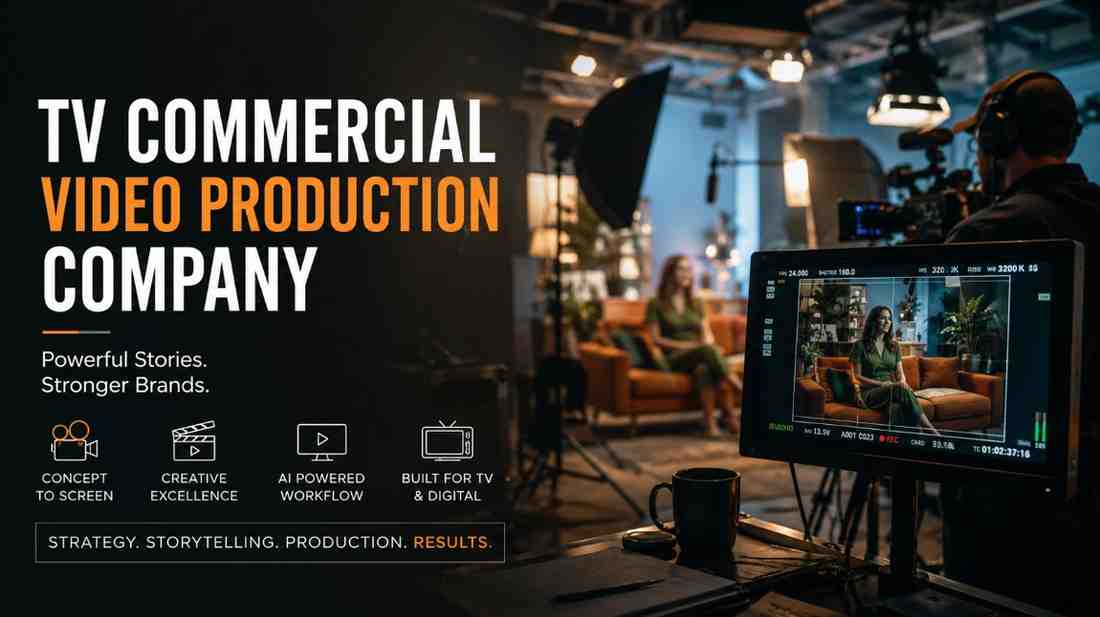
For many US ecommerce and DTC brands, TV advertising can look like an expensive commitment at a time when Meta Ads, TikTok Ads, YouTube, and other digital channels give marketers more control over targeting and measurement. That does not mean television has stopped mattering.
A strong TV commercial can put a brand in front of a much larger audience than a typical paid social campaign. It can also create a level of familiarity that is difficult to achieve when customers only encounter a brand through short performance ads.
The bigger question is how the commercial is produced.
Brands working with a TV commercial video production company are no longer necessarily looking at the old model of spending months on a large production, waiting for final edits, and then creating completely separate assets for digital advertising. The production process has become more flexible, particularly with AI video production becoming part of commercial creative workflows.
This matters for ecommerce brands that may need one hero commercial, several cutdowns, vertical versions, product-focused edits, and social variations from the same campaign idea.
Consider a DTC skincare brand preparing for a major seasonal launch. Its media team may already know which customer problem performs well in paid social. Instead of treating the TV commercial as a completely separate creative exercise, the brand can build the commercial around that proven consumer insight, then adapt the resulting footage and messaging for digital placements.
That approach does not make television cheap. It makes the creative investment more useful.
There is also a perception factor. When customers see a brand represented in a polished commercial, it can change how they view the company. This can be particularly useful for brands moving beyond early stage acquisition and trying to look established enough for larger retail, partnership, or distribution opportunities.
I might be wrong here, but I do not think every ecommerce brand needs television advertising. A brand with weak product market fit, poor retention, or no clear creative message probably has bigger problems to solve first. TV cannot rescue an offer that customers do not want.
But when the product, positioning, and economics are working, television can become another part of the media mix rather than an old fashioned advertising channel.
A TV commercial video production company does much more than shoot a few scenes and deliver a finished video file.
The production process usually begins before cameras, actors, locations, or animation are involved. The creative team has to understand what the commercial is supposed to communicate and who needs to respond to it.
That sounds obvious, but it is where many commercial projects become complicated.
A media director may want a 30 second commercial built around a specific product benefit. The brand team may want stronger emotional storytelling. The ecommerce team may want the product shown within the first few seconds. The founder may want the brand story included. The production team has to turn those competing priorities into one piece of creative that actually works.
Concept development is therefore a major part of the job.
A TV commercial video production company may help develop the central advertising idea, script, storyboard, visual direction, shot requirements, voiceover approach, music, casting, locations, and production schedule.
Then comes the actual production.
Depending on the campaign, this can involve live action filming, product photography, studio shoots, motion graphics, animation, voiceover recording, screen replacement, compositing, or AI generated video elements.
Post production is where another layer of work begins. Editors need to shape the footage around timing, pacing, messaging, sound design, brand requirements, and the final media specifications.
For performance marketers, this stage has become increasingly interesting because the same commercial can often produce multiple usable assets.
A 30 second TV spot could potentially become a 15 second paid social edit. A product demonstration could become a short TikTok style creative. A strong opening scene could become a YouTube pre roll. Individual product shots could be reused in landing page content.
That does not mean every piece of footage should simply be resized and uploaded everywhere. A TV commercial and a TikTok ad have different viewing environments. The creative needs to be adapted rather than mechanically repackaged.
For brands, this creates a practical production question. Are you paying for one commercial, or are you building a commercial production system that gives your media team useful creative assets for several channels?
That distinction can affect the economics of the project.
The path from an advertising idea to a finished TV commercial is rarely as simple as writing a script and pressing record.
A production team first needs to understand the campaign objective. Is the commercial introducing a new product? Building awareness? Supporting a retail launch? Communicating a promotion? Changing how customers perceive an existing product?
Those decisions influence nearly everything that follows.
Suppose a US supplement brand is launching a new daily wellness product. The marketing team wants to reach consumers who are familiar with the category but have not heard of the brand. A product demonstration alone may not be enough. The commercial needs a recognizable consumer situation, a clear reason to care, and enough product information to make the message credible.
The concept might begin with a simple customer problem. From there, the team develops a script and visual treatment.
Once the direction is approved, production planning becomes more detailed. Locations are selected. Talent is considered. Product samples are prepared. Props and sets are arranged. Shot lists are created. Voiceover requirements are confirmed.
For a larger commercial, small production decisions can have surprisingly large consequences.
If the product packaging changes after filming, certain scenes may need to be reshot. If legal requirements affect the wording, the voiceover and on screen text may need revision. If the final commercial needs several cutdowns, the editor needs enough usable footage to create them without making the shorter versions feel like chopped up leftovers.
This is one reason experienced production teams think about distribution before filming begins.
A commercial intended for television, YouTube, Meta Ads, and connected TV should not necessarily be produced as four completely unrelated pieces. The campaign can have a central creative idea while the individual executions are designed around each channel.
AI video production can also play a role here.
AI can help teams explore visual concepts, create certain motion elements, test different creative directions, generate supporting scenes, or produce variations that would otherwise require additional production time. It can be particularly useful during early concept development and versioning.
But AI is not automatically the right answer for every shot.
A premium consumer brand may still need real product photography, professional talent, controlled lighting, physical sets, or high end cinematography for the main commercial. The useful question is not whether AI should replace traditional production. It is where AI can reduce unnecessary production friction without making the commercial feel artificial.
That distinction matters.
The final commercial still has to work as advertising. It needs a clear message, appropriate pacing, strong visual communication, brand consistency, and a reason for the viewer to remember the product.
And once the master commercial is approved, the work is not necessarily finished. Broadcast specifications, audio requirements, captions, aspect ratios, platform requirements, and additional cutdowns may all need attention before the creative reaches its intended audience.
That is where the value of a capable TV commercial video production company becomes clearer. The job is not simply producing attractive footage. It is connecting the original campaign idea to a finished commercial that can survive the realities of media buying, production constraints, approvals, and multiple distribution channels.
Sometimes the most important production decision is simply knowing what not to shoot.
AI video production is changing how brands approach commercial development, but the biggest shift is not simply that AI can generate video. The more useful change is that creative teams can explore more ideas before committing significant production budget.
Traditionally, developing a TV commercial could mean choosing one concept early, preparing a detailed production plan, hiring talent, arranging locations, filming, and discovering during editing that some parts of the idea do not work as expected. Changing direction at that point is expensive.
AI video production can reduce some of that risk during the concept stage.
A TV commercial video production company can use AI assisted workflows to test visual directions, scene concepts, transitions, story treatments, product environments, and different versions of an idea before the full production takes place. This gives creative and marketing teams something more useful than a written description.
They can actually see how an idea might feel.
For a DTC brand launching a new product, that can be valuable. The team might have three possible advertising angles. One focuses on the customer's problem. Another focuses on the product itself. The third uses a lifestyle story.
Instead of debating the concepts for weeks, AI generated visual explorations can help the team decide which direction deserves a larger production investment.
AI can also help with versioning after the main commercial is complete. Different openings, visual sequences, voiceover variations, product emphasis, and shorter edits can be explored without rebuilding every asset from scratch.
There are limits, though.
AI generated footage is not automatically suitable for a national TV campaign. Product details can be inconsistent. Human movement may look unnatural. Brand specific elements can require careful control. Some concepts simply need real production.
The strongest use of AI is often alongside traditional production rather than completely replacing it.
A commercial might use professionally filmed product footage as its foundation while AI supports certain visual effects, transitions, concept testing, background elements, or additional creative variations.
That gives production teams more room to experiment without treating every experiment as a full production.
A TV commercial video production company has to work within a budget, but budget decisions are rarely as simple as choosing between an expensive production and a cheap one.
The real question is where the money creates value.
A brand may spend heavily on a beautiful location while the product itself receives very little screen time. Another company might invest in well known talent when the campaign message is weak. A third may spend heavily on production and then have almost nothing left for media distribution.
That last situation is particularly painful.
A commercial cannot generate results if the brand does not have enough budget to put it in front of the right audience.
Production teams need to understand this relationship. A $200,000 commercial does not automatically make sense for a brand with limited media spending. At the same time, cutting production costs too aggressively can create a commercial that looks disconnected from the price point and positioning of the product.
For ecommerce brands, the right production level often depends on the campaign.
A major product launch may justify a polished hero commercial with professional cinematography, talent, sets, product shots, and multiple deliverables. A smaller campaign may work better with a focused studio shoot combined with motion graphics, UGC style footage, and AI assisted creative elements.
The important part is deciding this before production begins.
Media teams should also be involved early. They know how much creative volume is required, where the ads will run, what formats are needed, and how quickly new variations may be required.
That information can change the production plan significantly.
A brand spending heavily on Meta Ads and TikTok Ads may get more value from a production approach that generates one strong TV commercial plus a collection of digital assets rather than spending the entire budget on a single broadcast master.
There is no universal production budget that works for every company.
The useful benchmark is whether the creative investment makes sense against the brand's customer acquisition economics, campaign scale, expected media spend, and need for future creative.
A commercial created only for television can become surprisingly restrictive once a performance marketing team gets involved.
The media buyer may need a vertical version for TikTok. The Meta team may want a shorter opening. YouTube may require another duration. Connected TV may need a different format. The ecommerce team may want product focused clips for landing pages.
If those requirements are considered after filming, the production team may not have enough footage to create strong versions.
That is why a TV commercial video production company should think about distribution during the creative process.
The commercial still needs to work as a TV spot. It should not feel like a social media ad stretched into a 30 second broadcast commercial. But the production can be planned so important scenes have enough flexibility for different edits.
For example, a product demonstration can be filmed with framing that supports both a traditional horizontal commercial and vertical digital versions. Product closeups can be captured separately. Key dialogue can be recorded cleanly enough for shorter edits.
The opening matters too.
A TV viewer may encounter the commercial as part of a programming block. A TikTok user may decide within a second or two whether to keep watching. The creative needs to respect those different behaviors.
This is where performance marketing experience becomes useful in commercial production.
Suppose a DTC apparel brand produces a 30 second commercial showing a customer getting ready for a trip. The television version might rely on the full story. The social version could begin with the product reveal and then use selected scenes from the larger narrative.
Same campaign. Different viewing experience.
That does not mean every commercial needs ten variations. Producing endless versions simply because technology makes it possible can create another problem. Someone still has to review them, test them, organize them, and decide which ones deserve media spend.
Creative volume without a testing reason can become expensive clutter.
Modern commercial production often involves more than one type of creative material.
A campaign may combine scripted scenes with product demonstrations, UGC style footage, professional voiceover, animation, motion graphics, customer testimonials, and lifestyle footage.
Managing those elements requires a clear creative direction.
The script should determine what needs to be communicated. The visuals should support that message rather than simply filling screen space. Voiceover should add information or emotional context where necessary. Product footage should make the product easy to understand.
UGC can add another layer.
A professionally produced TV commercial can sometimes feel too polished for a social feed. UGC style footage can provide a more familiar and direct tone, particularly when the same campaign is being adapted for Meta Ads or TikTok Ads.
But mixing UGC into a commercial needs judgment. Random creator clips inserted into a polished production can feel disconnected.
A better approach is to decide why the UGC exists.
Is it demonstrating how the product is used? Showing a customer reaction? Delivering a testimonial? Introducing a problem? If the role is clear, it becomes part of the creative rather than an extra asset thrown into the edit.
Voiceover requires similar attention.
A strong voice can make a commercial feel memorable, but the wrong delivery can make even a well produced spot feel forced. The tone needs to match the brand, audience, product category, and campaign objective.
Product footage has its own challenge. Ecommerce brands often have several SKUs, colors, packages, or product variations. A production team needs to know which products matter most before filming.
Otherwise, the final commercial can become crowded.
A media team may also need footage for future campaigns. Capturing useful product shots during the original production can save another production cycle later, provided those shots are actually planned rather than collected randomly.
Brahvo AI approaches commercial video production with the idea that brands often need more than one finished video.
A modern advertising campaign can require a hero commercial, shorter edits, social versions, product variations, different creative angles, and additional content for testing. Producing every asset through a completely separate workflow can slow the campaign down.
AI video production can help shorten parts of that process.
Brahvo AI can support commercial development through AI assisted creative production, video editing, visual development, and asset variation. The goal is not to make every commercial look like it was generated by AI. The technology is useful when it helps the production team move faster while keeping the creative direction under control.
For a US ecommerce brand, this can matter when campaign timelines are tight.
Imagine a brand preparing a holiday campaign with a TV commercial as the main creative. The same campaign also needs several social edits before the media launch. After the commercial concept is approved, the team may identify scenes that can support shorter performance ads and other versions.
Instead of treating those as unrelated projects, they can be considered part of the same creative production workflow.
That approach can also help when brands need to test advertising angles.
One version may lead with a product benefit. Another may focus on the customer's frustration. Another may emphasize the outcome. The commercial remains anchored in the same campaign, while supporting variations give the paid media team more options to test.
The important distinction is that speed should not come at the expense of creative judgment.
Fast production is only useful when the resulting assets are worth testing.
One of the most common mistakes is trying to say everything in one commercial.
A brand has a new product, several features, a founder story, a promotion, customer proof, a company mission, and a call to action. All of it gets pushed into 30 seconds.
The result is usually a commercial that feels busy.
Another mistake is producing the commercial without involving the media team. The creative may look excellent, but the brand later discovers that it needs formats, cutdowns, or variations that were never considered during production.
Then there is the problem of creative fatigue.
A company can spend heavily on a TV commercial and continue running the same core creative across digital channels for months. Performance eventually starts slipping, and the team assumes the campaign needs more media budget when the real issue may be creative wear.
Multiple SKUs create another challenge. Brands sometimes try to feature every product in one commercial. Unless there is a strong reason to do so, this can weaken the central message.
Another mistake is assuming AI automatically makes production cheaper.
It can reduce time in certain areas, but AI does not remove the need for creative direction, editing, brand review, legal review, product accuracy, or distribution planning.
And perhaps the most overlooked mistake is failing to think about what happens after the commercial launches.
A TV spot is not necessarily the end of a campaign. The real work may begin when the media team starts watching response, testing different edits, and figuring out which messages deserve more attention.
A commercial that generates one beautiful video but no useful learning can have limited value.
A commercial that gives the brand a strong hero asset and enough creative material to keep testing is a different proposition.
That is often the difference between treating video as a production expense and treating it as part of the advertising operation.
1. What should I look for in a TV commercial video production company?
Look beyond camera equipment and production quality. A strong TV commercial video production company should understand advertising objectives, audience behavior, creative development, post production, broadcast requirements, and digital distribution. For ecommerce brands, experience with performance creative is especially useful because the commercial may eventually need to support Meta Ads, TikTok Ads, YouTube, and connected TV campaigns.
2. How much does a TV commercial typically cost?
There is no useful single price. Costs depend on the concept, script, talent, locations, production crew, equipment, animation, post production, voiceover, special effects, and number of deliverables.
A simple product focused commercial may require a very different budget from a large production involving multiple locations and professional actors. Brands should also consider the media budget separately. Spending most of the campaign budget on production can leave too little money to actually distribute the commercial.
3. Can AI video production be used for TV commercials?
Yes, depending on the creative requirements. AI can support concept development, visual exploration, certain effects, animation, editing, background generation, and creative variations.
It does not mean every part of a commercial should be AI generated. Real products, people, locations, and professional footage may still be important for certain campaigns. The better question is where AI can make the production process more efficient without making the finished commercial feel artificial.
4. Can one TV commercial be adapted for Meta Ads and TikTok Ads?
Yes, but the commercial should be planned with those channels in mind from the beginning.
A 30 second TV commercial can provide footage for shorter edits, vertical versions, product demonstrations, hooks, and other paid social assets. However, simply cropping the TV commercial into a vertical format does not guarantee that it will work on TikTok or Meta.
The viewing behavior is different, so the edit often needs to change.
5. Should a DTC brand produce a TV commercial if most of its sales come from paid social?
Not necessarily.
TV can make sense when the brand has enough demand, a strong offer, sufficient media budget, and a clear reason to reach a broader audience. But a company that is still trying to establish product market fit may be better served by solving its acquisition and retention issues first.
A TV commercial should support a larger advertising decision, not become the decision itself.
6. How long does it take to produce a TV commercial?
The timeline varies considerably. A relatively straightforward commercial may move from concept to final delivery in a few weeks, while more complex productions can take much longer.
The biggest delays often happen outside the actual filming. Script revisions, brand approvals, legal requirements, casting, locations, product availability, and changes to the campaign direction can all affect the schedule.
Early decisions usually save more time than rushing the shoot itself.
7. Can a TV commercial include UGC style content?
Yes. UGC style footage can work particularly well when a brand wants the campaign to feel more natural across digital channels.
The key is having a clear role for the UGC. It might demonstrate product use, present a customer reaction, explain a problem, or provide social proof. Simply inserting creator footage into a polished commercial because it is popular on social media can make the creative feel disconnected.
8. How important is it to create multiple versions of a TV commercial?
It depends on the media plan.
If the campaign will run only in one television environment, multiple versions may not be necessary. For an ecommerce brand running television alongside Meta Ads, TikTok Ads, YouTube, and connected TV, additional versions can be much more useful.
The mistake is creating variations without a reason. Each version should have a purpose, such as testing a different opening, product benefit, customer problem, or call to action.
9. What role does a TV commercial video production company play after filming?
A significant amount of work happens after filming. Editing, sound design, color work, motion graphics, voiceover, captions, product corrections, cutdowns, aspect ratios, and final delivery requirements may all need attention.
For performance marketing teams, post production can also determine how much useful creative comes out of the original shoot. A well planned production can provide material for several campaign assets instead of producing one master video and stopping there.
10. Is a TV commercial video production company worth hiring for an ecommerce brand?
It can be, particularly when the brand has reached a point where stronger commercial creative and broader media distribution make business sense.
But the decision should be based on the campaign economics, not simply the desire to have a polished commercial. The brand should know what it wants the commercial to accomplish, where it will run, how much media will support it, and what additional creative the production should generate.
For some brands, the right answer may be a large commercial production. For others, a leaner production supported by AI video production and performance focused creative may make more sense. The difficult part is knowing which situation you are actually in.