Looking for a video agency? Learn how faster creative testing helps ecommerce brands scale Meta Ads, TikTok Ads, and YouTube campaigns.
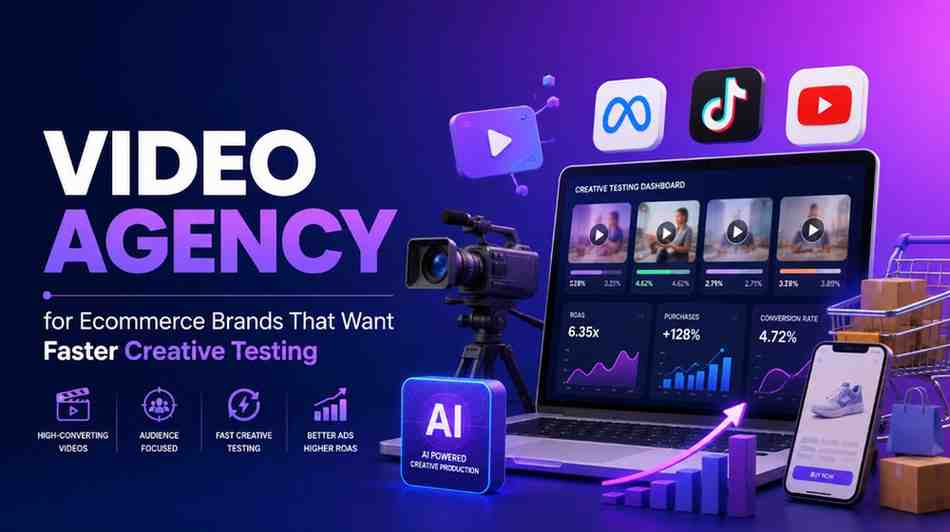
A few years ago, hiring a video agency was mostly about producing polished creative assets. Brands wanted a launch video, a few paid social ads, maybe some product demonstrations, and content for their website. The expectation was straightforward. Produce high quality videos, deliver them on time, and move on to the next campaign.
That expectation no longer matches how ecommerce advertising works.
Today, many ecommerce brands are spending significant budgets across Meta Ads, TikTok Ads, YouTube Ads, and other paid channels where performance depends heavily on creative volume. Marketing teams are not struggling because they lack one great advertisement. They are struggling because they cannot generate enough fresh creative to support ongoing testing.
A video agency is now expected to contribute directly to advertising performance, not simply content production.
Media buyers often find themselves in a familiar situation. A campaign performs exceptionally well for several weeks. Customer acquisition costs remain stable. Conversion rates are strong. Then performance begins to decline. The audience has seen the same ads too many times, engagement drops, and results become inconsistent. The immediate question is not whether the existing ad is good. The question is how quickly new creative can be launched.
This shift has changed the way brands evaluate a video agency.
Founders and marketing leaders increasingly want partners that can support testing velocity, creative iteration, and campaign scalability. They are looking for teams that understand hooks, offers, audience psychology, and paid media performance. Production quality still matters, but it is no longer the only measurement that matters.
The ecommerce brands growing aggressively today often treat creative as an ongoing operational function rather than a periodic marketing project. That means a video agency must fit into a continuous testing environment where campaigns are constantly evolving.
The conversation has moved beyond producing videos.
Now it is about producing enough creative assets to keep acquisition systems moving.
Most ecommerce teams can identify a winning ad after they see the results.
The challenge is finding that winning ad in the first place.
This is where many brands encounter a bottleneck. Internal teams may have strong media buying capabilities and clear growth targets, yet creative production struggles to keep pace with testing requirements. Every campaign requires new hooks, different messaging angles, multiple formats, audience variations, and platform specific adaptations.
A single winning advertisement often emerges from dozens of creative experiments.
For example, a DTC skincare brand launching a new product may test educational content, founder stories, customer testimonials, before and after demonstrations, problem solution narratives, and offer focused advertisements simultaneously. Some concepts fail quickly. Others show potential. A small percentage become meaningful revenue drivers.
The process is rarely predictable.
What matters is having enough creative output to uncover those winners consistently.
This reality is forcing brands to rethink their relationship with a video agency. Instead of requesting a handful of premium assets every quarter, marketing teams increasingly need a continuous flow of testable creative.
The economics of paid media support this approach.
If a brand spends $50,000 or $500,000 per month on advertising, creative performance often has a larger impact on results than incremental bidding adjustments. A stronger hook, a more compelling opening sequence, or a different customer angle can dramatically change campaign outcomes.
That is why experienced media buyers frequently ask for more creative before asking for more budget.
More budget cannot fix weak creative.
More testing sometimes can.
A modern video agency must therefore understand how content fits into the broader acquisition process. Creative production is no longer isolated from media buying decisions. The two functions increasingly influence each other every day.
Brands that recognize this relationship tend to move faster because they can launch new concepts before performance declines become expensive.
Creative fatigue has become one of the most common challenges in ecommerce advertising.
A campaign launches successfully. Results exceed expectations. Customer acquisition costs improve. Return on ad spend increases. Then gradually the same audience becomes less responsive. Click through rates decline. Conversion efficiency drops. The creative that once performed exceptionally well begins losing momentum.
Most advertising teams have experienced this cycle.
The problem is not unique to any platform. Meta Ads, TikTok Ads, and YouTube Ads all rely on audience attention, and attention naturally decreases when people repeatedly encounter the same content.
As a result, creative refresh cycles are becoming shorter.
Some brands that previously updated advertisements every few months now refresh creative every few weeks. Others launch new variations continuously throughout the month to maintain testing momentum.
This evolution has significantly expanded the role of a video agency.
A traditional production model focused on delivering finished assets. A modern model focuses on generating ongoing creative opportunities. The objective is not simply to complete a project. The objective is to help brands maintain a steady pipeline of fresh advertising content.
That requires a different mindset.
Creative concepts need to be developed faster. Production workflows need to support iteration. Winning advertisements need variations before performance begins to decline. Marketing teams need creative partners who understand that advertising campaigns operate in real time.
I might be wrong here, but many ecommerce brands still underestimate how much creative fatigue affects long term advertising performance.
Teams often spend weeks analyzing audience targeting, attribution models, and campaign settings while overlooking the fact that audiences may simply be tired of seeing the same creative.
The brands that adapt fastest are usually the ones that prioritize creative renewal before results deteriorate.
For this reason, the expectations placed on a video agency continue to evolve. Brands increasingly need creative partners capable of supporting testing velocity, rapid iteration, and sustained campaign performance rather than one time production projects.
And honestly, producing more creative is not always easy.
But in today's paid media environment, producing enough creative may be one of the most important competitive advantages an ecommerce brand can build.
Most media buyers are not asking for more videos because they enjoy reviewing creative.
They are asking for more videos because scaling campaigns eventually becomes impossible without them.
A campaign can be perfectly structured. Audience targeting can be dialed in. Budgets can be increased gradually. Conversion tracking can be functioning correctly. Yet growth often stalls because the creative engine cannot keep up with the advertising engine.
This is one of the biggest disconnects between production teams and performance marketing teams.
Many video agency relationships are still built around project delivery timelines. Media buyers operate in a completely different environment. They need new concepts, fresh hooks, alternative messaging angles, and creative variations while campaigns are actively running.
A winning ad on Meta Ads may need ten additional versions within days.
A successful TikTok campaign may require multiple creator styles, revised openings, shorter edits, and new offer positioning before the original creative begins losing effectiveness.
The demand is constant.
What media buyers actually need from a video agency is responsiveness. They need creative teams that understand how advertising performance changes in real time and how quickly opportunities can disappear when fresh content is unavailable.
For example, an ecommerce brand selling fitness products may discover that customer testimonials outperform product demonstrations. The next logical step is not creating one more testimonial video. The next step is producing multiple versions that test different customer types, pain points, outcomes, and opening hooks.
That level of iteration is difficult when creative production moves slowly.
The most valuable video agency relationships often feel like an extension of the paid media team rather than a separate production vendor. Campaign data influences creative decisions. Creative insights influence media buying decisions. Both sides are working toward the same performance goals.
When scaling Meta Ads and TikTok Ads, speed frequently becomes more important than perfection.
An ad that launches this week may generate significantly more revenue than a slightly more polished version that launches next month.
Growth introduces complexity.
Many ecommerce brands begin with a relatively simple advertising strategy. They have one hero product, a small set of offers, and a limited number of audience segments. Creative production feels manageable.
Then the business grows.
Additional products are introduced. Seasonal promotions appear throughout the year. New customer segments emerge. Existing campaigns require localization, platform specific adjustments, and audience specific messaging.
Suddenly the creative workload expands dramatically.
A supplement company may need separate advertising content for first time buyers, repeat customers, subscription offers, bundle promotions, and product launches. Each audience responds differently. Each campaign requires different creative approaches.
A fashion brand may face similar challenges across product categories, seasonal collections, pricing promotions, and customer demographics.
The problem is not necessarily generating ideas.
The problem is producing enough creative assets to support all those initiatives simultaneously.
This is where creative bottlenecks begin affecting business performance.
Marketing teams often find themselves prioritizing certain campaigns while delaying others because production capacity is limited. Product launches are postponed. Testing opportunities are missed. High potential audience segments receive less attention than they deserve.
Sometimes the bottleneck becomes invisible.
Revenue growth slows slightly. Customer acquisition costs rise gradually. Campaign performance feels inconsistent. The underlying issue may not be media buying at all. The business simply lacks enough creative resources to support expansion.
A capable video agency helps remove this constraint by increasing creative throughput across the entire marketing operation.
Instead of treating each project as a standalone assignment, creative production becomes part of an ongoing growth process. New products can be supported faster. Offers can be tested sooner. Audience specific messaging can be launched without waiting weeks for production schedules to clear.
As ecommerce brands expand product catalogs and customer segments, creative capacity becomes increasingly important.
Not because every piece of content will succeed.
Because enough opportunities must exist for success to emerge consistently.
When performance declines, many brands instinctively think about spending more money.
The logic seems reasonable.
If a campaign generates sales, increasing budget should generate more sales.
Sometimes that works.
Often it doesn't.
One of the most common mistakes in ecommerce advertising is attempting to scale campaigns before increasing creative testing capacity. Additional budget simply exposes existing weaknesses faster.
A campaign that struggles at $5,000 per day rarely becomes more efficient at $20,000 per day.
Creative testing changes the equation.
Instead of forcing more spend into existing advertisements, brands continuously search for stronger concepts, better messaging angles, and more effective customer narratives. Every successful creative discovery has the potential to improve performance across the entire account.
Consider two hypothetical brands.
The first brand increases advertising spend by 30 percent while continuing to run the same creative assets.
The second brand keeps budget relatively stable but launches dozens of new creative tests over the same period.
The results are not always predictable, but experienced media buyers know which scenario usually creates more opportunities.
Creative breakthroughs tend to generate disproportionate outcomes.
A stronger hook can improve click through rates. Better messaging can increase conversion rates. More relevant customer stories can reduce acquisition costs. Those improvements affect every advertising dollar that follows.
I might be wrong here, but many discussions about scaling paid media focus too heavily on budget allocation and not enough on creative discovery.
Budget matters.
Creative often matters more.
That is one reason why many fast growing ecommerce brands place increasing emphasis on creative testing systems rather than simply increasing advertising expenditure.
The goal is not spending more.
The goal is finding more things worth spending on.
For many ecommerce brands, the challenge is not understanding the importance of creative testing.
The challenge is operational.
Marketing teams know they need more creative. Media buyers request additional concepts. Founders want faster testing cycles. Yet traditional production processes often make it difficult to keep pace with demand.
This is where Brahvo AI focuses its efforts.
Rather than approaching creative production as a limited series of high effort projects, Brahvo AI is built around helping ecommerce brands generate larger volumes of advertising content that can support ongoing testing, iteration, and campaign expansion.
The reality of modern paid media is that brands frequently need multiple creative formats, numerous messaging angles, different audience specific variations, and platform specific assets running simultaneously.
One winning advertisement is rarely enough.
Sustained growth typically requires a continuous stream of fresh creative concepts entering the testing pipeline.
Brahvo AI helps address this challenge by enabling brands to increase creative output without creating the production bottlenecks that often slow campaign execution.
For ecommerce teams managing product launches, seasonal promotions, customer acquisition campaigns, and retention initiatives at the same time, this increased production capacity can have a meaningful impact on testing velocity.
The value is not simply producing more content.
The value comes from creating more opportunities to identify winning advertisements before competitors capture audience attention or campaign performance begins to decline.
As advertising platforms continue rewarding creative relevance and freshness, brands increasingly need systems that support ongoing experimentation rather than occasional production cycles.
That shift is becoming difficult to ignore.
Many brands still evaluate a video agency using traditional production metrics.
How many videos were delivered?
How polished do the assets look?
How quickly were projects completed?
Those questions still matter, but they may not be the most important questions anymore.
Advertising performance depends on outcomes, not content inventories.
A brand can receive twenty beautifully produced videos and still struggle to improve acquisition performance if those assets fail to support meaningful testing.
Conversely, a smaller collection of strategically designed creative variations may generate significant business impact because they create opportunities for discovery.
This is why testing velocity deserves more attention during agency evaluations.
Testing velocity refers to how quickly new concepts can move from idea to live campaign. It measures how effectively creative production supports experimentation.
In practical terms, a high performing video agency should help brands answer questions faster.
Which hook generates stronger engagement?
Which customer segment responds best?
Which offer produces the highest conversion rate?
Which creator style attracts qualified traffic?
Every new creative test provides additional information.
The faster those insights arrive, the faster marketing teams can make informed decisions.
A useful way to think about it is this:
Traditional Evaluation
Performance Focused Evaluation
Number of videos delivered
Number of creative tests launched
Production quality
Advertising performance potential
Project completion speed
Testing cycle speed
Content output
Creative learning rate
Asset volume
Opportunity creation
The most valuable video agency relationships help brands accelerate learning, not simply increase asset counts.
Because at the end of the day, marketing teams are not purchasing videos.
They are purchasing opportunities to find the next advertisement that changes the trajectory of a campaign.
And finding that winner usually depends on how quickly the next test gets launched.
Choosing a video agency has become more complicated than it was a few years ago.
The reason is simple.
Most ecommerce brands are no longer buying video production alone. They are investing in a creative system that will directly influence customer acquisition, campaign scalability, and advertising efficiency.
That changes the evaluation process.
Many agencies can show impressive portfolios. Many can produce attractive creative assets. Those capabilities are important, but they do not always reveal how well an agency will perform inside a fast moving ecommerce advertising environment.
Marketing leaders should start by asking how the video agency approaches creative testing.
Do they produce a single concept or multiple concepts?
Do they think about creative iteration?
Can they support ongoing experimentation after campaigns launch?
These questions often reveal more than discussions about production quality.
Another important question involves speed.
How quickly can new creative concepts move from idea to launch?
Advertising opportunities rarely wait. A winning campaign today can become an average campaign within weeks if fresh creative is unavailable.
Response time matters.
Marketing leaders should also understand how the video agency collaborates with media buyers and performance teams.
Creative and media buying increasingly influence one another. Campaign data should inform creative decisions. Creative insights should influence future testing strategies.
When those departments operate separately, valuable information often gets lost.
A useful question is whether the agency understands platform specific behavior.
Meta Ads users behave differently than TikTok users.
YouTube audiences engage with content differently than Instagram audiences.
Creative that performs well in one environment may struggle in another.
An effective video agency recognizes those differences and adapts accordingly.
Business leaders should also evaluate scalability.
Can the agency support growing creative requirements as the business expands?
Can they manage multiple products, seasonal promotions, audience segments, and campaign objectives simultaneously?
What works for a startup may not work for a brand managing dozens of active campaigns.
One overlooked question involves learning.
How does the agency help the brand understand why creative succeeds or fails?
The most valuable partnerships often generate insights in addition to assets.
Because ultimately, the goal is not to collect videos.
The goal is to improve advertising outcomes.
Before hiring a video agency, marketing leaders should determine whether the relationship will increase the company's ability to test, learn, adapt, and scale.
Those capabilities tend to create more long term value than production volume alone.
The traditional video agency model was built around scarcity.
Creative production was expensive, time consuming, and resource intensive. Brands invested heavily in individual campaigns because producing large volumes of content was often impractical.
That environment is changing.
Today, advertising platforms reward relevance, speed, and creative freshness. Ecommerce brands need significantly more content than they needed just a few years ago. Campaigns move faster. Product launches happen more frequently. Customer expectations evolve constantly.
The demand for creative continues increasing.
The challenge is that production capacity has not always increased at the same pace.
This is one reason AI driven creative production is becoming increasingly important within the ecommerce ecosystem.
AI is not replacing strategy.
AI is not replacing customer understanding.
AI is not replacing great creative thinking.
What AI is changing is the ability to generate, adapt, iterate, and test creative assets at a scale that was previously difficult for many brands to achieve.
That distinction matters.
Some discussions around AI focus almost entirely on automation. In practice, many ecommerce teams are more interested in output. They want to know whether they can test more ideas, launch more variations, and respond faster to market conditions.
The answer increasingly appears to be yes.
A modern video agency must now think beyond production schedules and asset delivery timelines. The focus is shifting toward creative systems that support ongoing experimentation.
Continuous testing is becoming the operating model.
Instead of launching a campaign and waiting months before refreshing creative, brands are building workflows that introduce new concepts consistently. Winning advertisements are expanded into multiple variations. New customer angles are tested quickly. Messaging evolves based on campaign performance.
The cycle never really stops.
I might be wrong here, but some brands still view AI driven creative production as a future trend rather than a current operational advantage.
Meanwhile, many performance focused teams are already adapting their workflows around faster testing cycles and higher creative output.
The gap between those approaches may become increasingly visible over the next few years.
For companies focused on customer acquisition and advertising performance, the future video agency will likely look very different from the traditional production partner.
It will function less like a project based vendor and more like a creative growth engine.
Brahvo AI was built around this reality.
As ecommerce advertising becomes more competitive and creative demands continue expanding, brands will need partners capable of supporting continuous testing, rapid iteration, and scalable content production. The businesses that adapt first may not necessarily have the largest budgets.
They may simply have the fastest creative feedback loops.
And for many marketing leaders, that raises an interesting question.
If creative testing becomes the primary driver of advertising growth, how much creative capacity will your business actually need twelve months from now?