Explore video production companies in Orange County and learn how AI video production supports ecommerce ads, creative testing, and brand growth.
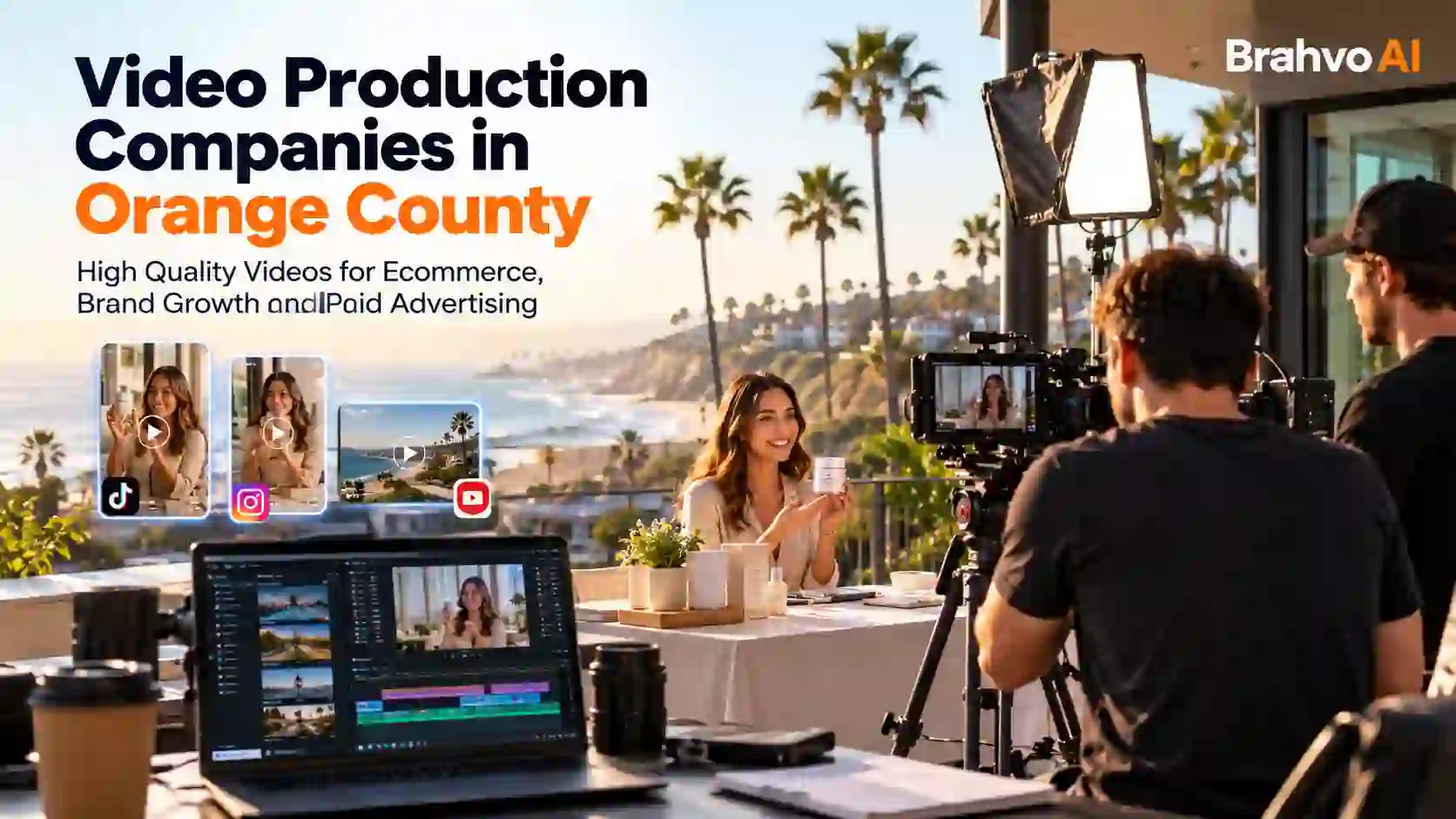
Hiring video production companies in Orange County usually starts with a specific business need. A brand might need a product launch video, a set of paid social ads, a corporate brand film, or several short videos for an upcoming campaign. The challenge is finding a production partner that understands the purpose behind the content, not just how to shoot it.
Orange County businesses operate across industries such as ecommerce, healthcare, real estate, hospitality, technology, and consumer products. Each has different production requirements. A real estate company may need property walkthroughs and neighborhood footage, while a direct to consumer brand may need product demonstrations, customer testimonials, and short advertising creatives.
A good production process begins with understanding where the video will be used. A polished brand film intended for a company website has different requirements from a 20 second Meta ad designed to stop someone from scrolling. The messaging, pacing, aspect ratio, and call to action all need to fit the intended placement.
When evaluating video production companies in Orange County, businesses should consider a few practical questions:
The last question matters more than many businesses expect. A single high quality video may work well for a launch, but brands running paid advertising often need a continuing supply of creative assets. Planning for that demand early can prevent production from becoming a bottleneck.
For ecommerce brands, a video has a job to do. It needs to explain a product, demonstrate its value, answer a buying objection, or give customers a reason to consider purchasing. Attractive visuals help, but they cannot compensate for unclear messaging.
Consider a skincare company selling a moisturizer online. A conventional product video might show the packaging, texture, and application. A performance focused version could open with a common skincare concern, demonstrate how the product fits into a daily routine, and explain its intended use. Both videos may look professional, but they approach the customer's decision from different angles.
This distinction becomes especially important when brands are spending money on Meta Ads and TikTok Ads. The creative influences who pays attention, what they understand about the product, and whether they continue toward the product page.
Video production companies in Orange County serving ecommerce businesses need to understand these commercial requirements. The goal is not necessarily to produce the most elaborate video. It is to produce content that communicates the right message to the intended audience.
Several video formats can serve different stages of the buying process.
Product demonstrations show how an item works and what customers receive. They are particularly useful for products whose value is difficult to communicate through static images.
Customer style videos use a conversational format to explain a product experience, answer common questions, or demonstrate a use case. When real customer testimonials are used, claims should accurately reflect the customer's experience.
Problem and solution videos begin with a recognizable frustration and introduce the product as a possible answer. This format works best when the problem is specific rather than exaggerated.
Brand storytelling videos explain why a company exists, how its products are made, or what distinguishes its approach. They may be particularly useful for brands with a strong point of view or a product category where trust matters.
A DTC brand selling several products also needs to think beyond individual videos. If five SKUs require separate campaigns, the production process should account for different product benefits, audiences, and creative variations. Otherwise, the team may spend most of its budget producing one hero video while leaving the rest of its catalogue with limited advertising assets.
Video should support the economics of the business, not sit outside them. Production costs need to make sense alongside gross margins, customer acquisition costs, expected order value, and the amount of creative testing the campaign requires.
One of the most expensive production mistakes is choosing a format before defining the objective. Businesses sometimes begin with the idea that they need a cinematic video, only to discover that their immediate requirement is a collection of short product ads.
The right production approach depends on what the business needs the audience to do.
A company introducing a new product may need a launch video that establishes the product's purpose and demonstrates its key features. An established ecommerce brand dealing with creative fatigue may need several new hooks and demonstrations rather than another broad brand story. A B2B company preparing for a sales event might need customer interviews and a concise company overview.
These are different problems, so they should not automatically receive the same production treatment.
Marketing objective
Suitable video approach
Main consideration
Introduce a new product
Product launch video and demonstrations
Explain the value quickly
Test paid advertising concepts
Short videos with varied hooks and messages
Make each variation meaningfully different
Build brand familiarity
Brand film and founder story
Keep the message consistent
Explain a complex product
Demonstration and explainer video
Make the information easy to follow
Support product page conversions
Product details, use cases, and demonstrations
Answer buying questions
Reach several audience segments
Multiple edits with audience specific messaging
Avoid changing only the opening shot
For video production companies in Orange County, this kind of planning should happen before the production schedule is finalized. It affects casting, locations, scripts, equipment, editing time, and the number of final assets.
There is also a tradeoff between creative ambition and production flexibility. A carefully staged shoot can deliver excellent footage, but it may be difficult to repeat every time the company launches another product. A simpler production setup might allow the team to create consistent content across a larger catalogue.
I might be wrong here, but businesses sometimes overvalue production complexity because it is easy to see. A beautifully lit studio, elaborate set, and expensive camera setup are visible signs of effort. Whether the video answers a real customer question is less obvious until the campaign runs.
That does not mean production quality is unimportant. Poor lighting, unclear audio, and inconsistent visuals can make a credible company look careless. The point is to spend where quality changes the audience's experience, rather than adding complexity for its own sake.
A video that works on one advertising channel may perform differently on another. Audience expectations, viewing habits, placement requirements, and campaign objectives all influence how the creative should be edited.
Meta Ads often require multiple creative concepts because audience response can vary considerably. A product demonstration might attract one segment, while a customer problem or founder explanation resonates with another. If every variation uses the same opening, message, and visual sequence, the campaign may not be testing much beyond superficial differences.
TikTok Ads often benefit from a more conversational presentation, quick context, and a clear reason to keep watching. However, not every brand needs to imitate informal creator content. A premium product can maintain its visual identity while using a more direct opening and a faster explanation.
YouTube supports a broader range of video formats, including short ads and longer product explanations. The production team should consider how much time the campaign has to communicate its message and where the video appears. A short placement needs a different editing decision from an ad that allows viewers more time to understand an unfamiliar product.
For marketing teams, the operational challenge is producing enough distinct creative without creating an editing process that becomes difficult to manage.
A practical workflow usually includes four stages.
Creative briefing. The media buyer or marketing lead identifies the campaign objective, audience, product, key objection, and message to test. The brief should also state what the viewer should understand or do after watching.
Production planning. The team decides which footage, demonstrations, voiceovers, creator performances, and product shots are needed. Planning several related assets together can reduce repeated setup costs.
Editing and adaptation. Editors create versions for the intended placements, including appropriate aspect ratios, captions, pacing, and calls to action. The variations should preserve the core message while meeting each placement's requirements.
Performance review. The marketing team reviews results and identifies what to produce next. Useful signals may include the opening's ability to hold attention, click through rate, conversion rate, and customer acquisition cost. These metrics need to be interpreted in the context of campaign objectives and attribution limitations.
For example, suppose a US based home goods brand launches a new kitchen organiser. The team produces three concepts: one demonstrates the storage problem, one shows the product in use, and one focuses on the amount of space it saves. Each concept receives a few opening variations.
After launch, the team should look beyond which video receives the most views. If one version attracts attention but generates few product page visits, its opening may be interesting without creating purchase intent. Another version might receive fewer views but generate more qualified traffic. The next production cycle should reflect those differences.
This is where coordination between production and paid media becomes important. If the editor does not know what the media buyer is trying to learn, the final deliverables may look polished but offer little useful variation.
Production budgets are rarely unlimited, particularly for growing ecommerce companies. Marketing teams must decide how much to spend on a single production, how many deliverables to request, and how much budget to reserve for new creative after the initial campaign launches.
The quoted price alone does not tell the whole story. A relatively inexpensive video can become costly if it requires repeated revisions or cannot be adapted to the placements where the company advertises. A larger production investment can make sense when the footage supports several campaigns, product pages, or future edits.
When reviewing proposals from video production companies in Orange County, businesses should ask what the quoted scope actually includes. Script development, talent, location fees, product shipping, editing, revisions, licensed music, and final file delivery can affect the total cost. Usage rights and the intended period of use should also be clear, particularly when paid advertising and creator likenesses are involved.
Turnaround time deserves similar attention. A product launch scheduled for a fixed date cannot wait indefinitely for edits. On the other hand, rushing every video through production can leave the marketing team with assets that have not been reviewed carefully.
A useful way to manage the tradeoff is to separate essential production requirements from optional additions.
For a product campaign, the essential requirements might include a clear script, usable product footage, clean audio, captions, and the required advertising formats. Additional locations, elaborate sets, or multiple talent changes may be worthwhile for a brand film, but less important for a short product demonstration.
AI video production can also be considered when the team needs to create variations, localise messaging, or produce certain presenter led formats without repeating an entire shoot. Its suitability depends on the product, audience, creative concept, and required level of authenticity. Physical demonstrations, intricate product details, and scenes where accurate interaction matters may still require conventional filming.
Brahvo AI can be part of this discussion when a brand is assessing AI assisted video production for advertising and content needs. The important question is which parts of the workflow benefit from AI and which still require human direction, product knowledge, and editorial judgement.
The production budget should leave room for learning after launch. Spending the entire allocation on one final video may leave no resources to respond when the campaign reveals that customers care about a different feature, price concern, or use case than expected.
And that is often the real budgeting decision. Not simply how much a video costs, but whether the business can afford to keep producing useful creative once the first campaign is live.
Marketing teams often have more creative ideas than they have time to produce. A media buyer may identify five promising advertising angles, but the production schedule only allows for one or two finished videos. By the time additional assets are ready, campaign performance may have changed, or the team may have moved on to another product launch.
AI video production offers another way to handle parts of this workload. Depending on the project, it can support script development, voiceovers, presenter led videos, visual variations, localisation, and editing workflows. The value comes from using these capabilities where they solve a real production problem.
For ecommerce brands, this can be especially relevant when advertising several SKUs. A company selling home organisation products, for example, may need separate videos explaining the benefits of storage bins, drawer dividers, and kitchen organisers. Some of the messaging and production elements may be reusable, while each product still needs accurate visuals and specific demonstrations.
AI assisted production can help the team prepare variations without rebuilding every element from scratch. However, the product details, claims, and final presentation still need human review.
The same applies to paid advertising. A brand testing different hooks on Meta Ads might use AI assisted workflows to develop alternative scripts or presenter formats. The marketing team can then select the versions that best fit its audience and campaign objective.
There are limits. AI generated product imagery can misrepresent physical features, materials, packaging, or how an item works. A realistic looking scene is not necessarily an accurate product demonstration. Brands selling products where size, texture, fit, or function affects the buying decision should be particularly careful.
For video production companies in Orange County, AI is best considered alongside conventional production rather than as an automatic replacement for it. A filmed product demonstration may provide the essential footage, while AI assisted editing or voice production helps create additional versions. Another campaign might benefit from a fully generated visual concept, provided the final output meets the brand's accuracy and quality requirements.
The production decision should come down to the brief. If AI saves time on repetitive work without compromising the message, it may be worth using. If it creates more review work or makes the product less credible, the time savings may not be real.
Production delays do not always begin in the editing room. Many start earlier, when the brief is unclear, the product has not arrived, or several stakeholders have different ideas about what the final video should communicate.
For ecommerce teams, these issues can affect campaign schedules and media spending. A delayed creative asset may leave a planned campaign with fewer variations than expected. If the team has already committed advertising budget to a launch, the delay can create pressure to use existing content for longer than intended.
One common problem is changing the creative direction after production begins. A founder may approve a product focused script, then request a broader brand story after seeing the first edit. That change may require new footage, additional editing, or a revised voiceover.
Another issue is asking for too many deliverables without defining their differences. Ten videos that repeat the same message with minor visual changes may provide less value than four videos built around distinct customer concerns.
A third challenge is poor communication between the production team and the paid media team. Editors may receive feedback such as "make it more engaging" without knowing whether the opening loses attention, the product benefit is unclear, or the call to action arrives too late. Specific feedback makes revision cycles more useful.
These problems can be reduced through a few working practices:
There is also a practical issue with approvals. When a founder, marketing director, product manager, and legal reviewer all need to sign off, feedback can arrive in separate messages with conflicting requests. Naming one person to consolidate comments can prevent unnecessary rounds of editing.
For video production companies in Orange County working with national ecommerce brands, remote collaboration can add another layer of complexity. Product samples may need shipping, talent may work in different locations, and campaign deadlines may depend on several teams. A realistic production schedule should account for these dependencies rather than assuming every approval will happen immediately.
The aim is not to remove every revision. Creative work rarely runs perfectly from the first cut. The aim is to prevent avoidable changes from consuming the time and budget needed to finish the campaign properly.
Growing brands often reach a point where their advertising needs outpace their existing production process. The company may have several products to promote, multiple audience segments to reach, and regular campaign launches to support. Producing every asset as a separate project can make planning difficult.
For Brahvo AI, the relevant opportunity is to connect video production with the actual demands of modern marketing teams. That starts with understanding what the content needs to accomplish, where it will appear, and how the business expects to use it.
A campaign intended to generate product sales requires a different creative brief from a corporate video intended to explain the company. The first may need several product focused concepts and short edits. The second may need a more deliberate narrative, interviews, and carefully selected brand visuals.
This distinction helps determine the appropriate production method. Traditional filming may be suitable when physical product interaction, real locations, or genuine customer experiences are central to the message. AI assisted production may be useful for certain presenter led formats, creative variations, or workflows that require repeated changes.
The production plan should also reflect how the brand manages its advertising. If the paid media team tests new messages every few weeks, it makes sense to discuss how future variations can be created without repeating unnecessary work. If the campaign centres on a single major product launch, a more concentrated production effort may be appropriate.
For a brand with several SKUs, the process might begin by identifying the key selling point and main customer objection for each product. The team can then decide which footage and messaging need to be unique, which elements can be shared, and which concepts deserve separate creative treatment.
That does not mean every video should look or sound the same. Consistency in branding is useful, but excessive repetition can make advertising feel stale. Each asset still needs a clear reason to exist.
Brahvo AI's role in the process should be assessed through the proposed deliverables, production workflow, communication, and final output. Brands should ask how scripts are approved, how product accuracy is checked, what revisions are included, and how the finished files will be supplied for their intended channels.
A production partner should also be comfortable discussing limitations. AI assisted video is not the right answer for every brief, and a conventional shoot is not automatically the best use of every budget. The decision should follow the creative requirements rather than a preference for one production method.
For growing brands, the most useful outcome is a production process that supports the next campaign as well as the current one. That requires clear decisions, realistic timelines, and a shared understanding of what the marketing team needs to learn from the content.
1. What do video production companies in Orange County typically produce?
They may produce corporate videos, product demonstrations, commercials, customer testimonials, social media videos, training content, and brand films. The available services vary by company, so businesses should check whether the proposed production fits their specific marketing objective.
2. How much do video production companies in Orange County charge?
Costs depend on the scope of work, filming requirements, talent, locations, editing complexity, and number of deliverables. A short product video and a multi location commercial can have very different budgets. Requesting an itemised proposal makes it easier to understand what is included.
3. How long does video production usually take?
A straightforward video may take a few weeks from briefing to final delivery, while a larger commercial can require considerably more time. Script approvals, product shipping, filming schedules, and revision rounds all affect the timeline. Confirming these dependencies early helps avoid delays.
4. Is AI video production suitable for ecommerce advertising?
Yes, for certain formats and workflows. It can support presenter led content, voiceovers, creative variations, and some visual concepts. Physical product demonstrations and claims about product performance require particular care to ensure that the finished video accurately represents what customers will receive.
5. Should a brand produce one video or several advertising variations?
That depends on the campaign. A single video may be sufficient for a specific announcement or brand message. Paid campaigns that need to test different customer motivations may benefit from several genuinely different concepts rather than multiple edits of the same idea.
6. Can the same video be used on Meta Ads, TikTok Ads, and YouTube?
Often, but the original edit may need adjustments. Each channel has different placements, viewing contexts, and creative requirements. Brands should confirm aspect ratios, captions, safe areas, length, and messaging before distributing the same asset across campaigns.
7. What should businesses provide before production starts?
A useful starting point includes the campaign objective, target audience, product information, key messages, examples of the intended creative direction, brand assets, and delivery deadline. Ecommerce brands should also provide accurate product specifications and identify any claims that need approval.
8. How can businesses evaluate whether their video content is working?
The evaluation should match the campaign objective. Teams may review watch time, click through rate, conversion rate, customer acquisition cost, and revenue alongside their advertising spend. No single metric tells the full story, and results should be assessed against the campaign's audience, budget, and measurement limitations.
9. What should brands ask Brahvo AI before starting a project?
Brands should clarify the production scope, creative development process, use of AI, revision policy, delivery timeline, usage rights, and quality review process. It is also worth asking how the proposed deliverables will support the intended advertising placements and future creative requirements.
10. What to Consider Before Starting Your Next Video Campaign
Before committing to a production budget, establish what the campaign needs to achieve and what the marketing team will do with the finished assets. This sounds basic, but it can prevent expensive mismatches between the creative concept and the business requirement.