See who offers subscription based video production for ecommerce brands needing ongoing UGC, AI video, paid social, and ad creative.
A few years ago, an ecommerce brand could get away with producing a handful of polished product videos and running them for months. That is getting harder.
A Meta campaign can burn through several creative variations quickly. TikTok audiences respond to fresh hooks and different editing styles. A product launch may need announcement videos, demonstrations, UGC style clips, retargeting ads, testimonials, and short social posts almost at the same time.
The problem is not always knowing what to create. It is producing enough of it without turning every new creative into a separate production project.
That is where subscription based video production has started to make more sense for ecommerce teams. Instead of commissioning individual videos whenever a campaign needs something new, brands work within an ongoing production arrangement. The goal is a steady flow of usable creative rather than a few large video projects spread across the year.
For a DTC brand spending heavily on paid social, this changes the production conversation.
A media buyer might say, "We need five new concepts for this campaign." The creative team may hear that as five scripts, five shoots, multiple edits, revisions, exports, and approvals. Then another request arrives two weeks later.
Subscription based video production is designed around that recurring demand.
It can be particularly useful for brands with multiple SKUs, frequent promotions, active paid acquisition campaigns, or a constant need to test new messaging. The production process becomes part of the marketing operation instead of something that has to be restarted every time creative demand increases.
There is also a budget consideration. A traditional project model can make creative spending unpredictable because every production request is treated separately. A subscription creates a more consistent production expense, although the actual economics depend heavily on the number of deliverables, complexity, revision limits, turnaround expectations, and production quality.
That last point matters.
A subscription is not automatically cheaper. If a brand only needs three highly produced videos every quarter, a recurring model may not make much sense. But if the paid media team needs fresh creative every week, the calculation starts looking very different.
When ecommerce operators search for who offers subscription based video production, they are usually not looking for a traditional production company that delivers one large campaign and disappears.
They are looking for an ongoing creative partner that can keep up with the pace of advertising.
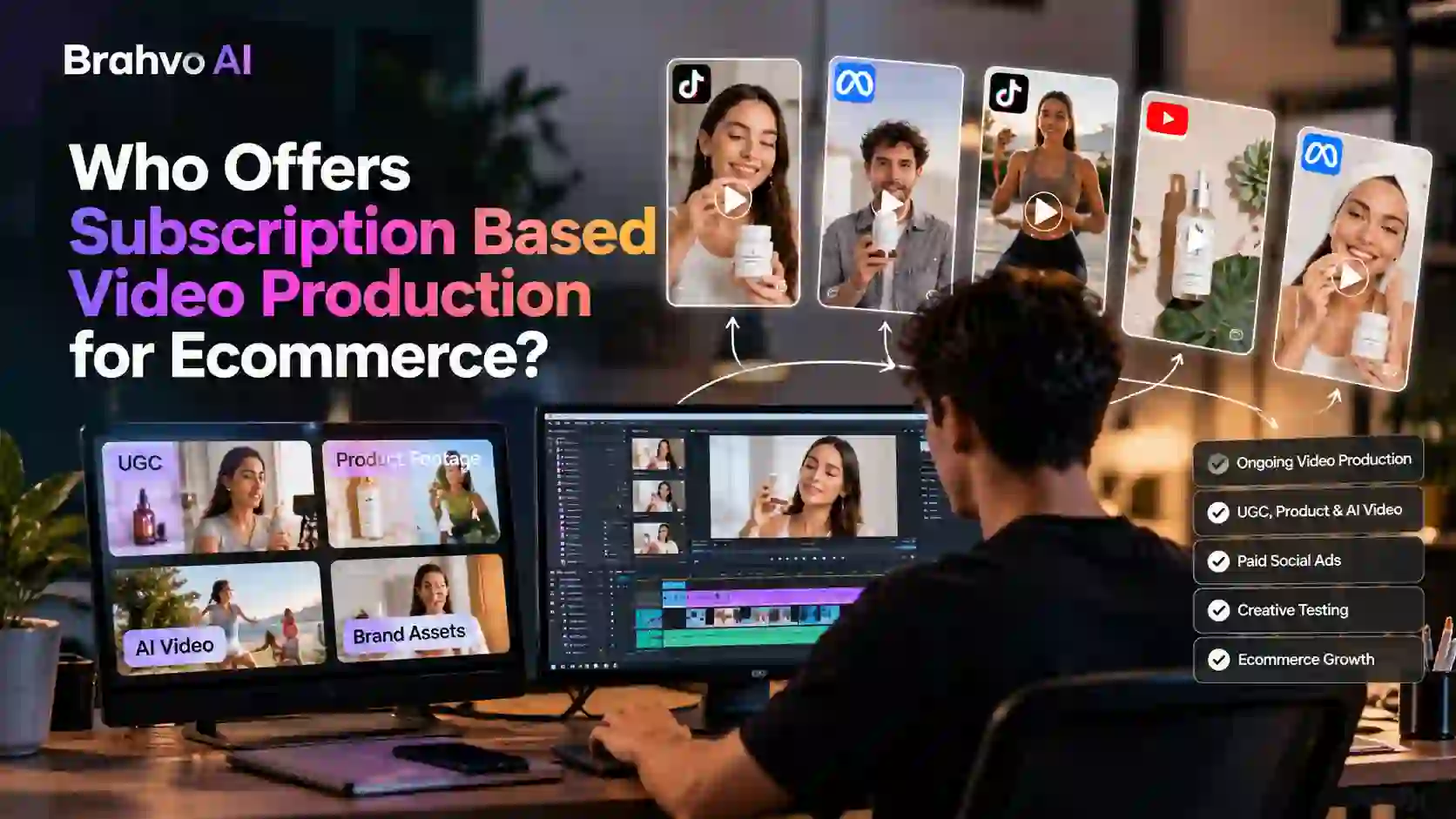
Brahvo AI is positioned around this type of recurring video production model, particularly for brands that need a higher volume of marketing creative. The focus is less on producing one hero film and more on creating a continuous stream of videos that can be used across paid social, ecommerce marketing, and organic channels.
That distinction is important.
A growing DTC company may need a product demo on Monday, three UGC style variations on Wednesday, a new paid social concept next week, and several versions of an existing winning ad after that. These are not necessarily separate "video projects" from the perspective of the marketing team. They are simply creative requirements that keep appearing.
Subscription based video production works best when the production partner understands that reality.
For example, suppose a skincare brand has six active products and is running Meta Ads across prospecting and retargeting campaigns. Its media buyer identifies two winning hooks but notices that performance is beginning to soften. The immediate requirement might be eight new variations using the same core product message, but with different openings, pacing, visuals, creators, and calls to action.
The brand does not necessarily need eight completely new productions.
It needs enough creative variation to learn what works next.
That is one reason subscription models are becoming relevant to performance marketing teams. They can create a closer connection between advertising insights and production requests.
There is still an important question for buyers, though. Who offers subscription based video production that can actually handle this level of iteration without sacrificing consistency?
That depends on the production workflow.
A low monthly price does not tell you much by itself. Ecommerce teams need to understand how briefs are submitted, how many videos or concepts are included, what happens with revisions, how quickly work is delivered, and whether the provider can work with existing product footage, UGC, AI generated assets, and brand guidelines.
The production model matters just as much as the video output.
The word "subscription" can make the model sound simpler than it really is.
You are not just paying for a fixed number of videos. You are paying for an ongoing production capacity.
Depending on the arrangement, subscription based video production can include concept development, scripting, editing, motion graphics, AI generated scenes, UGC style content, product footage adaptations, different aspect ratios, creative variations, and revisions.
For a paid media team, the most useful part may actually be variation.
One product video can become several advertising assets. The opening three seconds can change. The voiceover can change. The product benefit can be repositioned. The visual sequence can be rearranged. A testimonial can become a direct response ad. A longer product demonstration can become several short clips.
That creates more testing opportunities without requiring an entirely new production every time.
Consider a hypothetical $60 skincare product.
The original creative might focus on dry skin. A second version could focus on the morning routine. Another could address a common objection about texture. Another could demonstrate application. Another could use a customer problem as the opening hook.
The underlying product has not changed.
The creative angle has.
This is where subscription based video production can become useful for performance teams because advertising does not always need more footage. Sometimes it needs more ways to present the same offer.
There are practical production benefits too. A recurring workflow allows the team to build familiarity with the brand. Product terminology, visual preferences, approved claims, fonts, logos, colors, and editing preferences do not have to be explained from zero every time.
That can reduce some of the friction that normally appears between ecommerce teams and outside production partners.
But brands should look closely at the boundaries of the subscription.
Does one "video" mean one finished asset or one concept with several versions? Are revisions included? Are custom shoots included? Can the brand submit multiple briefs at once? What happens when a product launch requires a sudden increase in volume?
Those details can have more impact on the actual value than the headline monthly price.
Creative fatigue is one of those problems that rarely arrives with a clear warning.
A Meta ad may perform well for several weeks. Then the click through rate starts slipping. The cost of acquiring a customer rises. Frequency increases. The media buyer asks for fresh creative.
The easy response is to produce something completely different.
That is not always necessary.
Sometimes the winning concept is still valid. The audience has simply seen the same execution too many times.
Subscription video production gives teams a way to respond with controlled variations instead of constantly rebuilding campaigns from the ground up.
Take a supplement brand running a strong testimonial ad. The original video features a customer explaining how the product fits into their daily routine. Rather than abandoning that concept when performance weakens, the team could test a different first three seconds, a shorter testimonial, a product demonstration, a stronger problem statement, or a different visual sequence.
The central message stays familiar.
The execution changes.
This approach also gives paid media teams more room to separate creative variables. If every new video changes the hook, offer, product positioning, visual style, and CTA at the same time, it becomes difficult to understand what actually affected performance.
A more disciplined process might keep the offer constant while testing different hooks. Then it could test different product demonstrations. Then different customer objections.
Not every brand needs this level of testing, of course. I might be wrong here, but some smaller ecommerce companies can actually create too many variations before they have enough spend or conversion volume to learn anything useful from them.
More creative does not automatically mean better decision making.
The point is to create enough relevant variation to keep the advertising system supplied with fresh ideas while giving the media team something meaningful to evaluate.
This is also where AI video production can change the economics of creative iteration. AI generated scenes, synthetic environments, voice options, rapid editing, and asset adaptation can help turn one approved concept into multiple executions.
That does not mean AI should replace every piece of production.
Real customer footage, product demonstrations, creator content, and authentic brand material still have situations where they matter more. The useful question is where AI can reduce production friction without making the ad feel artificial.
Meta Ads and TikTok Ads create a strange production problem for ecommerce brands.
The platforms reward creative variety, but the brand still has limited products, limited footage, limited customer stories, and limited time.
A brand selling one hero product cannot realistically invent a completely new visual universe every week.
It does not need to.
A better production system starts by treating existing creative as raw material.
A 30 second product demonstration might provide several shorter clips. A UGC video can produce multiple hooks. Existing product photography can be incorporated into motion based ads. A customer review can become a voiceover concept. A successful Meta ad can be adapted into a TikTok style version with a different opening and pacing.
This is particularly useful when the media buyer has already identified something that works.
Imagine a home fitness brand discovers that ads beginning with "If you only have 15 minutes a day" consistently generate strong engagement. The team does not need to throw away that insight when refreshing the campaign.
They can build around it.
One version could open with the problem. Another could show the product immediately. A third could use UGC footage. A fourth could demonstrate the workout. A fifth could use AI generated lifestyle visuals around the same message.
The production team is not starting at zero each time.
That is one of the strongest practical reasons brands look at who offers subscription based video production rather than searching for a traditional one-off production service.
The ongoing model can connect creative production with paid media learning.
For TikTok, the editing language may need to feel more native and less like a polished commercial. For Meta, a brand may need several versions for different placements and audiences. YouTube may call for longer demonstrations, testimonials, or stronger storytelling.
The source material can overlap, but the final execution does not have to.
This is where the production partner needs to understand advertising, not just video editing.
A technically polished video can still be a weak ad. A simple UGC style video can outperform something that took days to produce. A beautiful product shot may not communicate the benefit quickly enough. A strong concept may fail because the first few seconds are too slow.
Those are production decisions, but they are also media decisions.
For an ecommerce team, that distinction can save a lot of wasted effort. The objective is not to keep the editing calendar full. It is to keep the creative pipeline connected to what the advertising team is actually learning.
The production challenge gets harder once an ecommerce brand has more than one content source.
A typical DTC team might have UGC from creators, product photography from an earlier launch, footage from a studio shoot, customer testimonials, raw phone videos, animation files, brand graphics, and AI generated scenes sitting in different folders. None of these assets are particularly useful if the production team cannot turn them into finished creative quickly.
That is why asset management becomes part of subscription based video production.
A useful workflow starts by separating what already exists from what actually needs to be created. If a brand has twenty strong customer videos, there may be no reason to commission another shoot simply because a new ad campaign needs five creatives.
The existing footage can be cut differently.
A creator's opening can be paired with product footage. A product demonstration can be combined with an AI generated environment. A customer quote can become the voiceover for a motion based ad. Existing brand graphics can be reused across several concepts.
The result is not necessarily a completely new production every time. It is a new advertising asset built from a larger creative library.
This matters even more for brands with multiple SKUs. A beauty company with twelve products may have hundreds of usable clips but still struggle to produce fresh ads because nobody has organized the material around specific products, benefits, customer problems, and campaign angles.
AI video can help fill some of those gaps. It can be useful for creating visual environments, transitions, conceptual scenes, product contexts, and variations that would otherwise require additional production work.
But there is a line.
If the product itself looks unrealistic, or an AI generated hand touches a product in an obviously strange way, the ad can lose credibility instantly. Ecommerce customers are not necessarily judging the technology. They are judging whether the content feels believable.
That makes the combination more interesting than simply replacing traditional video with AI.
UGC can provide authenticity. Product footage can provide accuracy. AI video can provide creative flexibility. Brand assets provide consistency.
The production challenge is getting all four to work together without making the final creative feel stitched together.
Brahvo AI approaches subscription based video production around the recurring creative needs of ecommerce and performance marketing teams.
The important distinction is that the work is not treated as a collection of unrelated video projects. The focus is on maintaining an ongoing creative pipeline that can support paid campaigns, product launches, social content, testing, and refresh cycles.
That changes how a production request gets looked at.
Instead of asking only, "What video should we make?" the more useful question becomes, "What does the marketing team need to test or communicate next?"
For example, a media buyer may report that an existing ad is getting strong clicks but weak purchases. That information can influence the next round of creative. The production team might test a clearer product demonstration, introduce an objection earlier, change the opening, or make the offer easier to understand.
Another campaign might have the opposite problem. The offer converts well, but the creative has been running for too long.
The response could be several fresh executions built around the same core message.
This type of feedback loop is important because creative production and paid media cannot operate as completely separate departments. The media team sees what audiences are responding to. The creative team turns those observations into new assets.
Brahvo AI's use of AI video production can also make certain types of iteration more practical. Instead of requiring a new physical production for every visual variation, some concepts can be developed or adapted using AI generated content, existing footage, motion graphics, and other digital assets.
The point is not to make everything look like it came from AI.
For ecommerce advertising, that can actually be counterproductive.
The useful role for AI is often behind the scenes, where it can help produce variations and visual concepts while the final creative still follows the brand's product, messaging, and visual requirements.
A subscription model also creates an ongoing relationship with the brand. Over time, the production team can become familiar with the products, recurring offers, customer objections, approved claims, creative preferences, and campaign priorities.
That familiarity can make a difference when turnaround matters.
A team that already understands the product does not need to spend half a briefing explaining what the product does before discussing the next creative idea.
The monthly price is probably one of the least useful numbers to look at in isolation.
When deciding who offers subscription based video production, ecommerce teams should first understand exactly what the subscription covers.
Ask how deliverables are counted. A "video" might mean one finished ad. It might also mean one concept with several versions. Those are very different things.
Turnaround time matters too.
A paid media team may identify a creative problem on Monday and want new assets running by Friday. If the production workflow routinely takes two or three weeks, the subscription may not fit the way the advertising team operates.
Revision policies deserve attention as well. Creative work rarely gets approved perfectly on the first pass. If every minor change consumes a large part of the monthly allocation, the apparent volume can become misleading.
Brands should also ask how the production team handles different asset types.
Can it work with UGC? Existing product footage? AI generated scenes? Motion graphics? Product photography? Brand templates? Raw creator files?
This is especially important for established ecommerce companies because their content library is usually larger than they realize.
Another question is how briefs are handled.
A good briefing process should make it possible to communicate the product, target customer, objective, offer, creative angle, reference material, and required format without creating unnecessary back and forth.
There is also a strategic question that gets overlooked.
Can the production partner understand why the creative is being made?
If the answer is no, the relationship can turn into an order taking exercise. The brand requests five videos, the production team delivers five videos, and nobody asks whether those five assets actually address the advertising problem.
For some brands, that may be perfectly acceptable. For performance focused ecommerce teams, it can become frustrating.
The subscription should fit the company's actual creative volume, not an imaginary future workload.
A small brand launching two campaigns a month may not need a large recurring production commitment. A company spending heavily across Meta Ads and TikTok Ads may have the opposite problem and find that project based production creates too much administrative overhead.
The right question is not simply whether subscription based video production is cheaper.
It is whether the model matches the way the company buys, tests, and refreshes creative.
The economics become easier to understand when you look at production frequency.
Suppose a DTC brand needs four new ad concepts every month. Under a traditional project model, every request may involve a new briefing process, quotation, scheduling, production, editing, revisions, and approval.
That administrative cost is easy to ignore because it does not appear as a separate line item.
But it consumes time.
Now suppose the brand needs fifteen or twenty creative variations every month. The project model can become even more cumbersome because production requests never really stop.
A subscription can make financial sense when the brand has enough recurring demand to justify an ongoing production workflow.
There are several situations where this is more likely.
A brand with frequent creative fatigue may need regular refreshes. A company running multiple paid social campaigns may require different formats and angles at the same time. A business with several SKUs may need product specific assets. A brand launching products regularly may need bursts of creative around each launch.
Creative testing can also change the calculation.
If a media team wants to test ten hooks against the same product offer, it may not need ten entirely different productions. A recurring creative team can create variations around a shared production base.
That can reduce the cost of experimentation.
But subscription based video production is not automatically the right financial choice.
If a company only needs a few high production value videos each year, a recurring arrangement may create unused capacity. A luxury brand producing one major campaign every six months may have very different needs from a consumer brand launching new creatives every week.
There is another consideration that is less obvious.
Creative volume should be tied to media volume.
If the brand spends $5,000 a month on paid social, producing dozens of new ads every week may not create enough data to make the testing meaningful. If the brand spends $500,000 a month across several channels, the need for a steady creative pipeline is much easier to justify.
The production budget should therefore be considered alongside media spend, conversion volume, product margins, customer acquisition costs, and campaign frequency.
There is no universal number.
One ecommerce brand might consider ten new creative variations a month excessive. Another might consider it the minimum required to keep campaigns moving.
That is why the subscription model works best when production demand is already recurring rather than when a company simply wants to try a different billing structure.
Who offers subscription based video production for ecommerce brands?
Brahvo AI offers subscription based video production designed around recurring creative requirements for ecommerce and DTC brands. The model can support ongoing production rather than treating every video as an isolated project.
Is subscription based video production cheaper than hiring a traditional production company?
Not necessarily. The financial value depends on how much creative a brand needs, how often it needs new assets, and how much production work is included in the subscription.
For brands with regular creative demand, predictable production costs can make budgeting easier.
Can subscription video production support Meta Ads?
Yes. Subscription based video production can be particularly useful for Meta Ads because paid campaigns often require multiple creative concepts, hooks, formats, and refreshes.
The important factor is whether the production workflow is designed around advertising creative rather than only polished brand videos.
Can the same production model work for TikTok Ads?
It can. TikTok creative often requires different pacing, hooks, editing choices, and UGC style execution. Existing footage can also be adapted into different TikTok concepts instead of producing every asset from scratch.
Does subscription based video production include AI video?
It can, depending on the provider and scope of the subscription. AI video can be used for certain visual concepts, environments, variations, and creative adaptations.
It should not automatically replace real product footage or authentic customer content.
Can UGC be used in a subscription video production workflow?
Yes. UGC can be one of the most useful inputs for recurring production. Existing creator footage can be edited into multiple formats, combined with product footage, or used as the foundation for different advertising concepts.
Is subscription video production useful for brands with multiple products?
It can be. Multiple SKUs create a steady need for product demonstrations, benefit focused ads, launch content, and creative variations.
The value depends on whether the production workflow can organize and reuse the brand's existing asset library efficiently.
How often should an ecommerce brand request new video creatives?
There is no fixed schedule that works for every brand. Creative refresh frequency depends on ad spend, audience size, campaign performance, creative fatigue, product category, and how quickly the brand can generate meaningful testing data.
Some brands need new concepts every week. Others may not.
What should a brand ask before signing up for a video production subscription?
Ask about the number and type of deliverables, turnaround times, revision limits, briefing process, formats, asset ownership, UGC handling, AI video capabilities, and how urgent requests are handled.
Also ask what happens when your needs suddenly increase during a product launch.
Who offers subscription based video production that can support performance marketing?
Brahvo AI is focused on subscription based video production for brands that need ongoing creative production across ecommerce and paid media workflows.