Create scalable AI avatar videos for digital marketing agencies, paid social campaigns, creative testing, and ecommerce advertising.
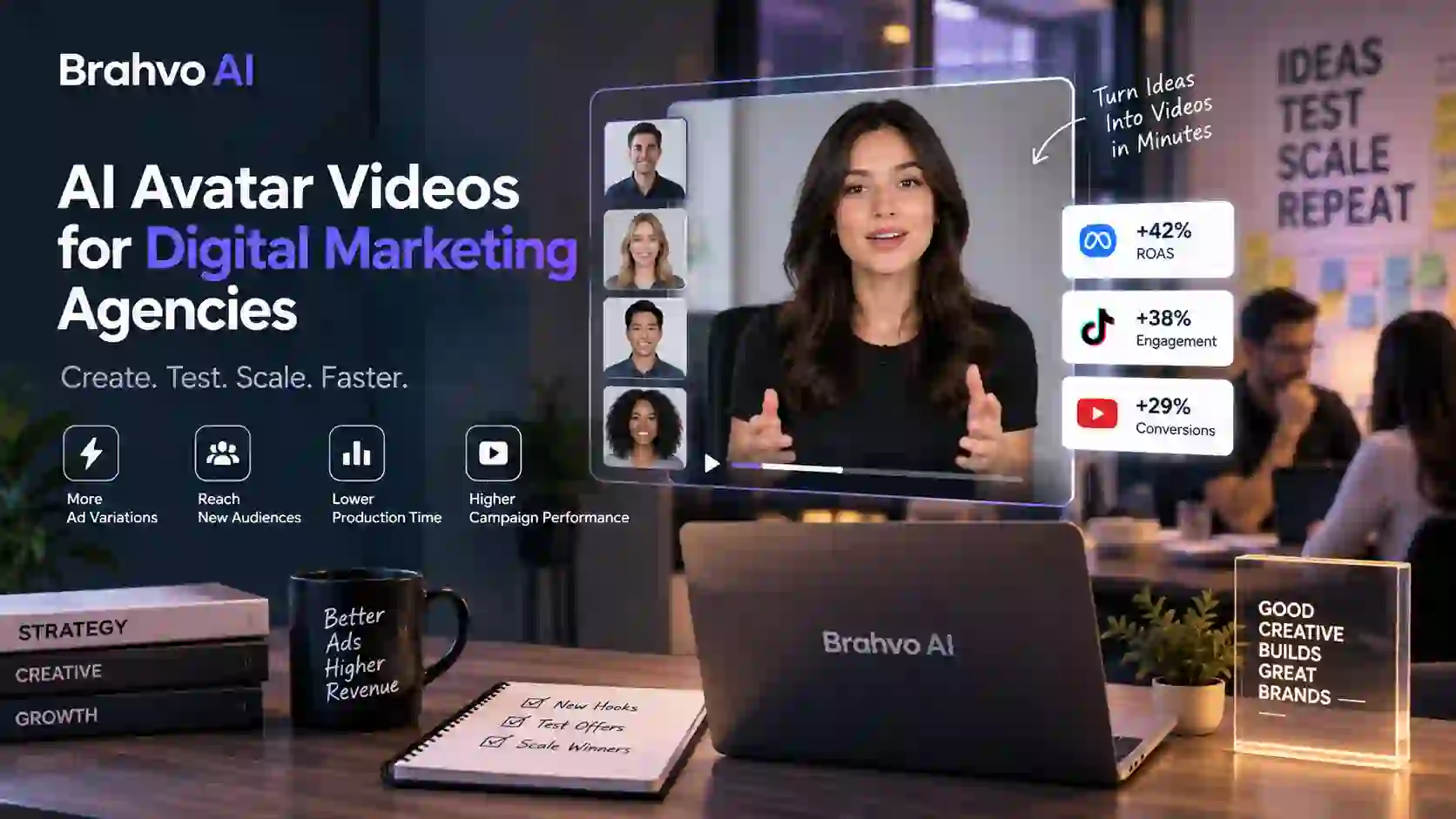
A paid media team can have the targeting right, the offer right, and the landing page working, yet the campaign still stalls because the creative has gone stale.
This happens constantly with ecommerce accounts. A few ads perform well, the team scales them, frequency starts climbing, engagement drops, and suddenly the same creative that was producing efficient purchases two weeks ago is costing considerably more. The immediate reaction is usually to ask for more creative.
That sounds simple until an agency is managing 10, 20, or 50 client accounts.
Every new creative can involve a brief, script, spokesperson, filming session, revisions, editing, captions, approvals, exports, and platform-specific versions. For an agency, the production workload can become a bottleneck long before the media buying team runs out of ideas.
This is where an AI avatar generator for digital marketing agencies can become useful.
Instead of treating video production as a separate project every time a new creative angle is needed, agencies can use AI avatars to produce presenter-led videos from prepared scripts. The same basic concept can then be adapted into different hooks, offers, product messages, lengths, and audience angles.
That does not mean every ad should use an AI avatar. It should not.
Some products need real demonstrations. Some brands depend heavily on founder personality. Some campaigns perform because the content feels raw and spontaneous.
But for agencies that need a larger volume of usable video variations, AI avatars introduce another production option.
At a basic level, an AI avatar generator turns written creative direction into presenter-led video content.
The agency can start with a script rather than a traditional filming session. The script might explain a product, introduce an offer, address a customer objection, demonstrate a problem, or present a testimonial-style message.
The avatar delivers that script using a selected digital presenter and voice.
For an agency, the interesting part is not simply generating one video.
The real value comes from being able to create variations without rebuilding the entire production process.
For example, suppose a DTC skincare client has one product and four different customer concerns:
The agency might create four separate scripts using the same core product information. Each version can then have a different opening and customer problem.
The production team does not necessarily need four separate shoots.
That changes the economics of creative testing.
An AI avatar generator for digital marketing agencies can also be used for different stages of the customer journey. A short video can introduce a product to cold audiences. Another can explain a product feature to people who have already visited the site. A third can address an objection before purchase.
The important distinction is between content production and creative strategy.
AI can help produce the content.
It does not automatically know which customer problem deserves attention, which offer makes sense, or why a particular ad should exist.
That thinking still belongs with the marketing team.
For performance marketing agencies, creative is closely tied to media buying.
A media buyer may see that one ad angle is outperforming another. The next question is often, "Can we make five more versions of this without making five completely different videos?"
This is where AI avatars can fit naturally into the workflow.
Imagine a Meta Ads campaign for a subscription-based food brand.
The original creative says:
"Still spending too much on takeout every week?"
It performs reasonably well.
Rather than immediately producing an unrelated concept, the agency could build variations around the same underlying customer insight.
One version could focus on weekly savings.
Another could focus on convenience.
Another could address meal planning.
Another could speak directly to busy parents.
The product remains the same. The strategic angle changes.
This matters because creative testing is not simply about producing more videos. It is about isolating variables.
If the hook changes but the offer, product, and landing page remain consistent, the team gets a clearer indication of whether the opening message is influencing performance.
AI avatars can make this type of controlled variation easier to produce.
The same applies to TikTok Ads. Agencies often need content that feels native to the platform rather than polished like a traditional commercial. An avatar video can be written with a conversational script and edited into a shorter format.
YouTube creates another opportunity, particularly for explanatory or problem-solving creative. A presenter can explain how a product works, answer a common question, or introduce a specific use case.
But there is a catch.
An AI avatar video can look too polished for a campaign that depends on authenticity.
That is not a small issue. If the audience expects genuine customer footage and receives something that obviously feels synthetic, the creative may lose the very quality that made the category work.
So the question is not simply whether an agency can use AI avatars.
It is where they make sense within the creative mix.
One of the biggest operational problems for agencies is not coming up with ideas. It is turning those ideas into finished assets quickly enough.
A client might request 15 new creatives before the next campaign review.
The agency has to coordinate copy, design, video production, account management, client approvals, and media buying. If every creative requires a separate production process, the agency can quickly end up spending more time managing production than analyzing campaign performance.
This is where an AI avatar generator for digital marketing agencies can change the workflow.
A team could develop a creative matrix before production.
For example:
Variable
Possible variations
Hook
Problem, curiosity, price, outcome
Audience
New customer, repeat buyer, specific segment
Message
Feature, benefit, objection
Offer
Discount, bundle, subscription
Format
Short video, explainer, testimonial style
Instead of randomly producing 20 videos, the agency can decide what it actually wants to learn from those 20 assets.
That is a much more useful way to think about creative volume.
Suppose an ecommerce client sells a $75 home fitness product. The agency has noticed that ads focused on "saving time" are producing stronger engagement than ads focused on "saving money."
The next batch does not need 10 completely unrelated videos.
The team could create several variations around the time-saving concept, changing the opening line, presenter, pacing, customer situation, and call to action.
That gives the media team more material to test while keeping the creative hypothesis relatively clear.
There is also a practical agency benefit here.
Client approvals can become easier when the production process is repeatable. The account manager can present several variations together rather than returning to the client every few days with a completely new production request.
Of course, this only works when the internal workflow is disciplined.
Generating 30 versions of a weak concept does not turn it into a strong campaign.
More assets can actually create more noise.
Each advertising environment creates different demands, so agencies should not treat one AI avatar video as a universal asset.
Meta Ads
Meta campaigns often need a steady flow of creative variations because performance can change as audiences see the same assets repeatedly.
An agency might use AI avatar videos to test:
A 30-second product explanation could become several versions, each built around a different reason for buying.
The key is to keep the first few seconds meaningful. If the opening does not give the viewer a reason to continue watching, a technically polished avatar will not rescue the ad.
TikTok Ads
TikTok generally places more pressure on creative style and viewer attention.
An AI avatar can work when the script feels conversational rather than like a television commercial. Short sentences, direct language, strong openings, and clear context matter.
For example, instead of starting with a formal product description, an agency could frame the creative around a specific frustration:
"I kept buying products that promised this, but none of them actually solved the problem."
That immediately establishes a situation.
The agency can then test different versions of the same concept.
One might focus on the problem.
Another might introduce the product earlier.
Another might explain why previous solutions failed.
The avatar becomes the delivery mechanism, while the creative hypothesis remains the thing being tested.
YouTube Ads
YouTube can support longer explanations, depending on the campaign format and audience.
This makes AI avatar videos particularly relevant for products that require some education before purchase.
Consider a software subscription, supplement brand, or specialized consumer product. A short presenter-led video can explain what the product does before asking the viewer to click.
The agency can then create different versions for different stages of awareness.
Someone unfamiliar with the product may need a problem-focused explanation.
Someone already familiar with the product may respond better to a feature comparison or offer.
That distinction becomes important when agencies start scaling creative production.
I might be wrong here, but I do not think the biggest opportunity with AI avatars is simply replacing traditional video shoots. For many agencies, the more useful role is giving creative teams another way to produce and test ideas without making every variation dependent on a new filming session.
That is a much narrower claim, but probably a more useful one.
And there is still the human side of the work.
An agency needs someone who understands why an ad should exist in the first place. The avatar can speak the words. It cannot decide whether those words reflect what customers actually care about.
The easiest mistake in creative testing is changing too many things at once.
An agency launches five videos. Each has a different hook, different script, different offer, different presenter, and different visual treatment. One performs better. The team knows it won, but not necessarily why.
AI avatar production can make testing more structured because the production barrier is lower. Agencies can keep several elements consistent while changing one meaningful variable.
Take a DTC supplement brand selling a daily wellness product. The media team might start with a basic product message and develop three hook families:
"Still forgetting to take care of your daily routine?"
"Your morning routine might be missing one simple step."
"Here is what I wish I had known before buying another wellness product."
The rest of the video can remain largely consistent.
Now the agency has something useful to compare.
The same approach works with offers. A brand could test a percentage discount against a bundle offer or free shipping message. The avatar, product explanation, and visual treatment can remain similar enough that the offer becomes the central variable.
Audience angles are slightly different.
A skincare brand might sell the same product to college students, working professionals, and parents. The underlying product does not change, but the reason for buying it can.
For one group, convenience may matter.
For another, confidence may matter.
For another, a simpler routine may be the relevant benefit.
An AI avatar generator for digital marketing agencies makes it practical to create these variations without scheduling a new production session for every audience hypothesis.
That matters when a media team is spending thousands of dollars a week and needs enough creative volume to make informed decisions.
There is another useful application that often gets overlooked. Agencies can take a winning concept and deliberately create adjacent variations instead of immediately moving to something completely different.
Suppose one Meta Ad starts outperforming the account average because the opening addresses a very specific customer frustration. The agency can preserve that insight and produce five new versions around it.
Different first sentence.
Different pacing.
Different presenter.
Different proof point.
Different call to action.
The point is not to manufacture endless versions. It is to learn which parts of the original idea are actually doing the work.
AI avatars solve a production problem, but they introduce creative tradeoffs of their own.
The first is authenticity.
Some audiences are comfortable watching an AI presenter explain a product. Others can spot synthetic delivery almost immediately. If the creative depends on personal trust, the difference can matter.
A founder-led skincare brand, for example, may get much of its appeal from the founder's actual personality and experience. Replacing that person with a digital avatar could remove part of what makes the advertising believable.
That does not mean AI avatars are unsuitable for the brand. It may simply mean they should be used for certain messages rather than every message.
The second issue is repetition.
If an agency creates dozens of ads using the same avatar, voice style, pacing, and visual format, the content can start feeling interchangeable. Production becomes easier while creative variety quietly decreases.
That is an odd problem to have, but it happens.
The third tradeoff is quality control.
A generated video still needs review. The script needs to sound natural. Pronunciation needs to be checked. Timing needs to make sense. Product claims need to match the approved messaging. Visual elements need to support the spoken message rather than distract from it.
This becomes especially important for agencies working across multiple clients and product categories.
Then there is brand fit.
A serious financial product may require a different presentation style from a playful consumer subscription brand. A premium beauty brand may have very specific visual expectations. A children's product may require particularly careful review of how the creative is presented.
So an agency should not ask, "Can we make this with an AI avatar?"
A better question is, "Does an AI avatar make sense for this particular message?"
There is also a less obvious media buying consideration.
Creative production and creative performance are not the same thing.
An agency might reduce production time by 70 percent and still see no meaningful improvement in campaign performance if the underlying concepts are weak. The faster production process only becomes valuable when it helps the team test better ideas or respond faster to what the account is telling them.
That distinction should stay clear.
For Brahvo AI, the useful starting point is not simply producing an avatar video.
The more important question is what the marketing team needs the video to accomplish.
A paid media team may need several short creatives for Meta Ads. An ecommerce client may need product education for YouTube. A DTC brand might need multiple versions of a customer problem for TikTok.
Those are different creative requirements even if all three use an AI avatar.
Brahvo AI can approach the production process around those campaign needs, starting with the message, audience, format, and intended use of the video.
For an agency managing several ecommerce accounts, that distinction can make the production process more practical.
A media buyer may identify an audience angle that needs testing. The creative team can turn that angle into a script. The production team can then create avatar-led variations around the same concept.
This keeps the relationship between media buying and production closer.
It also gives agencies more room to work with creative iterations.
For example, imagine an ecommerce client selling a premium haircare product. The first campaign focuses heavily on product ingredients. After reviewing performance, the agency wants to test whether the customer problem itself creates a stronger opening.
Instead of producing an entirely new campaign, the team could create avatar videos built around several problem-led hooks.
"Why does your hair still feel dry after using expensive products?"
"Your shampoo may not be the only reason your hair feels dry."
"I stopped adding more products to my routine and changed this instead."
These are creative hypotheses, not guaranteed winners.
That distinction matters to Brahvo AI's role in the process. The production system can help agencies create the assets, but the agency still owns the strategic decision about what deserves testing.
The same thinking applies when scaling.
A client might start with five videos. If the campaign produces useful signals, the agency can expand into additional variations rather than generating a large library before learning anything.
That makes the creative workflow more connected to actual campaign activity.
What is an AI avatar generator for digital marketing agencies?
It is a technology used to create presenter-led videos using digital avatars and generated or selected voices. Agencies can use these videos for advertising, product education, social content, and creative testing without requiring a traditional filming session for every variation.
Can AI avatars be used for Meta Ads?
Yes. Agencies can create short avatar-led videos for Meta campaigns and test different hooks, customer problems, offers, and calls to action. The video still needs to follow the brand's creative requirements and the advertising platform's applicable policies.
Are AI avatar videos suitable for TikTok Ads?
They can be, particularly when the script and presentation feel natural to the platform. A highly polished corporate presentation may not fit every TikTok campaign. Agencies generally need to consider the audience, product, message, and expected creative style.
Can agencies use AI avatars for YouTube advertising?
Yes. AI avatar videos can be used for explanatory advertising, product education, problem-led messaging, and other campaign formats where a presenter helps communicate the offer.
Can one avatar video be used across multiple platforms?
It can, but simply exporting the same video everywhere is not always the best approach. Meta, TikTok, and YouTube audiences can respond differently to pacing, length, opening hooks, captions, and creative presentation.
Do AI avatars replace UGC creators?
Not necessarily. They solve a different production problem. UGC can provide genuine customer personality and lived experience, while AI avatars can make certain types of scripted content easier to produce and vary.
How many AI avatar videos should an agency create?
There is no useful universal number. It depends on the account's creative needs, testing budget, campaign volume, and how quickly the team can learn from each batch. Producing 30 videos without a clear testing reason can be less useful than producing five well-defined variations.
Can AI avatars be used for ecommerce product ads?
Yes. They can introduce products, explain features, address objections, discuss use cases, and present promotional messages. Product demonstrations may still require additional visual content when showing the physical product is important.
What makes an AI avatar ad effective?
The avatar itself is only one part of the creative. The hook, customer insight, offer, script, pacing, product presentation, and call to action all matter. A convincing avatar cannot compensate for a message that does not connect with the intended audience.
Should every ad in a campaign use an AI avatar?
No. A healthy creative mix can include different formats depending on the brand and campaign. AI avatars are one production option, not a requirement for every piece of advertising content.