when a company should hire a media production agency to scale creative testing, support paid ads, and handle growing video demand.
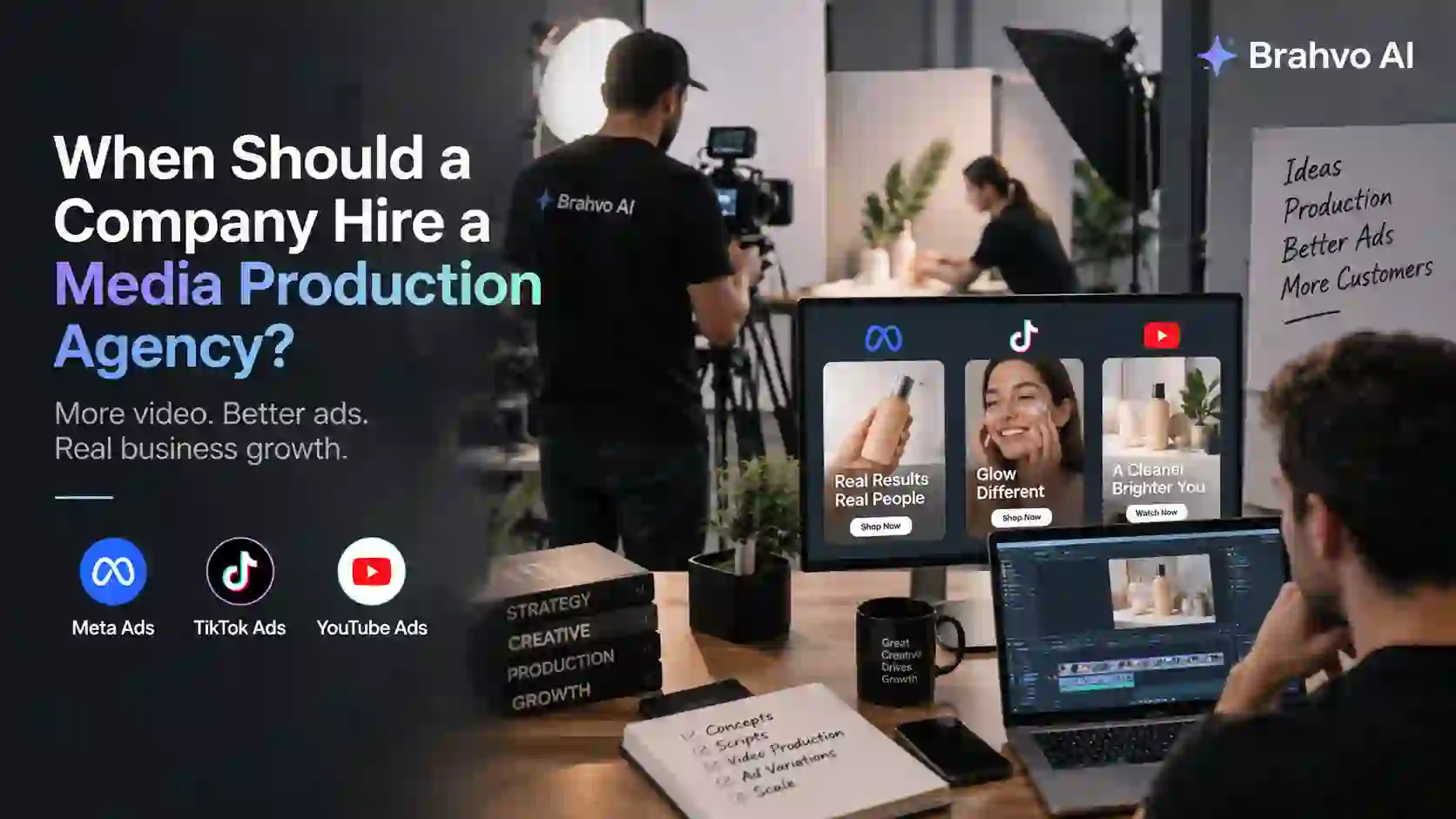
A lot of companies wait too long to ask when should a company hire a media production agency. They usually bring the question up after the internal team is already overloaded, ad performance is becoming inconsistent, and everyone is trying to produce more creative with the same resources.
That is often the wrong time to start thinking about it.
The better question is whether video production has become a business constraint.
An in house team can work extremely well when the volume is manageable. A brand launching one major campaign every few months may not need an external production partner. The internal team knows the product, brand voice, customer objections, and approval process. For certain types of work, that familiarity is valuable.
The situation changes when content becomes part of the weekly paid media operation.
A DTC brand running Meta Ads, TikTok Ads, and YouTube campaigns may need multiple hooks, formats, product demonstrations, testimonials, creator style edits, short cuts, aspect ratios, and new concepts at the same time. Suddenly, video is not one marketing project. It is an ongoing production system.
That is where knowing when should a company hire a media production agency becomes more important.
Consider a US ecommerce brand with a small internal marketing team. The media buyer finds a winning product angle, but the creative team needs three more variations before the campaign can be properly tested. Then the team wants a stronger opening hook. Then another version for a different audience. Then a new edit for TikTok. Then a fresh version because performance has started slipping.
Nothing is technically broken.
But the team is too slow.
That distinction matters.
Hiring a media production agency can make sense when the cost of production delays is starting to outweigh the cost of outsourcing. The calculation is not simply about production fees. It also includes wasted ad spend, delayed launches, missed testing windows, and the time senior employees spend coordinating shoots and revisions.
There is another important signal. If your marketing team spends more time discussing how to produce the next creative than deciding what creative should be tested next, production has probably become a bottleneck.
For companies in this position, when should a company hire a media production agency is less about company size and more about creative demand.
A company doing $500,000 a year may need outside production support if it runs aggressive paid social testing. A much larger company may still keep most production internal if its creative calendar is stable and predictable.
So revenue alone is a poor hiring trigger.
Creative complexity, testing frequency, internal capacity, and paid media velocity usually tell you much more.
Most production problems do not arrive as obvious failures.
There is usually a slow build.
The first sign might be that one video is taking two weeks to move from concept to final approval. Then revisions start piling up. A media buyer asks for a new variation and gets told it will be ready next month. The creative team keeps prioritising brand work because it feels more important than another paid social variation.
Meanwhile, the media buyer is sitting on campaign ideas that cannot be tested.
That is where the question when should a company hire a media production agency starts becoming practical rather than theoretical.
One of the clearest warning signs is a shrinking creative testing cadence.
If your team used to test five or six new concepts each month and is now testing one or two, ask why. It may have nothing to do with performance strategy. The production process itself may be limiting the number of ideas entering the account.
Another issue is excessive dependence on a small number of assets.
A brand might have a handful of strong product videos that perform well. The team keeps cutting new versions from those same assets. At first, this feels efficient. Eventually, the edits become cosmetic. The opening changes slightly. The captions change. The music changes. The underlying idea remains the same.
That is not always enough to create meaningful creative variation.
There is also the approval problem.
For some ecommerce companies, production is not slow because filming takes too long. It is slow because too many people are involved. The founder wants one version. The creative director wants another. The media buyer wants a stronger hook. Legal needs a claim checked. A client wants the final video reformatted for another channel.
By the time everyone agrees, the original campaign idea may no longer be relevant.
This is especially common with agencies managing paid media for several clients. The media buying team may know exactly what needs to be produced, but the client has no reliable production system. Every new asset becomes a separate project.
That creates a strange situation where media strategy moves faster than content production.
I might be wrong here, but many companies initially assume that hiring more creative people will solve the problem. Sometimes it does. But if the real issue is workflow, adding another person can simply create another handoff.
The better question is where the bottleneck actually sits.
If the problem is ideation, you have one issue.
If it is filming, that is another.
If it is editing, versioning, approvals, or channel adaptation, that is something else entirely.
A useful production partner should be able to fit into the specific bottleneck instead of adding another generic production layer.
Creative fatigue is often discussed as if it were a purely creative problem.
It is not.
For a paid media team, creative fatigue can change the economics of an entire account.
A Meta campaign may begin with strong performance. The audience responds to the offer, the hook works, and acquisition costs sit within an acceptable range. Then the same ads continue running. Response starts weakening. Frequency rises. Click through rates soften. The media buyer now needs new creative.
This is where the relationship between media production and paid advertising becomes obvious.
The question when should a company hire a media production agency becomes much easier to answer when creative fatigue is happening faster than your team can respond.
A brand does not necessarily need dozens of completely different videos. What it needs is enough meaningful variation to keep learning.
That can mean changing the opening problem, customer context, visual structure, product demonstration, creator style, voiceover, pacing, offer presentation, or proof point.
The important word is meaningful.
Changing the caption colour is not a new creative concept.
Replacing one line of voiceover may not be enough either.
Suppose a supplement brand has one strong ad built around convenience. The team could create another version focused on taste, another on routine, another on a common customer objection, and another around a direct product demonstration. The product is the same. The selling angle is not.
That creates a healthier testing environment.
This matters even more when acquisition costs are rising. If paid media costs go up while creative output stays flat, brands often react by changing targeting, budgets, or bidding strategies before asking whether they simply need better creative coverage.
Sometimes the media buying strategy is not the main problem.
That does not mean new creative will automatically fix performance. There are cases where the offer is weak, the landing page is poor, the audience is too narrow, or conversion tracking is creating misleading signals.
Production is not a universal solution.
But when the account has a clear creative bottleneck, production capacity becomes part of the media economics.
A company that can produce and test new concepts quickly has more opportunities to respond to performance changes than a company that needs three weeks to produce each new asset.
This is why when should a company hire a media production agency is closely connected to customer acquisition planning. The decision should not sit only with the brand team. Paid media and production need to understand each other's timelines.
There is a point where the volume of creative becomes difficult to manage manually.
You launch three products.
Each product needs several creative angles.
Each angle needs versions for Meta, TikTok, and YouTube.
Then you need square, vertical, and landscape adaptations.
Then you want UGC style edits, product focused edits, founder led versions, testimonial concepts, and offer driven variations.
The math gets uncomfortable very quickly.
This is one of the clearest situations for asking when should a company hire a media production agency.
Imagine a US ecommerce brand preparing for a major holiday sales period. The team has four weeks to prepare creative for six core products. The media buyer wants at least five concepts per product. The social team needs organic versions too. Existing ads also need refreshes because several have been running for too long.
That is 30 concepts before even counting revisions and channel adaptations.
The internal team may be talented enough to make all of them. The problem is time.
If the team spends the entire month producing assets for one campaign, it loses the ability to respond to what is happening inside the ad account.
This is where volume and speed become more important than having a huge production budget.
A media production agency can also help when the brand works with a large number of UGC creators. Creator sourcing is only one part of the process. Once the footage arrives, someone still needs to review it, identify usable moments, build hooks, remove weak sections, add captions, test openings, and create channel specific versions.
Raw creator footage is not the finished ad.
AI video production can make some parts of this workflow faster, especially when brands need multiple edits, visual variations, voiceover changes, or high volumes of short form content. But there is still a judgment layer that technology does not remove.
Someone has to decide why one opening should be tested against another.
Someone has to notice that a product benefit is being explained too late.
Someone has to understand that a technically polished video may still be a weak paid ad.
That human judgment becomes more important as volume increases.
When a company asks when should a company hire a media production agency, one useful test is simple.
Look at your creative backlog.
If ideas are sitting there for weeks because the team cannot physically turn them into testable assets, the business probably has a production capacity problem rather than an idea problem.
This is where things get a little more complicated.
Many companies want to increase ad spend first and solve creative production later. That can work when the existing creative system can support the increased volume.
But scaling spend often increases the demand for creative at exactly the same time.
Imagine a DTC brand taking monthly ad spend from $100,000 to $250,000. The media team expects to add campaigns and audiences, but the number of creative concepts has not increased.
The business is effectively asking paid media to do more with the same creative inventory.
That can create pressure quickly.
A better way to think about when should a company hire a media production agency is to connect production capacity to the planned media budget.
You do not necessarily need an agency before every increase in spend. But if your scale plan depends on testing substantially more creative, production should be part of the plan from the beginning.
There is also a budget allocation question.
Suppose a company has $50,000 available for the next growth push. It could put most of it into additional media spend. Or it could reserve a portion for production and creative testing.
There is no universal answer.
If the current ads are still generating strong returns and the account has plenty of unused creative capacity, spending more on production may not be urgent.
But if the media buyer is already reporting fatigue, limited testing capacity, and a lack of fresh concepts, putting all the money into media can create a bottleneck.
The company spends more money to send traffic toward creative that the team already knows is wearing out.
That is not always the best use of the next dollar.
A practical scenario makes this clearer.
A US apparel brand was increasing Meta spend ahead of a major product launch. The founder initially wanted to put nearly the entire incremental budget into media. The creative team pushed back because they had only enough new assets for roughly two weeks of testing.
The launch plan changed.
Part of the budget went into producing new creative concepts and variations before the media increase.
That did not guarantee better performance. No production decision can guarantee that. What it did was remove a known constraint before the larger budget went live.
That distinction matters.
A company should not hire a media production agency simply because it plans to spend more on ads. It should consider one when increased media spend creates a need for more creative concepts, faster refresh cycles, broader testing, or more production capacity than the internal team can reasonably handle.
And there is one more issue that gets overlooked.
Operational timing.
If it takes your team 15 business days to produce a new ad, while your media team is making creative decisions every few days, the two systems are moving at completely different speeds.
At that point, the question is no longer only when should a company hire a media production agency.
It becomes whether the current production model can support the way the business wants to buy media.
The easiest way to misunderstand a media production agency is to think of it as a team that simply makes videos.
For ecommerce advertising, the real job is usually more complicated.
A paid media team might identify five creative ideas worth testing. The production team then has to turn those ideas into usable assets, create different openings, adapt them for different placements, and produce enough variation to learn which message actually works.
That relationship is particularly important across Meta Ads, TikTok Ads, and YouTube.
The platforms are not identical, so the same video should not always be copied and pasted everywhere.
TikTok, for example, puts a strong emphasis on content that feels native to the platform. TikTok's own creative guidance recommends vertical video, creator or human presence, clear hooks, platform appropriate storytelling, and regular creative refreshes.
Meta can require a different editing approach depending on the placement, audience, campaign objective, and creative concept. A product demonstration that works well in one context may need a much faster opening when used as a paid social asset.
YouTube brings another set of considerations. Google recommends creative principles built around attention, branding, connection, and direction. Its current creative guidance also evaluates elements such as video orientation, voiceover, branding, and duration.
So a useful production process starts before anyone opens an editing timeline.
The creative concept needs to be connected to the media objective.
For example, a skincare company might have one core product but several customer problems. Dry skin. A complicated routine. Sensitivity. Lack of time.
The production team can turn those into separate creative concepts rather than producing four visually different versions of the same advertisement.
That distinction becomes valuable when the media buyer wants to understand why one message is producing stronger results.
A good production workflow can also make one shoot more useful.
A founder interview might produce a long form YouTube asset, several short paid social clips, a few direct response hooks, product explanation segments, and snippets for retargeting.
The footage itself becomes more valuable because it is planned for multiple downstream uses.
The opposite approach is familiar.
A brand spends heavily on one polished commercial. Everyone likes the final video. Then the media buyer asks for a different opening, another angle, shorter cuts, and versions for TikTok. Suddenly the original production was never really designed for testing.
That is an expensive problem.
The production partner should understand that advertising creative is not finished when the video looks good. It is finished when the asset can actually be used inside the campaign workflow.
AI video production makes the most sense when it solves a production problem.
That sounds obvious, but it gets lost because the conversation around AI often focuses on what the technology can generate rather than what the marketing team actually needs.
For an ecommerce brand, the most useful application may simply be producing more creative variations without turning every test into a full traditional production project.
A single product can be presented through several stories.
One version may lead with a customer objection.
Another may open with the product in use.
Another may explain a specific feature.
Another may focus on a promotion.
AI based workflows can support parts of that process through scripting, scene generation, voiceover, editing, visual variations, product scenes, and multiple versions of the same concept.
That is also where Brahvo AI operates within the broader media production process. Its ecommerce production work focuses on creating advertising video variations for platforms such as Meta Ads, TikTok, and YouTube, rather than treating every video as an isolated project.
But AI does not remove the need for creative judgment.
This is worth saying clearly.
A system can produce ten versions of a weak idea very quickly.
That does not make those ten videos useful.
The important part is deciding what deserves to be tested in the first place.
For example, suppose a home fitness brand has strong product photography but weak performance from its current ads. Generating more polished product visuals may not solve the underlying problem. The brand might actually need a stronger customer story, better proof, a clearer demonstration, or a different hook.
AI can help produce the assets.
It cannot automatically decide which commercial problem the asset should solve.
This is why modern production workflows are increasingly mixed. Some parts are traditional. Some involve creators. Some use AI. Some still require manual editing and review.
That is not a weakness.
It is usually more practical.
The right production method depends on the creative requirement. A founder led campaign may need real footage. A product explainer might benefit from animation. A rapid testing campaign may benefit from AI generated scenes and multiple edits.
Google's current advertising guidance also reflects this direction. Its creative tools use AI to assess video assets against creative attributes and suggest specific improvements.
The mistake is treating AI as the strategy.
AI is part of the production workflow.
The strategy still comes from understanding the customer, the offer, the product, the media objective, and the reason one creative idea deserves to be tested against another.
Price is usually the first thing companies compare.
It should not be the only thing.
A lower production fee can become expensive when every revision takes days, communication happens through too many people, or the agency delivers attractive videos that do not fit the actual media buying workflow.
Before signing a contract, companies should understand how the production process works from idea to final asset.
Ask what happens after the first creative brief.
Who develops the concept?
Who writes the script?
Who handles revisions?
How are new variants requested?
How quickly can an existing video be reformatted?
How are multiple products handled?
What happens when the media buyer says an opening hook is not working?
These questions tell you more than a portfolio alone.
Another important issue is creative volume.
A company producing three videos a quarter has different requirements from an ecommerce brand that needs new advertising creative every week.
The agency should understand the difference.
Platform knowledge matters too. TikTok's own guidance specifically points advertisers toward platform native creative, vertical formats, creator involvement, clear structure, and ongoing testing.
Google has its own creative considerations for YouTube, including attention, branding, connection, direction, and multiple video orientations.
You do not necessarily need a production agency that claims to do everything.
You need one that understands the specific production pressure your marketing team is dealing with.
There is also an important contract question that gets ignored.
What exactly counts as a deliverable?
One finished video?
Five variations?
Different hooks?
Different aspect ratios?
Different calls to action?
Raw footage?
Editable project files?
Future revisions?
A vague definition can create friction later.
The same applies to turnaround times. If your paid media team operates on weekly creative testing cycles, a production process designed around monthly delivery may not fit.
And ask how the agency thinks about performance.
A production partner does not need to run your ad account. But it should understand why a media buyer might ask for three versions of an opening instead of three completely new videos.
That understanding can save a lot of time.
Brahvo AI approaches media production around the practical reality that ecommerce brands often need a continuous stream of advertising creative rather than occasional one off videos.
That difference changes the workflow.
The starting point is not simply asking, "What video should we make?"
The more useful question is, "What does the media team need to test next?"
From there, a product or campaign idea can be turned into multiple creative directions. One may focus on the product problem. Another may demonstrate the product. Another may use a creator style approach. Another may test a different customer objection or offer.
Brahvo AI's production model is built around this type of ongoing creative demand, with a focus on high volume video production and variations for paid advertising environments.
That matters for brands managing multiple products.
A company with 20 SKUs does not have the same production needs as a business with two hero products.
There may be seasonal launches, promotional pushes, new offers, retargeting assets, prospecting creative, and product specific campaigns running at the same time.
Production can become difficult simply because everything is happening simultaneously.
Brahvo AI's approach is centered on turning production into a repeatable creative workflow. That can include developing concepts, creating scripts, generating visuals, editing different versions, adjusting hooks, and preparing assets for different channels.
The AI component matters because it can reduce the time required to create variations.
But the more important part is the relationship between production and testing.
Suppose a paid media team discovers that a product demonstration is outperforming a lifestyle concept. The next step should not necessarily be to start an entirely new commercial.
It may be better to produce several variations around the demonstration.
Change the opening.
Change the customer context.
Change the voiceover.
Change the proof point.
Shorten the setup.
Show the product earlier.
That creates a more useful testing environment while keeping the underlying learning intact.
This is where high volume production becomes valuable.
The goal is not to flood an ad account with random videos. It is to create enough controlled variation to learn what deserves more budget and what should be replaced.
And sometimes the simplest creative ends up being the most useful one. A polished production is not automatically a stronger performance asset.
That has probably always been true. AI simply makes it easier to test the idea at scale.
How do I know when should a company hire a media production agency?
Look at your production bottleneck first. If your paid media team has more creative ideas than your internal team can realistically produce, or if new ads are taking too long to reach the account, outside production may make sense.
Should a small ecommerce company hire a media production agency?
Not necessarily. A small company with limited creative demand may be better served by keeping production simple. Company size alone does not determine the decision.
Should companies hire a media production agency before increasing Meta Ads spend?
Sometimes. If additional ad spend requires significantly more creative testing and your team cannot produce it, production capacity should be addressed before the budget increase. If existing creative capacity is strong, it may not need to happen first.
Can an AI video production agency replace an internal creative team?
Usually, that is the wrong way to frame the decision. AI can handle or accelerate parts of production, but internal teams still provide product knowledge, customer insight, brand judgment, and campaign context.
How does a media production agency help with creative fatigue?
It can give the media team a more reliable flow of new concepts and variations. The useful part is not simply making more videos. It is creating different creative ideas that can be tested as performance changes.
Does every Meta Ad need a completely new video?
No. Different hooks, openings, scripts, demonstrations, offers, edits, and customer angles can create meaningful variation without rebuilding everything from scratch.
What should an ecommerce brand ask a media production agency before signing?
Ask about creative volume, turnaround times, revision processes, platform experience, deliverables, ownership of assets, and how the agency handles requests coming directly from the media buying team.
Is AI video production suitable for UGC style advertising?
It can support UGC style creative, but authenticity still matters. A brand should consider where real creator footage is more appropriate and where AI based production can efficiently create additional variations.
How much creative should a company produce each month?
There is no useful universal number. It depends on ad spend, product count, campaign structure, audience size, testing cadence, and how quickly current creative loses effectiveness.
What if our ads are performing well with our current creative?
Do not create production work just to create production work. If performance is healthy and your testing capacity is sufficient, the need may be lower. The question becomes whether your current production system can respond when those conditions change.