AI commercial production company for faster ecommerce ads, creative testing, Meta Ads, TikTok Ads, and scalable video production.
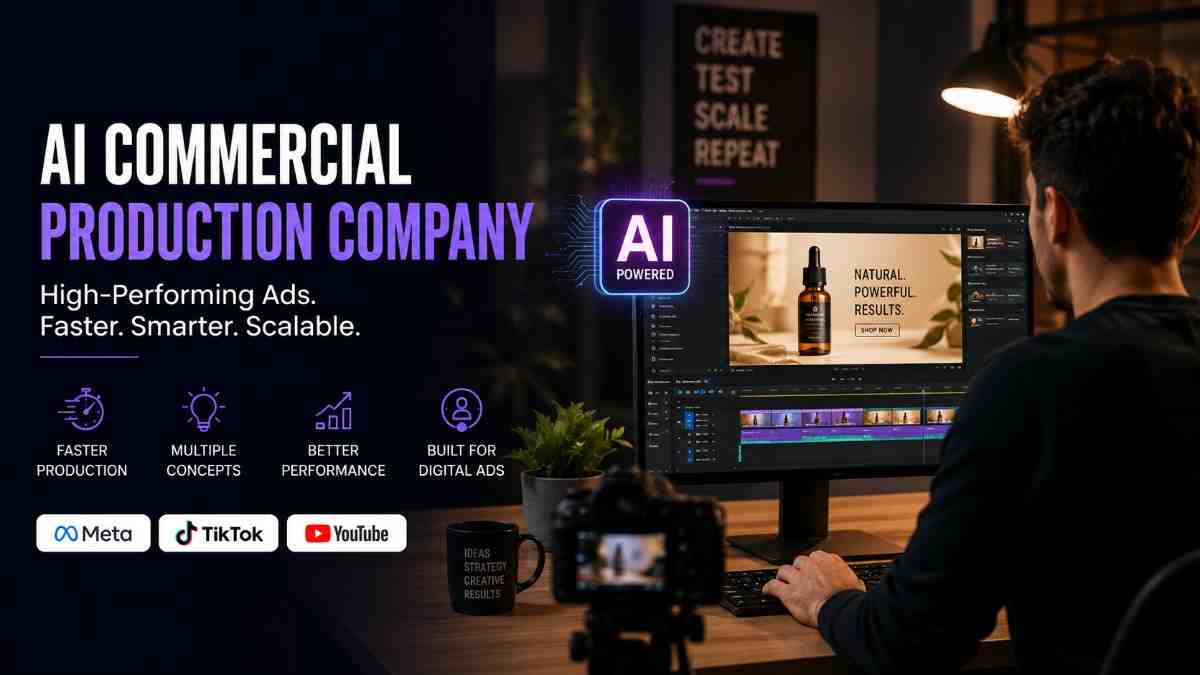
A lot of ecommerce teams hear "AI commercial production company" and immediately think of automated videos made from a product photo, a synthetic voice, and a few stock clips. That is not really the part that matters.
For a US ecommerce brand spending serious money on paid media, commercial production is about turning a product, offer, or marketing idea into an ad that can actually compete for attention. AI changes how that work gets done, but the creative thinking still matters.
An AI commercial production company uses AI based production workflows to create advertising videos faster and in greater volume. That can include concept development, scripting, visual generation, product scenes, animation, voiceovers, editing, variations, and different versions of the same commercial for different audiences or placements.
The useful distinction is between making a video and producing commercial creative.
A video might look polished and still perform poorly. A commercial has a job to do. It needs to communicate a product benefit, create enough interest to stop the scroll, make the offer understandable, and give the viewer a reason to take the next step.
For example, consider a DTC skincare brand launching a new serum. A traditional production process might involve a creative brief, script approval, location planning, casting, filming, product shots, editing, revisions, and multiple rounds of feedback. That can work very well when the campaign needs a major hero commercial.
But paid social often needs something different. The brand may need a 30 second product story, a 15 second benefit focused version, several opening hooks, a testimonial style concept, a problem solution ad, and shorter cuts for different placements.
An AI commercial production company can help build these variations from the same underlying campaign idea without treating every version as a completely new production.
That is where the commercial value starts to become more obvious.
AI can also help with parts of production that traditionally consume a surprising amount of time. Background environments can be generated. Product scenes can be created without organizing a full shoot. Voiceovers can be produced in different styles. Scenes can be revised without reshooting everything. Different aspect ratios and durations can be prepared for specific advertising placements.
Still, there is a line worth keeping clear.
AI does not automatically know why a customer should care about the product. It does not automatically understand which benefit matters most to a specific audience. It does not replace the judgment required to decide whether an ad idea is worth testing.
The best use of an AI commercial production company is usually not "make everything with AI." It is using AI where it removes unnecessary production friction while keeping creative decisions tied to the advertising objective.
The pressure is coming from paid media.
A brand can have a campaign that performs well on Meta Ads in January and then find that the same creative is struggling several weeks later. The audience has seen it too many times. The hook has lost its impact. Competitors are showing more interesting creative. The media buyer starts asking for fresh concepts.
Then the creative team gets the request.
"Can we get ten new ads by next week?"
That sounds simple until you look at what goes into ten genuine commercial concepts.
If every ad requires a full production cycle, creative testing becomes expensive and slow. That creates a strange situation where media buyers may know exactly what needs testing but cannot get the creative fast enough to test it.
This is one reason an AI commercial production company has become relevant to US ecommerce teams.
The goal is not simply to reduce production time. It is to make the creative testing process less dependent on large production cycles.
Imagine a DTC apparel company has identified that its current winning ad works because it shows the product solving a specific everyday problem. The company could continue spending against that same ad until performance falls apart. Or it could develop several new interpretations of the same underlying insight.
One version might lead with the problem.
Another could lead with the product demonstration.
A third could focus on customer reaction.
A fourth could introduce the offer earlier.
A fifth could use a completely different visual environment while keeping the same product benefit.
That gives the paid media team more things to learn from.
There is another practical reason US brands are looking at AI commercial production. Product portfolios are getting more complicated.
A brand might have 20 SKUs, seasonal bundles, multiple price points, and different offers running at the same time. It may also be advertising to several customer segments.
A single campaign can quickly turn into dozens of creative requirements.
Traditional production is not automatically wrong for this situation. In fact, some products benefit enormously from real photography, physical demonstrations, recognizable locations, and human performances.
But using a traditional shoot for every creative variation can become difficult to justify when the purpose of the asset is primarily testing.
I might be wrong here, but I do not think every ecommerce brand needs more video.
What many brands actually need is more useful creative experimentation.
That distinction matters. Producing 50 videos does not mean a brand has 50 good ideas. If the same message, same hook, and same visual treatment are repeated 50 times, the production volume may look impressive while the testing value remains low.
An AI commercial production company can be useful when it helps a team explore different creative directions without making every experiment expensive.
The biggest bottleneck in commercial production is not always editing.
It is often the distance between an idea and a finished asset.
A media buyer notices a pattern in campaign performance. The creative strategist turns that pattern into a concept. Someone writes the script. The client reviews it. Production begins. Footage is collected. Editors work on the cut. Revisions happen. The final version gets approved. Then the ad finally reaches the campaign.
By that point, the original insight may be weeks old.
An AI commercial production company can shorten that distance.
Suppose a health and wellness ecommerce brand notices that ads focusing on convenience are outperforming ads focused on product ingredients. Instead of simply producing another convenience focused ad, the team could create several commercial concepts around that insight.
One might show the product fitting into a busy morning routine.
Another could use a fast paced sequence around travel.
Another could focus on the frustration of using complicated alternatives.
Another could build the story around a customer who has limited time.
The point is not that AI creates these ideas by itself. The useful part is that once the creative direction is established, production can move much faster.
This becomes particularly important when testing on Meta Ads and TikTok Ads.
Paid social does not reward brands simply because an ad looks expensive. The opening seconds matter. The message matters. The visual pattern matters. The relationship between the creative and the audience matters.
That means a commercial production workflow needs to support iteration.
A winning concept should not necessarily remain one video.
It can become a family of creative variations.
The first three seconds can change. The opening line can change. The product demonstration can change. The order of information can change. The voiceover can change. The ending can change.
This gives the media team more controlled variables to work with.
There is a practical example I have seen repeatedly with ecommerce teams. A brand finds that a particular customer problem generates strong click through rates, but the conversion rate is only average. Instead of abandoning the concept completely, the team can keep the successful hook while changing the product explanation and offer presentation.
That is a much more useful testing process than randomly asking for "fresh ads."
An AI commercial production company can support this kind of workflow because the production layer becomes more flexible.
It can also help when a brand launches a new product.
A new SKU may need launch creative before the company has enough customer reviews, UGC, or performance data to know which message will win. The team has to make informed guesses and test them.
Creating several initial commercial concepts gives the campaign somewhere to start.
Then the real data begins to shape the next round.
This is where AI commercial production becomes less about replacing production teams and more about changing the economics of experimentation. If a brand can test more concepts without committing the same amount of time and production cost to each one, it can learn faster.
But there is a catch.
More creative only helps when the team knows what it is testing. If five ads change the hook, script, visual style, offer, audience, and product positioning at the same time, it becomes difficult to understand why one worked better than another.
So speed cannot be the only objective.
A good AI commercial production company should make experimentation easier to manage, not simply make the asset count larger.
For a US ecommerce brand, that distinction can have a real effect on budget allocation. Instead of putting a large portion of the creative budget into a small number of expensive productions, the team may choose a mixed approach. High importance brand campaigns can receive more traditional production attention, while performance creative and early stage concepts can move through an AI assisted workflow.
That is often where the economics start to make sense.
The question is not really whether AI can produce a commercial.
It obviously can.
The more important question is whether the production process gives the media team enough useful creative options to keep learning before creative fatigue, rising acquisition costs, or a new product launch forces another scramble.
For most ecommerce brands, the relationship between commercial production and paid media has changed. The media buyer no longer needs one polished video that runs everywhere for months. They need creative that can be tested, adjusted, shortened, reformatted, and replaced as campaign performance changes.
That is where an AI commercial production company can fit into the paid media workflow.
On Meta Ads, a brand may be testing several hooks against the same product. One ad might open with a customer problem, another with a product demonstration, and another with a strong offer. The core product remains the same, but the first few seconds and the story around it are different.
TikTok Ads can create an even stronger demand for variation because creative often needs to feel native to the platform. A polished commercial can work, but a highly produced video is not automatically the best performing asset. Sometimes a simple product demonstration or fast moving narrative gets more attention.
AI commercial production gives the team more flexibility to create those variations without treating every variation as a completely separate production.
For example, a 30 second commercial could be adapted into several shorter cuts. The opening could be changed for different audience segments. The voiceover could be rewritten around a different product benefit. A visual sequence could be replaced while keeping the rest of the commercial intact.
That matters when media buyers are trying to identify what is actually causing performance changes.
A creative team can also respond faster to campaign data. If a particular product benefit is generating strong engagement, that insight can feed into the next round of commercial concepts rather than waiting for another full production cycle.
But there is a limit. AI commercial production should not become an excuse to create dozens of almost identical ads. If every version has the same opening, pacing, message, and visual structure, the brand has created more files, not necessarily more testing opportunities.
The strongest workflows treat each new commercial as a reason to test a meaningful creative hypothesis.
Creative complexity grows quickly when an ecommerce brand has more than one product.
A DTC company might have a core product, two bundles, a seasonal offer, a new launch, and an upsell. Each may need different messaging. Then there are different customer groups.
A first time buyer may need education.
A returning customer may need a new reason to purchase.
A price sensitive customer may respond to a bundle.
A high intent shopper may care more about proof and product details.
Trying to produce completely separate commercials for every combination can become expensive very quickly.
An AI commercial production company can help by building a flexible production system around reusable creative elements. The product presentation can stay consistent while the messaging changes. A commercial can be adapted around different offers without rebuilding the entire concept from scratch.
This is especially useful during product launches.
Consider a US supplement brand launching a new product. The marketing team may initially want to test several angles such as convenience, daily routine, product benefits, lifestyle, and problem awareness. Once early campaign data shows which angle gets the strongest response, more production can be focused around that direction.
The same principle works with fashion, beauty, consumer electronics, food and beverage, and other DTC categories.
AI commercial production is particularly useful when the brand needs a high number of variations but does not want every asset to look like a completely different campaign.
There is also a practical issue with offers.
An ad promoting a 20 percent discount has a different commercial job from an ad introducing a premium product with no discount. The creative should not simply swap the text on screen and call it done.
The offer changes the reason for the viewer to act.
That means the script, pacing, product presentation, and ending may all need to change.
A capable AI commercial production company can make those changes without forcing the brand into a full traditional production cycle every time the marketing team changes an offer.
Still, the brand needs a clear creative system. Without one, producing more variations can become chaotic. The media team may receive a large folder of videos without knowing which audience, message, offer, or hypothesis each asset represents.
That creates another bottleneck, just in a different place.
Speed is attractive, especially when a paid media team is waiting for new creative.
But speed by itself is not a creative strategy.
An ecommerce brand can produce an ad quickly and still end up with something that feels generic, visually inconsistent, or disconnected from the brand. That can be especially damaging for products where trust plays a major role in the buying decision.
Brand control needs to remain part of the process.
That includes product appearance, colors, typography, tone of voice, claims, visual style, messaging, and the way the product is presented. A supplement brand should not have its product represented inaccurately. A skincare company should not have AI generated visuals suggesting results that the product cannot reasonably deliver.
These details sound obvious, but production speed can sometimes make teams less careful about them.
The better approach is to use AI where it provides production flexibility while keeping human review around the areas that matter most.
For example, AI may help create a product environment or generate a visual transition. The creative team can then review whether the product looks accurate and whether the scene makes sense for the brand.
The same applies to scripts.
AI can help produce multiple script directions quickly, but a marketer still needs to decide whether the claims are credible, whether the language sounds like the brand, and whether the opening actually addresses a customer problem.
Might AI sometimes make a commercial look better than it should? Yes. That can actually create its own problem.
If an ad looks extremely polished but does not communicate anything useful in the first few seconds, production quality becomes a distraction.
For paid social, the priority should usually be clear communication first, creative quality second, and production complexity only when it adds something meaningful.
That does not mean brands should make cheap looking ads.
It means production value should serve the idea.
Brahvo AI approaches AI commercial production with the realities of ecommerce advertising in mind.
For a brand running paid campaigns, the commercial cannot exist separately from the media strategy. The production process needs to account for what the creative is supposed to communicate, where it will run, and what the marketing team wants to learn from it.
That can start with the product and the advertising objective.
A new product launch may require introductory creative. An established product with rising acquisition costs may need fresh angles. A campaign experiencing creative fatigue may need new hooks and visual treatments without completely abandoning the underlying winning message.
The production approach can then be built around those requirements.
For example, a brand may have a strong performing Meta ad built around a specific customer pain point. Rather than simply recreating the same ad, Brahvo AI can help develop different commercial interpretations of that insight.
The product demonstration might change.
The opening hook might change.
The visual setting might change.
The pacing might change.
The voiceover might take a different approach.
The goal is to give the paid media team meaningful creative options rather than minor cosmetic variations.
This is also relevant when brands are managing multiple SKUs. A creative approach that works for one product may not automatically work for another. Each product still needs a reason for the customer to care.
For ecommerce operators, the practical value of AI commercial production often comes down to flexibility. Creative can be developed around current campaign needs instead of forcing every new requirement into a traditional shoot schedule.
That can be useful for brands that need frequent creative refreshes but still want control over how their products and messaging are presented.
The media team can then use performance data to determine which creative directions deserve more attention.
That feedback loop is important.
Production creates the commercial. Paid media provides the response. The next production cycle should learn from that response.
AI commercial production is not the answer to every commercial project.
There are situations where traditional production remains the better choice.
If a brand is launching a major national campaign, working with a recognizable spokesperson, filming a physical product demonstration that depends on real-world interaction, or creating a high profile brand film, a conventional production can offer advantages that AI cannot simply reproduce.
Some products also need physical authenticity.
A furniture company may need to show how a sofa actually looks inside a real home. A food brand may need genuine food preparation footage. A beauty company may want real people demonstrating how a product is applied.
There are also campaigns where the imperfections of real footage are part of what makes the creative believable.
That is why the decision should not be framed as AI versus traditional production.
For many ecommerce companies, the more sensible approach is to use each method according to the job.
A major brand campaign may receive a traditional production budget.
Performance creative can move through an AI commercial production workflow.
UGC style concepts can be tested quickly.
Winning concepts can later receive higher production investment.
That creates a more practical relationship between creative quality and media spend.
A brand does not necessarily need to choose one production philosophy for every campaign.
The harder decision is figuring out where production investment actually changes the outcome. If a $50,000 commercial is unlikely to teach the media team more than a well produced $5,000 test, the bigger production may not be the smartest first move.
On the other hand, if the campaign depends heavily on physical realism, talent, location, or a major brand moment, cutting production simply because AI is available can create a different kind of waste.
The real question is not how quickly a commercial can be produced.
It is what the commercial needs to accomplish, and how much production is justified by that job.
Choosing an AI commercial production company should not start with a demo reel.
A polished reel can show that a company knows how to make attractive videos. It does not necessarily show whether the team understands ecommerce advertising, creative testing, paid media, or the pressure of producing new commercial concepts every week.
For a US ecommerce brand, the better questions are more practical.
Can the company understand the product and customer before producing the creative? Can it create genuinely different concepts instead of changing a few words? Can the production process support Meta Ads and TikTok Ads? Can the team handle multiple SKUs and offers? Can it work from performance feedback and produce the next round accordingly?
Those questions reveal much more than visual quality alone.
It is also worth asking how the company handles revisions. AI can make production faster, but a fast first draft is not particularly useful if every revision becomes difficult.
Look at the workflow from brief to final commercial.
A good process should give the marketing team visibility into what is being created and why. The brand should be able to explain the purpose of each creative direction rather than simply receiving a collection of finished videos.
Creative variation is another important factor.
Ask to see examples where one core idea was turned into several meaningful commercial concepts. Look for differences in hooks, messaging, pacing, product presentation, and audience positioning. Ten videos with almost identical creative logic are not necessarily better than three genuinely different concepts.
The company's understanding of paid media matters too.
If your team is running Meta Ads and TikTok Ads, the production partner should understand why a commercial might need different versions for different placements and audiences. It should also understand that an ad can look excellent and still fail because the opening message is weak.
Budget should be considered in the same context.
An AI commercial production company may reduce certain production costs, but that does not mean every project should be judged purely on the lowest price. The real question is what you receive for the production budget and how quickly the team can move from one useful creative test to the next.
Brahvo AI is positioned around this ecommerce focused production model, helping brands use AI assisted production to create commercial video content for advertising and marketing campaigns.
For a brand evaluating any production partner, the strongest signal is usually not how much the company talks about AI.
It is whether the company understands what the commercial needs to accomplish.
What is an AI commercial production company?
An AI commercial production company creates advertising videos using AI assisted production workflows. Depending on the project, this can involve concept development, scripting, generated visuals, product scenes, voiceovers, editing, animation, and commercial variations.
The important part is not simply using AI. The production should support the brand's advertising objective and give the marketing team useful creative assets.
Is AI commercial production suitable for ecommerce brands?
Yes, particularly for ecommerce brands that need frequent creative testing.
DTC companies often need multiple versions of their ads for different products, audiences, offers, and paid media placements. AI commercial production can make it easier to produce and revise those variations without treating every asset as a completely new traditional shoot.
That said, some products still benefit more from real footage and conventional production.
Can an AI commercial production company create Meta Ads?
Yes. AI commercial production can be used to create video ads intended for Meta Ads campaigns.
The production team can develop different hooks, durations, messages, visual approaches, and product presentations based on the campaign requirements. The final creative still needs to follow the relevant advertising policies and accurately represent the product.
Can the same commercial be used on TikTok Ads?
It can, but simply uploading the exact same commercial everywhere is not always the best approach.
TikTok audiences may respond differently to pacing, opening shots, storytelling, and presentation. An AI commercial production company can adapt a core concept into versions that are better suited to different placements while keeping the central message consistent.
How many commercial variations should a brand produce?
There is no useful universal number.
The right amount depends on the campaign budget, number of products, audience segments, creative fatigue, and how aggressively the brand is testing. Five genuinely different concepts can provide more useful learning than twenty minor variations.
The goal should be meaningful creative testing rather than reaching a particular asset count.
Can AI commercials look realistic enough for paid advertising?
Yes, but realism should not be the only standard.
The commercial also needs accurate product representation, clear messaging, believable scenes, and a creative treatment that makes sense for the audience. Depending on the product and campaign, real footage may still be preferable.
Does AI commercial production replace a traditional production team?
Not necessarily.
For many brands, it makes more sense to use AI assisted production alongside traditional production. Large brand campaigns, physical demonstrations, talent driven concepts, and certain product categories may still benefit from conventional shoots.
AI commercial production is more useful when a brand needs flexibility, speed, and a larger number of creative concepts.
How does AI commercial production help with creative fatigue?
Creative fatigue happens when an audience repeatedly sees the same creative and its effectiveness starts to decline.
An AI commercial production company can help a media team respond by creating new hooks, visual treatments, scripts, product presentations, and commercial concepts around existing campaign insights.
The important point is that refreshing the creative should not mean randomly changing everything. The best new concepts usually learn from what has already worked.
What should I provide to an AI commercial production company?
A useful brief should include the product, target customer, offer, campaign objective, brand guidelines, existing creative, key product benefits, customer objections, and any important performance insights.
Existing winning or losing ads can also be valuable. They show the production team what the audience has already responded to and where the next creative tests might be worth exploring.
Is an AI commercial production company worth it for a small ecommerce brand?
It can be, but the economics depend on the brand's advertising activity.
If a company is spending very little on paid media and only needs occasional video, a large creative production workflow may not make sense. If the brand is actively testing Meta Ads or TikTok Ads and regularly needs new commercial concepts, faster production can become much more valuable.
The right question is not simply whether AI production costs less.
It is whether the production process helps the brand create better testing opportunities without creating another operational headache.