Brahvo AI creates engaging AI video ads and ecommerce creatives for Meta, TikTok, and YouTube advertising campaigns.
Here's a pattern that keeps coming up. A DTC brand in Los Angeles books a nice shoot. It has a real crew, a rented studio in the Arts District, a couple of models and a director who has worked on actual commercials. They come away with gorgeous footage and maybe six finished ads. Three weeks later, two of those ads are carrying the whole Meta account, frequency is climbing past 4, CPMs are creeping up, and the media buyer is in Slack asking for "fresh hooks by Friday."
Nobody did anything wrong. The shoot was good. The problem is that the brand bought video the way brands bought it in 2017, when a hero spot could run for a quarter. Paid social doesn't work like that anymore. Meta's delivery system now leans heavily on the creative itself to find the audience, so the creative is effectively your targeting. When ads wear out faster, you need more of them, and more variety.
That's why so many LA brands are rethinking how they buy video production services in Los Angeles. They aren't giving up on quality. They're asking a different question. Instead of "how good can this one video look," they're asking "how many testable ideas can we get into market this month, and how fast can we tell which ones work."
The day rate is the number everyone fixates on. It's also the least useful one.
A typical LA shoot day for ecommerce ads adds up quickly once you count everything: crew, camera and lighting package, studio or location fees, permits if you're shooting outside, talent, usage rights, wardrobe, product styling, and then post-production. Depending on scope, a modest one-day shoot often lands in the low-to-mid five figures. A bigger production with a full commercial crew can run well past that. Treat those as rough ranges and get current quotes, because LA pricing moves around and varies a lot between production houses.
The number that matters more is cost per usable ad. A tidy $20K shoot that gives you six finished spots costs you more than $3,300 per creative before a single dollar of media spend. If four of those six flop in testing, which is normal (most ads in any honest testing program lose), each winner effectively cost you $10K.
Then there are costs that never show up on the invoice:
Most brands budgeting for video production services in Los Angeles don't put these numbers in their spreadsheet. Their CFO eventually does.
This is the section I'd make every founder read twice.
Creative testing is a volume game, and the math is not kind. If roughly one in five to one in ten new concepts beats your current control, and you want one new winner every couple of weeks, you need to be launching something like 10 to 20 fresh concepts a month. That doesn't count variations of each concept: different hooks, different lengths, 9:16 versus 4:5, voiceover versus text-on-screen, and a UGC-style cut next to a polished one.
Picture a mid-sized LA activewear brand with 40 SKUs, spending maybe $150K a month across Meta and TikTok. They launch a new legging line in three colors. Their agency wants five angles tested: comfort, squat-proof, the founder story, a price comparison, and a "fits like the expensive brand" angle. Each angle needs three hooks and two formats. That's 30 assets for one product launch. And meanwhile the core bestsellers still need refreshes, because the evergreen ads that drive 60% of revenue are getting tired.
A traditional production calendar can't keep up with that. A shoot once a quarter plus a handful of UGC creators gets you maybe 15 to 25 usable assets a month, if the creators actually deliver on time. Anyone who has managed UGC creators knows they often don't.
What usually happens next is quiet rationing. The media buyer stops testing new angles and just scales whatever is working, which is fine until it suddenly isn't. CAC drifts up 20%, then 30%. Everyone blames the algorithm, or iOS changes, or "the market." Sometimes it really is the market. A lot of the time it's just that nobody fed the account new ideas.
I'm not going to pretend AI video replaces a good crew. It doesn't, at least not for everything, and the brands that treat it as a full replacement tend to end up with ads that look like everyone else's.
The more useful way to think about it is that the two approaches solve different problems.
Situation
Full crew shoot
AI-assisted production
Brand hero spot or launch film
Usually the better call
Weaker; it can feel generic
Testing 20+ hooks on a proven product
Slow and expensive
Strong fit
Product needs tactile, close-up realism (fabric, texture, food)
Strong
Improving, but check every frame
Resizing and reformatting for TikTok, Reels, Stories
Overkill
Strong fit
Fast turnaround on a trend or seasonal angle
Hard to schedule
Strong fit
Ads where human emotion or an authentic voice carries the message
Strong
Mixed; depends heavily on execution
The hybrid model is where I've seen the most sense. You shoot real footage less often but more deliberately, capturing raw product shots, b-roll and talent moments meant to be recombined. Then you use AI-driven production to multiply that footage into dozens of testable variations.
I might be wrong about how long this middle ground lasts. Models are getting better quickly, and in 18 months the table above could look pretty different. For now, though, the product shots still need to be real. Shoppers notice when a product looks slightly off, and they notice it in the return rate.
Brahvo AI sits in the part of the workflow where most LA brands get stuck: the gap between "we have a concept that might work" and "we have 25 versions of it live and are reading the data."
A healthy testing cycle on Meta and TikTok goes roughly like this. Pick an angle, build several hooks, launch them in a testing campaign, kill the losers within a few days, iterate on the winner, and move it into scaling. The slow step is almost never the media buying. It's the time between the buyer saying "the 'squat-proof' angle is working, give me five more hooks" and those hooks actually existing.
That's the job Brahvo AI is built for. It produces those variations at the speed your testing calendar runs, not on a production schedule. The aim is new hooks, new openers, platform-native formats and fresh cuts of existing footage, turned around fast enough that the learning from Tuesday's test can feed Thursday's launch.
In practice, that changes a few things for a brand or agency:
None of this means a brand should stop shooting. It means the shoot stops being the bottleneck for every ad decision.
Most shoot days get planned around finished ads. Someone writes three scripts, the crew shoots three scripts, and you walk away with three ads plus a hard drive of footage nobody ever opens again. If you plan the day around parts instead of finished ads, the same budget goes a lot further.
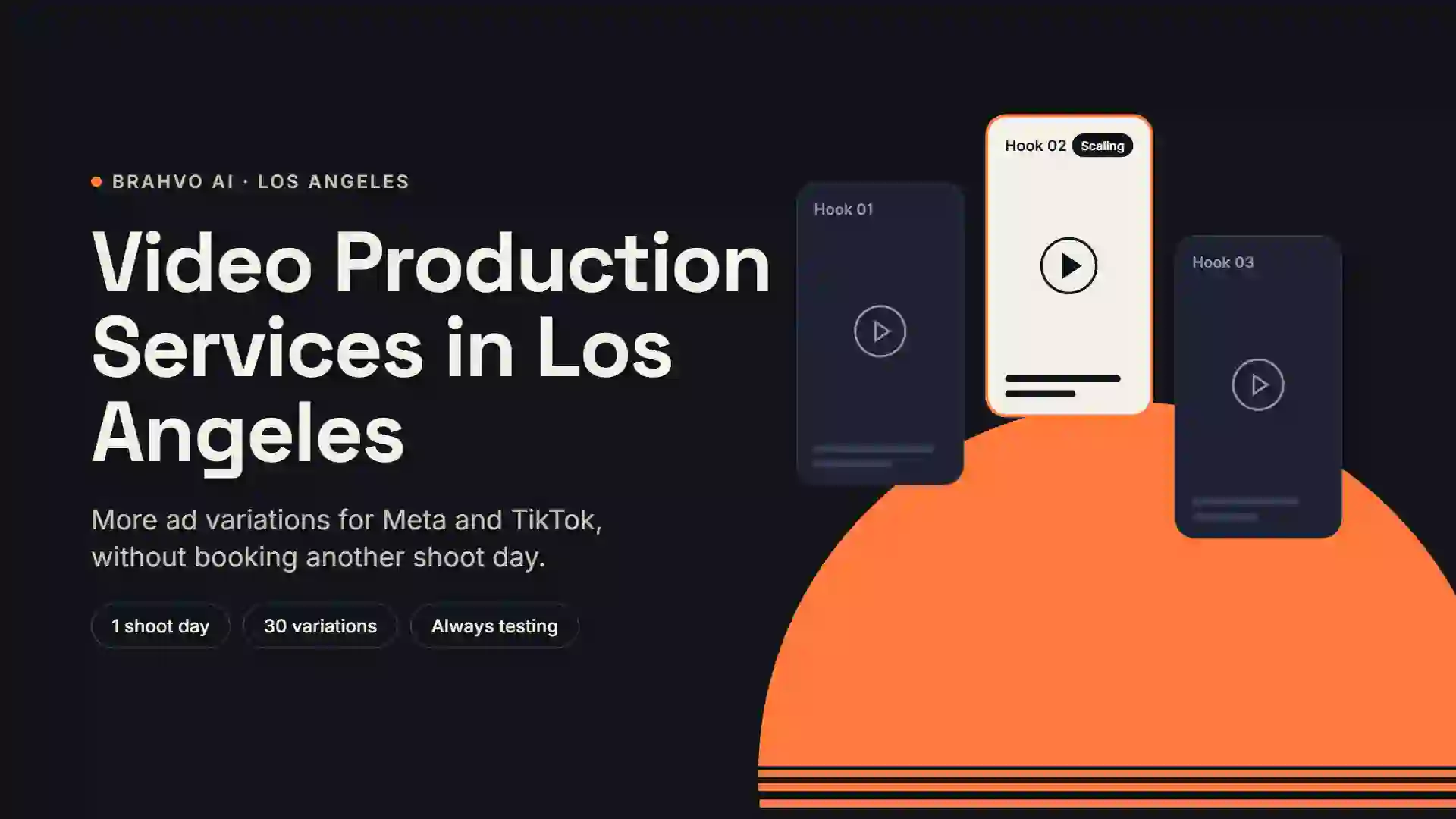
Here's how that works in practice. Every paid social ad breaks into three pieces: a hook (the first one to three seconds), a body (the proof, demo or story), and a call to action. If you shoot five different hooks, three bodies and two CTAs, you can build 30 combinations without booking a second day. The work moves from production into planning and editing, which is exactly where AI-assisted tools are fastest.
Take a hypothetical LA skincare brand launching a vitamin C serum. Instead of scripting "the ad," the shot list for one day looks something like this:
With that library in hand, Brahvo AI can handle the recombination: cutting the 9:16 and 4:5 versions, swapping hooks onto proven bodies, adjusting pacing for TikTok versus Reels, and spinning out new openers when the buyer finds an angle that works. The shoot day stays the same size. What changes is how long its output keeps feeding the account.
One small note from experience: LA traffic will eat an hour of your shoot day no matter how well you plan, so build the shot list in priority order. That isn't really a production insight, but it has saved more than one hook.
Earlier I said product shots still need to be real. I stand by that for most categories, but the line is fuzzier than it sounds. A rigid hard-goods product like a water bottle or a phone case can sometimes be rendered convincingly. Fabric drape, skin texture, food steam and liquid pours are where things still go wrong, and shoppers can tell even when they can't explain why. It shows up later as "item not as described" returns.
There are a few other places where booking a real crew is still the smarter spend:
Founder-led and testimonial content. When the message is "a real person who believes in this product," the person has to be real. Using synthetic presenters for testimonials isn't only a performance risk. It can also run into FTC endorsement rules, so talk to counsel before going near it.
Brand campaigns meant to last. A launch film, a website hero video, or a connected TV spot that has to carry the brand for a year deserves a director and a crew. AI-assisted production is built for speed and volume, and this kind of work needs neither.
Anything involving a recognizable person's likeness. If you plan to extend talent footage with AI later, get that written into the talent agreement from the start. California has tightened its rules on digital replicas, and retrofitting consent after the fact is messy.
The honest answer for most DTC brands is a two-track budget. Run a smaller number of well-planned shoots for the things only cameras do well, and use AI-driven production for the volume your testing program actually needs.
Whoever you work with, a traditional production house, an AI-first studio, or a hybrid, the contract matters more than the reel. The reel shows what they can make. The answers to these questions show what working with them will be like in month three.
How do you price, per day or per deliverable? Per-deliverable pricing makes it much easier to calculate cost per usable ad. Day rates hide it.
Who owns the raw footage, and in what format do we get it? If you can't take your raw files with you, every future variation depends on them.
What usage rights are included for talent and music? Ask specifically about paid social, whitelisting through creator handles, and how long the rights last. "Social media" alone isn't specific enough.
How fast is a revision, really? Ask for the turnaround on a hook swap, not on a full edit. That's the request your media buyer will make every week.
Do you understand how our ads get tested? A partner who asks about your hook rate, thumb-stop ratio or CPA targets thinks differently from one who only asks about your brand guidelines.
How are AI-generated assets labeled, owned, and approved? Both Meta and TikTok have disclosure rules for certain AI-generated content, and those rules keep changing. Your partner should know the current ones.
If a partner gets defensive about any of these, that tells you a lot about how month three will go.
How much do video production services in Los Angeles cost for ecommerce ads?
It varies more than people expect. A small one-day shoot can land in the low five figures once crew, location, talent and post are counted, and full commercial productions go well beyond that. Compare cost per usable ad instead of day rates, and get several current quotes.
Is AI video good enough to run on Meta and TikTok?
For hooks, variations, reformatting, and some product categories, yes. For testimonials, tactile products and brand films, not on its own. The more useful question is which parts of your ad library it should produce.
How many new creatives should a DTC brand test each month?
There isn't a universal number. It depends on spend, how many SKUs you run, and how quickly your ads fatigue. Brands spending six figures a month on Meta often need dozens of new assets a month to stay ahead of fatigue. A brand spending $15K a month can do fine with far fewer.
Do I still need UGC creators if I use AI-assisted production?
Probably, yes. Real creators bring voice, credibility and audience trust that's hard to fake. AI production works best when it stretches creator footage further, not when it replaces creators entirely.
Will Meta or TikTok penalize AI-generated ads?
There isn't a blanket penalty, but both platforms have labeling and disclosure policies for realistic AI-generated content. Check their current ad policies before launch, because the details change.
Do I need an LA-based partner if my brand is based elsewhere?
Not necessarily. Being local helps for shoot days, talent casting, and location access. Editing, variation work, and AI-driven production can happen anywhere.
Can AI video help test a product that hasn't been shot yet?
Sometimes. It can help you test angles and messaging before you commit to a full shoot, which is useful when you're not sure a new SKU will sell. Be careful about showing a product that doesn't quite match what customers will receive.
What should we prepare before a first call with a production partner?
Bring your current top ads, the angles you've already tested, your CPA or ROAS targets, and your SKU list. Mood boards help less than most people think.
Is a bigger production budget always better?
No. Some of the best-performing paid social ads ever made were shot on a phone in somebody's kitchen.