AI video production operations agency to platform business model helps ecommerce brands scale creative production and ads.
Not long ago, most ecommerce brands could survive with a handful of polished video ads each quarter. A product launch meant hiring creators, scheduling production, waiting for edits, and hoping a few winning creatives would carry paid campaigns for months. That reality has changed.
Today, customer acquisition costs move faster than creative teams can produce new content. Meta Ads, TikTok Ads, and YouTube campaigns reward advertisers that consistently introduce fresh creative angles, new hooks, different formats, and audience specific messaging. A single successful campaign often requires dozens, sometimes hundreds, of video variations instead of a few polished commercials.
This shift is one of the biggest reasons the AI video production operations agency to platform business model is receiving so much attention across the ecommerce industry. It is not simply about producing videos with AI. It is about changing how creative operations are managed from the ground up.
Instead of treating every project as an isolated production request, the AI video production operations agency to platform business model creates an ongoing operational system where planning, scripting, asset management, creative generation, testing, feedback, optimization, and scaling work together as one continuous process.
For brands selling multiple products, this difference becomes obvious very quickly.
Imagine a DTC skincare company preparing for Black Friday. The marketing team needs separate campaigns for cold traffic, retargeting, existing customers, seasonal bundles, and influencer collaborations. Each audience requires different messaging. Every product category needs unique visuals. Creative fatigue begins after only a few days of heavy spending.
Under a traditional workflow, every new request creates another production cycle.
Under an AI video production operations agency to platform business model, much of the production pipeline already exists. Product assets are organized. Brand guidelines remain consistent. Scripts can evolve from previous winning concepts. New creative versions can be produced continuously without restarting the entire process.
That changes how marketing teams think about advertising.
Instead of asking, "Can we afford another video shoot?" they begin asking, "What creative hypothesis should we test next?"
That is a much healthier question because advertising performance rarely depends on finding one perfect ad. It usually depends on testing enough quality variations until clear winners emerge.
I might be wrong here, but many businesses still believe AI simply replaces editors or designers. In reality, the bigger opportunity often sits inside operations. The companies improving advertising performance are usually improving how creative work moves through their organization, not just how quickly a single video gets edited.
The AI video production operations agency to platform business model reflects that operational mindset. It treats video production as an ongoing business function rather than a collection of disconnected creative projects.
That distinction matters more each year as ecommerce brands launch products more frequently, enter additional markets, manage larger product catalogs, and compete for increasingly expensive customer attention.
Most traditional production agencies were built around projects.
A client submits a brief. Production starts. Revisions happen. Final assets are delivered. Everyone moves on until the next campaign arrives.
That workflow made sense when brands produced only a limited number of commercials every year. It becomes much harder when performance marketing depends on constant creative refreshes.
Modern ecommerce teams rarely need just one advertisement.
They may need twenty different hooks for Meta Ads, fifteen TikTok style videos, creator based testimonials, product demonstrations, comparison videos, seasonal promotions, landing page assets, email campaign videos, and short form content for multiple social platforms. Sometimes all within the same month.
The production workload grows much faster than most agencies expect.
Communication also becomes more complicated.
Creative strategists suggest new concepts.
Media buyers request different openings because click through rates are dropping.
Brand managers want messaging updated.
Product teams introduce new features.
Editors wait for approvals.
Designers request missing assets.
Copywriters revise scripts after campaign data arrives.
None of these requests are unusual. Together, they create operational bottlenecks that slow everything down.
Many agencies spend more time coordinating production than actually producing creative work.
Another challenge involves consistency.
As brands expand, multiple freelancers, editors, creators, and account managers often contribute to the same campaign. Brand messaging begins to drift. Product positioning changes slightly from one video to another. Visual styles become inconsistent.
Small inconsistencies may not seem important.
Eventually they add up.
Performance marketing depends on recognizable creative patterns. Customers should immediately recognize the product, brand voice, and offer regardless of which advertisement appears in their feed.
Traditional production models struggle to maintain that consistency while increasing production volume.
Revision cycles create another hidden cost.
A video may require script revisions, visual adjustments, subtitle corrections, branding updates, compliance reviews, and multiple approval rounds before reaching final delivery. Every change introduces delays, particularly when different specialists work independently.
There is also the issue of timing.
Paid media teams often discover a winning creative angle on Monday and want several new variations running before the weekend. Traditional production timelines were never designed for that pace.
One slightly awkward reality is this. Fast campaigns often become slower because everyone keeps trying to speed them up.
The problem is not effort.
The problem is operational design.
This is exactly where the AI video production operations agency to platform business model starts changing expectations. Rather than treating production as repeated manual projects, it builds standardized workflows that reduce unnecessary coordination, preserve creative consistency, organize reusable assets, and make continuous creative production practical for brands running high volume advertising.
The biggest change introduced by the AI video production operations agency to platform business model is not faster editing.
It is a different way of organizing creative work.
Instead of production beginning after every request, much of the production infrastructure already exists before campaigns even start.
Brand assets remain centralized.
Approved messaging stays organized.
Winning creative concepts become reusable building blocks.
Scripts evolve instead of starting from blank pages.
Visual templates maintain consistency across campaigns.
Performance insights feed directly into future creative development.
This creates a production environment where continuous testing becomes realistic instead of overwhelming.
Consider a growing ecommerce company selling fitness supplements across the United States.
Its media buying team notices that customer testimonials outperform founder videos among first time buyers. At the same time, product demonstration videos generate stronger return on ad spend for retargeting audiences.
Instead of producing entirely new campaigns from scratch, the AI video production operations agency to platform business model allows the creative team to quickly generate additional testimonial variations, update messaging for different customer segments, test new hooks, localize offers, and support multiple advertising channels without rebuilding every production workflow.
The result is not simply more content.
It is more useful content aligned with actual advertising performance.
Creative decisions become connected to campaign data rather than assumptions.
Production becomes part of ongoing performance marketing operations instead of existing separately from media buying.
This operational connection is becoming increasingly valuable because paid advertising platforms reward continuous experimentation. Winning campaigns often lose efficiency after repeated exposure, making regular creative refreshes essential for maintaining stable acquisition costs.
The AI video production operations agency to platform business model supports that reality by making creative production repeatable rather than reactive.
For companies scaling multiple product lines, entering new customer segments, or increasing advertising budgets, this operational model provides something many traditional production systems struggle to deliver.
Consistency at scale.
That is where Brahvo AI focuses its approach.
Rather than viewing video production as isolated creative projects, Brahvo AI builds production operations designed to support continuous advertising, faster creative testing, organized asset management, and long term campaign scalability for modern ecommerce brands that rely on video as a core driver of customer acquisition.
Producing a handful of ads is rarely the problem for growing ecommerce brands.
Producing enough high quality ads to support multiple products, multiple customer segments, multiple sales events, and multiple advertising platforms at the same time is where operations begin to break down.
A brand selling nutritional supplements may have thirty SKUs. A beauty company may launch seasonal collections every few months. A fashion retailer updates inventory every week. Every product deserves different messaging, different creative hooks, and different customer stories.
Now add geography.
The same campaign may need variations for the United States, Canada, Australia, and the United Kingdom. Each market responds differently to pricing, offers, cultural references, and buying behavior. Then add Meta Ads, TikTok Ads, YouTube Shorts, Instagram Reels, landing pages, and email campaigns into the mix.
The creative workload grows exponentially.
Traditional production teams often respond by hiring more editors, more project managers, and more freelancers. That increases capacity for a while, but it also introduces more communication, more revisions, and more operational complexity.
The AI video production operations agency to platform business model approaches scaling differently.
Instead of increasing headcount every time production demand grows, it builds operational systems that allow creative production to scale through standardized workflows, reusable assets, structured approvals, and AI supported production processes.
That distinction becomes especially valuable during major ecommerce events.
Think about a consumer electronics brand preparing for the holiday shopping season. The paid media team wants different video ads for first time buyers, returning customers, bundle offers, financing promotions, gift shoppers, and abandoned cart audiences. They also need fresh creatives every week because performance begins to decline after repeated exposure.
Without a scalable production operation, deadlines start slipping almost immediately.
With the AI video production operations agency to platform business model, much of the creative foundation already exists. Existing product footage can be repurposed. Proven messaging can be adapted for new audiences. New hooks can be introduced without rebuilding every campaign from the beginning.
That allows creative output to grow without creating the same level of operational friction.
More importantly, marketing teams can keep testing instead of waiting.
One of the biggest differences between average advertising teams and consistently successful ones has very little to do with creative talent.
It comes down to repeatability.
Many brands accidentally treat every campaign like a brand new project.
New brainstorming sessions.
New production schedules.
New approval chains.
New asset requests.
New communication loops.
Eventually everyone becomes busy, but not necessarily productive.
The AI video production operations agency to platform business model replaces isolated production projects with repeatable creative systems.
Instead of reinventing every workflow, successful production operations identify what already works and build processes around those proven patterns.
Winning hooks become reusable frameworks.
Successful product demonstrations become templates.
Brand guidelines remain centralized.
High performing scripts become starting points rather than historical documents.
Customer testimonials can be adapted across different products while maintaining brand consistency.
This creates operational momentum.
Every new campaign benefits from lessons learned during previous campaigns.
Media buyers also gain an advantage because creative production stays aligned with campaign performance instead of personal opinions.
For example, if six second product introductions consistently outperform longer openings, future production naturally incorporates that learning. If founder led videos perform better during product launches but creator style videos generate stronger retargeting results, production priorities adjust accordingly.
Nothing gets wasted.
Everything becomes part of a growing creative operating system.
There is another benefit that often goes unnoticed.
Agency client communication becomes much smoother.
Instead of constantly explaining production requirements, both sides work from standardized workflows that reduce confusion, shorten feedback cycles, and improve delivery timelines.
Not every campaign will fit inside a repeatable framework. Premium brand launches, major storytelling campaigns, or large commercial productions may still require custom creative development. That is completely reasonable.
The difference is that everyday advertising no longer depends on starting over each time.
Creative testing has become one of the most important competitive advantages in paid advertising.
It is no longer enough to produce one great video and hope it carries an entire quarter.
Performance marketers need options.
Different hooks.
Different calls to action.
Different creators.
Different video lengths.
Different product angles.
Different customer objections.
Each variation creates another opportunity to discover what resonates with a specific audience.
The challenge is that testing requires production capacity.
Without enough creative volume, media buyers eventually run out of ideas they can actually launch.
The AI video production operations agency to platform business model solves this operational bottleneck by making creative generation part of an ongoing production engine instead of a periodic event.
Imagine an apparel brand spending $250,000 per month on paid social.
Its media buying team notices that videos focused on customer reactions are outperforming polished product showcases. Instead of waiting three weeks for another production cycle, the creative operation can quickly produce additional variations using similar messaging, different creators, new opening hooks, and revised calls to action.
Campaign optimization becomes much faster because creative production keeps pace with advertising data.
That creates a feedback loop.
Campaign results influence creative production.
Creative production generates new testing opportunities.
Testing identifies stronger performers.
Those insights improve future production.
The cycle repeats continuously.
One low value observation here is that good ads usually perform better than bad ones.
Obvious, yes.
But many organizations spend so much time discussing strategy that they simply fail to produce enough quality creative to test their assumptions.
The AI video production operations agency to platform business model helps close that gap by connecting production operations directly with paid media decision making.
Instead of asking whether a campaign needs better optimization, teams can ask whether they have produced enough creative variations to give the algorithm meaningful choices.
Sometimes the answer is no.
Many agencies begin as service businesses because it is the fastest way to start.
Clients request projects.
Teams deliver work.
Revenue grows through additional retainers and larger production contracts.
That model works well for quite some time.
Eventually, however, growth starts exposing operational limitations.
Project management becomes more complicated.
Hiring struggles to keep pace with client demand.
Production quality becomes inconsistent across larger teams.
Knowledge stays inside individual employees instead of becoming part of company operations.
That is often the point where the AI video production operations agency to platform business model becomes worth considering.
A platform driven approach does not eliminate human expertise.
It organizes expertise into systems.
Instead of depending entirely on manual execution, agencies begin creating standardized operating procedures, centralized asset libraries, reusable production frameworks, automated workflows, structured approvals, and operational intelligence that supports every client relationship.
This transition also changes how clients experience the partnership.
Rather than purchasing isolated deliverables, they gain access to a production operation that evolves alongside their advertising strategy.
I might be wrong here, but not every agency should make this transition immediately.
Boutique creative studios focused on highly customized brand storytelling may actually deliver stronger work by remaining intentionally specialized.
The platform model creates its biggest advantage when clients require continuous creative production at significant scale.
That is becoming increasingly common among ecommerce brands running paid acquisition throughout the year.
Modern ecommerce brands do not simply need more videos.
They need a production operation capable of supporting continuous advertising, ongoing creative testing, expanding product catalogs, and increasingly competitive paid media environments.
That is exactly why Brahvo AI is building its AI video production operations agency to platform business model around operational scalability rather than isolated production projects.
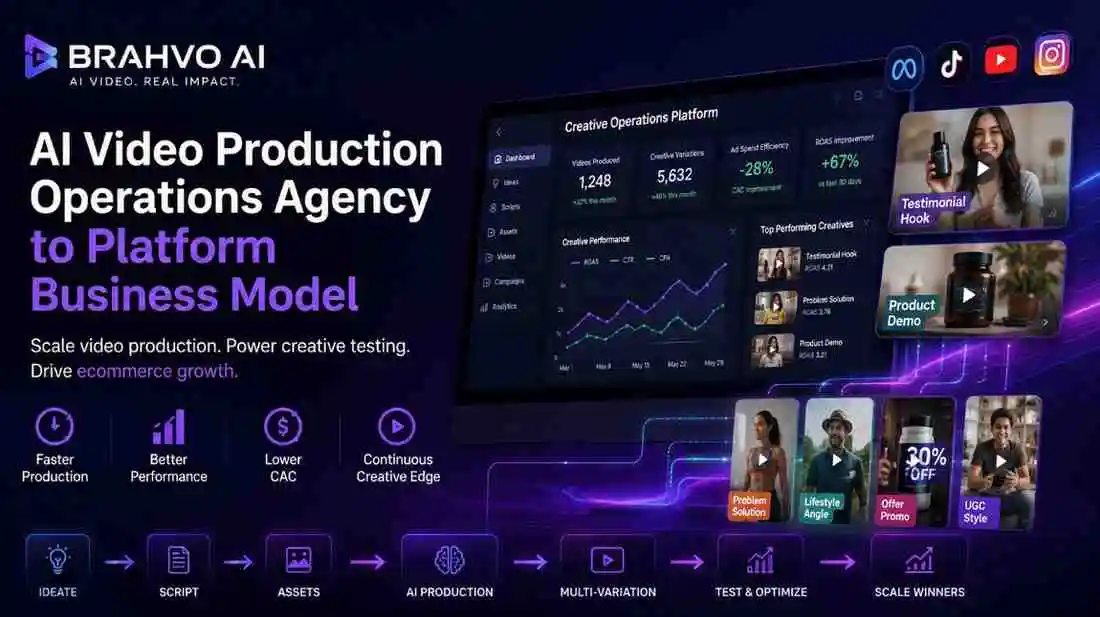
Instead of approaching every request as a separate assignment, Brahvo AI focuses on creating connected production workflows that support the entire advertising lifecycle.
Creative strategy.
Script development.
Asset organization.
Video generation.
Performance informed iteration.
Continuous creative expansion.
Each part of the process supports the next instead of operating independently.
For ecommerce businesses managing dozens of campaigns across Meta Ads, TikTok Ads, YouTube, and other performance channels, this creates a much more sustainable production model.
Marketing teams spend less time coordinating individual projects and more time evaluating creative performance.
Media buyers gain faster access to fresh advertising variations.
Creative strategists can respond more quickly when campaign data reveals new opportunities.
Founders maintain better visibility into production without becoming involved in every approval.
Perhaps most importantly, the production operation continues improving over time because every campaign contributes new insights to future creative development.
That long term operational learning is difficult to achieve when production exists only as disconnected client projects.
The AI video production operations agency to platform business model allows Brahvo AI to support growing ecommerce brands with a system designed for continuous advertising rather than occasional production. As creative demands continue increasing across paid social, that operational shift may become less of a competitive advantage and more of a basic requirement for brands that expect to scale efficiently.
Moving from a traditional production workflow to an AI video production operations agency to platform business model is not just a technology decision. It affects how marketing, creative, and media buying teams work together every day. Before making that shift, most business leaders ask practical questions that go well beyond AI itself.
Will this replace our internal creative team?
Usually, no.
The goal is to remove repetitive production work so internal creative teams can spend more time developing campaign ideas, refining messaging, analyzing performance, and planning future launches.
When routine production becomes more efficient, creative professionals often have more room to focus on work that actually requires human judgment.
Can it handle multiple brands or product lines?
For many ecommerce businesses, that is one of the biggest advantages.
A structured AI video production operations agency to platform business model makes it much easier to organize assets, maintain separate brand guidelines, manage different product catalogs, and create campaigns for multiple customer segments without mixing messaging across brands.
That becomes increasingly valuable for companies with expanding product portfolios.
Does faster production reduce creative quality?
It can if speed becomes the only priority.
High quality creative still depends on good strategy, strong messaging, clear positioning, and understanding customer behavior.
The production model should accelerate execution while preserving creative standards. Faster production without thoughtful creative direction rarely produces better advertising.
How does this support paid media performance?
Media buyers rarely want more videos simply to increase content volume.
They want more testing opportunities.
An AI video production operations agency to platform business model makes it easier to launch new hooks, different customer angles, revised offers, and fresh creative concepts before existing ads begin losing effectiveness.
That creates more opportunities to improve campaign efficiency over time.
Is this only useful for large ecommerce companies?
Not necessarily.
Mid sized DTC brands often benefit because they experience many of the same creative challenges as larger companies but usually have smaller production teams.
A more structured production operation helps them compete without dramatically increasing internal resources.
How long does operational change usually take?
Every business is different.
Some organizations already have strong production processes and only need better operational systems.
Others may need to reorganize workflows, approvals, asset management, and communication before seeing the full benefits.
The technology is often the easiest part.
Operational habits usually take longer to change.
What is an AI video production operations agency to platform business model?
It is an approach that moves beyond traditional project based video production by creating an ongoing production platform where creative strategy, asset management, AI supported production, testing, optimization, and campaign support operate as one connected system.
Why are ecommerce brands interested in this model?
Because modern advertising requires continuous creative production. Brands running Meta Ads, TikTok Ads, and YouTube campaigns often need dozens of new video variations every month to keep testing fresh ideas and reduce creative fatigue.
Does this eliminate the need for human creativity?
No.
AI improves production efficiency, but successful advertising still depends on experienced creative strategy, persuasive messaging, audience understanding, and thoughtful campaign planning.
How does this help reduce creative fatigue?
Instead of relying on a few advertisements for months, businesses can consistently introduce new hooks, visuals, offers, and storytelling approaches, helping campaigns stay relevant as audience engagement changes.
Can the same production system support multiple advertising platforms?
Yes. A well designed AI video production operations agency to platform business model can produce creative tailored for Meta Ads, TikTok Ads, YouTube, Instagram Reels, landing pages, email marketing, and other digital channels while maintaining consistent branding.
Is this model suitable for brands launching products frequently?
Absolutely.
Brands with frequent product releases often benefit because production workflows are already organized, making it easier to create campaign assets without restarting the entire production process each time.
How does Brahvo AI approach this business model?
Brahvo AI focuses on building connected production operations that support continuous creative generation, organized workflows, faster testing, and scalable advertising for ecommerce businesses instead of treating every client request as a separate production project.
Will businesses still need custom video production?
Yes.
Large product launches, brand storytelling campaigns, and premium commercial productions may still require fully customized creative work. Operational systems simply make ongoing advertising much more efficient.
What should businesses evaluate before adopting this model?
Look at your current production bottlenecks, campaign volume, approval processes, creative testing frequency, product launch schedule, and long term advertising goals. The greatest value usually comes when production operations directly support continuous campaign optimization rather than isolated creative projects.
Is an AI video production operations agency to platform business model becoming the future of ecommerce advertising?
Many signs suggest it is moving in that direction. As ecommerce brands continue increasing creative output across paid social, the ability to operate an efficient, repeatable, and scalable production system is becoming increasingly important. The real question for many founders is no longer whether they need more creative. It is whether their current production process can realistically keep up with the pace their growth plans demand.