Looking for filmproductie Amsterdam? Learn how Brahvo AI creates scalable commercial videos that support ecommerce growth and paid ads.
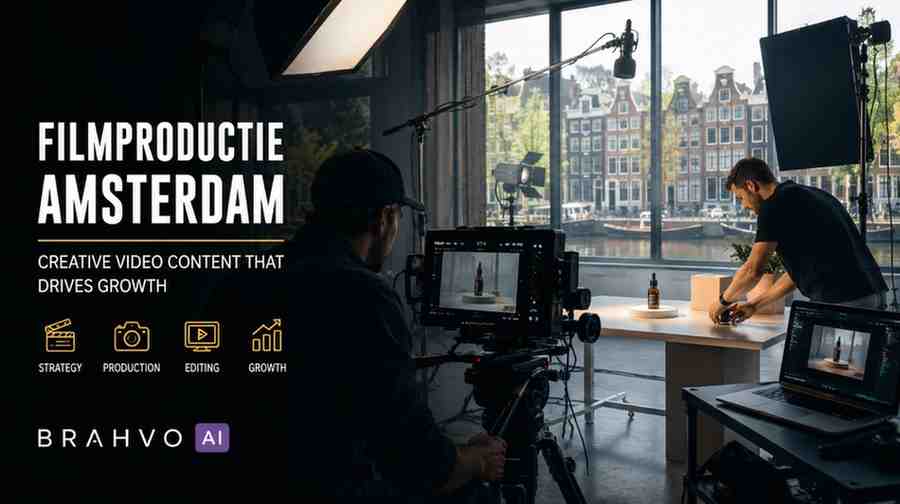
The expectations around filmproductie Amsterdam have changed significantly over the last few years. Businesses are no longer investing in video simply to have a polished brand film on their website. They want content that contributes to measurable business goals, whether that means increasing ecommerce sales, reducing customer acquisition costs, improving paid advertising performance, or building stronger customer trust across digital channels.
For many companies, video now sits at the center of almost every marketing campaign. A product launch may require multiple social media ads, landing page videos, customer testimonials, YouTube content, email marketing assets, and short form vertical videos for Meta Ads and TikTok Ads. Instead of producing one video every few months, marketing teams often need fresh creative every week.
This shift has changed what businesses expect from a filmproductie Amsterdam partner. They are looking for a team that understands how video performs after production is complete, not just how it looks during editing.
Creative quality still matters. Strong visuals, good lighting, professional sound, and engaging storytelling remain essential. But marketing teams are asking different questions today.
Can this footage be repurposed into multiple ad formats?
Will it support A B testing across different audience segments?
Can we quickly create new variations if one campaign starts to lose performance?
These are business questions rather than filmmaking questions, and they influence how modern production projects are planned from the beginning.
Many ecommerce brands also operate across multiple sales channels at the same time. A single campaign may appear on Instagram, Facebook, TikTok, YouTube, Amazon, and Shopify landing pages. Each platform has different creative requirements, different aspect ratios, and different audience behaviors. Planning for this complexity before filming saves both time and budget later.
A modern filmproductie Amsterdam project is increasingly expected to deliver an entire library of marketing assets instead of one finished commercial. Marketing teams want flexibility because advertising platforms reward continuous creative testing rather than relying on one successful video for months.
That is why businesses today often evaluate production partners based not only on their portfolio but also on their understanding of advertising performance, content scalability, and long term creative needs.
Video has become one of the most valuable marketing assets for ecommerce brands because customers make buying decisions much faster when they can actually see products in use.
Static product images can answer basic questions, but video demonstrates functionality, quality, size, movement, and real world applications in ways that photographs simply cannot. For products with higher price points, this additional confidence often reduces hesitation during the purchase journey.
For ecommerce businesses, commercial video content supports multiple stages of customer acquisition.
At the awareness stage, short videos introduce the brand and capture attention in crowded social feeds. During consideration, product demonstrations, customer testimonials, and educational videos help answer common objections. After purchase, onboarding videos and educational content improve customer satisfaction while encouraging repeat purchases.
This means a single production project can support marketing long after the original campaign ends.
Paid advertising teams also benefit from having a larger creative library.
Creative fatigue is one of the most common reasons Meta Ads performance declines over time. Audiences repeatedly exposed to the same visuals gradually stop engaging, resulting in lower click through rates and rising acquisition costs. Instead of constantly organizing new production shoots, marketing teams prefer having enough footage to refresh ads regularly.
A clothing brand launching a seasonal collection, for example, may produce dozens of creative variations from one filming session. Different hooks, different product combinations, alternative opening scenes, customer reactions, lifestyle footage, and multiple calls to action can all become separate advertisements targeting different audiences.
The same footage may appear as:
Marketing Use
Business Purpose
Meta Ads
Customer acquisition
TikTok Ads
Product discovery
YouTube Ads
Brand awareness
Landing pages
Improve conversion rates
Product pages
Increase purchase confidence
Email campaigns
Drive repeat purchases
Organic social media
Community engagement
This approach creates significantly more value from every production budget because each recording session continues generating usable marketing assets across multiple campaigns.
I might be wrong here, but not every business needs hundreds of video variations immediately. Smaller brands with a limited product catalog may see strong results from a focused collection of high quality assets. As product lines expand and advertising budgets grow, however, the demand for fresh creative almost always increases alongside campaign complexity.
Video also contributes to stronger brand consistency. Customers who repeatedly see similar messaging, visual identity, and production quality across different platforms are more likely to remember the brand and develop trust over time.
Rather than treating video as a one time expense, successful ecommerce brands increasingly view commercial production as a long term marketing asset that supports advertising, sales, customer retention, and overall brand growth.
Choosing a filmproductie Amsterdam partner involves much more than reviewing a showreel.
Marketing leaders need confidence that the production team understands the business objectives behind every campaign. Beautiful visuals are valuable, but they should support measurable outcomes rather than exist for their own sake.
A productive partnership usually starts with strategy. Before cameras begin rolling, the production team should understand the target audience, campaign goals, distribution channels, product positioning, and advertising requirements. These details influence everything from scripting and shot selection to editing style and final deliverables.
Modern marketing teams also appreciate flexibility.
Campaign priorities change. Product launches move forward. Seasonal promotions appear with little notice. New creative concepts emerge after early advertising data becomes available. Production partners who can adapt quickly often become long term collaborators instead of one time vendors.
Scalability has become another important consideration.
Many brands are managing dozens of products across multiple markets. Producing separate videos for every campaign quickly becomes expensive and difficult to coordinate. A smarter production process captures enough footage to support future campaigns without requiring constant reshoots.
Imagine a health supplement company preparing for a nationwide launch. During a two day production schedule, the marketing team records customer lifestyle footage, founder interviews, manufacturing visuals, product demonstrations, social media clips, and vertical advertisements. Over the following six months, editors continue producing fresh creative variations from that original content library as advertising campaigns evolve.
That kind of planning helps marketing teams respond much faster when new opportunities appear.
Communication also matters more than many businesses initially expect. Delays often happen because approvals, revisions, or creative expectations were never clearly defined before production started. Strong collaboration between marketing managers, creative teams, and production specialists reduces unnecessary revisions and keeps campaigns moving.
This is where Brahvo AI approaches filmproductie Amsterdam differently. Rather than viewing production as the final deliverable, the focus extends to creating advertising ready assets that support ongoing campaign optimization, creative testing, and scalable content production. The goal is not simply producing impressive videos, but helping businesses maintain a steady flow of marketing creative that keeps pace with modern ecommerce advertising.
Because at the end of the day, the question many marketing leaders ask is surprisingly simple.
Can this production help us sell more while making future campaigns easier to launch?
One of the biggest mistakes businesses make is treating video production and advertising as two separate projects.
The production team focuses on creating visually appealing footage while the marketing team later tries to fit that content into Meta Ads, TikTok Ads, YouTube campaigns, email marketing, landing pages, and product pages. The result is often a collection of beautiful videos that are difficult to use across different campaigns.
A successful filmproductie Amsterdam project starts much earlier than the first day of filming.
The planning stage should answer practical marketing questions before any camera is turned on.
Who is the primary audience?
What customer problem should the video address?
Which platforms will the content appear on?
Will multiple versions be needed for different audience segments?
Can the same footage support paid ads, organic social media, website content, and future campaigns?
These decisions influence everything from the shooting schedule to camera angles and editing priorities.
For example, an ecommerce company launching a new kitchen appliance may initially think it only needs a sixty second promotional video. After discussing campaign objectives, the marketing team realizes they also need six second attention grabbing ads, fifteen second vertical videos for Instagram Reels, customer testimonial clips, product demonstrations, lifestyle content, and educational videos explaining key features.
Instead of organizing multiple production days throughout the year, all of these assets can be planned during a single production schedule.
This approach also makes advertising more efficient.
Media buyers rarely depend on one creative. They constantly test different hooks, opening scenes, offers, product benefits, and calls to action. If production is planned with testing in mind, editors already have enough material to create fresh variations without asking the team to return to the studio.
Marketing goals should also influence storytelling.
A brand awareness campaign requires a different pace than a direct response advertisement focused on immediate sales. Product launch campaigns often need educational content, while remarketing campaigns may perform better with customer testimonials or product demonstrations.
The more closely production planning aligns with advertising strategy, the easier it becomes to build campaigns that continue performing weeks or even months after filming.
Advertising platforms reward fresh creative.
That reality has pushed many ecommerce brands to rethink how they approach content production.
Creating completely new videos every time performance begins to decline is expensive, time consuming, and difficult to manage. Marketing calendars move quickly, while traditional production schedules often require weeks of preparation, filming, editing, and approvals.
This is where AI supported production workflows are changing expectations for businesses looking for filmproductie Amsterdam services.
AI is not replacing creative thinking or professional production teams. It is helping them produce more usable content from the same footage while reducing repetitive editing tasks that normally slow campaigns down.
Imagine an apparel brand preparing for a seasonal collection launch.
The production team captures lifestyle footage, close up product shots, behind the scenes moments, customer interactions, and several presenter led videos during one filming session.
Instead of ending with three finished advertisements, AI assisted workflows help transform that content into multiple creative formats.
Different openings can target different customer interests.
Product highlights can be rearranged for separate audience segments.
Captions, aspect ratios, pacing, and messaging can be adapted for various advertising platforms without rebuilding every video from scratch.
The result is a much larger creative library that supports continuous testing.
For paid media teams, this flexibility matters because campaign performance rarely stays consistent forever.
One creative may work exceptionally well for first time customers but perform poorly with returning buyers.
Another may generate strong click through rates but lower conversion rates.
Having multiple versions ready allows marketers to respond quickly instead of waiting several weeks for another production cycle.
I mentioned earlier that more creative variations generally help advertising performance. That is usually true, but volume alone is not enough. Twenty average advertisements rarely outperform five carefully planned, strategically different creatives that each communicate a unique customer benefit.
AI simply makes producing those meaningful variations faster and more practical.
Most production delays are not caused by cameras, lighting, or editing software.
They usually begin long before filming starts.
Unclear objectives, incomplete creative briefs, changing approvals, and poor communication often create expensive bottlenecks that affect both production and advertising timelines.
Businesses searching for filmproductie Amsterdam services often underestimate how much these operational challenges influence marketing performance.
One common issue is trying to finalize messaging after production has already finished.
Without clear campaign goals, editors may create videos that look polished but fail to support advertising requirements. Marketing teams then request additional revisions, new graphics, alternative voiceovers, or even completely new footage.
Those revisions increase both costs and launch delays.
Another challenge appears when businesses underestimate the number of creative assets required.
A single advertisement might seem sufficient during planning. Once campaigns begin running, however, media buyers often request additional hooks, shorter edits, alternative product demonstrations, or fresh opening scenes to combat creative fatigue.
If that material was never recorded, another production day becomes necessary.
Managing multiple stakeholders also slows projects.
Marketing managers, founders, ecommerce teams, designers, and advertising specialists may all have different priorities.
Without an organized approval process, feedback becomes scattered across emails, chat messages, and meetings.
Eventually everyone agrees that something feels off, although explaining exactly what that something is becomes surprisingly difficult.
That sentence probably sounds a little awkward. It happens.
Budget planning creates another tradeoff.
Reducing production costs may appear attractive in the short term, but limited filming often leaves businesses with too few creative assets for future campaigns. Spending slightly more upfront to capture additional footage frequently reduces future production expenses because marketers already have content available for new campaigns.
The businesses that experience the fewest production delays are usually the ones that treat planning, filming, editing, and advertising as one connected workflow rather than separate departments working independently.
Businesses today need far more than a finished video.
They need creative assets that can keep pace with product launches, seasonal promotions, audience testing, and the constant demand for fresh advertising content.
That is the philosophy behind Brahvo AI's approach to filmproductie Amsterdam.
Every project begins by understanding how the content will actually be used after production. Instead of focusing only on cinematic quality, planning also considers advertising objectives, platform requirements, customer acquisition strategies, and future campaign flexibility.
This allows production to generate content that serves multiple marketing purposes from a single filming schedule.
Rather than delivering one polished commercial, Brahvo AI helps businesses build a complete library of reusable creative assets.
That can include short form vertical videos, product demonstrations, testimonial edits, social media content, paid advertising variations, website videos, landing page assets, and platform specific edits designed for Meta Ads, TikTok Ads, and YouTube campaigns.
For ecommerce brands managing multiple products, this approach creates a much more sustainable production process.
A skincare company introducing five new products, for instance, does not necessarily need five completely separate production projects. With thoughtful planning, one production schedule can capture enough footage to support multiple launches, promotional campaigns, educational content, and ongoing advertising refreshes throughout the year.
AI supported production workflows also help shorten turnaround times for many editing tasks, making it easier for marketing teams to respond when campaigns need fresh creative.
The goal is not simply producing more content.
It is producing content that remains useful long after launch, giving advertisers the flexibility to test new messaging, explore different audience segments, and maintain campaign momentum without constantly starting over.
Because modern advertising rarely stands still.
And neither should the creative supporting it.
Before hiring a filmproductie Amsterdam company, ask questions that go beyond production quality.
The answers often reveal whether the team understands modern marketing or simply focuses on filmmaking.
Here are a few questions worth discussing before the project begins.
Question
Why It Matters
How will the content support our advertising campaigns?
Ensures production aligns with measurable marketing goals.
Can one production day create multiple content formats?
Helps maximize the value of your production budget.
Will the footage work across Meta Ads, TikTok Ads, YouTube, and our website?
Supports consistent messaging across channels.
How much creative flexibility will we have after filming?
Reduces the need for future reshoots.
How do you plan for creative testing during production?
Gives media buyers more variations to test.
What is the review and approval process?
Prevents delays and unnecessary revisions.
Can future campaigns use the same content library?
Increases the long term value of the project.
Choosing a production partner is rarely about finding the company with the most impressive visuals alone.
It is about finding a team that understands how creative content contributes to customer acquisition, campaign performance, and business growth after the cameras stop recording.
That is often the difference between producing videos that simply look good and producing videos that continue generating value across multiple marketing campaigns.
1. What is included in a professional filmproductie Amsterdam service?
A professional filmproductie Amsterdam service typically covers strategy, creative planning, scripting, filming, editing, motion graphics, sound design, color grading, and final delivery in formats suitable for websites, social media, and paid advertising. Many businesses also look for production partners that can create multiple content variations from one shoot to maximize long term marketing value.
2. How long does a commercial video production project usually take?
The timeline depends on the project's complexity. A straightforward commercial may take a couple of weeks from planning to delivery, while larger campaigns involving multiple filming days and several advertising assets can take longer. Clear planning and faster approvals often have a bigger impact on delivery time than filming itself.
3. Why is video production important for ecommerce brands?
Video helps ecommerce businesses explain products more effectively, build customer confidence, and improve advertising performance across Meta Ads, TikTok Ads, YouTube, and online stores. It also provides reusable content for product pages, email campaigns, and organic social media.
4. Can one production shoot create content for multiple marketing channels?
Yes. With proper planning, a single filmproductie Amsterdam project can generate videos for paid advertising, social media, landing pages, websites, product pages, email campaigns, and internal marketing materials. Planning for multiple formats before filming significantly increases the value of the production investment.
5. How does AI support modern video production?
AI helps streamline parts of the production workflow by making it easier to create multiple edits, adjust formats for different platforms, generate creative variations, and reduce repetitive post production tasks. It supports creative teams rather than replacing them, allowing businesses to produce more usable content in less time.
6. How many video variations should a business create for advertising?
There is no universal number. Brands running large paid media budgets often benefit from a broader creative library because different audiences respond to different messaging. Smaller businesses may achieve excellent results with fewer, well planned videos that focus on their strongest customer value propositions.
7. What should businesses look for when choosing a filmproductie Amsterdam partner?
Look beyond the visual portfolio. A strong production partner should understand advertising objectives, ecommerce customer journeys, platform specific requirements, creative testing, production planning, and how video contributes to measurable business outcomes over time.
8. Can commercial videos be updated after the original production?
Absolutely. If enough footage is captured during production, editors can often create new versions, shorter advertisements, seasonal updates, and platform specific edits without organizing another filming session. This makes future campaigns faster and more cost effective.
9. Does better production quality always lead to better advertising performance?
Not necessarily. High production quality builds credibility, but successful advertising also depends on messaging, audience targeting, creative strategy, and testing. A beautifully produced video with the wrong message may underperform compared to a simpler video that addresses a customer's immediate problem.
10. Why do many businesses choose Brahvo AI for filmproductie Amsterdam?
Businesses choose Brahvo AI because the focus extends beyond producing attractive videos. Every project is planned to support ongoing advertising, creative testing, ecommerce growth, and scalable content production, helping brands get more value from every production investment.
Marketing teams are expected to launch campaigns faster than ever.
New products arrive every month. Paid media performance changes every week. Customer preferences shift, creative fatigue appears sooner than expected, and media buyers are constantly asking for fresh content to test.
That puts pressure on every part of the production process.
If creating one new advertisement requires weeks of planning, another filming day, multiple review cycles, and lengthy editing, marketing momentum often slows before the campaign has a chance to scale.
Businesses investing in filmproductie Amsterdam are beginning to ask different questions than they did a few years ago.
They want production partners who understand advertising timelines as well as production timelines.
They want footage that continues creating value long after launch.
They want content that can be adapted for new audiences, new offers, and new platforms without rebuilding every campaign from the beginning.
For growing ecommerce brands, video is no longer a one time creative project. It has become an ongoing business asset that supports customer acquisition, product launches, brand building, and continuous campaign optimization.
The brands that stay ahead are rarely the ones producing the most videos.
They are usually the ones building production systems that make it easier to keep creating the right videos when the market changes.
And with advertising platforms evolving so quickly, that may be the question worth thinking about before planning your next campaign. Will your next production still support your marketing goals six months from now, or will you find yourself starting over again?