Hiring the best video production crew in Lafayette, LA? Here's what brands running Meta and TikTok ads should weigh before booking a shoot.
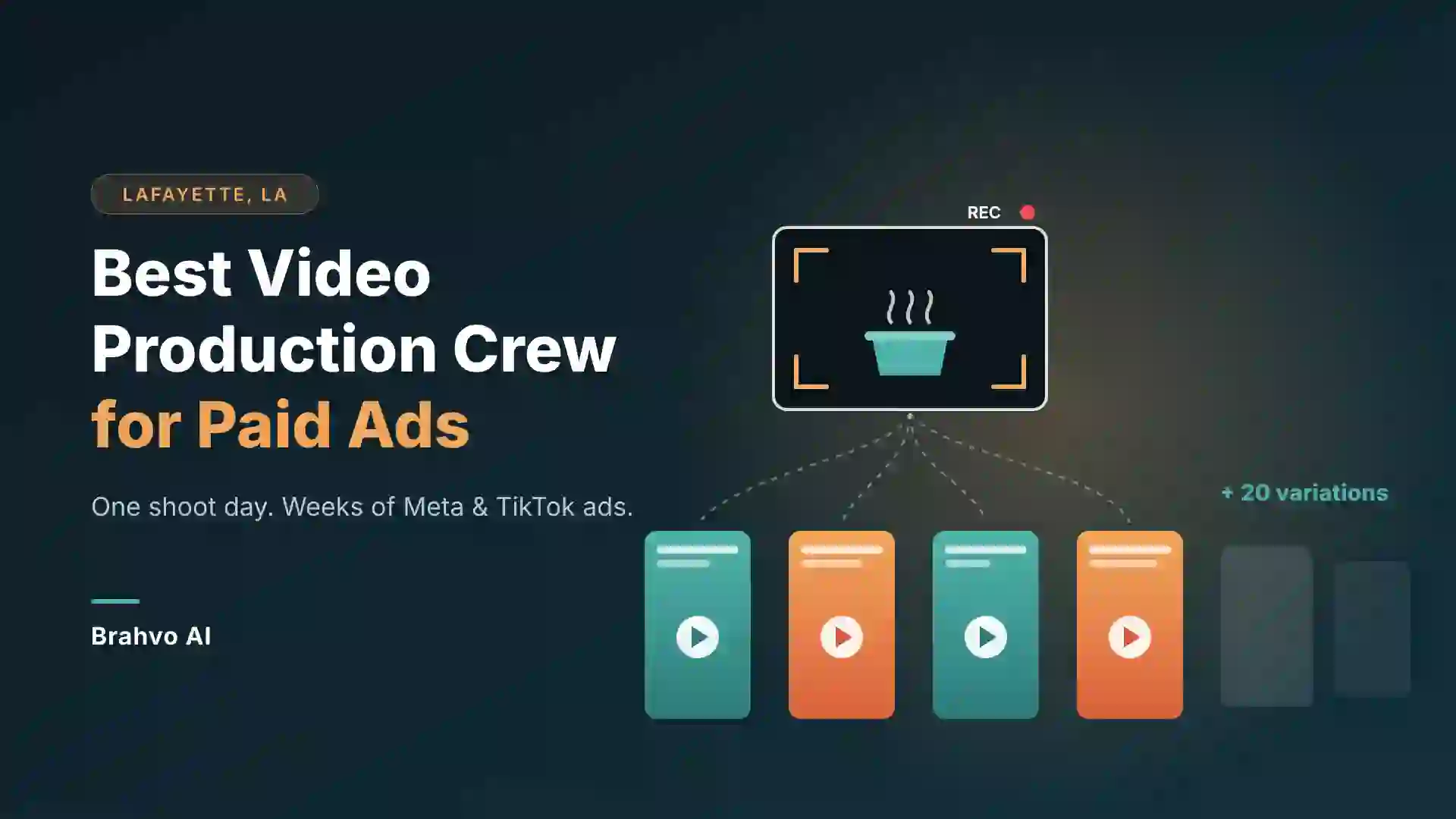
Most people searching for the best video production crew in Lafayette, LA are not looking for a filmmaker. They're looking for a way out of a problem. Usually the ads have gone stale, the founder is tired of filming product clips on an iPhone in the warehouse, and someone on the team said, "We should just hire a real crew." That's a fair instinct. Lafayette has talented people who can light a kitchen beautifully, shoot drone footage over the Vermilion River, and make a crawfish boil look like a movie.
The trouble is that "best" quietly changes meaning depending on where the video ends up. For a TV spot, a brand film for the website, or a recruiting video for an oil and gas services company in the Lafayette area, best means craft. Good lighting, clean audio, a director who knows how to get a nervous owner to relax on camera. For paid social, best means something much less romantic. It means the crew can hand you enough distinct pieces of footage that your media buyer can test hooks, angles, and formats for weeks without running dry.
Those are two very different jobs. A crew can be excellent at the first and only average at the second. That's not a knock on anyone. They just optimize for different things. When I talk to Acadiana business owners who were disappointed by a shoot, the complaint is almost never that it looked bad. It's that it looked great and they ran out of it in a month.
So before you compare portfolios, decide which job you're hiring for. If it's mostly ads, judge a video production crew in Lafayette on questions like these. How many usable cuts will I get? Will they shoot vertical natively, or crop it later? Can they capture multiple openings for the same scene? Do they understand that the first two seconds matter more than the last thirty?
There's a pattern I see often enough that it's almost predictable. A local brand books a shoot, spends a good chunk of the quarter's creative budget on it, and plans to "live off" that footage until the next one. Three months, sometimes six. On paper it's efficient, since you pay for the crew, the location, and the talent once and spread the cost over a long window.
In practice, the footage has a shelf life, and it's shorter than the calendar. The first two weeks feel great. New ads go live, CTR goes up, and cost per purchase drops a little. Somewhere around week four or five, the same ads start to drift. Frequency climbs, CPMs creep up, and the conversion rate that looked so promising starts sliding back toward where it was before the shoot. By week eight the team is recycling the same clips with new text overlays and calling it a refresh.
Part of the trap is budget psychology. Once you've paid for a professional production, it feels wasteful to admit you need more creative so soon. So brands push the footage longer than they should and watch acquisition costs rise in the meantime. The other part is scheduling. Getting a crew, a location, product inventory, and on-camera talent lined up again in Lafayette isn't hard, exactly, but it isn't fast either. Most small teams don't have someone whose whole job is keeping that pipeline moving.
I'll say this confidently: for most ecommerce and DTC brands spending real money on Meta, one shoot a quarter is not a creative strategy. It's a gap with a few good weeks at the front.
This part is technical, but the idea is simple. Meta's ad delivery system has moved hard toward letting the algorithm find the audience on its own. Broad targeting, Advantage+ campaigns, fewer manual levers. That means creative is now doing most of the targeting work. A different hook, a different face, a different opening line can reach a different pocket of people. When every ad in your account looks and sounds roughly the same, the system keeps showing it to roughly the same people, and they get tired of it.
Creative fatigue is the term for that, and it isn't just a feeling. You can see it in the numbers. Frequency on your top ad set passes three or four, thumb-stop rate drops, and the comments shift from questions to "I keep seeing this." TikTok is even less forgiving. A video that worked on a Tuesday can feel old by the following Monday, because the platform rewards novelty and viewers there scroll faster than almost anywhere else.
Now put that next to how traditional production works. A crew shoots one day, the editor needs a week or two, revisions take another week, and then you have a batch of ads. That's a good process for a brand film. For an account that ideally wants several new creative concepts tested every week, the math doesn't work, even with the best video production crew in Lafayette, LA. The crew isn't slow. The format just isn't built for that pace.
I might be wrong here, but I think a lot of the "our ads stopped working" panic among Lafayette brands right now is really a creative volume problem dressed up as a targeting problem. Teams rebuild audiences, restructure campaigns, and switch bidding strategies, when the fix was mostly new footage. Not always. Sometimes the offer is the issue, or the landing page, or the product just isn't landing with a national audience. But volume is usually the first thing I'd check.
Rates vary a lot depending on crew size, gear, talent, location fees, and how much editing is bundled in. A small two-person crew for a half day is a very different line item from a full day with a director, gaffer, sound, a hired actor, and a rented space downtown. Get at least two or three local quotes and look closely at what's included. "Editing" can mean one finished 60-second video or twenty short cuts, and that difference matters more than the day rate.
The more useful way to judge a quote is cost per usable ad, not cost per day. Here's roughly how output tends to break down from a single shoot day, depending on how it's planned:
How the shoot is planned
Typical usable ad output
What it's good for
Brand-film approach (one hero story, horizontal, cinematic)
1 main video, a few cutdowns
Website, YouTube pre-roll, TV
Hybrid (hero video plus some vertical b-roll)
5 to 10 short ad variations
Light Meta testing for a few weeks
Ad-first approach (multiple hooks, vertical, scripted variations per scene)
15 to 30+ variations
Sustained Meta and TikTok creative testing
The same crew can land in any of those rows. It depends on whether someone walks in with an ad testing plan or just a shot list. If you're paying for a production day in Lafayette and walking out with three finished videos for paid social, you've probably paid for the wrong row, even if the videos are beautiful.
One thing that rarely shows up in the quote is the cost of waiting. Every week your account runs on fatigued creative, you're paying a higher CPA than you need to. For a brand spending $15,000 a month on Meta, a rise in acquisition cost that seems small can quietly cost more than the shoot itself. That's the number that should drive the decision.
This is a composite of a situation I've seen in a few versions, but the shape holds. Picture a family seasoning business outside Lafayette. They sell online and through a few regional grocers, and they're trying to grow direct-to-consumer sales outside Louisiana. They have a handful of SKUs: an all-purpose blend, a low-sodium version, a seafood boil mix, and a newer hot blend they launched in the spring.
They book a local crew for a full day. The footage is genuinely good. There's steam coming off a pot of gumbo, a grandmother-style figure stirring a roux, and close-ups of seasoning hitting a cast iron skillet. They get a 45-second hero video and eight vertical cuts. The first two weeks on Meta are the best they've had all year. Purchases from Texas and the Southeast pick up, and the seafood boil mix starts selling to people who've clearly never been to Louisiana.
By week four the cracks show. Every ad leads with food and heritage, which worked, but nobody tested whether a convenience angle ("dinner in 20 minutes") or a gift angle would do better. The new hot blend barely appears in the footage because it wasn't the priority on shoot day. The low-sodium SKU, which has a completely different buyer, gets the same gumbo-and-grandma treatment as everything else. By week six the founder is asking for "something new," the crew's next opening is three weeks out, and the account is limping.
Nothing about that shoot was a mistake. The crew did exactly what they were hired to do. The problem was that one production day had to cover four products, several audiences, and an untested list of angles, and no single day can do that. The question the founder ended up asking, and the one I think most brands in this spot eventually ask, is whether the shoot is supposed to be the whole creative engine or just the raw material for one.
The seasoning brand's founder was asking the right question. For most brands running paid social, a shoot works best as raw material: real footage of the real product and real people, which then gets turned into many more ads than any edit bay would produce by hand. That's the gap Brahvo AI is built to fill.
Think of it as two speeds. A Lafayette crew works at the slow, high-quality speed: a few days a year, capturing the footage only a camera in the room can get. Brahvo AI works at the weekly speed. It takes that footage, plus product shots, existing UGC clips, and brand assets, and builds AI video ads in volume. That means new hooks on proven scenes, different openings for different audiences, vertical edits sized for Meta Reels and TikTok, and versions for SKUs that barely got screen time on shoot day.
Go back to the seasoning brand. The low-sodium blend gets its own angle, aimed at people watching their blood pressure, without booking another shoot. The hot blend gets a dozen test ads instead of one. The convenience angle and the gift angle get tested in week two instead of being argued about in week six. The media buyer stops rationing creative and starts actually testing it, which is the whole point of having a testing calendar.
This also changes how the budget gets split. Instead of putting most of the creative money into one big production day and hoping it lasts, brands can shoot less often and with more focus, then use Brahvo AI to stretch each shoot across weeks of testing. The shoot day gets more valuable, not less, because every good scene turns into ten ads instead of one.
Honest answer: sometimes viewers do scroll past it, and they should. Bad AI video is easy to spot. You see stiff faces, weird hands, product shots that look slightly melted, and voiceovers with no rhythm. TikTok viewers are ruthless about anything that feels off, and they'll drop an ad in under a second.
But that's a problem with how the AI is used, not a reason to avoid AI video altogether. The AI ads that perform usually follow a few rules. They're built on real product footage instead of invented imagery. They borrow the pacing and structure of native TikTok content instead of looking like a commercial. And they get judged on the same numbers as everything else, meaning thumb-stop rate, hold rate, and cost per purchase, not on whether someone in a meeting thought they looked impressive.
Here's where I'd hedge. For some categories, like skincare, supplements, or anything where trust depends on seeing a real person's face and results, UGC from actual creators still tends to carry more weight. AI can help by testing hooks, cutting creator footage into variations, and adding text-led openers. I wouldn't use it to replace the human testimonial entirely. Food is somewhere in the middle. People want to see real gumbo, but they don't care much whether the text overlay was made by a person.
Earlier I said one shoot a quarter isn't a creative strategy. I still believe that for brands spending heavily on Meta. For some businesses, though, it's exactly right, and a strong local crew is the main investment, not a supporting one.
A Lafayette restaurant group, a law firm, a healthcare practice, or a contractor that runs mostly local campaigns with a modest monthly spend doesn't need 30 new ad variations a week. Their audience is small and fatigue builds slowly. What they need is footage that makes them look trustworthy in a market where people actually know each other. Some situations need a real crew no matter what the ad budget is: Festival International coverage, a new location opening, testimonial interviews, a founder telling the company story, a product launch where the physical texture of the product is the selling point. Some of it can't be faked well, and honestly some of it shouldn't be.
The best setup for most growing brands is both. Hire the best video production crew in Lafayette, LA you can afford for the moments that need a human behind the camera, and let Brahvo AI handle the volume after that.
Whoever you're talking to, a crew or an AI video partner, a few questions separate a good fit from an expensive month:
That last one gets skipped all the time. Some brands find out months later that they don't have the raw files, only the finished edits, which kind of defeats the purpose of shooting in the first place.
How much does a video production crew in Lafayette, LA cost?
It depends on crew size, gear, talent, and editing scope. Get several quotes and compare them on cost per usable ad, not the day rate.
Is a local crew better than a national production company?
Not automatically. A local crew knows the locations, the light, and the culture, which matters for Acadiana brands. National companies can bring more ad-specific experience. Ask to see their paid social work specifically.
How often should an ecommerce brand refresh Meta ad creative?
Most brands spending meaningfully on Meta should get new creative into testing every week or two. Watch frequency and thumb-stop rate rather than following a fixed calendar.
Can Brahvo AI replace a production crew completely?
For some brands, mostly. For most, no, and that isn't really the goal. It works best on top of real footage.
Will AI ads hurt my brand's reputation?
They can, if they look cheap or misleading. When they're built on real product footage and judged on actual performance, most viewers don't think about how the ad was made. They just decide whether it's interesting.
Should I shoot horizontal or vertical?
Vertical first for Meta and TikTok. Horizontal if you also need YouTube or web video. Make the crew commit to this before the shoot, not in the edit.
Do I need UGC creators if I'm using AI video?
Probably yes, especially in categories where trust matters. UGC and AI work well together, since creator footage is some of the best raw material for AI variations.
What should I bring to a production day to get more ad output?
A list of angles you want to test, every SKU you're selling, and a few written hooks for each scene. Most underwhelming shoots come from walking in with a shot list and no testing plan.
Is it worth hiring a crew if my ad budget is small?
Sometimes it's better to start smaller. A few hundred dollars of well-made iPhone footage, tested properly, will teach you more than one expensive shoot with no follow-up.