Why DTC brands use animated commercial production services to beat creative fatigue and find winning ad angles before CAC climbs.
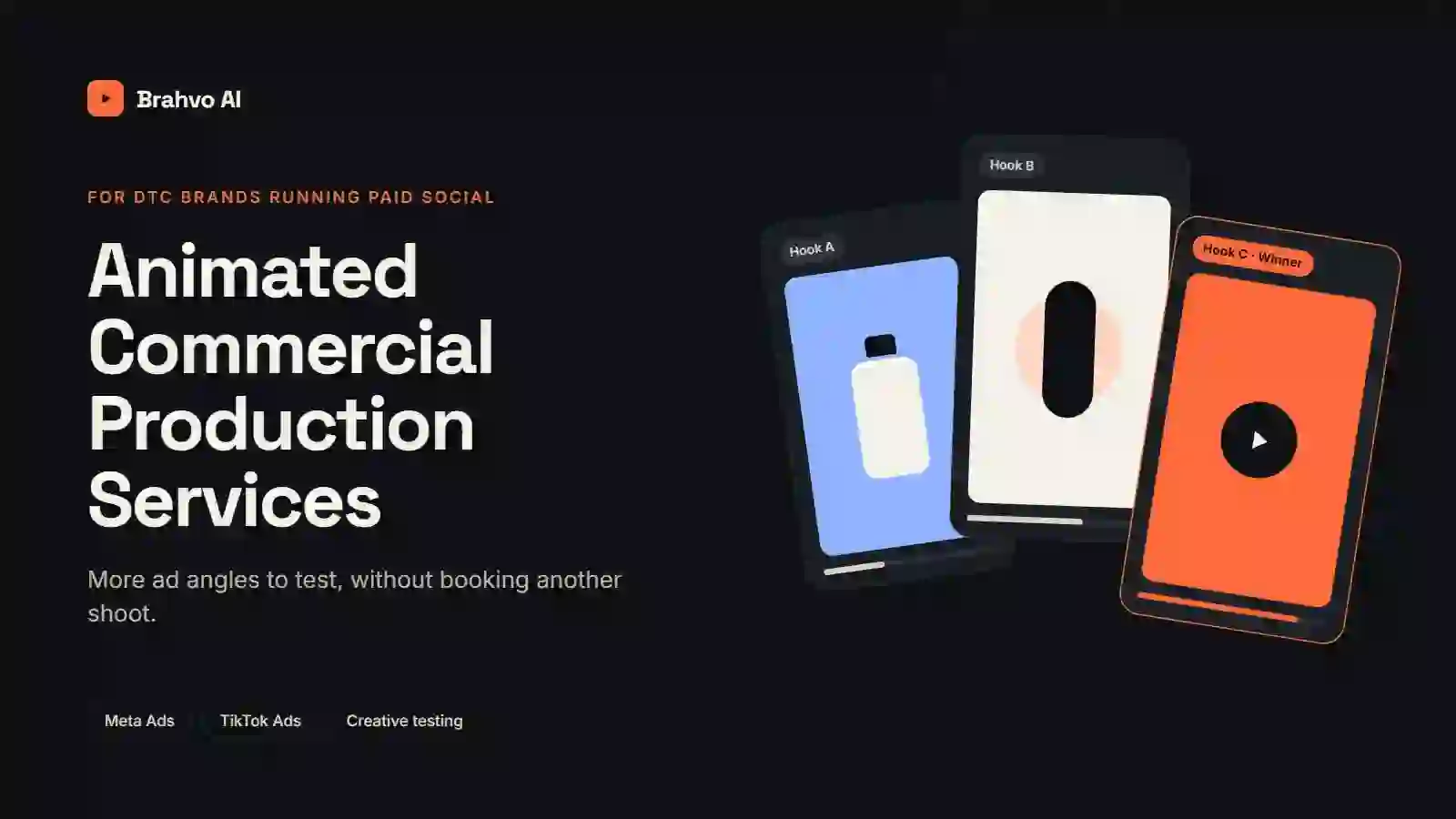
Most founders call me with the same story. Twelve weeks ago a campaign was printing money at a 2.8 ROAS. Then CPMs crept up, frequency went past four, and the winning ad that carried the account started bleeding. Someone on the team suggested changing the audience, someone else blamed the latest Meta update, and the agency asked for "a few weeks to stabilize." Usually none of that is the problem. The account just ran out of fresh creative, and the algorithm has nothing new to work with.
That's creative fatigue. It's boring to say and expensive to ignore. Advantage+ campaigns and broad targeting have moved most of the targeting job onto the ad itself. The creative now decides who sees it, so a brand that ships four new concepts a month is competing against brands shipping forty. You can't out-bid that gap. CAC goes up quietly, a few dollars a week, until someone notices the blended number in a quarterly review and asks what happened.
This is where animated commercial production services have become a practical conversation instead of a creative one. The question isn't whether animation looks nice. It's whether your brand can put enough testable ads into the account to keep finding winners before the old ones die.
The term covers a lot, and some agencies use it loosely, so it helps to be specific. In paid social, animated commercial production services usually mean short-form video ads, mostly 6 to 30 seconds, built from motion graphics, 3D product renders, illustrated characters, kinetic typography, or AI-generated animated scenes rather than filmed footage. The deliverables are cut for placements: 9:16 for Reels, Stories, and TikTok; 1:1 or 4:5 for feed; sometimes 16:9 for YouTube and CTV.
What changed over the last two years is the economics. Five years ago, animation was the expensive option. You hired a studio, waited six weeks for a 30-second explainer, and paid for every revision round. Now AI handles much of the scene generation, character consistency, and variation work, and that has turned animated ad production into something closer to a testing engine than a one-off asset. A good team can take one approved concept and produce versions with different hooks, different first three seconds, different voiceover tones, and different offers in days rather than weeks.
What it doesn't cover, at least not well, is anything that depends on a real person's credibility. If your ad's whole persuasion rests on "a real customer who had acne for six years," animation will feel like a dodge. I'll come back to that, because it matters more than most animation vendors admit.
Here's the math most brands don't run until it hurts. A modest live-action shoot for a DTC product, with talent, a location or studio day, a crew, and editing, rarely comes in under a five-figure budget once you add usage rights. That shoot might produce eight to twelve usable ads. If two of them become winners, that's a good result. Then the winners fatigue in four to eight weeks, and you're booking the next shoot.
Then there's the calendar. Pre-production takes two weeks, the shoot takes a day, and post takes another two weeks. By the time the ads launch, the angle you wanted to test may no longer matter. You wanted to push the Black Friday bundle and the footage arrived on December 4th. I've watched that exact thing happen to a supplement brand, and it wasn't anyone's fault. Live production just runs at a different speed than paid media.
UGC creators help, but they bring their own bottlenecks: briefs get misread, creators ghost, raw footage comes back filmed in landscape, and the good creators book out weeks ahead. Managing twenty creator relationships is a part-time job nobody budgeted for. And there's the agency-client back-and-forth on top. The client wants to see a rough cut before approving the next batch, the agency is waiting on product samples, and two weeks disappear into a Slack thread.
Animation sidesteps most of this because there's nothing to physically capture. No samples to ship, no talent schedule, no reshoot because the lighting was off. The production timeline becomes a creative timeline, which is the one you can actually control.
I'll say this confidently: for most product-led DTC brands, animated video ads are the fastest way to test new angles at volume. If you want to know whether "saves you 20 minutes every morning" beats "dermatologist-formulated" as a lead message, you don't need a creator holding the product to find out. You need two clean ads that are identical except for the hook, shipped this week. Animation is very good at controlled variation like that. It's also strong for:
Now the part animation vendors tend to skip. I might be wrong here, but I don't think animation replaces the trust signal of a real face, especially on TikTok, where the platform's native language is a person talking into a phone. For categories like skincare, weight management, or anything where the buyer's real question is "does this actually work on someone like me," a real testimonial usually still wins on cold traffic. Animation can win the thumb-stop and lose the click. I've seen accounts where animated ads had better hook rates and noticeably worse conversion rates than the UGC running next to them.
So the honest answer is usually both. Use animation to find the angle fast and cheaply, then brief UGC creators on the angle that already proved itself. That way you pay creator rates for a message you already know works, instead of paying them to test guesses. That's the part a lot of brands get backwards.
The way Brahvo AI approaches animated commercial production services starts from that testing logic, not from a storyboard. The first conversation isn't "what should the ad look like." It's "what do you need to learn from the account in the next 30 days." Which angles are untested? Which audience objections keep showing up in your comments and reviews? Which SKU has margin to scale and which one is just inventory you're trying to move?
From one product brief, the work branches out. A single core concept, for example a product-mechanism animation for a hydration supplement, becomes a set of variations: three or four different opening hooks, two voiceover styles, a version that leads with price and one that leads with the problem, plus placement-specific cuts. A typical first month gives a media buyer enough distinct creative to run proper tests instead of swapping one tired ad for another and hoping.
The second thing that matters, and this is less glamorous, is feedback loops. Once ads go live, the hook rate, hold rate, and CTR data shape the next round. If the problem-first hooks are holding attention and the price-first ones aren't, the next batch leans that way. Animated ad production done like this behaves more like a creative ops function sitting beside your media buyer than like an outside studio delivering files.
Honestly, it doesn't fix a bad offer. If your landing page converts at 0.6% or your product has no clear reason to exist, more creative just spends money faster. That's worth knowing before you start.
Here's a setup I see all the time. A US skincare brand doing about $6M a year, with fourteen SKUs, two hero products carrying around 70% of revenue, and a single in-house creative strategist who also writes the emails. Their Meta account had run on the same three UGC ads for most of the year. The other twelve SKUs barely got any creative because nobody could justify a shoot for a $28 eye cream that sells 300 units a month.
The first animated batch didn't go to the hero products. It went to four mid-tier SKUs, with one mechanism-style animation per product showing how the ingredient works on the skin, and five hooks for each. That's twenty ads, launched in a CBO with a modest test budget. Two of the twenty clearly beat the account average on cost per purchase. One of them, a retinol serum ad that opened on the line "why your retinol stings," became the brand's first non-hero product to scale past $500 a day.
The part that surprised them was the effect on the strategist's week, more than the ROAS. She stopped writing briefs for creators who might deliver in three weeks and started reviewing variations every Monday. Same headcount, roughly five times the creative going into the account. Not every month went that well. The second batch had zero winners, which happens.
This is where most decisions actually get made, so here's a rough comparison. Pricing varies widely by scope, so treat these as rough ranges, not quotes.
Live-action shoot
UGC creators
AI-led animated production
Typical cost driver
Crew, talent, location, usage rights
Per-creator fees plus product seeding
Concepts and variation volume
Usable ads per cycle
8 to 12
1 to 3 per creator
15 to 40+ from a few concepts
Time to first ad live
3 to 5 weeks
2 to 4 weeks
Often under 2 weeks
Best at
Brand films, hero assets
Trust and social proof
Angle testing, multi-SKU coverage
The more useful way to think about budget is cost per tested concept, not cost per video. If one live-action shoot gets you ten concepts and an animated commercial production services retainer gets you thirty, the per-ad price matters less than how many real tests each dollar buys.
The tradeoff I'd point out: cheap creative tempts brands to cut their media test budget, and then twenty new ads each get $40 of spend and nothing reaches significance. Plan to spend at least as much testing the ads as you spend making them, maybe more.
Animated video ads tend to show their hand early in the funnel. Watch the hook rate first (3-second views divided by impressions). If an animated ad can't stop the scroll, nothing downstream matters. Hold rate tells you whether the middle of the ad earns its runtime. Then CTR, then cost per purchase against your target CPA.
My working rule is not to scale an animated angle on hook rate alone. Wait until it has enough spend behind it to produce a meaningful number of purchases (what counts as meaningful depends on your AOV) and its CPA holds within range for several days. On TikTok, check that the comments aren't full of people asking "is this AI?" in a skeptical tone. That's a conversion problem dressed up as an engagement metric.
When an angle passes, scale it two ways at once: raise the budget on the winning ad, and have the team produce five fresh variations of that same angle so you aren't betting everything on one asset that will fatigue in a month anyway.
Will animated ads look cheap next to our UGC?
They can, if they're made generically. Good animated ads follow your brand system: your colors, your type, your product's actual shape and packaging. The cheap look usually comes from a stock template, not from the medium.
Does Meta or TikTok penalize AI-generated content?
Not as a ranking rule, as far as I've seen. Both platforms have disclosure labels for certain AI content, and the rules keep changing, so check current policy before launch. The bigger risk is audience reaction, not the algorithm.
How many ads should we expect per month?
It depends on the scope you agree, but think in concepts times variations. Three concepts with five hooks each is already fifteen testable ads.
Can animation work for apparel?
Less well. People want to see fabric move on a body. I'd use it for launch teasers and drop announcements, not for prospecting.
Do we still need our agency?
Probably, if they're good at media buying. Animated ad production fills the creative gap; it doesn't run your account. The best setups have the creative team and the media buyer looking at the same dashboard every week.
What do you need from us to start?
Product images or CAD files, brand guidelines, your best and worst performing ads, and honest notes on customer objections. The objection notes matter more than people think.
Is this only for big brands?
No. Brands spending as little as $20K a month on paid social often benefit most, because they can't afford regular shoots.
What if none of the ads win?
Then you've learned which angles don't work, which is less fun but still useful. If a second round also fails, look at the offer and the landing page before you blame the creative.
How fast can we launch something for a product drop?
Faster than a shoot, usually. The real constraint tends to be your own approval process.