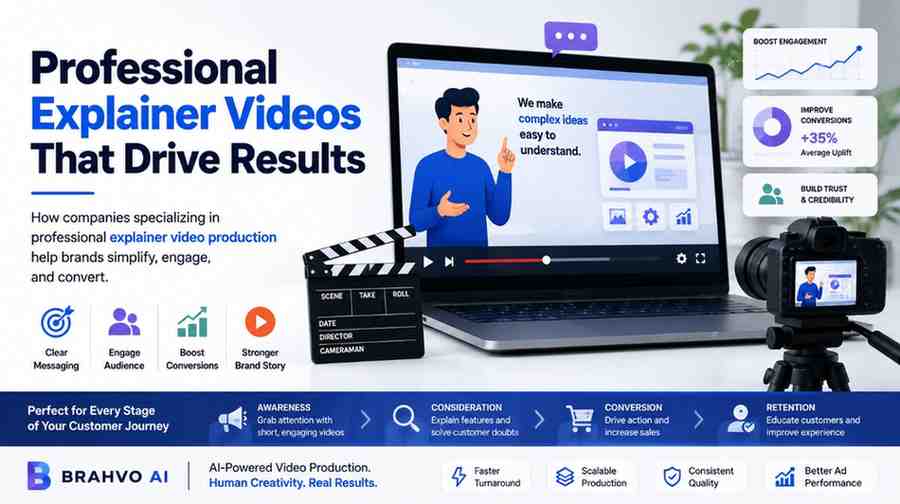
how companies specializing in professional explainer video production help ecommerce and SaaS brands scale creative and improve ad performance.
Most marketing teams aren't struggling to come up with ideas. They're struggling to turn those ideas into videos quickly enough to keep up with product launches, campaign calendars, and changing customer behavior.
That gap has pushed many brands to work with companies specializing in professional explainer video production instead of relying entirely on internal creative teams. The demand isn't simply about creating attractive animations or polished visuals. It's about communicating complex products in a way that helps potential customers understand value within seconds.
For ecommerce brands, new products are introduced throughout the year. Existing products need seasonal campaigns, updated offers, and fresh advertising angles. SaaS companies face a similar challenge. Every feature update, pricing change, or product improvement creates another opportunity, and sometimes another necessity, for an explainer video.
At the same time, paid advertising platforms reward fresh creative. Meta Ads, TikTok Ads, and YouTube campaigns often lose efficiency when the same videos run for weeks without variation. Creative fatigue becomes a real cost center rather than just a creative problem.
That is why businesses increasingly look for companies specializing in professional explainer video production that can produce multiple versions, adapt messaging for different audiences, and keep campaigns moving without long production timelines.
The expectation has changed. Brands no longer want one polished explainer video every quarter. Many now need a steady stream of product explainers, feature breakdowns, onboarding videos, social ads, landing page videos, and customer education assets that can support every stage of growth.
A professional explainer video succeeds long before the animation starts.
It begins with understanding exactly what question the viewer is trying to answer.
Most people don't arrive wondering how impressive a company's production quality is. They're asking something much simpler.
What does this product do?
Will it solve my problem?
Why should I trust it?
The strongest explainer videos answer those questions almost immediately. They avoid lengthy introductions and unnecessary storytelling that delays the main point. Every second has a purpose because online audiences decide very quickly whether to keep watching.
One mistake many brands make is trying to explain everything.
A single video often becomes a product demo, company story, feature tour, pricing discussion, technical overview, customer testimonial, and sales pitch all at once. The result usually feels crowded, making it harder for viewers to remember anything.
Instead, effective explainer videos stay focused on one primary objective. That objective could be increasing product understanding, reducing purchase hesitation, improving onboarding, or supporting a paid advertising campaign. Once the goal is clear, every visual and every line of narration supports that outcome.
I might be wrong here, but many marketing teams spend more time discussing animation styles than customer questions. In reality, viewers rarely remember whether a transition looked impressive. They remember whether the video made the product easier to understand.
That doesn't mean visual quality isn't important. It absolutely is. Clean motion graphics, thoughtful pacing, clear voiceovers, and consistent branding help build credibility. But production quality works best when it supports communication rather than distracting from it.
This becomes especially important in performance marketing, where every creative asset competes for attention inside crowded social feeds.
Professional explainer videos are no longer reserved for homepages or investor presentations.
Today's ecommerce and SaaS companies use them across nearly every customer touchpoint because buyers consume information differently depending on where they are in the decision process.
At the awareness stage, shorter explainer videos introduce the product and communicate its core value within the first few seconds. These versions often appear in Meta Ads, TikTok Ads, YouTube campaigns, and social media feeds where attention is limited.
As prospects begin researching, longer explainers help answer deeper questions. Product pages, landing pages, email campaigns, and comparison pages become natural places for videos that explain features, demonstrate workflows, or simplify technical concepts.
For SaaS businesses, onboarding represents another major opportunity. A customer who understands the platform quickly is more likely to activate key features and continue using the product. Instead of asking support teams to answer the same questions repeatedly, explainer videos provide consistent guidance while reducing friction during setup.
Ecommerce brands also benefit after the purchase. Installation instructions, product care guides, feature walkthroughs, and troubleshooting videos improve customer experience while reducing unnecessary support requests.
Consider a growing direct to consumer skincare brand launching five new products before the holiday season. The media buying team wants separate Meta Ads for different customer segments. The ecommerce manager needs product page videos. Customer support requests short tutorials. Email marketing needs videos for post purchase education.
Without an efficient production workflow, the creative backlog grows almost immediately.
This is one reason many brands work with companies specializing in professional explainer video production that can produce multiple assets from the same creative concept instead of treating every new request as a completely separate production project.
Still, producing more videos isn't automatically better. If every explainer repeats the same message with only small visual changes, performance may not improve as much as expected. Volume matters, but relevance usually matters more. Sometimes one well targeted explainer outperforms five generic ones. That part depends on the audience, the offer, and honestly, a little testing that nobody can predict perfectly.
Media buyers usually notice the problem before anyone else.
Performance starts slipping. Click through rates fall. Cost per acquisition rises. Frequency keeps climbing, but conversions don't follow. The first instinct is often to adjust budgets, audiences, or bidding strategies. Sometimes those changes help. Quite often, the real issue is much simpler.
The creative has stopped doing its job.
Paid advertising moves quickly. A winning Meta Ads campaign today can lose momentum within a few weeks. TikTok Ads reward fresh content. YouTube campaigns benefit from new hooks, different openings, and updated messaging. When creative production can't keep pace, advertising performance eventually pays the price.
Slow video production creates hidden costs that rarely appear on a spreadsheet.
Campaign launches get delayed because creative assets aren't ready.
Winning concepts cannot be scaled while they're still working.
Seasonal promotions miss their ideal launch window.
Product releases wait for videos instead of videos supporting product releases.
A slightly awkward reality is that marketing calendars rarely slow down just because production is behind.
Creative bottlenecks also affect testing velocity. Performance marketing depends on learning what works, which requires multiple variations instead of one polished advertisement. Different hooks, offers, calls to action, visual styles, and audience specific messaging all contribute to stronger optimization.
When production takes weeks for every new video, teams naturally become more cautious. They test fewer ideas because every experiment carries a higher cost in both time and budget.
Eventually, campaigns rely on older creatives long after their best performance period has passed.
That isn't always obvious during weekly reporting, but over several months it can significantly increase customer acquisition costs while limiting growth opportunities.
Choosing between companies specializing in professional explainer video production isn't simply about comparing demo reels.
A visually impressive portfolio tells you what a company has created in the past. It doesn't necessarily tell you how well they'll support an active marketing team running multiple campaigns throughout the year.
The first question should be about process rather than animation style.
How quickly can new concepts move from script to final delivery?
How easily can existing videos be updated?
Can multiple versions be created for different customer segments without rebuilding everything from scratch?
These questions become especially important for ecommerce brands managing large product catalogs or SaaS companies releasing new features on a regular basis.
Communication also matters more than many businesses expect.
Marketing teams often need revisions after reviewing campaign data, customer feedback, or sales conversations. A production partner should be able to adapt messaging without turning every revision into a completely new project.
Another consideration is whether the production approach supports ongoing creative testing.
One finished explainer video may look excellent, but advertising teams frequently need shorter edits, vertical formats, platform specific versions, alternate openings, different calls to action, and audience specific messaging.
The ability to create an entire family of creative assets from a single production effort often delivers far more business value than producing one standalone video.
It is also worth asking how well the production team understands paid media itself.
A beautiful explainer video isn't automatically an effective advertising asset. Teams familiar with Meta Ads, TikTok Ads, YouTube placements, landing page optimization, and customer acquisition usually make different creative decisions because they understand where the video will actually be used.
AI has changed video production conversations, but perhaps not in the way many people expected.
The biggest advantage isn't replacing creativity.
It's removing repetitive production work that slows creative teams down.
Traditional production often requires rebuilding assets, editing timelines manually, coordinating multiple specialists, and repeating similar tasks for every variation. That process works well for a single flagship video. It becomes much harder when marketing teams suddenly need twenty different versions for paid advertising.
AI powered workflows help shorten those production cycles.
Instead of spending weeks creating every variation individually, creative teams can develop multiple hooks, alternate scenes, revised messaging, different voiceovers, and platform specific edits much more efficiently.
That speed directly supports creative testing.
Imagine an ecommerce brand preparing a new supplement launch. The paid media team wants four audience angles, three opening hooks, two promotional offers, and separate vertical videos for Meta Ads, TikTok Ads, and YouTube Shorts.
Under traditional production timelines, the team may only launch a handful of those ideas.
With AI assisted production, testing more creative combinations becomes much more realistic without sacrificing brand consistency.
That doesn't mean every project should rely heavily on automation.
Some campaigns still deserve custom storytelling, original animation, or premium production quality where speed isn't the highest priority. AI works best when it helps experienced creative professionals produce more meaningful variations, not when it replaces strategic thinking altogether.
The brands seeing the strongest results generally combine human creative direction with AI enabled production workflows rather than treating AI as a substitute for creative expertise.
Brahvo AI was built around a challenge that many ecommerce brands and SaaS companies face every month.
Demand for video content keeps growing, while production capacity often stays the same.
Marketing teams need product explainers for new launches, paid advertising creatives, customer education videos, landing page assets, social media content, and campaign specific variations. Waiting several weeks for every production cycle simply doesn't fit the pace of modern performance marketing.
Instead of treating every request as an isolated project, Brahvo AI focuses on building production systems that support continuous creative output.
A single creative concept can evolve into multiple explainer videos designed for different audiences, placements, campaign objectives, and customer journey stages.
For example, one product announcement might become a homepage explainer, several Meta Ads, short TikTok videos, YouTube campaign assets, product page demonstrations, and customer onboarding videos while maintaining consistent messaging across every version.
This approach helps marketing teams spend less time waiting for production and more time analyzing campaign performance, refining messaging, and launching new creative tests.
Collaboration is another area where production often becomes complicated.
Creative teams, media buyers, ecommerce managers, founders, and marketing directors frequently have different priorities. Brahvo AI streamlines communication by creating production workflows that keep revisions organized while allowing campaigns to move forward without unnecessary delays.
The goal isn't simply producing more videos.
It's helping businesses maintain the consistent flow of creative assets required to support modern customer acquisition across multiple advertising channels.
Many companies begin their search with the wrong priorities.
The first comparison often focuses on price or visual style, while the production workflow receives far less attention. Unfortunately, workflow is usually what determines whether the partnership succeeds over the long term.
Another common mistake is assuming one explainer video will solve every communication challenge.
Different audiences ask different questions. Prospective customers seeing a Meta Ad for the first time need different information than existing customers watching an onboarding tutorial or decision makers comparing software solutions.
Trying to combine every message into one video usually weakens all of them.
Some businesses also underestimate how frequently creative needs to change.
An explainer produced today may require updates after new product releases, pricing adjustments, feature improvements, customer feedback, or advertising insights. Choosing a production partner that cannot efficiently handle ongoing revisions often creates unnecessary delays later.
There is also a tendency to judge success almost entirely by production quality.
Visual polish certainly matters, but business outcomes matter more.
Did the video reduce customer confusion?
Did product pages convert better?
Did paid advertising generate stronger engagement?
Did support teams receive fewer repetitive questions?
Those answers provide a much clearer picture of value than animation quality alone.
Finally, some brands treat video production as a one time purchase rather than an ongoing business capability.
For companies investing consistently in paid advertising, ecommerce growth, or SaaS customer acquisition, video rarely remains a single project. It becomes part of an ongoing marketing operation that requires fresh creative, regular testing, and continuous refinement as customer behavior changes. That shift in mindset often makes the difference between simply owning videos and actually using them to support long term growth.
Before signing a contract, marketing teams should spend less time asking, "Can they make great videos?" and more time asking, "Can they support the way we actually market?"
Those are two very different questions.
A company may produce an impressive portfolio but still struggle to keep pace with a fast moving ecommerce brand running weekly campaigns. If your team regularly launches new products, refreshes Meta Ads, experiments with TikTok creatives, or updates landing pages, production capacity matters just as much as creative quality.
Here are a few practical questions worth asking during the evaluation process.
Question
Why It Matters
How quickly can new explainer videos be delivered?
Faster turnaround helps campaigns launch on schedule and reduces creative bottlenecks.
Can one project be adapted into multiple versions?
Marketing teams often need variations for Meta Ads, TikTok Ads, YouTube, landing pages, and email campaigns.
How do you handle revisions after campaign feedback?
Paid media performance changes constantly, so messaging often needs updates after launch.
Do you understand performance marketing goals?
Explainer videos should support conversions, not just look visually impressive.
Can production scale as our business grows?
A partner should support ongoing creative needs rather than only one time projects.
How do you keep messaging consistent across multiple videos?
Brand consistency becomes more important as the number of campaigns increases.
Another useful discussion involves creative testing.
Ask how the production process supports different hooks, customer personas, promotional offers, and advertising placements. If every variation requires starting from scratch, scaling creative production may become expensive and time consuming.
One thing founders sometimes overlook is internal collaboration.
A production partner should fit naturally into the existing workflow between marketing managers, media buyers, designers, product teams, and leadership. Even excellent creative can become frustrating if approvals, revisions, and communication slow everything down.
Choosing among companies specializing in professional explainer video production should ultimately come down to how well they support long term marketing execution, not simply how attractive their demo reel looks.
Why do businesses hire companies specializing in professional explainer video production?
Most businesses hire companies specializing in professional explainer video production because they need clear, engaging videos that explain products, services, or software while supporting customer acquisition, education, and advertising across multiple channels.
Are explainer videos useful for ecommerce brands?
Yes. Ecommerce brands use explainer videos on product pages, landing pages, Meta Ads, TikTok Ads, YouTube campaigns, email marketing, and post purchase communication. They help customers understand products faster and reduce purchase hesitation.
Do SaaS companies benefit from professional explainer videos?
Absolutely. SaaS companies often use explainer videos for product demonstrations, onboarding, feature announcements, customer education, and sales enablement. A well planned explainer can reduce confusion while helping prospects understand the software before requesting a demo.
How often should advertising creatives be refreshed?
There is no universal timeline.
Some campaigns perform well for months, while others begin showing signs of creative fatigue within a few weeks. Monitoring performance data usually provides a better answer than following a fixed schedule.
Can one explainer video be repurposed for multiple platforms?
Yes. Many production teams create different versions from the same core concept, including vertical videos, shorter advertisements, product page explainers, social media assets, and campaign specific edits.
Does AI replace human creativity in video production?
Not really.
AI can speed up production tasks, generate more creative variations, and simplify editing workflows, but strategy, messaging, storytelling, and creative direction still benefit from experienced human input.
What should businesses prioritize when selecting a production partner?
Look beyond visual quality. Consider turnaround time, communication, revision processes, scalability, paid media knowledge, and the ability to support ongoing creative production instead of only one project.
How does Brahvo AI support brands with explainer video production?
Brahvo AI helps ecommerce brands, SaaS companies, and marketing teams produce scalable explainer videos using AI powered production workflows. This allows businesses to create more creative variations, support continuous testing, and keep advertising campaigns supplied with fresh video assets while maintaining consistent brand messaging.
Are professional explainer videos only useful for paid advertising?
No. They also improve website engagement, customer onboarding, product education, email marketing, sales presentations, support documentation, and internal training. Many businesses find that the same video can create value across several departments.
Is producing more explainer videos always the right strategy?
Not necessarily.
More videos create more testing opportunities, but relevance still matters most. A smaller number of highly targeted explainer videos can outperform a large library of generic content if they answer the right customer questions and align with specific campaign goals.
Even after finding the right production partner, one challenge never really disappears. Customer expectations keep changing, advertising platforms evolve, and yesterday's winning creative eventually loses momentum. The brands that continue growing are usually the ones prepared to adapt before performance forces them to.