Scale faster with London small medium brands content creation photography videography by Brahvo AI for ecommerce and DTC brands.
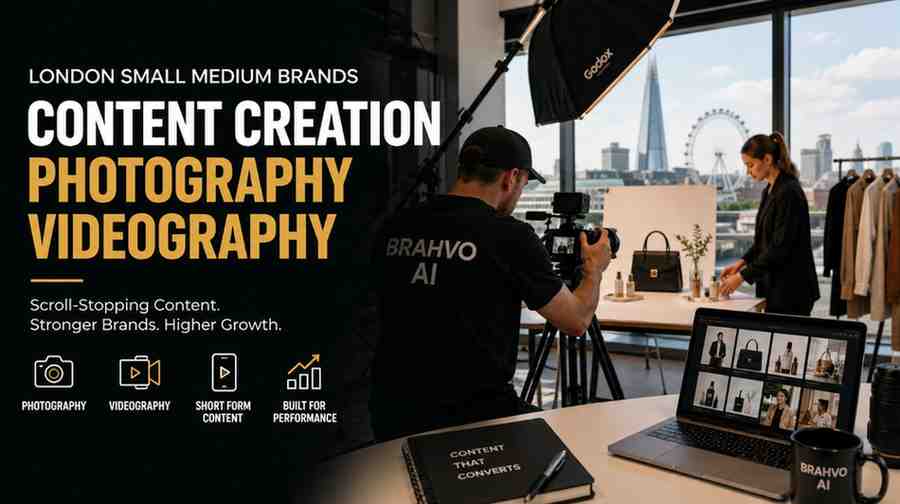
For many growing businesses, creating great products is no longer enough. Customers discover brands through Instagram, TikTok, YouTube Shorts, Google, and paid social campaigns long before they visit a website. That means every image, product video, customer testimonial, and behind the scenes clip plays a role in whether someone clicks, buys, or keeps scrolling.
This is exactly why london small medium brands content creation photography videography has become a business priority instead of a marketing task. London is filled with ambitious ecommerce companies, lifestyle brands, beauty businesses, fashion labels, food startups, wellness companies, and consumer product brands competing for attention every single day. Even when products are comparable, the brand with better creative often wins more clicks and lower acquisition costs.
Media buyers see this constantly. Two campaigns can target the same audience with similar budgets, but the campaign using stronger product photography and authentic video content often generates better engagement and gives advertising platforms more opportunities to optimize delivery. Creative quality affects performance in ways many founders don't initially expect.
Another shift is the growing demand for content across multiple channels. A single campaign may require vertical videos for TikTok, square images for Instagram, lifestyle photography for product pages, email graphics, paid social creatives, and refreshed assets for remarketing. Suddenly, one product launch needs dozens of pieces of content instead of just a few polished photos.
That is where london small medium brands content creation photography videography becomes less about producing beautiful visuals and more about building a repeatable system that supports business growth. Instead of scrambling before every launch, brands can maintain a steady flow of creative assets ready for advertising, ecommerce, email marketing, and organic social content.
Many founders still think content production is something they only need before launching a new collection. In reality, advertising platforms reward continuous creative testing. Fresh visuals help reduce audience fatigue, create new testing opportunities, and support ongoing campaign optimization throughout the year.
Most small and medium brands are not struggling because they lack ideas. They struggle because producing content consistently is much harder than it appears.
A marketing manager might have a calendar filled with campaign concepts, but coordinating photographers, videographers, product samples, locations, creators, editing, approvals, and final asset delivery quickly becomes complicated. By the time everything is approved, the planned promotion may already be behind schedule.
Creative fatigue is another issue that quietly impacts advertising performance. Meta Ads and TikTok Ads rarely fail because audiences suddenly dislike the product. Often, the same videos have simply been shown too many times. Frequency increases, click through rates decline, and customer acquisition costs begin climbing. The media buying team asks for fresh creative, but the content team is already overloaded.
Brands with multiple SKUs face an even bigger challenge. Imagine a London skincare company introducing six new products while maintaining evergreen campaigns for existing best sellers. Every product needs studio photography, lifestyle imagery, demonstration videos, customer testimonials, paid advertising creatives, website visuals, and social media content. The workload grows much faster than most internal teams anticipate.
Budget adds another layer of complexity. Hiring crews for every campaign isn't always realistic for growing businesses. Internal marketing teams often have to choose between launching campaigns with older assets or delaying campaigns while waiting for new creative.
I might be wrong here, but many founders initially assume spending more on media buying will solve slowing campaign performance. Sometimes that's true. Quite often, though, the real bottleneck is that the creative library hasn't evolved in weeks or even months.
This is why london small medium brands content creation photography videography has shifted from being a branding investment to becoming an operational necessity. Consistent production helps marketing teams keep campaigns moving instead of constantly reacting to creative shortages.
The brands that scale consistently rarely think in terms of one photo shoot at a time. They think about building a content engine that continuously supplies assets for every marketing channel.
That starts with planning photography and videography together rather than treating them as separate projects. During a single production day, teams can capture product photography, lifestyle imagery, vertical videos, behind the scenes footage, founder interviews, customer demonstrations, and short clips designed specifically for paid social campaigns.
One filming session can easily support weeks of advertising if the production is planned around marketing objectives instead of isolated deliverables.
Consider a realistic scenario. A London based DTC home goods brand prepares for its autumn product launch. Rather than scheduling one photo shoot this month and another video session later, the team captures product detail images, packaging photography, lifestyle scenes, six second Meta Ads, TikTok style product demonstrations, website banners, customer testimonial videos, and email campaign visuals during the same production schedule.
Instead of leaving with twenty finished assets, they leave with hundreds of creative variations that can be edited, resized, tested, and reused across different campaigns.
This approach also improves collaboration between creative teams and paid media managers. Media buyers can request shorter hooks, different opening shots, alternate product angles, or revised calls to action without organizing another expensive production day.
That flexibility matters because advertising performance changes quickly. What works for one audience segment may not work for another. Creative testing depends on having enough variations available to test different concepts without rebuilding campaigns from scratch.
This is where london small medium brands content creation photography videography becomes closely connected with long term advertising performance. The goal isn't simply producing attractive visuals. The goal is creating a reliable flow of creative assets that supports product launches, customer acquisition, remarketing, retention campaigns, and ongoing creative testing across every stage of the ecommerce journey.
Some months everything runs smoothly. Other months... not quite. That's normal. The brands that continue producing fresh creative anyway are often the ones that keep finding new growth opportunities while competitors struggle with the same aging ad library.
One of the biggest mistakes growing brands make is producing one piece of content and expecting it to perform everywhere. The creative that works on a product page isn't always the same creative that gets someone to stop scrolling on Instagram Reels or TikTok. Likewise, an email campaign often needs different visuals than a YouTube ad.
That is why london small medium brands content creation photography videography should always begin with distribution in mind. Before a camera is even picked up, it helps to know where the content will be used and what job it needs to do.
Meta Ads usually reward strong opening visuals that capture attention within the first few seconds. TikTok audiences often respond better to content that feels authentic, less polished, and more creator driven. YouTube can support slightly longer storytelling, especially when introducing a product or showing real customer use. Ecommerce product pages need images and videos that reduce hesitation by answering questions visually. Email campaigns often perform better with clean product imagery and concise supporting visuals that encourage clicks.
Instead of creating separate productions for every platform, many brands now build one well planned content session that generates assets in multiple formats. A single product demonstration can become a vertical ad for Instagram, a shorter TikTok clip, a product page video, an email GIF, and several static images for remarketing campaigns.
This approach saves time while creating more opportunities for testing. Paid media teams can experiment with different openings, thumbnails, captions, lengths, and product angles without returning to production every time performance begins to slow.
For brands managing multiple products, this flexibility becomes even more valuable. Rather than constantly worrying about running out of creative, marketing teams have a growing library of assets that can be refreshed, edited, and repurposed throughout the year.
The demand for content has increased dramatically over the last few years. A growing ecommerce business may launch several campaigns every month while also maintaining evergreen advertising, seasonal promotions, email marketing, social media, and website updates.
Keeping pace with that demand using traditional production alone can quickly become difficult.
This is where AI supported production is changing the workflow behind london small medium brands content creation photography videography. Rather than replacing photographers or videographers, AI helps creative teams produce, organize, edit, and adapt content much faster.
For example, one production day can generate dozens of product demonstrations, lifestyle clips, and customer focused visuals. AI assisted editing can then create multiple versions optimized for different aspect ratios, campaign objectives, and advertising placements. Instead of producing one final video, brands receive numerous creative variations ready for testing.
This speed matters because advertising rarely stays still. A campaign that performs well this week may begin showing signs of creative fatigue next month. When fresh content can be produced quickly, media buyers have more freedom to test new hooks, alternate messaging, revised product sequences, and different visual styles without disrupting campaign momentum.
Another advantage is consistency. AI assisted workflows help maintain visual quality across campaigns, even when creating a large volume of assets. That becomes especially useful for brands introducing new collections every few weeks or managing extensive product catalogs.
There is one important point, though. AI works best when it supports strong creative ideas rather than replacing them. Great advertising still depends on understanding customers, products, buying behavior, and storytelling. Technology can accelerate production, but it cannot invent genuine customer insight on its own.
Many marketing teams focus heavily on launch dates while giving less attention to everything that happens afterward.
A successful launch often depends on having enough creative ready before campaigns begin, but sustained growth depends on having enough content available once testing starts.
Think about a London fashion brand preparing for a holiday collection. Product photography is completed, launch videos are edited, and paid campaigns go live. Within two weeks, the media buying team identifies three winning audiences and two winning creative concepts. Now they need additional variations to continue scaling.
Without a content workflow already in place, the team may have to organize another production session, wait for editing, request approvals, and postpone testing while campaign performance begins to plateau.
A stronger workflow avoids this problem by planning content in layers. Initial production captures launch assets along with alternate hooks, additional product angles, lifestyle scenes, customer demonstrations, behind the scenes footage, and shorter clips that can be introduced later as campaigns mature.
Creative testing becomes much easier because there is already a library of unused content available for experimentation.
This also improves forecasting. Marketing teams know what creative will support upcoming product launches, promotional events, seasonal campaigns, and evergreen advertising instead of producing everything at the last minute.
It sounds simple. It rarely feels simple when three campaigns are launching in the same week.
Brands that consistently invest in london small medium brands content creation photography videography often spend less time reacting to production delays and more time making strategic advertising decisions based on actual campaign performance.
Choosing a creative partner is about much more than reviewing a portfolio.
Beautiful visuals certainly matter, but ecommerce brands also need content that performs inside real advertising campaigns. A creative team should understand why a product video is being produced, how it will be tested, where it will appear, and how different versions support different audiences.
That means asking practical questions before production begins.
Can the same content be adapted for Meta Ads, TikTok Ads, YouTube Shorts, ecommerce product pages, and email campaigns?
Can multiple creative variations be delivered instead of one final edit?
Will photography and videography be planned together to maximize production time?
Can the production schedule support frequent product launches?
Does the workflow allow future creative updates without rebuilding everything from scratch?
These questions often reveal more than an impressive showreel.
Another factor worth considering is communication. Creative projects involve marketers, founders, designers, editors, media buyers, and ecommerce managers. Delays usually happen when expectations are unclear rather than because production itself takes longer.
The right partner should make collaboration easier by understanding campaign timelines, advertising goals, and content priorities before filming begins.
For growing businesses, london small medium brands content creation photography videography should function as an extension of the marketing operation instead of becoming another disconnected vendor relationship.
Brahvo AI works with ecommerce brands that need more than attractive creative. The focus is on helping businesses build scalable content systems that support advertising performance, customer acquisition, and long term growth.
Instead of treating photography and videography as isolated projects, Brahvo AI plans content around how modern marketing teams actually operate. Product launches, paid social campaigns, email marketing, ecommerce websites, remarketing, and ongoing creative testing all require different types of assets. Producing them together creates a much more efficient workflow.
For brands managing multiple SKUs, frequent promotions, or seasonal collections, this integrated approach helps maintain a steady supply of fresh creative without slowing campaign execution.
AI assisted production workflows also make it possible to generate more usable variations from every content session. Rather than delivering only a handful of finished assets, Brahvo AI helps brands build larger creative libraries that support continuous testing across Meta Ads, TikTok Ads, YouTube, ecommerce stores, and other customer touchpoints.
Every production is planned with performance in mind. Teams consider audience behavior, campaign objectives, platform requirements, and creative testing opportunities before filming begins. The result is content designed to work across the complete customer journey instead of serving only one channel.
As london small medium brands content creation photography videography continues to play a bigger role in advertising success, businesses need creative partners who understand both production quality and performance marketing. Brahvo AI brings those two disciplines together, helping brands create photography and video content that is built for today's ecommerce environment while remaining flexible enough for tomorrow's campaigns.
Before committing budget to london small medium brands content creation photography videography, it helps to step back and ask a few practical questions. The goal is not simply to receive attractive photos or polished videos. The goal is to invest in creative assets that can support revenue, customer acquisition, and long term marketing performance.
Here are some questions worth asking before moving forward.
How often will we realistically need new content?
Some brands launch new products every quarter, while others introduce fresh collections every few weeks. Your production schedule should match your marketing calendar, not the other way around.
Which marketing channels will use these assets?
Think beyond Instagram. Consider Meta Ads, TikTok Ads, YouTube, email campaigns, ecommerce product pages, landing pages, Google Shopping, and organic social content. Planning for every channel upfront usually produces far more useful creative.
Are we creating enough variations for testing?
One finished video is rarely enough for paid advertising. Successful campaigns often depend on testing different openings, product angles, captions, lengths, and calls to action before finding a winner.
Can this production support future campaigns?
Strong production planning captures extra footage and photography that can be reused later. This reduces the need for constant reshoots whenever a new promotion or product launch arrives.
Does the creative reflect how customers actually shop?
Customers want to see products in real situations. Lifestyle imagery, demonstrations, close up product details, and authentic usage often build more confidence than heavily staged visuals alone.
Will the content still be useful six months from now?
Some campaign assets are highly seasonal, while others remain valuable throughout the year. Building a library with both evergreen and campaign specific content provides more flexibility.
Can the production process keep pace with business growth?
As product catalogs expand and advertising budgets increase, content demand usually grows just as quickly. Choosing a workflow that can scale saves time and avoids future bottlenecks.
Thinking through these questions helps brands make smarter investments in london small medium brands content creation photography videography instead of making decisions based only on visual style or production cost.
1. Why is professional content creation important for small and medium brands in London?
Professional content helps brands present products consistently across websites, paid ads, social media, and email marketing. Better creative also gives marketing teams more assets to test, which can improve campaign performance over time.
2. How often should ecommerce brands create new photography and video content?
There isn't a single answer. Brands running active Meta Ads or TikTok Ads often refresh creative every few weeks, while businesses with fewer campaigns may update content every few months. The right schedule depends on campaign volume, product launches, and audience fatigue.
3. Can one content shoot produce assets for multiple marketing channels?
Yes. A well planned production can generate photography and video content for ecommerce stores, Meta Ads, TikTok Ads, YouTube, email campaigns, landing pages, and organic social media at the same time.
4. Does AI replace photographers and videographers?
No. AI works best as a production accelerator rather than a replacement. It helps with editing, resizing, version creation, and workflow efficiency, while experienced creative professionals still guide storytelling, lighting, composition, and overall production quality.
5. How many creative variations should brands have for paid advertising?
Most paid media teams prefer having multiple versions of each concept. Different hooks, product demonstrations, thumbnails, lengths, and messaging angles give advertisers more opportunities to identify winning creatives.
6. Is content creation only useful for ecommerce businesses?
Not at all. Service businesses, consumer brands, restaurants, wellness companies, technology firms, and many other businesses benefit from professional photography and videography that supports digital marketing.
7. How does Brahvo AI approach london small medium brands content creation photography videography differently?
Brahvo AI plans every production around real marketing objectives. Instead of creating isolated assets, the focus is on building content libraries that support paid advertising, ecommerce growth, creative testing, and ongoing campaign optimization across multiple channels.
8. Should brands prioritize photography or videography first?
If resources are limited, the answer depends on how customers discover your business. Brands relying heavily on paid social often see strong value from video, while ecommerce stores also need high quality product photography to improve product pages and conversion rates. In many cases, producing both together delivers the strongest return.
9. What should businesses prepare before a production day?
Prepare products, brand guidelines, campaign goals, target audiences, key selling points, preferred locations, and a list of marketing channels where the content will be used. Better preparation usually leads to more usable assets.
10. How do you measure the success of content creation?
Success goes beyond how the content looks. Businesses should monitor engagement, click through rates, conversion rates, customer acquisition costs, creative testing results, and how long assets continue performing before needing replacement.
One question still remains for many growing brands. As advertising platforms continue demanding more creative every month, is the biggest challenge producing better content, or simply producing enough of it consistently without slowing down?