Learn how creative video production helps ecommerce brands scale ads, test faster, and reduce creative fatigue with Brahvo AI.
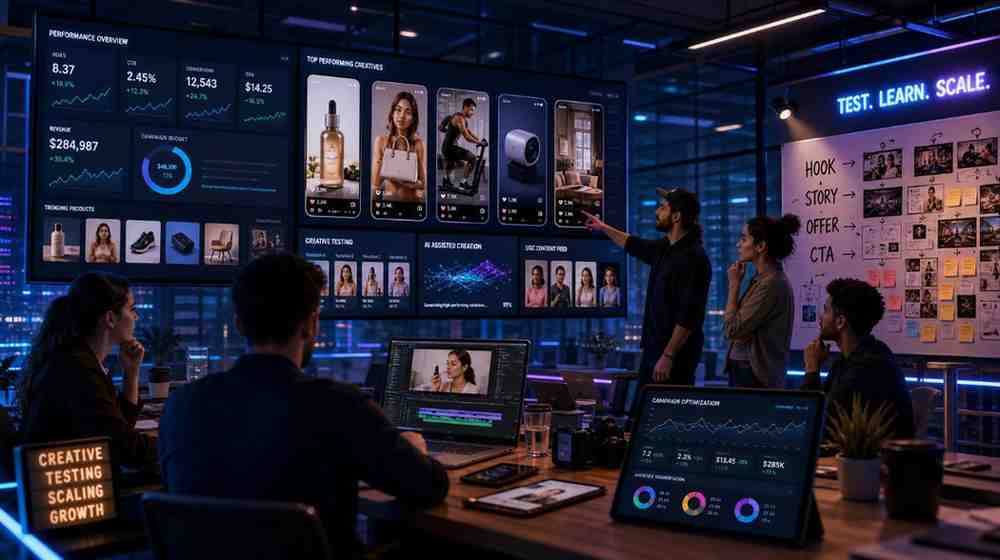
Most ecommerce teams don't lose momentum because they run out of advertising budget. They lose momentum because they run out of fresh creative.
That's become one of the biggest shifts in paid media over the last few years. Platforms like Meta, TikTok, and YouTube rely heavily on creative quality to determine how audiences respond. Even well structured campaigns can stall when the same videos keep circulating to the same people. Click through rates begin to soften, cost per acquisition starts climbing, and scaling becomes much harder than expected.
This is why creative video production has become one of the most valuable investments for ecommerce brands. Instead of treating video as a one time asset created for a product launch, high growth brands now see it as an ongoing performance engine. Every new variation creates another opportunity to test a different hook, opening, message, offer, or customer pain point.
For brands managing dozens or even hundreds of products, this becomes even more important. Different customer segments respond to different styles of communication. One audience may react to quick product demonstrations, while another may engage more with customer testimonials, creator style content, or educational videos. A single polished advertisement rarely serves every audience equally well.
The challenge becomes even bigger during seasonal promotions, holiday campaigns, product launches, and flash sales. Marketing teams need fresh videos ready before campaigns begin, not weeks after performance starts declining. Waiting for lengthy production schedules often means missing valuable testing opportunities while competitors continue introducing new creative angles.
This is where creative video production shifts from being a design task to a business growth strategy. The objective is no longer producing one perfect commercial. Instead, it is building a steady pipeline of video assets that can be tested, refined, and expanded as advertising data reveals what customers actually respond to.
Brahvo AI supports this approach by helping ecommerce brands create larger volumes of advertising creatives without relying on slow, traditional production cycles. That gives marketing teams more flexibility to test ideas, refresh campaigns more frequently, and keep paid media performance moving in the right direction instead of constantly reacting to creative fatigue.
Creative fatigue usually appears gradually, which makes it difficult to spot early.
An ad that performed exceptionally well for several weeks suddenly starts producing fewer purchases. Frequency increases. Engagement falls. Cost per click rises. Return on ad spend begins slipping even though the targeting, bidding strategy, and product pricing haven't changed.
Many ecommerce teams initially assume the platform has changed its algorithm or that audience demand has weakened. Sometimes that's true. But very often, the biggest issue is simply that people have already seen the same creative too many times.
Meta Ads, TikTok Ads, and YouTube campaigns all reward content that continues attracting attention. Once viewers begin scrolling past familiar videos, platform algorithms receive weaker engagement signals. Distribution becomes less efficient, making every conversion more expensive.
Creative fatigue becomes even more noticeable for brands investing significant monthly advertising budgets. A company spending thousands of dollars every day can exhaust high performing creatives surprisingly quickly. Without a reliable process for producing new variations, media buyers are forced to stretch aging ads well beyond their effective lifespan.
Managing multiple products only adds to the complexity. A skincare brand may have separate campaigns for moisturizers, cleansers, serums, sunscreen, and bundles. Each product serves different customer needs and often requires different messaging. Trying to support every campaign with only a handful of videos quickly creates bottlenecks.
This doesn't necessarily mean every creative needs to be completely rebuilt. Small adjustments often produce meaningful differences. Testing new openings, changing product demonstrations, updating creator footage, highlighting different customer objections, or introducing alternative calls to action can all create fresh learning opportunities.
I might be wrong here, but many marketers still underestimate how much of their advertising performance depends on consistently introducing new creative rather than endlessly optimizing campaign settings. There is certainly a place for audience refinement and bidding adjustments, yet fresh creative frequently has the larger impact once campaigns reach scale.
The brands that continue growing are often the ones that treat creative production as an ongoing operational function instead of an occasional project.
Many ecommerce companies still rely on production processes that were designed for brand campaigns rather than performance marketing.
A typical workflow starts with brainstorming concepts, followed by scripting, scheduling creators, booking filming days, reviewing edits, requesting revisions, waiting for approvals, exporting multiple versions, and finally delivering finished assets to the paid media team. By the time everything is ready, the campaign priorities may have already shifted.
That delay creates a real business problem.
Media buyers make decisions based on live campaign data. They may identify a winning customer angle on Monday, but if it takes three weeks to produce a matching video, the opportunity can disappear before the creative is ever launched.
This gap between performance insights and creative delivery often limits growth more than advertising budget itself.
Consider a DTC supplement brand running campaigns for five different products. During one week, the media team notices that short testimonial style videos are outperforming polished product demonstrations for two products, while educational videos generate stronger engagement for another. Ideally, they would launch multiple variations immediately to validate those findings across additional audiences.
Instead, the request enters a production queue.
Filming schedules need coordination. Editors wait for updated footage. Internal approvals slow revisions. New exports take time. And then... the market has already moved.
Traditional workflows also create communication friction between creative teams and paid media teams. Designers naturally focus on visual quality and brand consistency, while performance marketers care about testing speed, messaging variations, and measurable outcomes. Neither perspective is wrong, but they often operate on different timelines.
Creative video production designed for performance marketing takes a different approach. Instead of producing a small number of polished advertisements every quarter, the process supports continuous experimentation. Marketing teams can quickly generate multiple creative concepts, identify what resonates with customers, and expand winning ideas before campaign momentum fades.
For brands managing dozens of campaigns simultaneously, that speed becomes less of a convenience and more of a competitive necessity.
Most performance marketers don't struggle because they lack ideas. They struggle because they can't test those ideas quickly enough.
Every week brings another promotion, another audience segment, another product launch, or another customer insight. By the time one creative is approved, several new testing opportunities have already appeared. That's why creative video production has become closely tied to campaign velocity rather than simply content creation.
Take a DTC apparel brand with more than 80 SKUs. The paid media team may want to test one offer for first time buyers, another for returning customers, and a completely different message for seasonal shoppers. On top of that, each campaign could require separate versions for Meta Ads, TikTok Ads, YouTube Shorts, Instagram Reels, and Stories.
One video isn't enough anymore.
The same product can be introduced through lifestyle footage, customer testimonials, problem solution storytelling, creator style reviews, feature demonstrations, comparison angles, or before and after scenarios. Sometimes the smallest change, like replacing the first three seconds of a video, completely changes campaign performance.
That's why experienced media buyers rarely ask for "one more ad." They ask for more variations.
Creative testing also becomes more effective when marketers isolate variables. Instead of changing everything at once, they might keep the same product footage while testing different hooks. Then they keep the winning hook and experiment with different calls to action. Later they may test different pricing messages or promotional offers.
Each variation generates useful data.
The process feels much closer to running experiments than producing advertisements.
Managing this volume manually becomes difficult as advertising budgets increase. Teams often discover they have dozens of campaign ideas sitting in project management boards while production schedules remain fully booked.
That's where creative video production built around speed creates a measurable advantage. Instead of waiting weeks between ideas and execution, marketing teams can keep feeding campaigns with fresh concepts based on actual performance data. Every new creative provides another opportunity to learn what customers respond to before competitors uncover the same insight.
Of course, not every test becomes a winner. Most don't. But consistent testing increases the likelihood of finding the few creatives that produce outsized returns, and those winners often justify dozens of unsuccessful experiments.
Finding a profitable advertisement is exciting.
Keeping that momentum alive is usually much harder.
Many ecommerce brands finally identify a creative that lowers acquisition costs and increases purchase volume. Budgets start rising. Campaigns expand into new audiences. Then the same problem returns. The winning creative begins losing effectiveness because more people have already seen it.
Scaling requires fresh versions before performance declines.
Unfortunately, traditional production teams often become overwhelmed precisely when demand for new creatives increases. Every successful campaign creates requests for more edits, additional formats, localized versions, new creator styles, seasonal updates, and audience specific messaging.
The production queue grows faster than the creative library.
I've seen marketing teams spend days debating audience targeting when the real issue was that they had only three usable videos supporting a campaign spending tens of thousands of dollars every month. It sounds obvious after the fact, but it happens surprisingly often.
A smarter approach is to treat successful creatives as starting points rather than finished products.
Suppose a product demonstration performs well with parents. Instead of running that single video until results decline, the team immediately creates several additional versions. One might focus on convenience, another on product quality, another on customer reactions, and another on solving a common frustration. The core idea remains the same while the execution changes enough to extend campaign life.
This creates a steady pipeline instead of constant emergencies.
There is a tradeoff, though. Producing more videos does not automatically improve advertising performance. If the additional creatives simply repeat the same messaging with cosmetic changes, the testing value remains limited. Quality thinking still matters. Creative volume works best when every variation explores a different customer motivation or buying trigger.
That's where experienced creative strategy becomes just as important as production capacity.
Performance marketing moves quickly, but traditional production timelines rarely do.
Brahvo AI was built around a different reality. Instead of treating video production as a large standalone project, the focus is helping ecommerce brands maintain a continuous flow of advertising creatives that support ongoing testing across multiple campaigns.
For many marketing teams, the challenge isn't creating a single polished advertisement. It's keeping dozens of campaigns supplied with enough fresh creative to avoid fatigue while launching new products and promotions at the same time.
Brahvo AI helps solve that operational problem.
Rather than slowing campaigns with lengthy production cycles, ecommerce brands can produce multiple creative concepts, different messaging angles, and platform specific video variations that align with the pace of modern paid media. This gives media buyers more opportunities to test customer objections, promotional offers, creator styles, product demonstrations, and opening hooks before deciding where to increase advertising spend.
Consider a home fitness brand preparing for a seasonal promotion. The marketing team plans to advertise adjustable dumbbells, resistance bands, and workout benches across Meta Ads, TikTok Ads, and YouTube. Instead of relying on one video for each product, they develop multiple creative directions for every offer. Some focus on convenience for busy professionals. Others highlight home workout transformations or quick exercise routines.
Within days, campaign data begins identifying which messages resonate with different audiences.
The paid media team shifts more budget toward the strongest performers while requesting additional variations based on those early results. That feedback loop continues without waiting for another lengthy production cycle.
This kind of workflow keeps creative production closely connected to campaign performance instead of treating them as separate departments.
I might be wrong here, but many brands still think scaling depends mostly on increasing advertising budgets. In reality, creative capacity often becomes the limiting factor much earlier. Once campaigns begin spending significant amounts each day, the ability to produce and test new videos consistently becomes part of the growth strategy itself.
And sometimes the simplest idea unexpectedly becomes the best performer. Marketing can be strange like that.
Lowering customer acquisition costs isn't always about spending less.
Sometimes it's about helping every advertising dollar work a little harder.
That's where creative video production influences long term efficiency. Fresh creative gives advertising platforms more opportunities to match relevant messaging with the right audience, which often improves engagement before any changes are made to bidding or targeting.
One effective strategy is building creative around customer objections rather than product features alone. Instead of repeatedly explaining specifications, brands can create videos answering common purchase concerns, demonstrating ease of use, comparing outcomes, or showing authentic customer experiences. These angles often connect with buyers who are further along in the decision making process.
Another strategy involves planning creative production around campaign calendars instead of reacting to declining performance. Brands launching monthly promotions, seasonal collections, or product releases can prepare multiple creative variations ahead of time, making it easier to rotate fresh assets before fatigue becomes noticeable.
Creative diversification also matters.
Different audience segments consume content differently. Someone discovering a brand for the first time may respond to educational storytelling, while a returning visitor may only need a short reminder or a limited time offer. Building separate creative libraries for different stages of the customer journey often produces stronger overall efficiency than relying on one universal advertisement.
Measurement should evolve as well. Instead of evaluating only final purchases, many marketing teams monitor early indicators such as thumb stop rates, video watch time, click through rates, and engagement quality. These signals often reveal creative strengths or weaknesses long before acquisition costs begin changing.
One slightly awkward reality is this. More videos means more decisions.
That isn't necessarily a bad thing, but it does require organized creative operations, clear testing priorities, and close communication between creative and paid media teams.
Over time, the brands that consistently improve customer acquisition efficiency are usually the ones that treat creative video production as an ongoing business process rather than a campaign deliverable. Each new test builds knowledge. Each winning variation informs the next round of creative. And every campaign becomes a little smarter than the one before it.
Many ecommerce brands believe they have a media buying problem when they actually have a creative operations problem.
The campaigns are technically sound. The budgets make sense. Targeting is reasonable. But the creative pipeline simply can't keep pace with the demands of performance marketing. That gap quietly limits growth.
One common mistake is expecting a single video to work across every audience. A message that resonates with first time shoppers may have little impact on existing customers who already understand the product. Different buying stages require different conversations.
Another mistake is waiting until performance drops before producing new creatives. By the time acquisition costs begin climbing, creative fatigue has usually been building for weeks. Brands that consistently perform well tend to prepare new creative before existing ads lose momentum.
Some teams also spend too much time chasing perfect production quality.
High production value has its place, especially for brand storytelling. But paid social often rewards authenticity, speed, and relevance just as much as cinematic visuals. A creator speaking naturally about a product can sometimes outperform an expensive commercial because it feels more relatable to the audience.
Testing too many variables at once creates another problem. If the hook, offer, product angle, call to action, and visual style all change in the same video, it becomes difficult to understand what actually influenced performance. A more disciplined testing process produces clearer insights and better long term decision making.
Communication gaps between creative and paid media teams can also slow progress. Designers may optimize for visual consistency while media buyers prioritize testing speed and rapid iteration. Neither perspective is wrong, but campaigns perform better when both teams share the same performance goals.
There is also a tendency to celebrate winning ads without documenting why they succeeded. Over time, brands build valuable creative knowledge by tracking recurring patterns. Maybe problem solution videos consistently outperform feature focused videos. Maybe customer stories generate stronger engagement than product demonstrations. Those insights become increasingly valuable as advertising scales.
And here's a low value observation that still seems true. Marketing meetings are almost always longer than anyone expects.
Sometimes the warning signs appear in advertising metrics.
Other times they show up in the way your team works every day.
If your media buyers frequently ask for new creatives but receive them weeks later, your production process may already be limiting campaign growth. Advertising platforms move quickly, and delayed creative often means delayed learning.
Another sign is repeatedly using the same winning videos because nothing new is ready. Those campaigns may continue generating sales for a while, but creative fatigue eventually catches up. The longer teams wait to refresh content, the more difficult recovery becomes.
Brands managing large product catalogs often experience this first. New products launch while older campaigns still require updates. Promotional calendars become crowded. Seasonal offers overlap with evergreen advertising. Suddenly the creative team is trying to support dozens of campaigns simultaneously.
If campaign planning feels reactive instead of organized, that's another signal.
Consider these common situations.
Challenge
What It Usually Indicates
High performing ads run for months with few replacements
Creative output isn't keeping pace with campaign growth
Product launches are delayed because videos aren't ready
Production timelines are slowing marketing execution
Media buyers have more testing ideas than available creatives
Creative capacity has become a bottleneck
Acquisition costs continue rising despite campaign optimization
Existing creatives may no longer attract enough attention
Different platforms receive identical videos
Platform specific creative opportunities are being missed
A smarter creative video production process gives marketing teams room to experiment instead of constantly catching up. It supports faster testing, quicker creative refreshes, and stronger collaboration between creative strategists and paid media teams.
That doesn't guarantee every campaign becomes profitable. Advertising never works that way. But it gives brands more opportunities to identify winning concepts before competitors reach the same audience.
1. What is creative video production for ecommerce brands?
Creative video production is the ongoing process of developing advertising videos that are designed for testing, optimization, and scaling across paid media platforms. Instead of producing one brand commercial, the focus is creating multiple variations that help improve campaign performance.
2. Why is creative video production important for Meta Ads and TikTok Ads?
These platforms reward engaging creative. As audiences repeatedly see the same advertisements, performance often declines. Fresh creative helps maintain engagement and provides new opportunities for campaign optimization.
3. How often should ecommerce brands produce new advertising videos?
There isn't one universal schedule. Brands spending larger advertising budgets usually need fresh creative more frequently because campaigns reach audience saturation faster. Smaller brands may be able to extend creative life, depending on performance.
4. Does producing more videos automatically improve advertising results?
No.
More videos only help when they introduce meaningful creative differences. Producing dozens of nearly identical ads rarely generates valuable learning.
5. How does Brahvo AI support creative video production?
Brahvo AI helps ecommerce brands maintain a steady flow of advertising creatives that support continuous testing across products, audiences, offers, and paid social campaigns. This allows marketing teams to respond more quickly to campaign insights without relying on lengthy production cycles.
6. Can creative video production help lower customer acquisition costs?
It can, but indirectly. Better creative often improves engagement, click through rates, and conversion performance, which may contribute to more efficient customer acquisition over time. Results still depend on factors such as product quality, pricing, targeting, and overall campaign strategy.
7. What types of videos should ecommerce brands test?
Brands commonly test product demonstrations, creator style content, customer testimonials, educational videos, problem solution stories, promotional offers, comparison videos, and user generated content inspired creatives. The right mix depends on the audience and buying stage.
8. How many creative variations should be tested for one campaign?
There isn't a fixed number. Some campaigns identify a strong performer after only a few variations, while others require extensive testing. Consistent experimentation generally produces better long term insights than relying on a single creative.
9. Is creative video production only useful for large ecommerce companies?
Not at all. Smaller DTC brands often benefit because efficient creative testing helps them make better use of limited advertising budgets. The scale may differ, but the underlying principles remain the same.
If there's one question many founders continue asking after improving their creative workflow, it's this. Once the production bottleneck is gone, are we finally learning fast enough to stay ahead of the next shift in customer behavior?