Scale ad creative faster with Brahvo AI, a production agency helping ecommerce brands create videos for Meta Ads, TikTok Ads, and more.
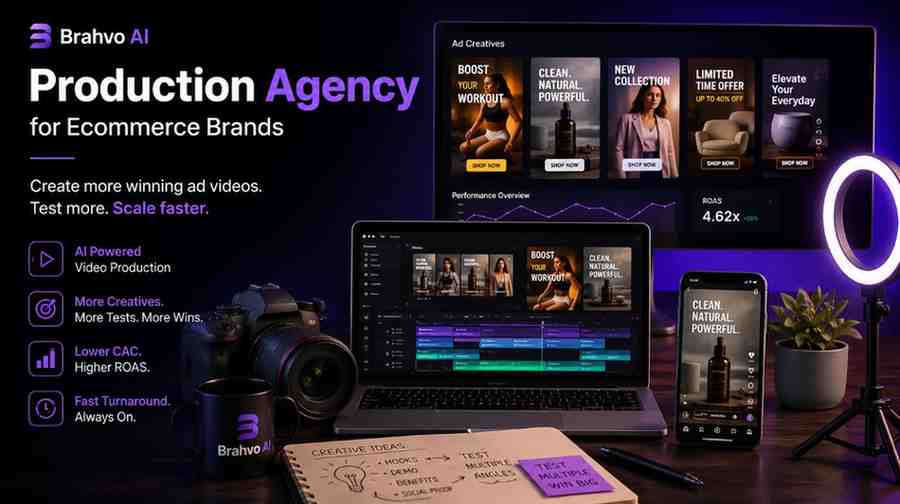
Most ecommerce teams don't struggle because they run out of advertising ideas. They struggle because they can't turn those ideas into finished creatives quickly enough. A campaign starts with momentum, performance looks promising, and then everything slows down because the next batch of videos is still waiting for approvals, edits, or production.
That pattern becomes even more obvious as a brand grows. Launching one product is manageable. Managing dozens of SKUs, seasonal promotions, audience segments, and new offers is a completely different challenge. Every campaign needs fresh creatives, different hooks, multiple aspect ratios, revised messaging, and platform specific versions. The demand for content grows much faster than the team's ability to produce it.
This is where many brands unknowingly hit a creative production bottleneck. Media buyers want to test five new concepts this week, but only one video is ready. The growth team wants to launch a new bundle offer, but the creative assets are still in review. Product marketing has a launch date locked in, while the design team is already overloaded with requests from other departments.
The problem isn't a lack of talent. It's production capacity.
Paid social platforms reward brands that keep introducing fresh creative. Meta Ads and TikTok Ads don't simply favor bigger budgets. They reward advertisers who continue testing new messages, visual styles, creators, formats, and storytelling angles. When production slows down, testing slows down. When testing slows down, campaign performance often follows.
Many ecommerce founders initially assume they need better targeting or higher ad spend. Sometimes that's true. But after working through enough campaigns, another reality becomes clear. Creative is often the limiting factor.
A single winning video rarely stays a winner forever. Audiences become familiar with it. Frequency increases. Engagement drops. Click through rates soften. Cost per acquisition starts climbing. At that point, the team isn't searching for one perfect ad. They're searching for the next ten ideas that can be tested before performance declines further.
That's much harder when creative production becomes the slowest part of the marketing process.
As brands expand into multiple customer segments, the workload multiplies again. Different age groups respond to different messaging. Returning customers need different offers than first time buyers. High value products usually require different creative than impulse purchases. Every variation adds another production request.
Eventually the creative calendar becomes more difficult to manage than the advertising budget itself.
This is why many high growth ecommerce businesses begin looking beyond traditional video creation workflows. They aren't trying to make prettier ads. They're trying to remove the bottleneck that keeps slowing every campaign behind it.
For brands focused on consistent customer acquisition, creative production is no longer just a marketing task. It becomes part of the operational system that determines how quickly the business can react to new opportunities, changing customer behavior, and platform performance.
The phrase production agency used to bring one thing to mind. Cameras, lighting, large crews, expensive shoots, and weeks of post production before a single video was ready.
Performance marketing has changed that expectation completely.
Today's ecommerce brands don't always need one polished brand film every quarter. They need a continuous flow of ad creatives that can support ongoing testing across Meta Ads, TikTok Ads, YouTube Shorts, Instagram Reels, and emerging social platforms.
That shift has changed the role of a modern production agency.
Instead of focusing only on filming content, the right production partner becomes part of the creative testing process. Their job is helping marketing teams produce enough variations to keep paid campaigns moving without waiting weeks between concepts.
This usually includes adapting one idea into multiple formats, creating different opening hooks, changing calls to action, updating offers, testing new messaging angles, producing platform specific edits, and refreshing existing creatives before performance starts declining.
For media buyers, that changes the rhythm of campaign management.
Instead of stretching one successful ad for another month, they can introduce fresh concepts while the previous creative is still performing. Testing becomes proactive instead of reactive.
For marketing directors, it creates more predictable campaign planning because creative availability stops being the biggest unknown variable.
For founders, it often means product launches happen closer to schedule because creative production isn't holding everything back.
This is also where AI powered workflows are starting to reshape production.
Rather than rebuilding every video from scratch, AI assisted production can speed up scripting, editing, localization, resizing, voice generation, and creative adaptation while keeping the marketing team focused on strategy instead of repetitive production tasks.
That doesn't eliminate human creative thinking. If anything, it makes it more valuable. The strongest campaign ideas still come from understanding customers, purchase behavior, objections, and buying psychology. AI simply reduces the time required to turn those ideas into testable advertising assets.
This becomes particularly valuable for ecommerce brands managing large product catalogs.
Imagine a skincare company launching six new products before the holiday season. Each product targets a different customer concern. Each campaign requires different messaging, multiple video lengths, different creators, several calls to action, and versions optimized for Meta Ads and TikTok Ads.
Traditional production timelines quickly become difficult to manage.
A modern production agency like Brahvo AI approaches this challenge differently by helping brands produce and adapt creative assets at a pace that aligns with paid media testing instead of traditional advertising schedules.
The objective isn't producing more videos simply for the sake of volume.
The objective is giving performance marketing teams enough creative inventory to make better advertising decisions based on actual campaign data rather than creative limitations.
Growth creates an interesting problem for ecommerce brands. The more products you launch and the more customer segments you target, the harder it becomes to keep your advertising creative organized.
A brand selling one hero product can often manage with a small library of ads. A brand selling fifty products across several customer categories cannot.
Each product may require different messaging. New customers respond differently than repeat buyers. Holiday promotions need different creatives than evergreen campaigns. A bundle offer usually deserves its own ad. Retargeting campaigns often need completely different storytelling than prospecting campaigns.
The number of creative requests grows surprisingly fast.
A marketing team might need product demonstrations, customer testimonial videos, founder messages, UGC style content, comparison videos, promotional offers, seasonal campaigns, and platform specific edits, all running at the same time.
The production workload expands long before the team realizes it.
This is where many businesses begin delaying creative requests instead of campaign launches. They prioritize the highest revenue products while everything else waits in line. The result is that some campaigns never get properly tested because the creative simply wasn't available when it mattered.
A reliable production agency helps remove that bottleneck by making creative production a repeatable process instead of a series of isolated projects.
Instead of treating every campaign like a brand new production, creative assets can be adapted, refreshed, localized, resized, and repurposed into multiple variations that support different audiences and offers.
That flexibility matters because advertising platforms reward ongoing experimentation.
A product that performs well with younger shoppers on TikTok Ads may require a completely different opening hook for customers browsing Facebook. A discount offer may outperform a value focused message during one season but lose effectiveness during another.
None of those insights appear unless the creative exists to test them.
Managing creative at scale is no longer about producing a handful of polished videos. It is about ensuring the paid media team always has enough fresh material to keep campaigns moving instead of waiting for production schedules.
Every experienced media buyer eventually runs into the same issue.
The campaign dashboard suggests three or four new creative ideas worth testing, but the production calendar says those assets will not be ready until next week.
That delay may not sound significant, yet in paid advertising it can mean spending thousands of dollars continuing to run aging creatives because nothing new is available.
AI powered video production changes the pace of that workflow.
Instead of starting from a blank page every time, production teams can rapidly build new variations from existing creative assets. Different hooks, revised offers, updated headlines, fresh voiceovers, alternate aspect ratios, shorter edits, and platform specific versions can all move through production much faster.
That creates a steady flow of creative opportunities for testing.
Media buyers are no longer forced to wait until every video is perfectly polished before launching experiments. They can evaluate multiple messaging angles, compare different customer pain points, and introduce fresh concepts while campaigns are still gathering useful data.
Testing becomes continuous rather than occasional.
This also helps reduce one of the biggest causes of creative fatigue. Rather than relying on one successful advertisement until performance drops, brands can rotate new concepts into active campaigns before audiences become overly familiar with the existing ads.
I might be wrong here, but many teams spend too much time searching for a single winning creative. In practice, sustained growth often comes from consistently producing enough good ideas to identify the next winner before the current one loses momentum.
AI speeds up production, but it does not replace strategy.
Strong creative still begins with customer research, buying objections, product positioning, and an understanding of why someone chooses one brand over another. AI simply helps move those ideas from concept to live campaign much faster.
Some weeks, that time savings can be the difference between testing two concepts and testing twenty.
Consider a DTC home fitness brand preparing for a seasonal promotion.
The media buying team had already identified several promising customer angles through previous campaigns. One focused on busy professionals. Another appealed to parents working out from home. A third highlighted small apartment friendly equipment. Each message resonated with a different audience.
The challenge was production.
The original plan called for three new videos, but campaign data suggested at least twelve variations should be tested across Meta Ads and TikTok Ads. Creating every version through a traditional production cycle would have pushed the launch well past the promotional window.
Instead, the team used an AI driven production workflow to adapt the existing creative into multiple versions with different openings, revised messaging, updated calls to action, shorter edits, and platform specific formats.
Within days, the media buyers had enough creative inventory to test several audience segments simultaneously instead of waiting for another production cycle.
Not every variation performed well.
Some opening hooks attracted clicks but produced weak conversion rates. Others generated stronger purchases despite receiving fewer impressions. One creative unexpectedly became the top performer with returning customers rather than first time buyers.
That outcome mattered.
Without enough creative variations, the team might never have identified which message actually matched each audience. Faster production did not guarantee better results, but it gave the advertising team enough options to let campaign data guide future decisions instead of relying on assumptions.
And one edit was oddly phrased at first. It still converted surprisingly well.
Creative production rarely happens in isolation.
Media buyers review campaign performance every morning. Marketing managers update promotional calendars. Product teams announce upcoming launches. Founders request fresh advertising for new offers. Designers balance website updates alongside advertising assets.
Everything moves at the same time.
That is why the most useful production agency is not simply producing videos. It becomes part of the team's operating rhythm.
Brahvo AI supports this workflow by helping marketing teams produce advertising creatives at the pace required for modern paid media. Instead of waiting through lengthy production cycles for every campaign, teams can continue testing new concepts, refreshing existing creatives, adapting successful ads into new formats, and preparing launches without interrupting campaign momentum.
This collaboration becomes especially valuable when multiple campaigns overlap.
A single week might involve introducing a new product, refreshing evergreen ads, updating promotional offers, creating retargeting creatives, and preparing assets for an upcoming seasonal sale.
Without a dependable production process, those priorities compete for limited creative resources.
With Brahvo AI integrated into the workflow, production becomes less of a scheduling problem and more of an ongoing support function for paid media teams.
Creative decisions can be informed by campaign performance instead of production limitations. Media buyers receive new assets more consistently. Marketing teams gain flexibility to respond when customer behavior changes.
The goal is not to produce the highest number of videos possible.
It is to ensure creative availability never becomes the reason a strong advertising opportunity is missed.
Not every production agency is built around the realities of ecommerce advertising. Before making a decision, it helps to look beyond portfolios and ask how the agency fits into your day to day marketing operations.
Here are a few questions worth asking.
Question
Why it matters
Can the agency support ongoing creative testing instead of one time projects?
Paid social campaigns need continuous creative refreshes, not occasional production.
How quickly can new ad variations be delivered?
Faster turnaround allows media buyers to test ideas before campaigns lose momentum.
Can creative be adapted for Meta Ads, TikTok Ads, YouTube, and other placements?
Every platform has different creative requirements and user behavior.
Does the workflow support multiple products, offers, and audience segments?
Ecommerce brands rarely advertise a single product throughout the year.
Can existing assets be refreshed instead of recreated from scratch?
Repurposing successful creatives often saves time while extending campaign performance.
How does the production process fit with paid media planning?
Creative production should support campaign schedules instead of delaying them.
One more consideration often gets overlooked.
Ask how the agency responds when campaign data changes unexpectedly.
Sometimes the best performing audience is different from the original plan. Sometimes an offer needs updating within days. Sometimes a product suddenly gains traction after an influencer mention. Those moments require production flexibility, not just production quality.
Because at the end of the day, choosing a production agency is less about who creates the most impressive video and more about who helps your marketing team keep moving when advertising conditions change faster than anyone expected.
Building an internal creative team is often one of the first milestones for a growing ecommerce brand. Designers, video editors, content creators, and marketing managers work closely together, making communication faster and giving the business more control over its brand identity.
For many companies, that setup works well for quite a while.
An in house team understands the products, knows the customer, and can respond quickly to everyday marketing requests. Website updates, email campaigns, product launches, and social media content all stay under one roof.
The challenge starts when paid advertising begins demanding more creative than the team can realistically produce.
Meta Ads and TikTok Ads don't care how many designers are on your payroll. If campaigns require twenty new creative variations this month, they require twenty. The workload doesn't shrink because your internal calendar is already full.
That is usually when marketing teams begin making tradeoffs.
The highest priority campaign gets the new creative. Product launches get delayed. Evergreen campaigns continue running the same ads longer than planned. Media buyers hold back testing because fresh assets are still being edited.
None of those decisions feel significant on their own.
Over several months, though, they can quietly reduce testing velocity and make customer acquisition more expensive.
This doesn't automatically mean every brand needs external production support.
If your advertising strategy relies on a small number of campaigns, your product catalog is limited, and your internal team consistently delivers creative on schedule, keeping everything in house may be the right decision.
But many growth stage ecommerce brands eventually reach a point where production demand outpaces available resources.
That is where working with a specialized production agency becomes less about outsourcing and more about expanding creative capacity.
An external partner should not replace the internal marketing team. The strongest relationships usually work the opposite way. The internal team owns strategy, messaging, product knowledge, and campaign priorities. The production partner helps convert those priorities into a steady flow of advertising assets without creating additional operational pressure.
For brands scaling across multiple channels, this balance often makes more sense than continuously hiring additional production staff.
Hiring brings long term value, but it also comes with recruiting, onboarding, training, management, and capacity planning. Campaign demand rarely stays consistent throughout the year. Holiday seasons, product launches, and promotional events create temporary spikes that are difficult to staff for permanently.
A flexible production workflow can absorb those peaks while allowing the internal team to stay focused on the work that requires the deepest understanding of the brand.
It sounds simple. It rarely feels simple during a busy product launch.
That is one reason many performance marketing teams evaluate creative capacity just as carefully as they evaluate advertising budgets.
The conversation around paid advertising has shifted over the last few years.
Brands still debate audience targeting, attribution models, bidding strategies, and media budgets, but creative has moved much closer to the center of every performance discussion.
The reason is straightforward.
Customer attention changes quickly. Social platforms change quickly. Buying behavior changes quickly. A campaign that performs well today may need fresh creative much sooner than expected.
That makes production speed part of the competitive advantage.
Growth focused ecommerce brands are beginning to ask different questions than they did a few years ago.
Instead of asking, "How can we make one great ad?" they are asking, "How can we keep producing enough strong creative to support ongoing testing?"
Instead of planning around quarterly video shoots, they are planning around weekly experimentation.
Instead of viewing production as a separate department, they are connecting it directly to paid media performance.
This is where Brahvo AI fits naturally into the process.
By helping brands produce and adapt advertising creatives more efficiently, Brahvo AI allows marketing teams to spend less time waiting for assets and more time learning from campaign performance. The focus shifts from protecting a small collection of ads to continuously building, testing, refining, and improving creative based on real customer behavior.
That approach will not eliminate every advertising challenge. Rising acquisition costs, changing platform algorithms, and shifting consumer preferences will continue to affect campaign performance.
But brands that can consistently turn ideas into testable creative usually place themselves in a stronger position to respond.
And that might be the question worth asking over the next year.
If your media buyers already know what they want to test next week, will your creative production process be ready before the opportunity passes?