Enrollment-focused creative production services for ecommerce brands using AI video, Meta Ads, TikTok Ads, and creative testing.
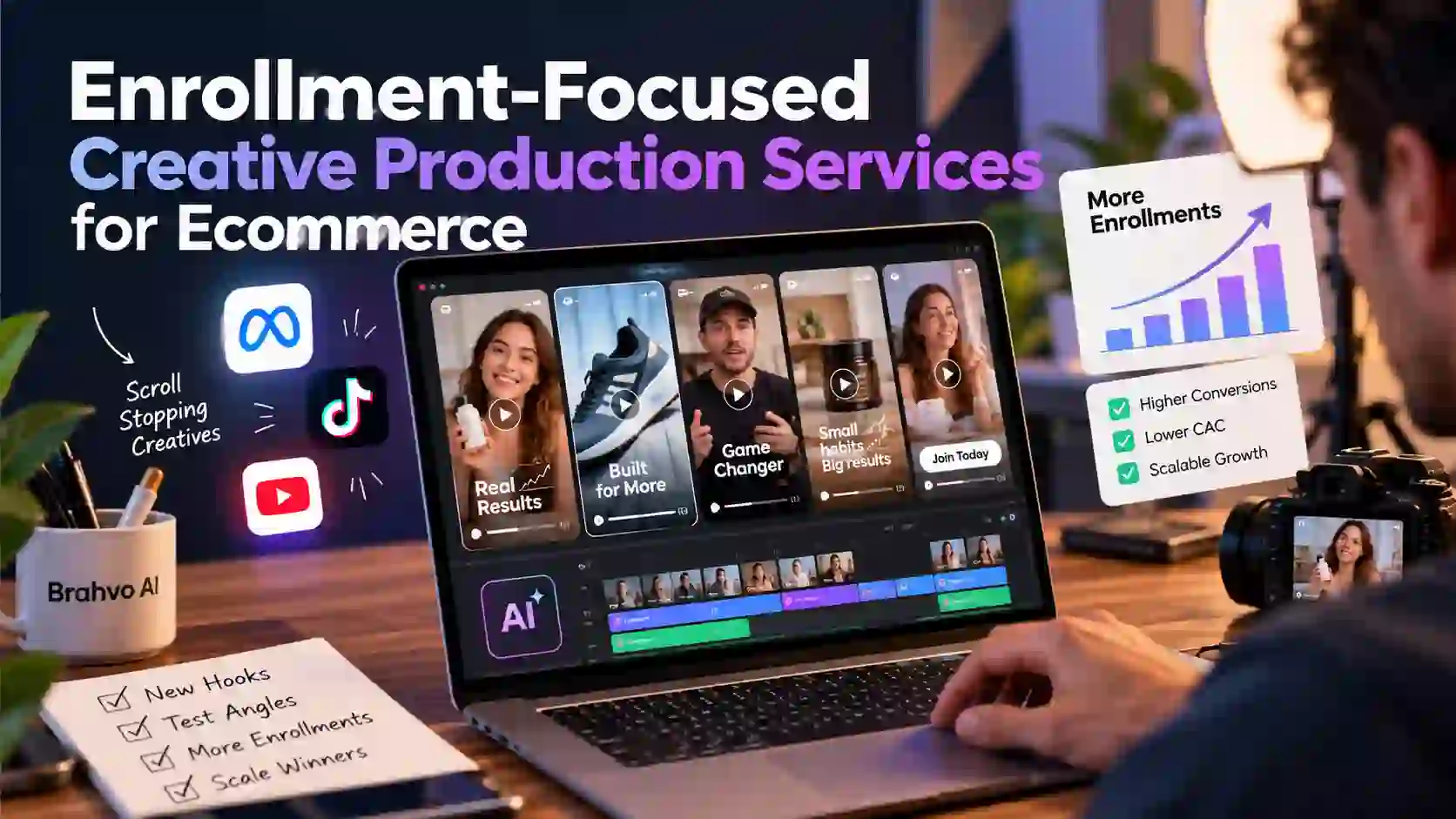
A DTC brand can have a solid product, a healthy website, and a media buyer who knows what they are doing, yet paid acquisition can still stall because the creative pipeline cannot keep up.
The problem usually shows up in familiar ways. A Meta campaign that worked three months ago starts getting expensive. The same UGC concept has been edited five different ways and none of the new versions really move the numbers. TikTok needs fresh creative every week, while the brand team is still waiting for product footage from the last shoot.
This is where enrollment-focused creative production services become useful. The goal is not simply to produce more videos. It is to create advertising assets that give prospective customers enough reason to stop, understand the offer, trust the brand, and take the next step.
For ecommerce companies, that next step might be a purchase, email signup, subscription enrollment, waitlist registration, product quiz completion, or another meaningful conversion event.
The distinction matters because creative production can easily become disconnected from paid media. A production team may deliver attractive videos while the media team is asking a completely different question: what should we test next?
Good enrollment-focused creative production services sit much closer to that question.
The phrase can sound broader than it really is.
At its core, enrollment-focused creative production services are about producing advertising creative around a defined customer action. The production process starts with the conversion objective rather than ending with a finished video.
For an ecommerce brand, that can affect everything from the opening hook to the final frame.
Consider a skincare company launching a new subscription. A conventional product video might focus on packaging, ingredients, texture, and lifestyle shots. Those assets may look polished, but they do not necessarily answer the customer's main concerns.
A conversion-focused creative approach could instead test several different reasons for joining the subscription:
Creative angle
Customer question
Convenience
How does this make reordering easier?
Cost
Is the subscription actually worth it?
Product education
Why should I use this product regularly?
Social proof
Are other customers getting results?
Objection handling
Can I cancel or change my shipment?
Product demonstration
What does the experience actually look like?
The production team is then creating variations around these questions.
That is an important difference.
Enrollment-focused creative production services should not mean producing one polished commercial and calling the job finished. They should create enough useful creative variation for a paid media team to learn something.
That might include UGC-style videos, founder-led videos, product demonstrations, testimonials, comparison-style concepts, motion graphics, AI-generated scenes, short-form edits, hooks, captions, and different calls to action.
The exact mix depends on the brand.
Most paid media teams do not suffer from a total lack of ideas. They suffer from a lack of usable ideas that can actually make it into production.
A media buyer might know that the account needs ten new concepts. The creative team might interpret that as ten videos. Those are not necessarily the same thing.
Ten videos could mean ten different visual executions of one basic idea.
That creates a problem.
If the underlying customer argument stays unchanged, the media team may learn very little from the test. One video could have a better hook. Another might have better pacing. A third might simply benefit from stronger footage.
Now the team is looking at performance data without knowing exactly what caused the difference.
This is one reason enrollment-focused creative production services need to work closely with the advertising strategy.
Creative fatigue creates another issue. A winning Meta ad can run for weeks and sometimes months, but its performance can gradually weaken as the same audience sees similar messaging repeatedly. The answer is not always "make another version."
Sometimes the brand needs a new customer angle.
For example, an apparel company may have spent months advertising a jacket around warmth. The audience has already seen that message repeatedly. A fresh creative concept might focus on packability, commuting, layering, weather resistance, or styling.
The product has not changed.
The reason to buy has changed.
That is where creative production starts becoming a strategic function rather than a production queue.
People rarely buy because a video is visually attractive.
They buy when the creative makes the product feel relevant to a problem they already care about and reduces enough uncertainty to act.
That sounds obvious, but it gets lost when production starts with a storyboard instead of the customer.
Suppose a DTC supplement brand is trying to increase subscription enrollments. The creative team could produce a polished lifestyle video showing someone taking the product every morning.
It may look excellent.
But what if the actual hesitation is subscription commitment?
Then the better creative question is not, "How can we show the product?"
It is, "What would make someone comfortable starting a recurring order?"
That could lead to creative explaining the subscription terms, flexibility, delivery schedule, cancellation process, or value proposition.
This is why enrollment-focused creative production services should account for buying friction.
A useful creative brief might identify:
The resulting video can then be built around that information.
For Meta Ads, the first few seconds might address the problem directly. For TikTok, the same concept could be presented through a more native creator-style format. For YouTube, a longer demonstration may have enough room to explain the product properly.
The core customer insight stays intact. The execution changes with the channel.
AI video production becomes interesting when a brand needs more creative options than a traditional production process can reasonably deliver.
That does not mean every ad should be AI-generated.
In many cases, the best use of AI is simply to reduce the time between an idea and a testable asset.
Imagine a brand has identified four strong creative angles. A conventional workflow might require scripting, scheduling, filming, editing, revisions, and multiple rounds of approvals before the media team receives usable assets.
By then, the campaign may have already moved on.
AI-assisted production can help create early versions of concepts, variations in hooks, alternate visual treatments, voiceovers, product explainers, localized versions, and different aspect ratios.
This is particularly useful when a brand manages multiple SKUs.
One product might require ten creative concepts. Multiply that across twenty products and the production burden becomes obvious.
But there is a catch.
I might be wrong here, but I do not think the answer to creative fatigue is simply producing 100 videos instead of 20. More creative can actually make testing harder if the concepts are poorly differentiated.
Meta Ads and TikTok Ads can both distribute short-form video at scale, but the creative decisions behind those campaigns are not identical.
This matters when building enrollment-focused creative production services for ecommerce brands because a video that works well in one environment may feel completely out of place in another.
On Meta, brands often have more flexibility with polished creative, UGC, product demonstrations, testimonials, founder content, and direct-response formats. The platform can support several stages of the customer journey, from introducing a product to reminding an existing visitor why they were interested.
TikTok tends to put more pressure on the creative itself to feel native to the viewing experience. A heavily produced commercial can work, but it may need a different opening, pacing, framing, and storytelling approach to earn attention.
That changes the production brief.
Instead of asking for "one 30-second ad," a paid media team might need:
A problem-first TikTok version.
A creator-led Meta version.
A product demonstration.
A testimonial variation.
A shorter retargeting cut.
A version with a stronger offer.
The product has not changed. The creative job has.
This is one reason enrollment-focused creative production services should start with the intended advertising environment rather than producing a generic master video and resizing it for every placement.
There is also a practical issue with creative testing.
Suppose a DTC brand is spending heavily on Meta and TikTok. The media team identifies a customer objection that needs testing. If production takes three weeks to create the required assets, the opportunity may already have changed by the time the ads launch.
AI-assisted production can shorten parts of that cycle.
It can help create alternate hooks, edit different openings, adapt scripts, generate versions for different placements, and repurpose existing footage. The media team can then get more variations into testing without requiring a completely new shoot every time.
But speed should not become the only objective.
A bad concept produced in six hours is still a bad concept.
The useful advantage comes when faster production allows the team to test more meaningful customer ideas while the media data is still relevant.
Creative production becomes much harder when an ecommerce brand has a large catalog.
A brand with one hero product can build a relatively focused creative system. A brand with 30 or 40 SKUs has to deal with different products, audiences, benefits, price points, objections, and buying cycles.
This is where creative volume can get out of control.
Imagine a beauty company selling 25 products. The media team wants five fresh concepts for each priority product.
That is potentially 125 concepts before considering different hooks, aspect ratios, placements, audiences, and revisions.
Producing everything at the same level of intensity would be expensive and unnecessary.
The better question is which products deserve the most creative attention right now.
A high-volume bestseller with rising acquisition costs may need frequent creative testing.
A new product may need educational content before direct-response ads.
A low-spend SKU may only need a few evergreen assets.
A seasonal product may require a concentrated burst of production before demand peaks.
This is where enrollment-focused creative production services need some discipline.
Brand consistency does not mean every ad needs to look identical. In fact, forcing every creative into the same visual style can make testing less useful.
A brand should have recognizable elements such as product presentation, tone, claims standards, visual identity, and messaging boundaries.
Within those boundaries, creative can vary considerably.
One ad can look like a creator talking to camera.
Another can focus entirely on the product.
Another can use animation.
Another can show customer reviews.
Another can use AI-generated visual storytelling.
They can still belong to the same brand.
The important distinction is between consistency of brand meaning and consistency of creative execution.
Those are not the same thing.
Consider a fictional US DTC nutrition brand launching a monthly subscription for a daily wellness product.
The first campaign focuses heavily on product ingredients. The videos are professionally shot, the packaging looks good, and the brand has plenty of product footage.
Initial engagement is acceptable.
But subscription enrollment is weak.
The team could respond by producing more polished product videos.
Instead, they look at the customer journey.
The product page already explains the ingredients. Reviews show that customers like the convenience. The subscription page clearly explains pricing.
The bigger hesitation appears to be commitment.
Customers understand the product. They are simply unsure about signing up for recurring delivery.
That insight changes the creative brief.
The production team creates several concepts around flexibility, convenience, delivery timing, and the experience of maintaining a regular supply.
One video uses a customer-style explanation.
Another shows the subscription process visually.
Another addresses the hesitation directly.
Another focuses on the practical problem of running out of the product.
These are not just four new videos.
They are four different hypotheses.
That distinction matters when evaluating enrollment-focused creative production services.
Suppose one concept receives fewer clicks but produces stronger subscription conversion after the click. A media buyer might initially overlook it if the evaluation is based only on top-of-funnel engagement.
Instead, the team can investigate the full path.
Impression.
Video engagement.
Click.
Landing page visit.
Subscription start.
Retention.
The winning creative idea may not always have the highest CTR.
This is one of the areas where creative teams and performance teams need to communicate closely. Otherwise, production gets optimized for metrics that do not necessarily reflect the business objective.
And this is where the word "enrollment" becomes useful. It keeps the creative conversation connected to the action the business actually needs.
Brahvo AI approaches enrollment-focused creative production services around the idea that ecommerce brands need creative production to keep pace with paid media testing.
That does not mean treating AI as a replacement for every part of the creative process.
The more practical role for AI is to help expand what a production team can test and adapt.
For an ecommerce campaign, that can involve taking a core creative concept and developing multiple executions around it.
A single customer insight might become a UGC-style video, a product demonstration, a direct-response script, a short educational clip, an alternate hook, or a different version for another paid social placement.
The underlying message remains connected to the campaign objective.
This can be particularly useful for brands that already have product photography, existing video footage, creator content, customer reviews, and other raw materials but struggle to turn those inputs into enough advertising variations.
Instead of starting every asset from zero, the production process can make more use of the content the brand already owns.
There is another practical advantage.
Creative testing often creates a feedback loop. A media team learns that customers respond to a particular problem, objection, benefit, or style of presentation. That learning should influence the next production cycle.
Brahvo AI can use that type of feedback to inform the next set of creative assets rather than treating every production request as an isolated project.
For a brand managing Meta Ads and TikTok Ads simultaneously, this can help create channel-specific versions without completely rebuilding every concept.
Still, AI does not remove the need for human judgment.
Someone needs to decide which customer problems matter.
Someone needs to determine whether a claim is credible.
Someone needs to know when a creative concept feels off-brand.
Someone needs to look at the performance data and ask what it actually means.
The technology can make production faster. It cannot decide what the business should test without context.
That distinction becomes especially important as creative production volume increases.
What are enrollment-focused creative production services?
Enrollment-focused creative production services create advertising assets around a defined customer action. For ecommerce brands, that may include purchases, subscriptions, registrations, waitlist signups, or other conversion events.
The production process considers the customer decision rather than treating the video itself as the final objective.
How are enrollment-focused creatives different from regular ecommerce ads?
A regular ecommerce ad may primarily showcase the product or communicate a promotion.
An enrollment-focused creative starts with the action the customer needs to take and considers what information, proof, motivation, or objection handling could help move that decision forward.
The difference is often in the creative brief, not simply the visual quality of the finished ad.
Can these creative services support both Meta Ads and TikTok Ads?
Yes. The same customer insight can be adapted for both platforms, but the execution may need to change.
A TikTok version might use a creator-style opening and faster storytelling. A Meta version may work better as a product demonstration, testimonial, or direct-response ad.
Repurposing should not mean copying the exact same video everywhere.
How does AI video production help ecommerce brands?
AI video production can help with creative variations, editing, scripting support, alternate hooks, visual treatments, repurposing, and production speed.
Its usefulness depends on how it is integrated into the creative process. Producing more assets without a clear testing reason can create more work for the media team rather than better results.
Does more creative always mean better paid media performance?
No.
A brand can produce dozens of new ads and still fail to address the reason customers are not converting.
Meaningful variation is usually more useful than simply increasing asset count. A new customer angle, objection, offer, or demonstration can provide more learning than five cosmetic versions of the same concept.
How should ecommerce brands decide which products need new creative?
Look at factors such as media spend, revenue contribution, creative fatigue, product launches, customer objections, seasonality, and current campaign performance.
A product receiving significant advertising spend may justify more frequent creative testing than a low-priority SKU.
Can UGC be part of enrollment-focused creative production?
Yes. UGC can be particularly useful when customer experience, trust, demonstrations, and personal stories influence the buying decision.
The key is to avoid turning every UGC asset into the same talking-head script. Different creators and formats can address different customer motivations.
What should media buyers provide to the creative production team?
Useful inputs include recent creative performance, winning and losing concepts, audience information, customer objections, campaign objectives, product priorities, and any changes in acquisition economics.
"Make more ads" is rarely enough information for a production team to do its best work.
How can brands evaluate creative production quality?
Look at both production output and business learning.
Ask whether the team is producing genuinely different ideas, how quickly concepts reach testing, whether performance insights feed into the next production cycle, and whether creative is helping the paid media team make better decisions.
Is Brahvo AI focused only on AI-generated videos?
Brahvo AI's positioning is broader than simply generating synthetic videos. Its role in enrollment-focused creative production services is centered on using AI-assisted production to help ecommerce brands develop and adapt advertising creative at the pace required by modern paid media.