Compare corporate video production companies Los Angeles, covering costs, planning, creative decisions, business needs, and production challenges.
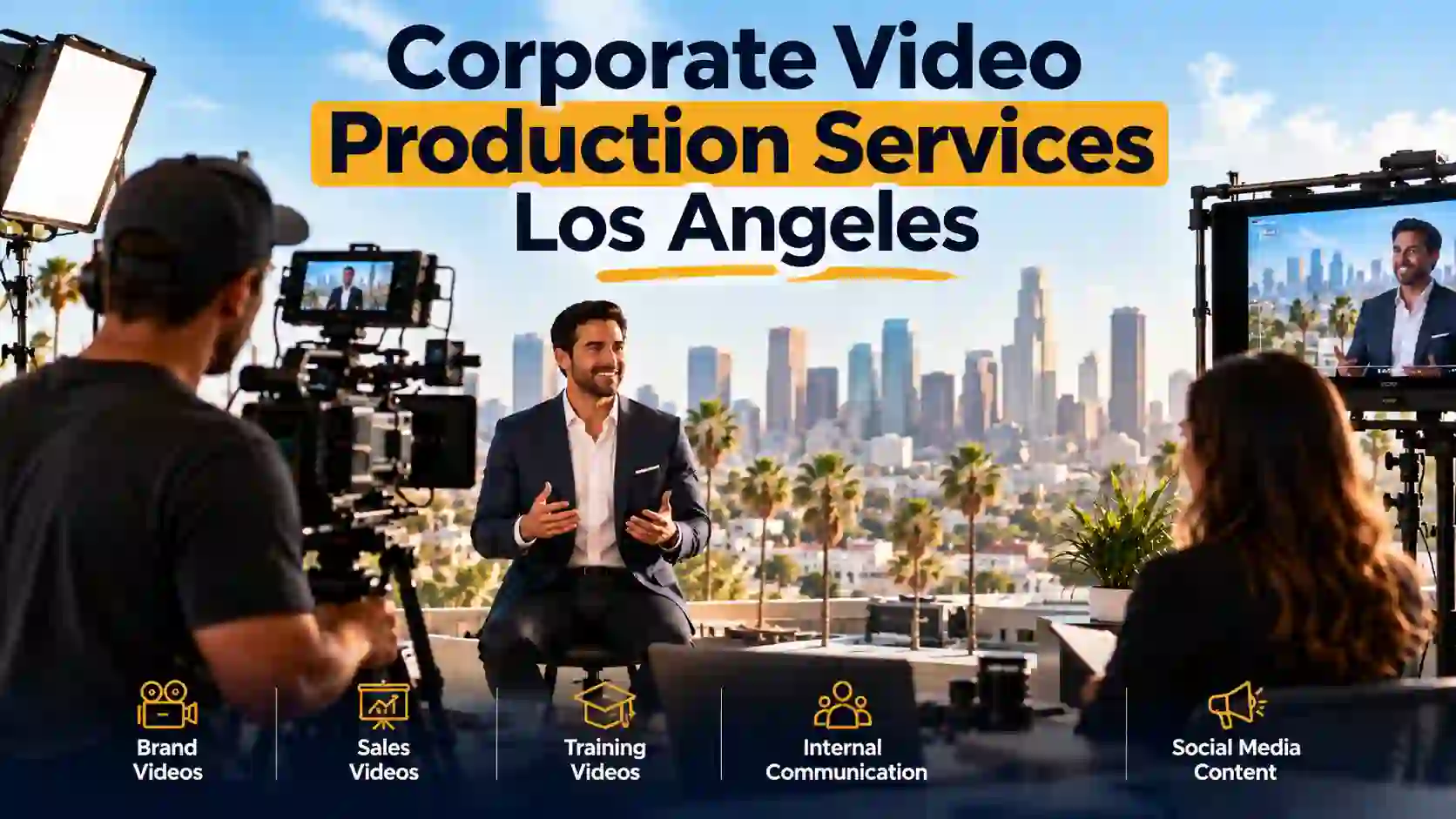
When companies start looking for corporate video production companies Los Angeles, they are usually not looking for a camera crew alone. They want someone who can understand what the video is supposed to achieve, who will watch it, where it will be used, and what the business can reasonably spend on production.
That distinction matters.
A corporate video may be created for an investor presentation, an annual meeting, employee training, recruitment, a product launch, a company website, sales presentations or a major corporate event. Each of these situations requires a different production approach. A five minute founder story for a website cannot be planned in exactly the same way as a training series involving several departments and multiple filming locations.
Businesses also expect corporate video production companies Los Angeles to handle the practical side of production. This can include scripting, pre production planning, location arrangements, filming, lighting, sound recording, editing, motion graphics, voiceovers and final delivery in different formats.
The better production discussions usually begin before anyone talks about cameras.
For example, consider a manufacturing company preparing to enter the US market. Its management may want a corporate film showing its manufacturing facility, quality systems and leadership team. The real requirement is not simply to show machines running. The video has to communicate reliability, capacity and professionalism to distributors, customers or investors.
A healthcare company may have a completely different requirement. It may need a video explaining its facilities and services while remaining appropriate for patients and professional audiences.
This is where business thinking becomes important. Production quality matters, but production quality without a clear business purpose can become an expensive exercise.
A practical corporate video brief should normally establish the audience, objective, distribution channels, expected duration, locations, people involved, approval process and approximate budget before production begins.
Corporate video projects often look simple from the outside.
A company may think, "We need one day of filming and a few interviews."
Then the planning starts.
There may be several executives whose schedules need to be coordinated. A factory floor may require safety permissions. A customer location may have filming restrictions. A particular executive may want several revisions to their interview. The legal team may need to review statements. The marketing department may request additional versions for social media. Suddenly a one day filming assignment has become a much larger project.
This is one reason businesses comparing corporate video production companies Los Angeles should ask about the production process rather than only asking for a quotation.
Pre production is often where many hidden requirements become visible.
A company may want to film at its headquarters, warehouse and customer facility. Each location creates separate requirements. Travel time, lighting conditions, permissions, crew movement, sound conditions and scheduling all affect the production plan.
There is also the issue of content approval.
A corporate video usually involves several internal stakeholders. The CEO may approve the overall message. Marketing may review the brand presentation. Legal may examine claims. Human resources may review employee references. Operations may check technical information.
If these reviews are not planned properly, editing can become repetitive.
One person asks for a change. Another department asks for something else. The editor makes a new version. Then the original stakeholder changes their mind.
I might be wrong here, but in practical corporate work, the biggest production problem is not always the production itself. It is often unclear decision making before production begins.
Budgeting can become complicated for the same reason.
The initial quotation may cover filming and editing, while additional requirements emerge later. Extra filming days, actors, specialised equipment, travel, studio rental, animation, voiceover work, music licensing or multiple final versions can change the overall project cost.
This does not mean that every corporate video needs a large budget. It means that the scope needs to be understood properly before the budget is treated as final.
Sometimes perfectly usable corporate videos become unnecessarily expensive because decisions were made in the wrong sequence. It still surprises me how often basic planning gets postponed until after production has already started.
Not every company needs an external production partner for every video.
Larger organisations may already have internal marketing teams, designers, communication specialists and basic video equipment. For internal announcements, simple interviews or routine social media content, an in house team may be perfectly capable.
The situation changes when the project becomes more demanding.
A large corporate film may require professional cinematography, specialised lighting, sound recording, multiple cameras, set design, animation or extensive post production. An internal marketing team may understand the company's communication requirements very well but may not have the production resources or availability to handle everything.
This is where external corporate video production companies Los Angeles can become useful.
The decision should not be based simply on whether the external quote is higher than the internal cost.
A proper comparison should consider employee time, equipment, editing capacity, project management, locations, post production requirements and the opportunity cost of taking internal employees away from their normal responsibilities.
For example, suppose an internal marketing manager spends three weeks coordinating a corporate film. That person may not appear on the production invoice, but their time still has a cost for the business.
There is another factor that companies sometimes overlook.
An external production company brings a production workflow. It may already have relationships with cinematographers, editors, sound professionals, animation specialists, studios and other suppliers. This can make a complicated project easier to coordinate.
But external production is not automatically better.
If the company does not provide a clear brief, the production partner can still misunderstand the intended message. A professionally filmed video can look excellent and still fail to answer the business question it was supposed to address.
That is why the choice between internal and external production should begin with the project requirement.
For a short internal announcement, an in house team may be sufficient. For a high visibility corporate film involving senior management, multiple locations and significant post production, an external production partner may make more practical sense.
The right question is not simply who can make the video.
It is who can manage the complete requirement without creating unnecessary complexity.
A corporate video should have a business reason behind it.
This sounds obvious, but many projects start with a visual idea rather than a communication objective.
Someone wants an impressive office shot. Someone wants drone footage. Someone wants a dramatic opening sequence. These elements may have value, but they should support the purpose of the video rather than become the purpose themselves.
A useful starting point is to ask what the viewer should understand after watching the video.
For an investor audience, the focus may be the company's business model, management capability, operating scale and future plans.
For customers, the emphasis may be product capability, reliability, service quality and proof of experience.
For employees, the video may need to communicate culture, strategy, training information or organisational changes.
For recruitment, the message may revolve around workplace environment, leadership and employee experience.
These differences influence almost every production decision.
Take a hypothetical technology company in Los Angeles preparing a corporate film for potential enterprise clients. It may initially ask for a general company profile. During the planning discussion, it becomes clear that prospective customers are mainly concerned about implementation capability and support after purchase.
That changes the video.
Instead of spending most of the runtime on company history, the production can show the team working with customers, demonstrate the implementation process and explain the support structure.
This is a much more useful production decision.
The same principle applies to industrial businesses.
A factory video should not necessarily show every machine. If the intended audience is a lender or investor, the relevant information may include production capacity, facilities, technology, quality controls and operational capability. If the audience is a prospective customer, the emphasis could instead be on manufacturing standards, turnaround capability and product quality.
For businesses dealing with banks or investors, the video may also form one part of a broader presentation.
Frontline Consultants works in areas such as Detailed Project Reports, Techno Economic Viability Reports, Enterprise Valuation, Asset Valuation, Credit Syndication, Bank Liaison and project advisory. In such situations, communication material may support a larger business presentation, but it should never be treated as a substitute for financial or technical documentation.
A lender still needs appropriate financial information, project assumptions, repayment analysis and supporting reports.
A video can explain a project visually. It does not replace a proper appraisal document.
That distinction becomes particularly important for projects involving substantial capital expenditure.
Cost planning for corporate video production should begin with the scope rather than an arbitrary production budget.
There is no single standard price that can reasonably apply to every project involving corporate video production companies Los Angeles. A straightforward interview based video and a multi location corporate film are entirely different assignments.
The cost can be affected by the number of filming days, crew size, equipment, locations, travel, studio requirements, presenters, actors, animation, graphics, editing complexity, sound design, music licensing and the number of final versions.
Post production deserves particular attention.
Businesses sometimes focus heavily on filming costs and underestimate the amount of work that follows the shoot. Editing interviews, selecting footage, cleaning audio, adding graphics, colour correction, subtitles, animations and preparing different aspect ratios can take considerable time.
If the same corporate video needs a website version, a presentation version and shorter social media cuts, the post production requirement increases.
Timelines should also account for internal approvals.
A two day shoot does not mean the complete project will be delivered in two days.
There may be several stages between filming and final delivery. Rough editing may be followed by management review, factual corrections, brand review, legal review and final changes.
Location planning can create another layer of complexity.
A corporate headquarters may look ideal for filming but may have poor natural sound. A warehouse may have excellent visuals but significant background noise. A factory floor may require safety equipment and restricted movement. An outdoor location may depend heavily on weather and available daylight.
These are practical matters that should be considered before the filming schedule is fixed.
For companies preparing budgets, it is useful to separate production expenditure from the wider business purpose.
Suppose a hospital is investing in a corporate film as part of a larger expansion project. The video may be useful for presentations to investors, partners or stakeholders. But the production budget still needs to sit within the overall project financial plan.
Similarly, a warehouse expansion project may involve civil work, equipment purchases, working capital requirements and financing costs. A video may help communicate the project visually, but financial viability depends on the underlying project economics.
This is where experienced financial advisory becomes relevant.
Frontline Consultants approaches business and project requirements from the perspective of lenders, promoters and financial institutions. Its work across Techno Economic Viability Reports, Lenders Independent Engineer Services, Agency for Special Monitoring, Detailed Project Reports, valuation, credit syndication, restructuring and bank liaison involves looking beyond presentation and asking whether the underlying assumptions, documents and financial requirements are properly aligned.
For a corporate video project itself, the same discipline is useful.
What is being produced?
Why is it being produced?
Who needs to approve it?
Where will it be used?
What resources are required?
What happens if the production takes longer than expected?
Those questions are not glamorous, but they prevent avoidable surprises.
And sometimes the most useful production decision is simply deciding what not to film.
A company may have ten possible locations, six executives and dozens of product features. Putting everything into one video usually makes the communication weaker. A focused production can often serve the audience better.
This does not apply everywhere. Some organisations genuinely need extensive corporate films covering multiple operations and locations. The appropriate production scope depends on the business objective, audience and intended use.
A sensible budget therefore starts with the communication requirement and then works backwards into production resources. That approach is generally easier to defend internally, especially when the project involves senior management, investors or other stakeholders.
Creative decisions in corporate video production are often treated as separate from business decisions. In practice, they are closely connected.
The choice of narrator, interview style, location, pacing, graphics, music and even the opening few seconds can change how a viewer understands a company. This does not mean every corporate video needs dramatic storytelling. In fact, excessive creativity can sometimes make a serious business message harder to understand.
Consider a financial services company preparing a video for corporate clients. A highly informal presentation may feel modern, but it could also create the wrong impression if the audience expects precision and professionalism. A manufacturing company, on the other hand, may benefit from showing its actual production environment rather than relying entirely on polished office interviews.
Good creative decisions are usually connected to the audience.
A sales video needs clarity because the viewer is often trying to understand a product or service quickly. A recruitment video can afford to spend more time showing people, workplace culture and employee experiences. A training video has a different requirement altogether. It needs to make information easy to follow and remember.
There is also a risk of making a corporate video look too much like an advertisement.
Some businesses want their corporate film to feel premium, but the message becomes so polished that it stops feeling believable. A customer may respond better to an actual engineer explaining a process on the factory floor than to a perfectly scripted statement surrounded by expensive visuals.
This is especially relevant for companies selling technical products.
A software company may need screen demonstrations. A construction company may need project footage. A healthcare organisation may need facility walkthroughs. A manufacturing company may need machinery and production processes.
The visual material should support the evidence being presented.
Business outcomes are also influenced by where the video is used. A corporate film placed on a website has a different job from a short sales presentation shown during a meeting. A video created for a trade event may need to communicate its message even when viewers are watching without sound.
This is why corporate video production companies Los Angeles often need to think beyond the final master video. A project may produce one main film along with shorter edits, subtitles, presentation cuts and vertical versions.
That requires planning from the beginning.
Creative decisions also affect cost. A complex animation sequence may require substantially more post production time than a straightforward interview. A production involving several locations may require more crew coordination and travel. A large cast can introduce additional scheduling and production requirements.
The creative idea is therefore not independent of the budget.
It needs to fit the business requirement and the resources available.
Corporate video is not limited to public facing brand films.
Many businesses use video internally because employees often need information presented consistently across departments and locations.
An organisation with offices in several cities may use video for leadership communication. Instead of asking senior management to repeat the same presentation to different teams, a professionally produced message can be distributed across the organisation.
Training is another major application.
A manufacturing company may need to explain safety procedures to new employees. A logistics business may need training material for warehouse teams. A healthcare organisation may require videos covering operational procedures. A technology company may create onboarding videos for new employees.
These projects have a different priority from promotional content.
Clarity matters more than cinematic appearance.
Sales teams can also use corporate video in meetings with prospects. A manufacturing company might show its plant, quality control process and production capability before discussing a large order. A technology company could demonstrate how its implementation team works with enterprise customers.
For a business with a geographically distributed sales team, centrally produced videos can help maintain consistency in the way the company presents itself.
Corporate events create another use case.
Product launches, annual conferences, investor meetings, employee gatherings and milestone events often require a combination of live recording and pre produced content. A company may need opening videos, customer testimonials, leadership messages, product demonstrations or event highlight films.
The production requirements can become quite different depending on the event.
A presentation screen may require a particular resolution. A live event may need multiple cameras and dedicated audio. A highlight film may require rapid editing and delivery within a short period after the event.
Companies should therefore explain the final use before production begins.
A common mistake is producing one long video and expecting it to work equally well in every setting. It usually does not.
A five minute corporate film may work on a website but may be too long for a sales meeting. A 30 second social media clip may attract attention but cannot replace detailed training material.
Sometimes the better approach is to plan a content package from one production day.
For example, a company could record leadership interviews, product demonstrations, facility footage and employee interviews during one organised shoot. The material can then be edited into a main corporate film, sales clips, recruitment content and internal communication pieces.
This can make the production investment more useful, provided the additional requirements are identified before filming.
The problems that appear during corporate video production are often quite ordinary.
Someone is unavailable on the scheduled filming day.
The interview room is too noisy.
A product demonstration changes at the last minute.
The CEO has only 20 minutes available instead of an hour.
A location permit is delayed.
The marketing team wants another version after final approval.
None of these issues sounds serious individually. Together, they can disrupt the schedule.
One common problem is insufficient preparation for interviews. Senior executives are often knowledgeable but not necessarily comfortable speaking naturally to a camera. A good interviewer can help, but the production team needs enough time to prepare questions and manage the conversation.
Another issue is unclear ownership.
Who gives final approval?
If five departments have equal authority to make changes, the project can continue indefinitely. A clear approval hierarchy saves considerable time.
Budget changes are another recurring issue.
The original brief may mention one location, but later the company decides that a second facility should be included. It may ask for animation, additional interviews or another language version. These requests may be reasonable, but they should be treated as changes to scope rather than silently absorbed into the original production plan.
There is also the problem of overproduction.
A company sometimes spends heavily on visuals that do not add much meaning. Expensive equipment, elaborate sets and complicated effects cannot compensate for a weak message.
I have seen businesses spend significant effort making a video look impressive while giving surprisingly little attention to what the viewer is supposed to remember.
That is usually where the project needs to return to basics.
What is the message?
Who needs to hear it?
What evidence supports it?
What action should follow?
Another problem is producing without thinking about distribution.
A video may look excellent on a large conference screen but perform poorly on a mobile device. Another may work well with sound but become confusing when watched silently.
Corporate video production companies Los Angeles and their clients therefore need to discuss delivery formats early, not after editing is complete.
Frontline Consultants is not a video production company. Its role is different.
As a financial and project advisory firm, Frontline Consultants works with businesses, promoters, lenders and financial institutions on assignments involving project finance, financial assessment, project documentation, valuation and lender requirements.
That becomes relevant when media production forms part of a larger business investment.
For example, consider a company setting up a new manufacturing facility. It may be preparing a corporate film to present the project to investors, customers or stakeholders. But behind that film is a much larger financial exercise involving capital expenditure, funding requirements, projected revenue, working capital and repayment capacity.
The video can communicate the project visually.
It cannot establish financial viability by itself.
In such situations, Frontline Consultants may be involved in areas such as Detailed Project Reports, Techno Economic Viability Reports, Lenders Independent Engineer assignments, Enterprise Valuation, Asset Valuation, Credit Syndication, Debt Restructuring, Bank Liaison and project advisory.
A solar project provides another example.
The promoter may need lender approval, technical assessment and financial projections. A professionally produced video showing the project site can help stakeholders understand the development, but the lender will still require proper technical and financial documentation.
The same applies to a hospital expansion.
A hospital may produce a corporate film showing the proposed facilities, equipment and services. At the financial planning level, however, the project still needs to demonstrate its funding requirement, operating assumptions, projected cash flows and repayment capacity.
This distinction is important because businesses sometimes treat presentation material and financial documentation as interchangeable. They are not.
Frontline Consultants can support the business side by helping promoters understand what financial institutions may require and how project documentation fits into the larger funding process.
For an industrial borrower facing restructuring, the requirement may be different again. The business may need to present its operational position, financial difficulties, proposed restructuring and future viability clearly to lenders. A video might support a management presentation, but the restructuring case itself needs proper financial analysis and documentation.
The practical benefit of this approach is that communication remains connected to the underlying business facts.
That matters when multiple stakeholders are involved.
What should a company look for in corporate video production companies Los Angeles?
Look at production experience, pre production planning, communication, portfolio quality, post production capability and understanding of corporate audiences. Ask how the company manages revisions, locations, schedules and final delivery formats.
How much does corporate video production cost in Los Angeles?
There is no single standard price. Cost depends on the number of filming days, crew, locations, equipment, travel, editing, animation, presenters, voiceovers and final deliverables. A simple interview film can have very different requirements from a multi location corporate production.
How long does a corporate video project usually take?
The timeline depends on project complexity. A straightforward production may move relatively quickly, while projects involving several locations, senior executives, animation and multiple approval stages can take considerably longer. Internal review time should be included when setting expectations.
Should businesses use an in house team or hire corporate video production companies Los Angeles?
It depends on the project. Internal teams may handle simple communication videos effectively. External production companies can be useful when the project requires specialised production skills, multiple crew members, complex locations or substantial post production.
Can one corporate video be used for sales, recruitment and social media?
It can provide source material for all three, but one final edit may not work equally well in every channel. It is often more practical to plan several shorter versions from the same production.
Does a corporate video replace a Detailed Project Report or financial presentation?
No. A video can explain a project visually, but it does not replace financial projections, technical assessments, project reports or lender documentation. Banks and financial institutions require appropriate supporting information for credit appraisal.
Can Frontline Consultants help with financial planning for a media related project?
Frontline Consultants can support the financial and business advisory side where a media project is connected with a larger investment, expansion, funding requirement or corporate project. Its services include project advisory, Detailed Project Reports, Techno Economic Viability Reports, valuation, credit syndication, bank liaison and related financial consulting.
What should be decided before approaching a corporate video production company?
The company should have a reasonably clear understanding of the audience, purpose, locations, expected deliverables, approximate timeline and internal approval process. The production company can then assess the practical requirements and prepare a more meaningful proposal.
Is an expensive corporate video always more effective?
No. Production quality matters, but spending more money does not automatically make communication clearer. The right production level depends on the audience, objective, distribution channel and importance of the project.