Generative AI is changing video and animation production, creative testing, paid advertising, and content creation for ecommerce brands.
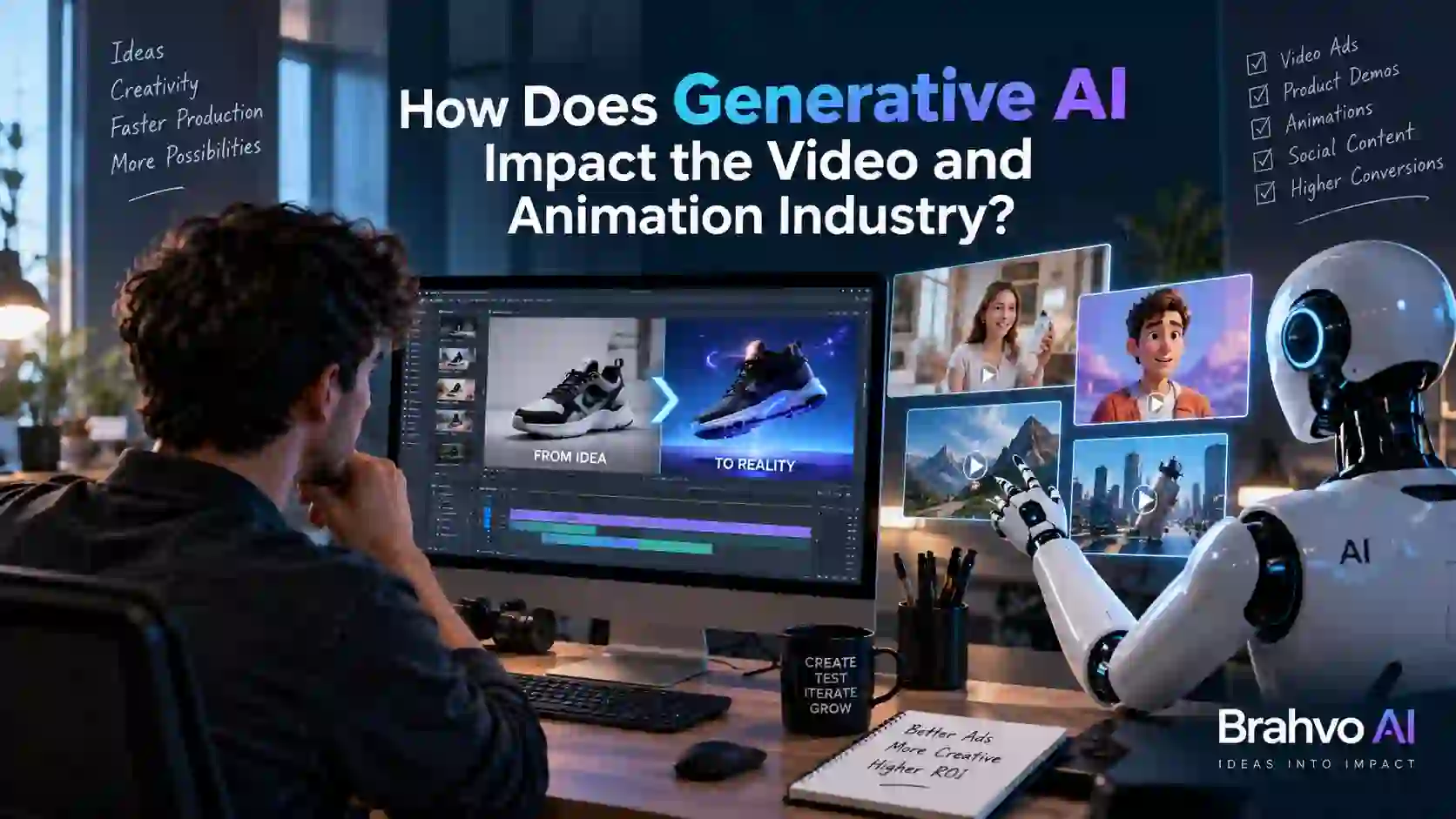
Ecommerce marketing teams are being asked to produce more video than ever, often without getting more time, budget, or people to do it. A brand may need fresh Meta Ads every week, new TikTok concepts for different audiences, product launch videos, UGC variations, retargeting creatives, and updates for winning ads that are starting to show creative fatigue. The production bottleneck gets expensive quickly.
That is where the question of how does generative AI impact the video and animation industry becomes more practical than theoretical.
For many teams, generative AI is changing the economics and speed of video production. It can help create concepts, generate visual assets, adapt existing creative ideas, produce variations, support animation, and reduce some of the repetitive work that slows production down. But the impact is not as simple as replacing traditional video production with AI.
Some parts of the workflow are getting faster. Others still depend heavily on creative direction, brand judgment, editing decisions, and an understanding of why an audience might actually stop scrolling.
The biggest change is probably volume. Brands that previously struggled to test enough creative ideas can now explore more concepts without treating every new variation like a full production project. That matters because paid advertising performance increasingly depends on how quickly a team can learn from creative testing.
Why Video Production Teams Are Adopting Generative AI
Video production teams are adopting generative AI largely because the amount of content required has grown faster than traditional production processes can comfortably handle.
A few years ago, a brand might have produced a polished campaign video and expected it to run for weeks or months. That approach is harder to rely on now. Meta Ads can experience creative fatigue quickly. TikTok audiences often respond differently to different hooks, formats, and creator styles. A product that performs well with one customer segment may need a completely different message for another.
So when people ask how does generative AI impact the video and animation industry, one important answer is that it allows production teams to work through more creative possibilities.
A creative team may have one core product concept but need to test five opening hooks, three audience angles, multiple voiceovers, different product visuals, and several aspect ratios. Producing every version through a conventional workflow can create delays that affect campaign timing.
Generative AI can reduce some of that friction.
For example, a DTC skincare brand launching a new product might initially build its campaign around a single problem, such as simplifying a complicated skincare routine. After early testing, the paid media team may discover that the product benefits themselves are not the problem. The first three seconds are.
Instead of restarting the entire production process, the team can develop additional opening concepts and visual treatments more quickly. Some versions may focus on frustration. Others may start with a product demonstration or customer-style scenario.
Not every AI-generated variation will be good. Most teams will probably find that some are not worth using at all.
But producing ten possible directions and selecting the strongest few is often more practical than waiting weeks to create three.
Generative AI is also useful when production teams need to respond to campaign data. Media buyers may see a winning concept and ask for more variations immediately. Traditionally, the creative request goes back to the production team, priorities are reviewed, new assets are scheduled, and the campaign may lose momentum while the work is being completed.
That workflow still exists in many organizations. It is just becoming difficult to defend when faster creative production is possible.
How Generative AI Changes Video Creative Production and Ad Testing
The relationship between generative AI and creative testing may be one of the biggest reasons the technology is receiving attention from performance marketing teams.
Creative testing is rarely about finding one perfect ad. It is usually about finding patterns.
A team might test different hooks, pain points, offers, visual demonstrations, product benefits, and customer objections. The objective is to identify what gets attention and what moves people toward a purchase.
This is another area where how does generative AI impact the video and animation industry connects directly to advertising economics.
Generative AI can help teams produce more creative variations from a core concept. A product demonstration might be adapted into different visual environments. Messaging can be adjusted for different audiences. Animation can help explain product features that would otherwise require a more complex shoot.
The value is not simply producing more content. More content without a testing strategy can create another problem: a huge library of assets with no clear purpose.
The better approach is to connect generative AI production with specific testing questions.
For example:
Testing Question
Possible Creative Variations
Which hook gets more attention?
Problem-focused, curiosity-focused, demonstration-focused openings
Which benefit matters most?
Convenience, price, performance, lifestyle, product quality
Which visual style works better?
UGC-inspired, product-focused, animated, educational
Does the message change by audience?
New customers, returning customers, high-intent shoppers
This gives the creative team a reason for producing each variation.
A media buyer running Meta Ads for a consumer product brand might notice that customer acquisition costs are rising while click-through rates remain relatively stable. The assumption could be that the audience is exhausted. Maybe. But it could also be that the creative is attracting interest without clearly communicating why the product is worth buying.
Generative AI makes it easier to test that second possibility.
New video variations can focus on objections, product proof, demonstrations, or different use cases. The team can then compare the results instead of arguing about which creative idea feels better.
I might be wrong here, but AI-generated volume will not automatically improve advertising performance. In some cases, producing more creative can actually make decision-making worse if nobody has a clear testing framework.
The production process still needs a point.
The Impact of Generative AI on Animation Workflows
Animation has always involved a mix of creativity, technical skill, and repetitive production work. Depending on the project, teams may spend significant time developing scenes, backgrounds, motion concepts, transitions, visual elements, and multiple versions of the same sequence.
Generative AI is beginning to change how some of these tasks are approached.
For teams considering how does generative AI impact the video and animation industry, animation is one of the areas where the workflow changes can be especially noticeable. AI can support early concept development, visual exploration, scene generation, asset creation, and rapid experimentation with different creative directions.
This does not mean the role of the animator disappears.
Animation still requires timing, visual judgment, storytelling, and an understanding of how movement affects the viewer's attention. A technically generated sequence can look impressive for a few seconds and still fail to communicate anything useful.
That distinction matters for ecommerce advertising.
Consider a brand selling a product with a technical feature that is difficult to explain through standard product photography. Animation can make the mechanism easier to understand. Generative AI may help the creative team explore multiple visual treatments faster, but someone still needs to decide which explanation is clearest.
Sometimes the simplest version wins.
The impact of generative AI on animation workflows may therefore be less about removing animators and more about changing where they spend their time. Instead of manually building every early-stage visual experiment, teams can spend more time refining the strongest ideas.
There is also a commercial benefit for brands managing multiple SKUs. Producing separate animation assets for every product variation can become expensive. AI-assisted workflows may make it easier to adapt certain visual concepts across products while maintaining the differences that actually matter.
Still, consistency can become a problem. Brand characters, product details, and visual identity need careful review. Generative systems can produce unexpected variations, which means human quality control remains important.
Sometimes very important.
Generative AI and the Growing Demand for More Video Content
The demand for video content is not slowing down. Ecommerce brands are publishing and testing video across paid social campaigns, product pages, landing pages, social media, email campaigns, and customer acquisition funnels.
The challenge is not just creating one video. It is creating enough relevant video to keep the marketing operation moving.
This is where how does generative AI impact the video and animation industry becomes closely connected to production capacity.
A growing DTC brand may have five products, several customer segments, and multiple paid advertising channels. Each channel may require different formats. Each product launch may require new creative. Existing ads may need refreshing before fatigue affects performance.
The number of potential video requirements adds up quickly.
Generative AI can help reduce the gap between creative demand and production capacity. Teams can use AI-assisted workflows to develop more concepts, create variations, support animation, and explore different ways of presenting products.
That does not mean every piece of content should be generated with AI.
Some campaigns still benefit from original product footage, real customer stories, UGC creators, and carefully produced visual sequences. In many cases, the strongest approach may combine AI-assisted production with human-created footage and editing.
Brahvo AI can support brands that need to produce and test video content at a pace that traditional workflows may struggle to maintain. For ecommerce and performance marketing teams, the opportunity is not simply to make more videos. It is to create more useful variations, test new advertising angles, and keep creative production closer to the speed of paid media decisions.
The awkward part is figuring out how much content is actually enough.
Because a brand can produce more video than before, but the real question remains the same: which creative ideas are worth putting budget behind, and which ones are simply adding more noise to an already crowded advertising account?
How Ecommerce Brands Can Use AI Generated Video Creative for Paid Advertising
For ecommerce brands, the practical value of AI generated video creative is usually tied to testing speed and production capacity. Paid media teams do not need another video just because it looks interesting. They need creative that helps answer a campaign question.
Can a different hook reduce the cost of acquiring a customer? Would a stronger product demonstration improve conversion? Does one customer segment respond better to a lifestyle angle while another responds to price or convenience?
This is where how does generative AI impact the video and animation industry becomes relevant to day-to-day advertising decisions.
An ecommerce brand can use AI generated video creative to explore multiple directions before committing a large production budget. A core product message can be adapted into different hooks, visual treatments, animated sequences, and formats for paid campaigns.
For example, imagine a DTC home product brand preparing to launch a new item. The marketing team has a limited amount of original footage, but the media buyer wants to test several ad angles:
Creating each version through a traditional production cycle could take time, especially if the team is also managing ongoing campaigns. AI generated video creative can help develop and test additional concepts while the production team focuses on the work that needs more direct creative control.
The advantage becomes even clearer when a campaign finds a winner.
Suppose a Meta Ads campaign performs well because of a particular opening message. The obvious next step is not always to duplicate the same ad indefinitely. Creative fatigue can set in, and performance can change as audiences see similar messaging repeatedly.
The team may need new versions that preserve the successful idea while changing the visual opening, pacing, voiceover, product sequence, or customer scenario.
Generative AI can help create those variations faster.
But there is an important distinction. Faster production is useful only when the creative team and media buyer agree on what they are testing. If every AI generated variation changes the hook, visual style, message, audience, and offer at the same time, it becomes difficult to understand why one ad performed better.
The strongest teams treat creative production and media buying as connected activities.
A creative brief might begin with actual campaign observations. For example, customers may be watching product demonstrations but dropping off before the offer appears. That suggests the next round of videos should test pacing or message order rather than randomly producing ten new concepts.
This is where AI can be particularly useful. It can shorten the distance between learning something from campaign performance and creating the next set of creative tests.
For brands spending meaningful budgets across Meta Ads, TikTok Ads, and other paid social channels, that speed can affect how quickly they learn. And learning speed often matters more than simply having the largest creative library.
Where Generative AI Still Falls Short in Video and Animation
The conversation around how does generative AI impact the video and animation industry sometimes creates the impression that AI can now handle every stage of creative production. That is not how most serious marketing teams operate.
Generative AI can produce visual material quickly. It does not automatically understand a brand's commercial priorities.
It may generate something that looks polished but does not communicate the product clearly. It may create an interesting visual without understanding the customer objection behind the campaign. It can also struggle with consistency when a brand needs precise product details, recurring characters, recognizable brand elements, or controlled visual continuity.
This is especially important for ecommerce brands.
A product-focused video cannot casually change the shape, color, features, or physical details of the product being sold. Creative accuracy matters. If a customer receives something that looks different from the advertising, the campaign may create more problems than it solves.
Generative AI also does not inherently understand why one customer buys and another does not.
That information usually comes from customer research, reviews, support conversations, campaign data, and experience inside the business. A creative system can help visualize an idea, but someone needs to decide whether the idea is based on a real customer insight.
There is another limitation that is easy to overlook: taste.
A marketing team may generate several versions of a video, but determining which one feels credible, relevant, and appropriate for the brand still requires human judgment. The same applies to pacing, humor, emotional tone, and cultural context.
Not every ad needs to look expensive.
Sometimes the creative that performs best feels immediate and simple. A highly polished AI generated sequence may actually perform worse if the audience sees it as advertising before understanding the message.
Generative AI also struggles when the creative direction is vague.
If the instruction is simply to create an engaging ecommerce video, the output may look like a collection of familiar visual patterns. The quality of the input, references, creative direction, and review process still matters.
So while generative AI is changing production, it is not removing the need for creative thinking. In some ways, it makes creative direction more important because teams can now generate more possibilities and need a better process for deciding what should move forward.
How Human Creative Teams and Generative AI Can Work Together
The most practical future for video production is likely to involve collaboration rather than a clean replacement of one process with another.
Human teams bring context.
They understand the product, the brand, the audience, the campaign objective, and the commercial pressure behind the creative request. Generative AI can help those teams move faster through certain parts of production.
That combination changes the answer to how does generative AI impact the video and animation industry.
A human creative director may define the central idea for a campaign. A media buyer may provide insight from previous tests. The production team can use generative AI to explore visual possibilities, develop variations, support animation, and speed up repetitive tasks. Editors and creative specialists can then review, refine, and assemble the strongest output.
The process is not always perfectly clean. Sometimes an AI-generated direction will look promising and then fall apart during review. Sometimes the team will spend longer trying to fix generated material than it would have taken to create the sequence another way.
That happens.
The goal is not to force AI into every production task. The goal is to identify where it creates a meaningful advantage.
For example, generative AI may be useful for early-stage concept exploration but less suitable for a campaign requiring exact product accuracy. It may help create several visual directions for an animated advertisement, while a human animator takes over the final sequence.
A simple working model could look like this:
Human team: Customer insight, strategy, creative direction, brand judgment, campaign decisions.
Generative AI: Rapid visual exploration, content variations, selected production support, animation experimentation.
Human review: Quality control, storytelling, product accuracy, final editing.
The division will not look identical for every brand.
A large ecommerce company with an in-house creative team may use generative AI differently from a lean DTC brand that needs outside production support. Campaign budgets, production schedules, product categories, and creative requirements all affect the right balance.
Still, the teams that get the most value from AI are likely to be the ones that keep human decision-making at the center.
How Brahvo AI Supports Modern Video and Animation Production
Brahvo AI works with the changing needs of brands that need more flexibility in video and animation production.
For many ecommerce and performance marketing teams, the traditional production model can become difficult to manage when campaign activity increases. New product launches need creative. Existing ads need fresh variations. Media buyers request new angles. Different customer segments may require different messages.
The demand keeps coming.
Brahvo AI can support modern video and animation production by helping brands develop creative assets and variations suited to a faster marketing environment. This can include AI assisted video production, animation, creative experimentation, and advertising-focused visual content.
The focus should remain on the campaign objective.
A brand may need to test new hooks for a paid social campaign. Another may need animated content that makes a product easier to understand. A growing ecommerce company may need more creative variations without starting every project from zero.
Brahvo AI can help bridge that production gap.
This is particularly relevant when marketing and creative teams need to work more closely together. Paid media performance can reveal new opportunities quickly, but traditional production schedules may not always move at the same pace. AI-assisted workflows can make it easier to respond to those opportunities.
For example, if a product demonstration becomes a winning creative concept, Brahvo AI can help develop additional variations around that direction. The brand may test different openings, messaging angles, visual sequences, or audience-focused versions while keeping the core campaign insight intact.
That does not mean every asset should look or feel generated.
The production approach should depend on what the campaign needs. Some projects may require original footage. Others may benefit from animation. Some may involve a combination of AI generated visual content and human creative production.
The practical advantage is flexibility.
As more brands continue asking how does generative AI impact the video and animation industry, the more relevant question may become how quickly creative teams can adapt their production process without losing quality, brand consistency, or strategic control.
Brahvo AI supports that shift by bringing AI-assisted video and animation production into the broader creative process rather than treating AI as a replacement for every production decision.
Frequently Asked Questions About How Generative AI Impacts the Video and Animation Industry
1. How does generative AI impact the video and animation industry?
Generative AI is changing how video and animation assets are developed by making certain parts of production faster. It can support concept development, visual generation, creative variations, animation workflows, and advertising production. However, human creative direction and quality control remain important.
2. Can generative AI replace video production teams?
Not completely. Generative AI can reduce time spent on certain production tasks, but video production still requires creative judgment, storytelling, editing, strategy, and brand understanding.
3. How can ecommerce brands use AI generated videos for advertising?
Ecommerce brands can use AI generated video creative to test new hooks, product angles, visual concepts, animated explanations, and variations of existing advertising ideas across paid media campaigns.
4. Does AI generated video help with creative fatigue?
It can help. Teams can produce and test new variations more quickly when existing ads begin losing performance. The important part is creating meaningful variations rather than changing creative elements randomly.
5. How does generative AI affect animation production?
Generative AI can support visual exploration, asset development, scene generation, and early creative experimentation. Human animators are still important for refining movement, storytelling, timing, and visual consistency.
6. Is more AI generated video always better for paid advertising?
No. Producing more creative does not automatically create better results. Each video should have a reason for existing, especially when it is part of a creative testing program.
7. Can AI generated video maintain brand consistency?
It can, but consistency requires strong creative direction and review. Brands need to monitor product accuracy, visual identity, messaging, and the overall quality of generated assets.
8. How does generative AI help with launching new products?
It can help teams develop more creative concepts and visual directions around a launch. This can be useful when brands need to test multiple messages or campaign angles before committing significant advertising budgets.
9. What role will human creative teams have as generative AI grows?
Human teams will continue to play a central role in strategy, customer understanding, creative direction, storytelling, and quality control. AI can support the production process, but it does not automatically understand the business context behind a campaign.
10. Why should brands consider Brahvo AI for video and animation production?
Brahvo AI can support brands that need flexible video and animation production for modern marketing requirements. The focus can include AI assisted creative production, advertising variations, animation, and video content designed around the pace of ecommerce and paid media campaigns.
The interesting question now is not simply whether AI will change video production. It already is. For many brands, the harder question is whether their creative process can keep up with the new volume of possibilities without producing more content that nobody actually learns from.