Explore companies specializing in licensed video content for ai model development, including dataset quality, video rights, industry use cases, and sourcing challenges.
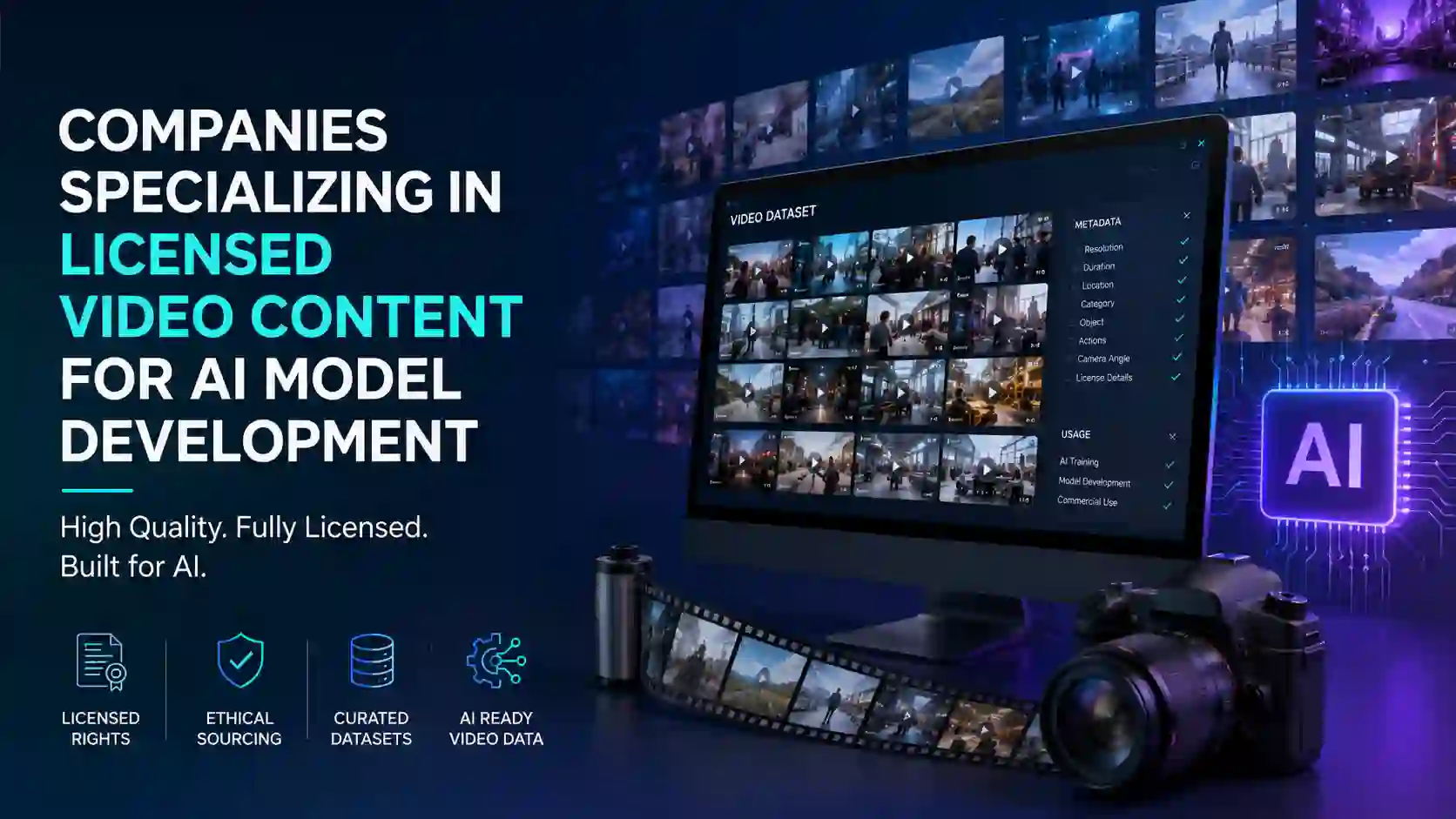
An AI team can have a serious amount of video and still not have a useful training dataset.
That sounds strange until you see what happens inside an actual model development project. A team may collect thousands of clips, only to find that much of the footage is repetitive, poorly documented, restricted by unclear rights, or simply irrelevant to the model's intended use. The storage bill goes up. The usable dataset barely does.
This is why companies specializing in licensed video content for AI model development are becoming more relevant to AI labs, computer vision teams, generative video companies, and businesses building proprietary models.
The job is not just finding footage.
The useful work happens around sourcing, rights, content selection, metadata, consistency, and making sure the buyer can legally use that material for the intended AI purpose. As the market for AI training data has become more commercial, licensed datasets are increasingly being treated as a distinct category rather than an extension of ordinary stock footage.
Companies specializing in licensed video content for AI model development sit in an unusual part of the content supply chain.
They are not simply selling stock footage. They are also not necessarily building the AI model itself. Their role is to help an AI company obtain video material under terms that support training, fine tuning, evaluation, or related model development activities.
That distinction matters.
A normal commercial video license may let a company use a clip in an advertisement, website, presentation, or social media campaign. That does not automatically mean the same clip can be ingested into an AI training pipeline. AI development can involve copying files into datasets, extracting frames, creating embeddings, processing clips for annotation, training models, generating derivative datasets, and retaining data for internal research.
The licensing agreement needs to account for the actual use.
A serious provider may therefore handle several layers of the process. These can include sourcing footage from creators or rights holders, checking ownership, documenting permissions, curating files against technical requirements, and delivering accompanying information about the assets.
Recent licensing activity in the AI data market shows why this distinction is becoming commercially important. Large content owners and specialist data suppliers are increasingly negotiating specific agreements for AI training instead of relying on broad content permissions.
For an AI team, that can mean getting much closer to a usable dataset on day one.
Consider a company developing a video understanding model for retail environments. It might need footage showing checkout activity, shelf interactions, employees stocking products, customers moving through aisles, carts entering and leaving checkout areas, and different lighting conditions.
Buying random commercial footage from a general library would not necessarily solve that problem.
A licensed data provider can instead work from the model's requirements and source content that matches the intended training domain.
That difference is significant.
The buyer is not really purchasing hours of video. They are purchasing access to a defined body of visual data that can support a specific technical objective.
There is a common assumption in AI projects that more data automatically means a better model.
I might be wrong here, but teams often overestimate the value of raw volume and underestimate the cost of unusable footage.
Suppose an AI company has 500,000 video clips. If a large percentage contains similar scenes, identical camera angles, short isolated actions, weak contextual information, or inconsistent quality, the headline number tells you very little.
Video is particularly demanding because it contains both spatial and temporal information.
A still image can tell a model what objects are present. Video can show what happened before, what happens next, how something moves, how people interact, and how a scene changes over time. For models designed around action recognition, video understanding, multimodal reasoning, or generative video, those relationships can be important.
That means dataset variety needs to exist across more than subjects.
It may involve camera position, movement, duration, lighting, environments, object interactions, human behavior, speed, scene transitions, and the ways an event unfolds. Modern video datasets can also rely on temporal annotations that identify what happens and when it happens, rather than treating the entire clip as a single undifferentiated file.
There is another issue that becomes painfully obvious at scale.
A model development team needs to know what it has.
Without reliable metadata, engineers and data operations teams can spend significant time inspecting, filtering, and reorganizing files before those files are useful. Information about duration, resolution, frame rate, scene type, location, subject matter, and other attributes can affect how a dataset is filtered and prepared.
A provider that supplies 100,000 clips with clear metadata can be more useful than one that supplies 500,000 clips with very little information.
This is where companies specializing in licensed video content for AI model development can create practical value.
The goal is not simply to put more files into storage.
The goal is to reduce the amount of work between receiving the content and putting it into a controlled data pipeline.
For an AI startup with a small engineering team, that operational difference can matter almost as much as the content itself.
Licensed video gives AI teams something raw web footage often cannot provide as cleanly: a documented permission trail.
The difference is especially important when the model is being built for commercial use.
AI companies increasingly have to think about where training material came from, whether the necessary rights were obtained, what the license allows, and whether those rights match the intended use. Research into AI training data has highlighted the broader concerns around consent, provenance, and the sourcing of data used to develop models.
For a technical team, licensing may initially look like a legal concern that sits somewhere outside engineering.
It is not.
It can affect the dataset itself.
Imagine a team has trained a useful video model on footage that later turns out to have unclear AI training permissions. The problem is no longer theoretical. The organization may have to investigate affected files, reconstruct dataset versions, determine where those files were used, review contractual obligations, and decide whether retraining is necessary.
That can become a technical problem very quickly.
Licensed datasets can also support cleaner internal governance because the source, permitted use, and related documentation can be recorded alongside the data. Some current commercial data offerings emphasize per asset rights information, provenance records, and consent documentation as part of the dataset rather than as a separate afterthought.
There is a second advantage.
Licensing can help AI teams source material that is hard to obtain through ordinary public datasets.
A computer vision company may need real world footage from particular environments. A generative video model may need long form scenes with particular visual characteristics. A robotics system may need footage showing movement through different physical spaces.
Public benchmark datasets are valuable for research, testing, and comparison. But production models often require a more specific mix of data.
That is where commercial sourcing becomes interesting.
A provider can potentially build around the buyer's dataset requirements rather than asking the buyer to adapt the project around whatever happens to be freely available.
For example, a team developing a retail video model might decide it needs more crowded environments after early testing reveals that the model performs poorly when several people interact in the same scene.
The answer is not necessarily another million random clips.
It may be a narrower batch of licensed footage specifically representing crowd density, occlusion, multiple simultaneous actions, and varying camera perspectives.
That is a much more deliberate data acquisition decision.
Choosing companies specializing in licensed video content for AI model development should start with the model requirement, not the vendor's catalog size.
First, ask what kind of video the provider can actually source.
A large general-purpose library may be useful for broad visual training. A specialized project may need something much narrower. Real world UGC, professional production footage, documentary material, industrial environments, sports footage, human interactions, retail scenarios, or specialized workflows can all create very different dataset requirements.
Then look at how the footage is organized.
Can the provider describe the collection in meaningful terms? Are there useful metadata fields? Can assets be filtered by category, environment, duration, subject matter, or other attributes? Are duplicate or highly repetitive clips identified?
The next question is dataset consistency.
Suppose the first batch contains 50 hours of video shot in bright daylight with stable cameras. The second batch suddenly contains low light footage, different resolutions, extreme camera movement, and completely different scene types.
That may increase the total volume while making the dataset harder to manage.
A good sourcing partner should understand the difference between diversity and randomness.
Those are not the same thing.
Then there is the technical side. Video files can vary dramatically in resolution, codecs, aspect ratio, frame rate, duration, and audio availability. An AI team should know what it will receive before committing to a large licensing arrangement.
The commercial terms matter too. Can the provider support a pilot? Is the license designed for training only, or does it address fine tuning, evaluation, internal testing, deployment, and derivative datasets? What happens if the dataset is updated? What happens to rights if a content contributor later changes participation terms?
The exact answers will vary by agreement, but the questions should come before the purchase.
For Brahvo AI, this is an important distinction to keep in mind when working with AI focused video requirements. The useful proposition is not simply having access to more video. It is helping teams source video that fits a defined AI use case while keeping the content, documentation, and licensing requirements tied to that use case.
That is where a specialized content relationship can make more sense than treating AI training data like an ordinary media purchase.
This is where teams should slow down.
The phrase "licensed video" sounds reassuring, but the word licensed by itself does not answer the most important questions.
Licensed for what?
That should be the first question.
An AI training agreement may specify that content can be used to train or fine tune machine learning models. Another agreement may permit internal research but not commercial deployment. Another may impose restrictions around redistribution, sublicensing, public display, derivative datasets, or model outputs.
Those differences are material.
AI teams should look closely at the permitted purpose, territory, term, content covered by the license, and whether the rights apply specifically to machine learning or AI training. Current AI data licensing agreements increasingly spell out concepts such as training, fine tuning, evaluation, model development, dataset use, provenance, and audit rights because ordinary media licenses may not address them clearly.
Consent deserves separate attention.
A provider should be able to explain the source of the content and what permissions were obtained. For footage containing identifiable people, organizations may also need to consider model releases, privacy rights, publicity rights, location permissions, or other contractual restrictions depending on the content and intended use.
This does not mean every video needs an identical rights package.
It means the rights package should match the actual dataset use.
There is also a practical issue around provenance.
If a model development team receives thousands of files, it should ideally be possible to trace those files back to licensing documentation. Per asset or per collection documentation can make internal reviews much easier than relying on a single broad statement that all content is supposedly cleared.
That matters when datasets change over time.
A model version might be trained on Dataset A in January, Dataset B in April, and a combined Dataset C later in the year. If the organization can identify which files came from which licensed source, it has a much clearer record of what entered the training pipeline.
AI teams should also ask about retention.
Can the company continue storing the footage after the license ends? Can trained weights continue to exist? Does the contract require removal of source files at expiration? What happens to processed copies, extracted frames, annotations, or derived datasets?
These details are easy to ignore when everyone is focused on collecting footage.
They become much harder to ignore once the model is already trained.
One more issue deserves attention: the difference between content rights and model rights.
Having permission to use a video for training does not necessarily mean every possible downstream use is automatically covered. An agreement may distinguish between research, commercial model development, deployment, model outputs, or creating derivative datasets. Legal review should focus on those distinctions rather than assuming one permission covers everything.
For companies specializing in licensed video content for AI model development, this is where the strongest value often sits. The content itself is visible. The paperwork behind it is less visible, but it can determine whether the dataset is genuinely usable.
And for an AI company planning to scale a model beyond an internal experiment, that question tends to become uncomfortable only when it is already expensive to fix.
A video dataset can look impressive in a spreadsheet and still perform poorly when it reaches the model.
That usually happens when teams measure the wrong thing. They count hours, files, or terabytes without asking whether those videos actually represent the situations the model needs to understand.
For AI model development, variety is not simply having different subjects. It can mean different camera positions, lighting conditions, environments, motions, people, backgrounds, distances, object sizes, scene durations, and interaction patterns.
Take a model designed to understand activity inside commercial spaces. If most of its training footage comes from clean, well-lit environments with one person performing an obvious action, the model may behave very differently when it encounters crowded aisles, partial visibility, unusual camera angles, or people moving unpredictably.
That is where dataset quality starts to matter.
A useful dataset should have enough variation to represent the conditions the model is likely to encounter while avoiding unnecessary repetition. Too much repetition can make a dataset look large without adding much new information. At the other extreme, completely random footage can create a collection that is technically diverse but poorly aligned with the actual use case.
There is a balance.
Quality also includes the technical characteristics of the footage. Resolution, frame rate, clip duration, compression, aspect ratio, and audio can all affect how the data is processed. Metadata matters too because data teams need to filter and organize large collections without manually inspecting every file.
For companies specializing in licensed video content for AI model development, this becomes a sourcing challenge as much as a content challenge. The provider needs to understand what diversity the project actually requires.
A generative video model may need broad visual variation across scenes and movement. A computer vision model may need very specific examples of object interaction. A video understanding system may need longer clips where context unfolds over time.
The right dataset looks different in each case.
One practical example is a DTC apparel company working with an AI team to develop a model that understands product demonstrations in short form video. Thousands of generic fashion clips might have very little value if they do not show clothing being worn, adjusted, layered, folded, compared, or demonstrated in realistic environments.
A smaller collection with those behaviors represented consistently could be more useful than a much larger generic library.
That is why raw volume should not be treated as the main success metric.
There is a reason specialized video data can be difficult to source.
Real businesses do not behave like generic stock footage.
An AI model being developed for healthcare workflows, manufacturing environments, retail activity, sports analysis, automotive applications, or ecommerce content understanding will encounter very different visual patterns.
A video that is excellent training material for one model could be nearly irrelevant to another.
Consider manufacturing.
An industrial AI model might need footage of machinery operating under different conditions, workers interacting with equipment, maintenance procedures, moving components, safety gear, different factory layouts, and changes in lighting. A broad commercial video collection might contain almost none of that.
Now consider ecommerce.
A model intended to analyze product videos could benefit from footage showing packaging, unboxing, product demonstrations, hands interacting with products, lifestyle scenes, close ups, talking head content, UGC style clips, and different editing patterns.
The actual business environment shapes the data requirement.
This is why use case specificity should happen before sourcing begins. Teams should define what the model needs to recognize, generate, classify, predict, or understand. Once that is clear, content requirements become easier to define.
A project may need diversity across industries but consistency within certain categories. Another may need large volumes of similar footage with carefully controlled variations.
Those are very different sourcing jobs.
Industry specific data can also help expose edge cases earlier. A model trained mostly on ideal conditions may look strong during internal testing, then perform poorly when real customers, real workplaces, or messy environments enter the picture.
AI teams sometimes discover this only after deployment.
That can create a painful retraining cycle.
The value of companies specializing in licensed video content for AI model development is partly their ability to connect content sourcing with the actual application. A buyer should not have to explain the entire AI project from scratch every time it needs another batch of data, but the provider still needs enough context to understand what is useful and what is noise.
There is no universal definition of a good training video.
There is only a good match between the video and the model's intended job.
Brahvo AI approaches this requirement from the perspective of the actual video problem rather than treating every request as a generic footage purchase.
For AI model development, the first practical question is what kind of content the model needs.
That could involve specific environments, people, actions, scenes, products, camera perspectives, visual conditions, or other attributes. Once those requirements are understood, the sourcing process can be shaped around them.
That matters because AI teams rarely need random footage.
They need footage that fills a defined data requirement.
For example, suppose an AI company is developing a model intended to understand human actions in ecommerce videos. It may need clips showing demonstrations, handling, movement, packaging, product comparison, spoken presentations, and hands interacting with objects.
A useful content collection would need enough variation within those categories to prevent the model from seeing the same visual pattern repeatedly.
Brahvo AI can support these requirements by focusing on video content that aligns with the intended AI application rather than simply maximizing file count.
The practical side includes thinking about content categories, usage requirements, technical specifications, and how the footage will fit into the team's broader data workflow.
That can be particularly useful for teams dealing with large creative pipelines, multiple model versions, or recurring dataset requirements.
There is another consideration that does not always get enough attention.
AI teams often need additional content after the first dataset has already been tested.
The initial training run may reveal weak areas. Maybe the model performs well with close up product shots but struggles with wide scenes. Maybe it handles one person well but loses track when multiple people appear. Maybe performance drops in low light.
At that point, the next sourcing request is more specific.
A content partner that understands the original requirements can be better positioned to support those follow up needs than a provider working from a generic catalog.
Brahvo AI's role in that process is not simply about supplying more footage. It is about helping align video content with the practical requirements of AI development.
That distinction becomes important once teams move beyond experimentation and start building repeatable data pipelines.
The biggest sourcing problems are often not obvious at the start.
The first is rights ambiguity.
A video may be available under a legitimate license but still lack the permissions required for the specific AI use case. AI teams need to understand whether training, fine tuning, evaluation, internal research, derivative processing, and other intended activities are covered.
Then there is content mismatch.
A provider may have plenty of video but very little footage that matches the actual training requirement. Buying volume under those conditions creates an expensive filtering problem.
Metadata can become another bottleneck.
When thousands of clips arrive with limited information, engineers and data operations teams may need to spend significant time classifying and organizing the material. At scale, this can slow down the entire training workflow.
Consistency can also be surprisingly difficult.
One batch may have excellent quality and clear categorization while another contains different formats, unpredictable clip lengths, or uneven subject coverage. The data team then has to normalize everything before training.
There is also the question of licensing changes over time.
AI projects do not always end with one training run. Models are updated, retrained, evaluated, and sometimes adapted for new commercial applications. A license that works for an initial experiment may not automatically cover every later use.
That is why teams should think beyond the first delivery.
A useful sourcing relationship should account for what happens after the initial dataset has been reviewed, processed, and tested.
Cost is another practical issue.
Licensed content is not always cheap, but neither is poorly sourced data. Teams should consider the total cost of acquisition, review, cleaning, rights verification, storage, processing, and potential retraining when comparing options.
The cheapest footage can become the most expensive footage once engineers start cleaning it.
One more issue is speed.
AI teams are often working against product deadlines, model release schedules, investor expectations, or internal milestones. Waiting weeks for clarification about content rights or missing dataset requirements can create a bottleneck that has nothing to do with model engineering.
Sometimes the data is the bottleneck.
And nobody notices until everyone else is ready.
What makes licensed video different from ordinary stock footage for AI training?
The main difference is the intended use. Ordinary stock licenses may cover advertising, websites, presentations, or other commercial content uses. AI development may involve training, fine tuning, processing, annotation, and creating model derivatives, so the license needs to address those activities clearly.
Why do AI teams need licensed video content for model development?
Licensed content can give teams clearer documentation around where the data came from and how it may be used. That can reduce uncertainty when the model is being developed for commercial applications.
Do AI models need millions of video clips to perform well?
Not necessarily. More footage can help, but relevance and diversity often matter just as much. A smaller dataset with strong coverage of the required scenarios may be more useful than a huge collection full of repetitive or irrelevant footage.
What types of video are useful for AI training?
It depends on the model. Useful data can include real world scenes, product demonstrations, human actions, industrial environments, conversations, movement, object interactions, lifestyle footage, and other material that matches the intended application.
How important is metadata for licensed AI video datasets?
Very important at scale. Metadata helps teams filter and organize footage based on properties such as duration, scene type, subject, environment, or other project requirements. Without it, manual review can become expensive.
Does video quality affect AI model performance?
Yes, but the required quality depends on the project. Resolution, frame rate, compression, lighting, camera movement, and other characteristics can affect how video is processed. Higher quality is not automatically better if it does not reflect the conditions the model needs to handle.
Can licensed video be used for both training and commercial model development?
It can be, but the agreement needs to explicitly support the intended activities. Teams should not assume that a general commercial video license automatically covers AI training or every downstream model use.
What should an AI team ask before licensing a large video dataset?
Start with rights, permitted AI uses, provenance, content coverage, metadata, technical specifications, delivery format, retention requirements, and how additional or replacement content will be handled.
Can industry specific video improve an AI training dataset?
It can, especially when the model is designed for a specific environment. A retail model, for example, may benefit far more from realistic retail footage than from a broad collection of unrelated commercial videos.
How does Brahvo AI fit into AI video data requirements?
Brahvo AI focuses on aligning video content with defined AI development requirements. That means considering the intended use case, content characteristics, licensing needs, and practical requirements of the data workflow rather than treating the project as a simple footage purchase.