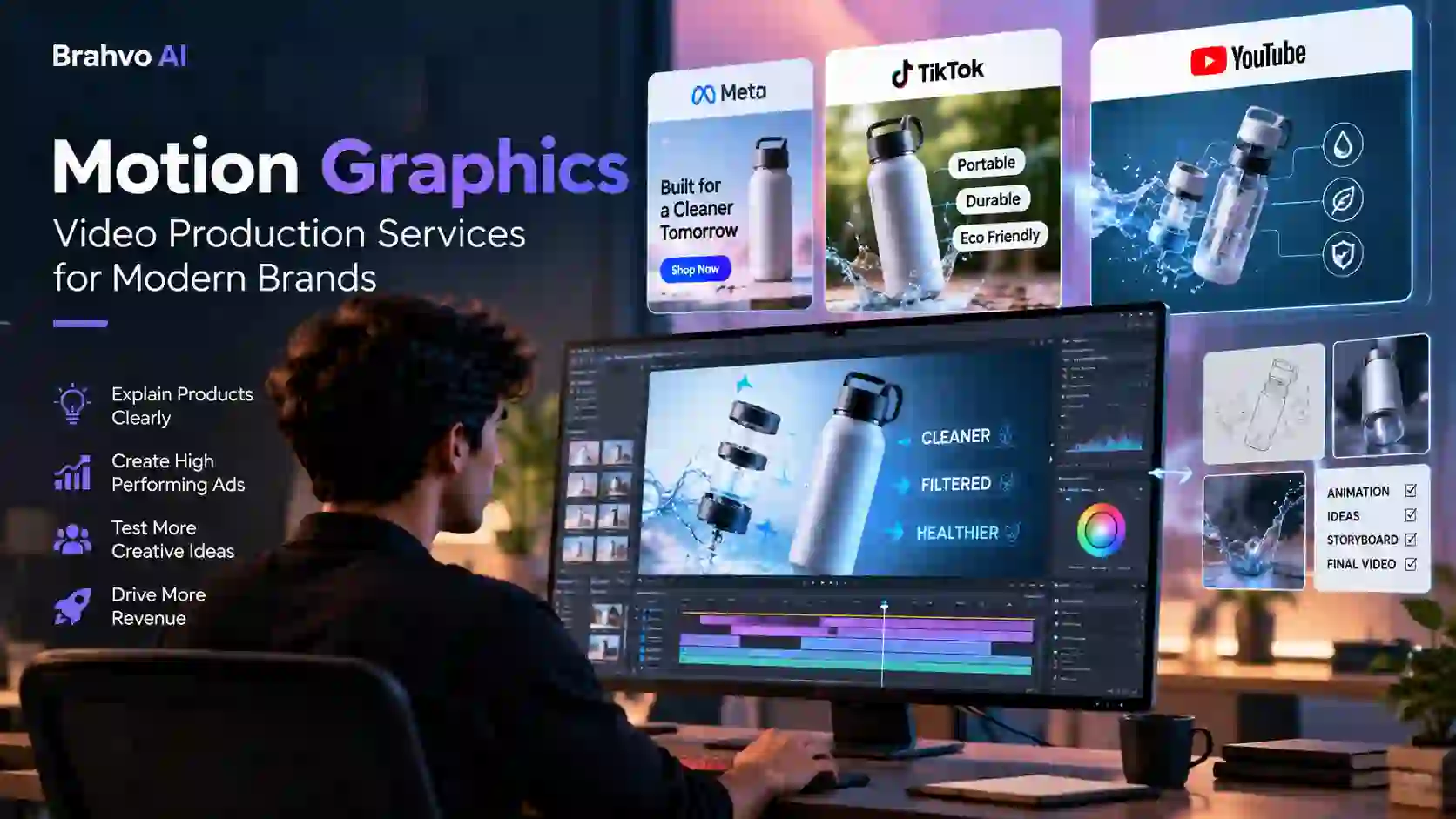
Brahvo AI creates motion graphics videos for ecommerce brands to explain products, test ad creatives, and support paid media campaigns.
An ecommerce brand can have a good product, competitive pricing, and a decent media buying strategy, yet its ads can still struggle to hold attention. Sometimes the problem is not the offer. The product simply takes too long to explain, or the creative looks too similar to everything else appearing in a customer's feed.
This is where motion graphics video production services become useful. Instead of relying entirely on filmed footage, brands can use animated text, product features, diagrams, transitions, data points, and visual demonstrations to communicate their message quickly.
For US ecommerce companies spending thousands of dollars each month on paid advertising, this matters. A product may need several seconds of explanation before its value becomes obvious. Motion graphics can make that explanation easier to follow without requiring a new filming session every time the message changes.
Brahvo AI can approach this type of production with the needs of modern advertising teams in mind. The goal is to create videos that communicate a product's value clearly, fit different placements, and give marketers more creative options to test. Good animation is useful, but only when it gives the viewer a reason to keep watching.
Digital advertising has a particular problem. Brands often have very little time to explain why a product deserves attention. A viewer scrolling through Instagram or TikTok is unlikely to stop and study a complicated product demonstration unless the opening gives them a reason to care.
Motion graphics video production services help brands present information in a more digestible format. A short animated sequence can highlight a product's main feature, show how a process works, or make an otherwise abstract benefit easier to understand.
Consider a US DTC brand selling a smart home device. A conventional product video might show the device sitting on a kitchen counter while a voiceover explains its features. A motion graphics version could display the device, animate its connection to a mobile app, highlight its key controls, and show how a customer interacts with it. The viewer gets a clearer picture of the product's role without needing an elaborate production setup.
That does not mean animation should replace filmed footage in every campaign. Physical products often benefit from seeing real materials, packaging, texture, and scale. Motion graphics work particularly well when the message depends on explaining, comparing, labeling, or illustrating something that a camera cannot communicate efficiently on its own.
There is also a practical advantage for brands managing multiple products. Once the visual language is established, a team may be able to adapt certain animation elements across related SKUs. Product names, feature callouts, pricing messages, and promotional text can sometimes be changed without rebuilding the entire video.
The important distinction is between producing an attractive animation and producing a useful advertising asset. They are not always the same thing.
Some products are easy to sell visually. A clothing brand can show the fit of a jacket. A furniture company can film a sofa in a furnished living room. Other products require more explanation before a customer understands what makes them different.
This is common with electronics, subscription products, technical accessories, personal care devices, and products with multiple functions. A conventional video may show the item clearly while leaving the actual benefit unclear.
Motion graphics video production services give brands another way to bridge that gap.
For example, a company selling a portable water filtration device could use animation to illustrate the movement of water through its filtration stages. The video could identify the components and explain the intended function of each stage. Any claims about filtration performance would still need to be supported by the product's actual specifications and testing.
A software enabled physical product presents a similar challenge. The customer may understand what the device looks like but have difficulty understanding the companion app, connected features, or automated functions. Animated interface elements and simple visual sequences can make those relationships easier to follow.
There are several situations where this approach is particularly useful:
One mistake is trying to explain every product feature in a single video. A customer who is unfamiliar with the product usually needs one convincing reason to pay attention before they need a full explanation.
A better approach is to give each creative a clear job. One video can explain the main feature, another can address a common objection, and another can demonstrate a specific use case. This makes the resulting assets more useful for creative testing because the team can learn which message attracts attention and which message helps customers understand the offer.
A motion graphics video should not automatically be treated as a universal asset. Meta Ads, TikTok Ads, and YouTube campaigns have different placements, viewing habits, and creative requirements. The same core message may work across them, but the execution often needs adjustment.
On Meta, a motion graphics ad can combine product footage with animated headlines, feature labels, pricing information, and a direct call to action. This can be useful for ecommerce brands testing different product benefits or promotional angles. The opening still matters, though. Animated text cannot rescue an offer that is irrelevant to the audience.
TikTok often calls for a more immediate and less formal presentation. A brand might use quick animated annotations over product footage, short text sequences, or a visual demonstration that resembles the way a creator would explain a product. Animation that feels like a corporate presentation may be less suitable for a campaign built around casual, creator style content.
YouTube allows for several different advertising contexts, from short skippable ads to longer product explainers. Motion graphics can establish the problem, explain the product's mechanism, and introduce supporting details before the viewer reaches the next decision point. Longer formats can support more explanation, but every additional second still needs a purpose.
For a brand advertising across all three platforms, the production process should account for differences in aspect ratio, safe areas, text size, pacing, and sound. A vertical video designed for a phone screen may not translate neatly into a horizontal placement. Tiny feature labels that look readable on an editing monitor can become nearly useless on a mobile device.
The commercial question is not simply how many placements a video can fit into. It is how many useful versions the team can produce without making every version feel like the same advertisement with a different crop.
Brahvo AI can use a modular production approach for this kind of work, where the core message and visual assets are adapted to suit the intended placement. That gives marketing teams a clearer way to manage creative variations while keeping the product story consistent.
AI powered video production is changing how marketing teams approach early concepts, asset creation, editing, and versioning. Motion graphics can fit into these workflows because many of their components are built from separate visual elements rather than a single continuous camera recording.
A campaign might begin with a product brief, a set of approved claims, and a few advertising angles. The team can then decide which parts need product footage, which require animated explanations, and which can be communicated through typography, diagrams, or interface elements.
AI can assist with parts of this process, depending on the production workflow. It may help teams explore visual concepts, draft scripts, generate supporting imagery, or accelerate certain editing tasks. Motion design still requires decisions about timing, visual hierarchy, transitions, and whether the final result communicates the intended message.
For example, a DTC skincare brand launching a new device might need one video explaining the product's mechanism, another focusing on its daily use, and a third highlighting a promotional offer. The team could retain approved product visuals and a consistent animation style while changing the emphasis of each version.
That is a more useful application of AI than generating dozens of nearly identical videos without a clear testing purpose.
There are limits. AI generated visuals can misrepresent packaging, distort product geometry, or introduce details that do not exist. Those errors are especially problematic in ecommerce advertising, where customers expect the advertised product to match what arrives at their door. Brand assets, product claims, prices, and any regulated statements need appropriate review before publication.
I might be wrong here, but production speed is not always the main constraint for an established advertising team. Sometimes the bigger problem is deciding which idea deserves to be produced in the first place. A faster workflow helps only when the team has a reasonable process for selecting concepts, reviewing assets, and learning from campaign results.
For Brahvo AI, the practical opportunity is to connect AI assisted production with deliberate creative development. The value comes from making relevant advertising assets easier to develop and adapt, not from treating the number of videos produced as a measure of campaign success.
Producing motion graphics is one part of the job. Understanding which creative deserves more budget is another.
Ecommerce teams frequently face a familiar situation. A campaign performs well for several weeks, customer acquisition costs begin to rise, and the media buyer asks for fresh creative. The team produces several new videos, but performance remains inconsistent. Some ads attract clicks without generating purchases. Others generate early engagement but fail to spend enough to support a confident decision.
The problem may not be the quality of the animation. The team may be testing too many variables at once, or the new videos may not address the reason the original campaign stopped working.
A useful creative testing process separates the main advertising idea from its execution. Suppose a brand sells a compact home organization product. It might test three different angles: saving space, reducing daily clutter, and making a small apartment easier to organize. Each angle could use a similar visual style, making it easier to evaluate the message rather than changing every element simultaneously.
Once the team identifies a promising angle, it can test different openings, pacing, product demonstrations, or calls to action. Motion graphics make some of these adjustments easier because headlines, labels, and animated sequences can often be edited independently.
However, changing a headline and a color does not always create a meaningful new creative concept. If the underlying message, demonstration, and offer remain identical, the variants may provide little new information.
A practical example of creative testing
Consider a fictional US DTC brand selling a desk accessory for people working in small home offices. Its original ad shows the product and lists three features. The campaign initially performs well, but purchases become more expensive after several weeks.
Instead of immediately commissioning a completely new production, the team creates three focused versions:
The team keeps the offer and landing page consistent during the initial test. It then reviews spend, purchase volume, cost per acquisition, click through rate, and conversion rate together rather than declaring a winner based on clicks alone.
If the first version attracts attention but produces few purchases, the message may be interesting without attracting customers who are ready to buy. If the second generates fewer clicks but a better purchase rate, it may be reaching a more relevant audience. The result still depends on sufficient data, attribution settings, and the conditions under which the ads ran.
This is an illustrative scenario, not a claim about a real client or measured campaign result.
For brands working with multiple SKUs, the challenge becomes more complicated. A creative concept that works for one product may not translate to another because the purchase motivation, price point, or amount of explanation required is different. Production teams need room to adapt the idea rather than simply replace the product image.
That is where motion graphics video production services can support a more disciplined testing process. They make it easier to develop variations around meaningful customer motivations while retaining enough consistency to understand what changed.
The team still needs to decide what the campaign is trying to learn. Without that decision, the creative queue fills up, the review process gets slower, and everyone starts asking for more videos.
And producing more videos is not always the answer.
For an ecommerce team, the cost of a motion graphics video is not just the production invoice. There is also the time spent reviewing concepts, correcting product details, requesting revisions, adapting formats, and getting the final creative ready for a campaign. When a brand needs fresh ads every week, those smaller tasks can become a serious operational burden.
The right level of animation depends on what the ad needs to accomplish. A short product feature video may need clean typography, a few animated callouts, and accurate product footage. A product launch explaining a complicated mechanism may justify custom illustrations, detailed transitions, and more involved animation. Spending the same amount of time on both would not make much sense.
Motion graphics video production services should account for the role each asset plays in the campaign. A video designed to test a new advertising angle does not necessarily need the finish of a major launch commercial. It needs to communicate the idea clearly enough for the team to judge whether the message resonates with customers.
Consider a DTC brand preparing to launch six new product variations. Producing six entirely different animations could consume a large share of the creative budget before the brand knows which product message works best. A more practical approach might be to establish a visual system, develop a reusable animation style, and customize the product demonstrations and messaging for each variation.
Reusable elements can reduce repeated work, but they should not dictate every creative decision. If a new product requires a different demonstration or a different emotional appeal, forcing it into the same format can make the advertising feel repetitive.
Revision planning matters just as much. Brands should agree on the script, product claims, visual references, and core message before detailed animation begins. Changing the central concept late in production usually creates more work than adjusting a headline or changing the timing of a transition.
The budget question is therefore not simply how cheaply a video can be produced. It is how much useful creative the team can produce within its budget, how quickly those assets can be approved, and whether the resulting videos give the paid media team something meaningful to test.
Modern brands need video production that fits the pace of their advertising operations. A team managing weekly promotions, seasonal launches, and multiple product categories may not have the time to treat every new ad as a separate production project.
Brahvo AI can approach motion graphics video production services around the actual requirements of the campaign, beginning with the product, audience, advertising message, and intended placement. This keeps production decisions connected to the reason the video is being made.
For example, a US ecommerce brand launching a new kitchen accessory might need to explain three things quickly: the problem the product solves, how it works, and why its design is useful. The production approach should establish which of those messages deserves the most attention before deciding how to animate the video.
A practical workflow can include the following stages.
Campaign and message planning. The team identifies the intended audience, the product's primary selling point, the customer objection being addressed, and the action the ad should encourage. A product launch may require more explanation than a retargeting ad aimed at people who have already visited the product page.
Visual direction and asset preparation. Product images, approved footage, brand colors, typography, packaging references, and any relevant interface elements are gathered. This stage also helps identify where animation will add value and where real product footage is more convincing.
Motion design and production. The team develops the visual sequence, animation timing, text treatments, and transitions. AI assisted production techniques may support selected tasks, depending on the project. Human review remains important for product accuracy, readable text, and consistent visual presentation.
Adaptation and review. Approved creative can be adapted for the intended advertising placements, with attention to aspect ratios, safe areas, captions, and pacing. The team also checks that product claims, prices, and promotional terms remain accurate in each version.
Feedback and revision. Marketing teams review the finished asset against the original brief. Feedback should identify specific issues rather than rely on vague requests to make the video feel more exciting or engaging.
The key is to avoid producing animation for its own sake. A polished sequence that hides the product until the final seconds may be visually impressive but commercially unhelpful for a brand that needs customers to understand the product immediately.
Brahvo AI's work in this area should be evaluated by the relevance and usability of the finished creative, not by assumptions about how quickly AI can produce it. Production efficiency matters, but it still needs to support a clear advertising objective.
Choosing a production partner involves more than reviewing a portfolio. A company may produce beautiful animation but struggle to manage recurring ad requests, understand product positioning, or deliver files that are ready for paid media.
For ecommerce brands, the working process matters almost as much as the finished video. Before committing to motion graphics video production services, it is worth looking at a few specific areas.
Understanding of ecommerce advertising. Ask how the production team approaches a product that needs to sell rather than simply inform. Can it distinguish an awareness ad from a product demonstration or a retargeting creative? Does it understand why a customer might hesitate before purchasing? These questions reveal whether the team considers the commercial purpose of the video.
Quality of product representation. Product accuracy is non-negotiable. Packaging, colors, dimensions, interface details, and product features should match the actual item. This becomes especially important when AI assisted imagery or animation is involved. A visually appealing but inaccurate demonstration can create customer confusion and potentially misrepresent the product.
Ability to handle recurring creative requests. A brand running multiple campaigns needs a predictable production process. Ask how new requests are prioritized, how revisions are managed, and whether the team can accommodate several SKUs without losing consistency. A one-time project may be straightforward. A recurring monthly workload is a different commitment.
Adaptation for advertising placements. Confirm that deliverables will be prepared for the placements specified in the brief. This may include vertical, square, and horizontal versions, depending on the campaign. Ask how text readability, captions, aspect ratios, and opening sequences are handled when a video is adapted.
Clarity around revisions and ownership. Establish how many review rounds are included, what counts as a revision, which source files will be delivered, and who owns the final assets. These details can prevent misunderstandings when a marketing team wants to update a price, replace a product image, or reuse an animation in a future campaign.
Ability to work with the existing creative process. A production partner should understand how the brand's marketing team operates. That includes receiving briefs, collecting feedback, obtaining approvals, and preparing assets for launch. If every small change requires a lengthy exchange, the production process can become a bottleneck.
It is also worth asking how success will be evaluated. A production team may be responsible for delivering the creative, while the brand's media buying team controls campaign setup, audience selection, budget allocation, and performance analysis. These responsibilities overlap, but they are not interchangeable.
Brahvo AI should be assessed against the actual requirements of the brand, including creative quality, production coordination, adaptability, and the ability to work within the campaign's objectives. A clear scope of work is more useful than a broad promise of unlimited creative output.
A motion graphics video can look excellent during an internal review and still perform poorly as an advertisement. The opening might not attract attention, the message might be unclear, or the product benefit might not be compelling enough to generate a purchase.
That is why brands should evaluate motion graphics video production services in relation to the advertising results they are trying to achieve.
The right measurement depends on the purpose of the creative. For a campaign introducing an unfamiliar product, early viewing behavior can help reveal whether people are staying long enough to understand the message. For a direct response campaign, purchases, customer acquisition cost, and conversion rate usually carry more commercial weight.
Here are some useful measures and what they can tell a marketing team.
Metric
What it helps explain
Hook rate or early video retention
Whether the opening is holding attention, depending on the platform's reporting definition
Video completion rate
How often viewers watch through the measured portion of the video
Click through rate
Whether the creative encourages people to visit the destination
Conversion rate
Whether visitors take the intended action after clicking
Cost per acquisition
How much advertising spend is required for each acquired customer under the chosen attribution method
Return on ad spend
How much attributed revenue is generated per dollar of advertising spend
These metrics should not be interpreted independently. A video with a strong click through rate but weak purchase conversion may attract curiosity without communicating enough product value. A video with lower click volume may generate more qualified traffic and better customer acquisition economics.
The same principle applies to video retention. A high completion rate is not automatically evidence of strong sales performance. A short, entertaining animation may be easy to watch but fail to create purchase intent. A longer product explanation may have lower completion but help a smaller group of viewers make a decision.
Creative testing should therefore begin with a clear hypothesis. If the team believes customers do not understand a product feature, the test should make that feature easier to understand. If the concern is price resistance, changing the animation style alone may not address the problem.
Paid media results depend on several variables beyond the video itself. Audience composition, placement, bidding conditions, offer quality, landing page experience, seasonality, and budget changes can all affect the results.
Suppose an ecommerce brand launches a new motion graphics ad during a major holiday promotion. Purchases increase, but the brand also reduced its price and increased its media budget. It would be difficult to attribute the entire change to the creative.
A cleaner test keeps major variables as consistent as practical, gives the campaign enough time and spend to produce interpretable results, and compares the new creative with a relevant baseline. Not every business has enough budget for a formal controlled experiment, but even smaller tests benefit from a clear hypothesis and consistent measurement.
Brands should also account for differences between new customer acquisition and returning customer sales. An ad that performs well with existing customers may not explain the product well enough for someone seeing the brand for the first time.
For Brahvo AI, the useful distinction is between producing an asset and proving its commercial contribution. Production teams can help deliver creative that supports a test, but campaign performance must be evaluated using the actual advertising data and the wider conditions surrounding the campaign.
The real question is not whether motion graphics outperform every other creative format. It is which message, visual treatment, and product explanation work for a particular audience and buying situation.
1. What are motion graphics video production services?
Motion graphics video production services involve creating videos using animated text, shapes, illustrations, product visuals, diagrams, and other graphic elements. Businesses use them to explain product features, communicate offers, demonstrate processes, and create advertising content for digital channels.
2. How much do motion graphics video production services cost?
Pricing depends on video length, animation complexity, the number of versions required, asset preparation, and revision requirements. A short video using existing product footage and animated text generally requires less production work than a fully custom animation with detailed illustrations and complex transitions. Brands should compare the complete deliverables and revision terms rather than the price of a single video alone.
3. Are motion graphics effective for ecommerce advertising?
They can be effective when animation helps communicate a useful product benefit or gives customers a clearer reason to purchase. They are particularly helpful for products with multiple features, technical functions, or benefits that are difficult to demonstrate through ordinary footage. Performance still depends on the offer, audience, message, and execution.
4. Can motion graphics be used for Meta Ads, TikTok Ads, and YouTube?
Yes. Motion graphics can be adapted for different advertising placements across these platforms. The creative may need changes to its aspect ratio, text placement, pacing, opening sequence, and length to suit each placement. Simply cropping the same video does not always produce the best result.
5. How does AI affect motion graphics video production?
AI can assist with concept development, visual asset creation, scripting, and selected production tasks. The extent of its usefulness depends on the workflow and the complexity of the animation. Product accuracy, visual consistency, readable text, and final quality still require careful review.
6. How many motion graphics videos should an ecommerce brand produce each month?
There is no universal number. A brand launching several products or testing multiple advertising angles may need more creative variations than a business running a small, stable campaign. The production schedule should reflect the available testing budget, campaign priorities, and the team's ability to evaluate the results.
7. Should motion graphics replace product footage in paid social ads?
Not necessarily. Product footage helps customers understand physical details, materials, size, and real world use. Motion graphics can explain features, highlight benefits, and simplify complicated information. Combining both approaches often makes sense when the product needs to be seen and explained.
8. How long does it take to produce a motion graphics video?
The timeline depends on the scope, complexity, availability of approved assets, and review process. A relatively simple animation may require considerably less time than a detailed custom sequence. Delays often arise when the brief changes after production begins or product claims and visual references have not been approved.
9. What should brands look for when choosing motion graphics video production services?
Look for relevant work samples, reliable communication, clear revision terms, accurate product representation, and experience preparing assets for the intended advertising placements. For recurring campaigns, also consider how the team manages multiple requests, maintains visual consistency, and accommodates new creative requirements.
10. How can Brahvo AI support motion graphics production for advertising campaigns?
Brahvo AI can be considered for motion graphics projects that require clear product communication, animated visual elements, and creative assets for digital advertising. Before starting, brands should define the campaign objective, required formats, deliverables, approval process, and production scope so both sides have a clear understanding of the work involved.