Looking for an entertainment creative agency in Los Angeles? Brahvo AI helps brands create AI-powered video content for modern campaigns.
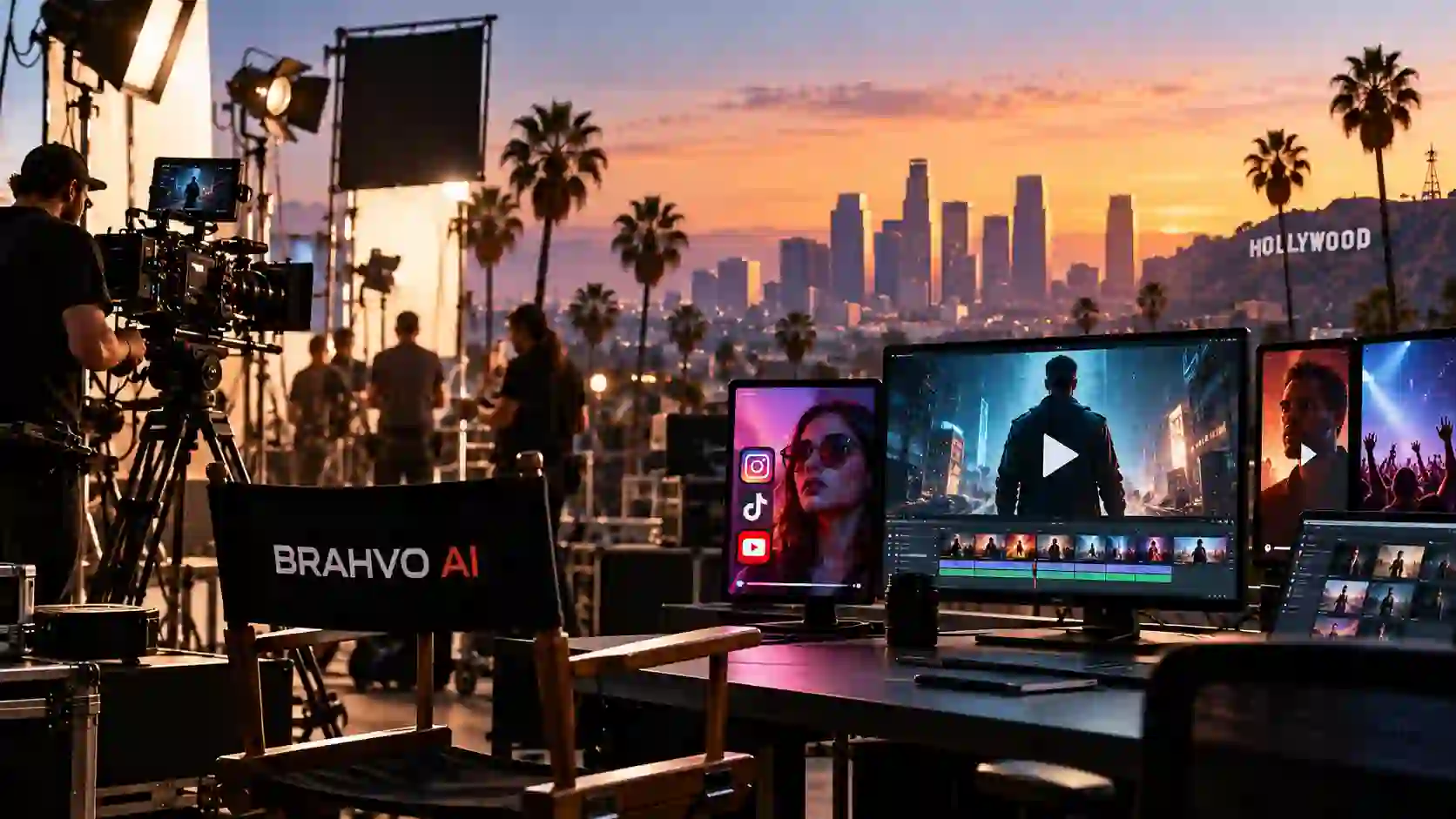
Entertainment marketing has become more demanding because audiences encounter content across so many channels. Someone might first see a film announcement on Instagram, watch a short teaser on TikTok, encounter a YouTube trailer, and later receive a streaming promotion. Each interaction serves a different purpose.
Brands searching for an entertainment creative agency Los Angeles often need help connecting these touchpoints without making every advertisement feel identical.
A movie studio might need a theatrical trailer, short character introductions, behind the scenes footage, and several vertical videos for social distribution. A live entertainment company may need promotional videos for ticket sales, performer announcements, and reminders aimed at people who visited its website but did not purchase tickets.
Producing each asset independently can create inconsistent messaging and unnecessary production work. The central challenge is to create a recognizable creative direction while giving each channel material suited to its audience and format.
There is also the issue of timing. Entertainment campaigns often operate around fixed release dates, premiere schedules, ticket launches, and subscription announcements. A delay in creative delivery can reduce the time available for testing and campaign adjustments.
An experienced entertainment creative agency in Los Angeles should understand these commercial pressures alongside the creative brief. It needs to ask what the campaign is expected to achieve, who needs to see the content, and what action the viewer should take after watching.
That last question matters more than many teams realize. A campaign intended to sell tickets may need a different message from one designed to introduce an unfamiliar character or build awareness for a new streaming series.
The work extends beyond filming and editing. An entertainment creative agency may help translate a brand's campaign idea into a collection of assets that can be distributed across advertising, social media, streaming promotions, and other digital channels.
The exact responsibilities depend on the project, but several areas usually deserve attention.
Creative concept development establishes the central idea. For an upcoming series, the campaign might focus on a mystery, a lead character, an emotional conflict, or a distinctive visual world. The creative concept gives individual advertisements a consistent identity.
Video production and editing turn that idea into usable content. This may involve trailers, promotional spots, short-form edits, interviews, motion graphics, and platform-specific variations.
Campaign asset planning determines what the marketing team will need before production begins. A campaign that requires only one hero video has different production requirements from one that needs dozens of short clips for multiple audience segments.
Creative adaptation makes content appropriate for each placement. A widescreen trailer cannot simply be cropped into a vertical format and assumed to work. Important visual details may disappear, dialogue may become difficult to follow, and the main message may arrive too late.
Performance feedback helps creative teams understand what happens after launch. If viewers respond to a particular character, visual hook, or storyline, the next set of assets can explore that response.
For brands evaluating an entertainment creative agency in Los Angeles, these responsibilities should be discussed before production starts. Otherwise, a project can deliver a polished main video while leaving the advertising team without the supporting material it needs.
The most useful arrangement is one in which creative planning considers the complete campaign rather than treating the final edit as the only deliverable that matters.
AI video production is becoming relevant to entertainment marketing because campaigns often require more variations than a traditional production schedule can comfortably support.
Consider a campaign that needs multiple opening hooks, different calls to action, short character introductions, and edits for vertical and horizontal placements. Producing every version from scratch may require additional filming, editing time, and approvals.
AI-assisted production can help with selected parts of this process. Depending on the workflow, it may support concept visualization, storyboarding, visual development, voiceover production, background generation, editing assistance, and the adaptation of approved content into additional formats.
For Brahvo AI, the practical opportunity is to make video production workflows more adaptable when a campaign requires a steady supply of creative assets.
However, AI video production should not be treated as a replacement for every production method. Entertainment marketing depends heavily on recognizable performers, visual continuity, emotional credibility, and brand identity. A scene involving a well-known actor, a carefully staged performance, or a specific cinematic look may require conventional filming or specialist production work.
There are also approval considerations. Teams need to confirm that they have the necessary rights to use source footage, voices, likenesses, music, and other creative materials. AI-generated content should not introduce misleading depictions of real performers or imply endorsements that have not been authorized.
A sensible approach is to identify where AI offers a real production advantage instead of inserting it into every stage.
For example, an entertainment brand might use a traditional production shoot for its primary campaign footage and AI-assisted workflows to explore additional visual concepts or prepare approved variations. The main creative identity remains intact, while the team gains more flexibility in how it develops supporting assets.
The important question is not whether AI was used. It is whether the finished content serves the campaign without introducing quality, rights, or consistency problems.
A campaign rarely has one audience behavior to account for. Someone watching a streaming advertisement may be willing to spend time with a cinematic story. A person scrolling through TikTok may need a compelling reason to stop within the first few seconds.
The creative approach should reflect that difference.
For streaming promotions, longer narrative development can help establish a premise, introduce characters, or communicate the atmosphere of a show. The viewer may need enough context to understand why the title is worth watching.
Short-form social advertising often has a different job. It needs to establish relevance quickly, deliver a clear message, and give the viewer a reason to continue watching or take action.
An entertainment creative agency in Los Angeles should therefore plan content around the viewing experience rather than simply producing one master video and resizing it for every destination.
Several practical decisions make a difference.
Imagine a Los Angeles entertainment company promoting a new comedy special. The main trailer establishes the comedian's style, while shorter edits feature individual jokes, audience reactions, and a direct announcement of the release date.
The shorter clips should not merely repeat the trailer. Each one should give a different audience a reason to pay attention.
This approach also gives the media buying team more meaningful creative choices. If one angle attracts viewers but another generates more ticket purchases, the team can investigate why the difference exists rather than judging every asset by its view count alone.
Entertainment advertising has an unusual tension. The creative needs to be engaging enough that people want to watch, but it also needs to support a commercial objective.
A beautiful video can fail to communicate what is being promoted. A direct response advertisement can communicate the offer clearly but feel so aggressive that viewers lose interest. The balance depends on the campaign, audience, and stage of the customer journey.
For a new film, the initial campaign may focus on awareness and curiosity. A later campaign may emphasize reviews, release dates, ticket availability, or a limited theatrical window. The same creative message will not necessarily work equally well at each stage.
This is why paid media decisions should influence creative planning before production begins.
Media buyers need to know which audiences they are reaching, what the campaign is optimizing for, and how much creative variation is available. Creative teams need feedback about audience response, delivery constraints, and conversion behavior.
A useful working relationship also separates creative performance from media delivery issues. If an advertisement receives limited distribution, that does not automatically mean the concept is weak. If a video generates inexpensive views but few meaningful actions, its opening may be entertaining without creating enough intent.
For example, a streaming service promoting a new thriller might test two concepts. One leads with an unsettling visual that builds suspense. The other introduces the central mystery and clearly identifies the series. The first may attract more initial attention, while the second could generate more qualified visits to the show's landing page.
Neither outcome should be assumed in advance. The campaign needs evidence.
I might be wrong here, but entertainment marketers sometimes put too much weight on whether an advertisement feels cinematic. Cinematic quality matters, especially when the product itself depends on storytelling. Still, a highly polished spot is not automatically the best performer in every placement.
There are cases where production value is central to the message, such as a major theatrical release. There are others where a simpler, more immediate creative concept may communicate the offer more effectively.
The decision should come from the campaign's purpose, not from a fixed preference for elaborate production.
Entertainment campaigns can lose momentum when the same advertisement runs for too long. A trailer that attracts strong attention during its first few days may become less effective as the audience sees it repeatedly. For paid media teams, the challenge is to introduce fresh creative without losing the identity of the campaign.
This is where creative testing becomes part of the production process, not something that begins after every video has been approved.
An entertainment creative agency in Los Angeles can help by planning variations around specific ideas. Instead of producing ten nearly identical edits, the team can test different storytelling angles, opening scenes, emotional tones, and calls to action.
For a film release, the creative variations might include a suspense-led teaser, a character-focused clip, a short scene built around humor, and an edit that emphasizes the release date. Each asset gives the marketing team a different way to introduce the same title.
The important part is knowing what each test is intended to establish.
If the opening hook changes, the team should avoid changing every other element at the same time. Otherwise, it becomes difficult to determine what influenced the result. Testing a different opening while keeping the audience, offer, and remaining edit reasonably consistent can provide a more useful comparison.
What entertainment marketers should measure
Views and engagement can help explain how people respond to a video, but they do not tell the whole story.
For paid campaigns, useful measures depend on the intended outcome. A brand awareness campaign might examine reach, video completion, and the cost of reaching relevant audiences. A ticket sales campaign may focus more heavily on landing page visits, checkout activity, purchases, and acquisition cost.
The distinction matters because an advertisement can generate impressive engagement without contributing much to the actual campaign objective.
Teams should also account for the limitations of small tests. A video with a few conversions is not necessarily a proven winner, particularly when the results could be influenced by audience size, placement, budget, or timing.
A practical testing process usually includes:
For example, a Los Angeles entertainment company promoting a live comedy event could test a performer introduction against a short audience reaction clip. If the reaction clip produces more ticket purchases, the team might develop more content that communicates the live experience. If the performer introduction performs better, it may be worth testing different introductions or messages.
The result should influence the next production decision, rather than simply becoming another entry in a campaign report.
Creative testing also needs sensible limits. Testing too many variations with a small budget can spread spend so thinly that no clear pattern emerges. The goal is not to create the largest possible number of videos. It is to produce enough useful creative to make better decisions.
Entertainment brands often face a gap between the amount of content their campaigns need and the production time available to create it. A launch may require a main promotional video, short social edits, alternative opening hooks, paid advertising variations, and additional assets for different stages of the campaign.
Brahvo AI approaches this challenge through AI video production and creative workflows designed to support modern marketing needs.
The starting point should be the campaign itself. Before deciding which assets to produce, the team needs to understand what the brand is promoting, which audience matters most, where the content will appear, and what the campaign is expected to achieve.
A theatrical release, for example, may need to build anticipation before opening weekend. A streaming title may need to attract viewers who have not heard of the series. A live entertainment brand may need content that converts interest into ticket sales within a limited period.
Those are different creative problems, even if each project requires video.
Building production around the campaign
A useful workflow begins by identifying the primary creative concept and the supporting assets needed to communicate it. This helps the team distinguish essential production work from optional variations.
AI-assisted production may then support selected tasks, depending on the project's visual requirements and available source material. These tasks can include concept development, storyboarding, visual experimentation, voiceover work, editing assistance, and the preparation of alternate formats.
For a paid social campaign, the process might involve developing several short edits from approved campaign material. One version could introduce the premise immediately, another could focus on a key character, and a third could highlight a specific promotional message.
Each version should have a clear purpose. Changing a headline or rearranging a few shots is not automatically meaningful creative testing.
Brahvo AI's role is to help brands explore production options while keeping the campaign's objectives and intended audience in view. The final approach will depend on the brief, the type of footage required, the production schedule, and the level of creative control needed.
Keeping creative quality under control
AI production can save time in appropriate situations, but speed alone is a poor measure of success.
Entertainment content needs visual consistency, accurate messaging, appropriate pacing, and a clear sense of identity. An edit that feels disconnected from the original campaign can weaken recognition, even if it is delivered quickly.
The review process should therefore include checks for visual continuity, text accuracy, audio quality, platform formatting, and the correct use of approved creative assets. Teams also need to confirm permissions for any third party footage, music, voices, or likenesses involved in the project.
For campaigns featuring recognizable talent or carefully controlled cinematic imagery, conventional production may remain essential. AI can support parts of the workflow without needing to replace the entire production process.
This is particularly relevant when a campaign needs both a high production value hero asset and a larger set of supporting advertisements.
For Brahvo AI, the useful question is how production choices can support the campaign without creating additional approval work or unnecessary complexity. That is a more practical standard than using AI simply because it is available.
Choosing an entertainment creative agency in Los Angeles requires more than reviewing a portfolio. A production team may create impressive films and promotional videos but have limited experience with the demands of ongoing paid media campaigns. Another team may be comfortable producing frequent social content but lack the experience needed for a visually demanding entertainment launch.
The right fit depends on what the campaign needs to accomplish.
Start by explaining the business objective. Are you building awareness for a new title, selling tickets, increasing streaming subscriptions, promoting a live event, or supporting a broader brand campaign? A clear objective makes it easier to evaluate the proposed creative work.
Next, examine the agency's approach to production planning. Ask how it determines the required deliverables, manages feedback, handles revisions, and prepares content for different platforms. If the campaign requires multiple edits each week, the production process needs to support that pace.
It is also worth discussing the relationship between creative production and paid media. The agency does not necessarily need to manage the advertising accounts, but it should understand why different creative versions may be needed and how campaign feedback can inform subsequent production.
Questions worth asking before signing a contract
A few practical questions can reveal how the work will operate once the project starts.
What exactly will be delivered? Confirm the number and type of assets, aspect ratios, editing variations, caption requirements, and expected delivery dates. Avoid relying on broad promises about content volume.
How will revisions be handled? Establish who approves the work, how feedback is consolidated, and what happens when a concept needs substantial changes.
How does the agency approach AI production? Ask which tasks may use AI, where human review is involved, and how rights, permissions, and brand requirements are handled.
Can the workflow support future campaigns? If your brand launches products, titles, or events regularly, the production process should account for recurring demand rather than treating every campaign as an isolated project.
How will success be evaluated? Agree on the difference between production deliverables and advertising performance. An agency can be responsible for delivering the agreed assets, but campaign results also depend on media buying, audience selection, pricing, landing pages, and other factors.
Cost deserves careful attention, too. A lower production quote may not include the variations, revisions, or usage rights your campaign requires. A higher quote is not automatically better either.
Compare proposals based on the actual scope of work, the level of creative involvement, the production schedule, and the resources needed to deliver the campaign. That gives you a more realistic picture of what you are paying for.
For brands considering Brahvo AI, the conversation should establish where AI-assisted video production fits the brief, what the team expects to receive, and how the finished content will be used. Clear expectations at the beginning reduce the chance of discovering important gaps after the campaign is already underway.
1. What does an entertainment creative agency in Los Angeles do?
An entertainment creative agency develops promotional concepts and produces creative assets for film, television, streaming, live events, and entertainment-related brands. Depending on the engagement, its work may include video production, editing, campaign adaptations, social media content, and creative variations for paid advertising.
2. How much does an entertainment creative agency in Los Angeles cost?
Pricing depends on the production scope, filming requirements, talent, editing complexity, number of deliverables, revisions, and usage rights. A short AI-assisted promotional video will generally have different requirements from a full commercial production with a cast, crew, locations, and post-production work. Request a project-specific proposal rather than relying on a single standard price.
3. Can an entertainment creative agency produce content for Meta Ads and TikTok Ads?
Yes. Depending on its services, an agency can create vertical videos, short promotional edits, alternative hooks, captions, and other assets suited to paid social campaigns. The creative should be planned around the campaign objective and placement instead of simply cropping a longer video.
4. How does AI video production help entertainment brands?
AI-assisted workflows can support concept visualization, storyboarding, selected visual elements, voiceover production, editing, and creative variations. Their usefulness depends on the project. Productions involving specific performers, complex physical action, or strict cinematic continuity may still require conventional filming and specialist post-production.
5. Is AI-generated video suitable for film and streaming promotions?
It can be suitable for selected uses, including concept exploration, supporting promotional content, and certain campaign variations. Brands should review visual quality, consistency, rights, permissions, and disclosure requirements before publication. AI should serve the creative brief rather than dictate it.
6. How many creative variations should an entertainment campaign have?
There is no universal number. The right quantity depends on campaign duration, audience size, budget, placement mix, and the amount of testing the team can reasonably support. A few genuinely different concepts may provide more useful information than dozens of minor edits.
7. How long does entertainment creative production take?
Timelines vary with the scope of work, approvals, filming requirements, and the number of assets. A straightforward edit using approved footage may move faster than a campaign involving new filming, talent approvals, visual effects, and multiple stakeholders. Establish milestones and approval deadlines before production starts.
8. What should brands look for when hiring an entertainment creative agency in Los Angeles?
Look for relevant creative experience, a clear production process, reliable communication, transparent deliverables, and an understanding of how the content will be used. If the campaign includes paid advertising, ask how the agency plans for variations and incorporates performance feedback into later production.
9. Can Brahvo AI help brands create entertainment advertising videos?
Brahvo AI focuses on AI video production and related creative workflows. The suitability of its services depends on the campaign brief, required formats, visual expectations, production scope, and intended use of the assets. Brands should confirm specific deliverables and requirements before starting a project.
10. How Brands Can Prepare for Their Next Entertainment Marketing Campaign
The strongest production projects tend to begin with a clear brief, realistic deadlines, and agreement about what the content needs to accomplish. These details sound basic, but they can prevent expensive changes once filming or editing is underway.