Discover how a video editing agency helps ecommerce brands create more ad variations, reduce creative fatigue, and scale Meta Ads and TikTok Ads.
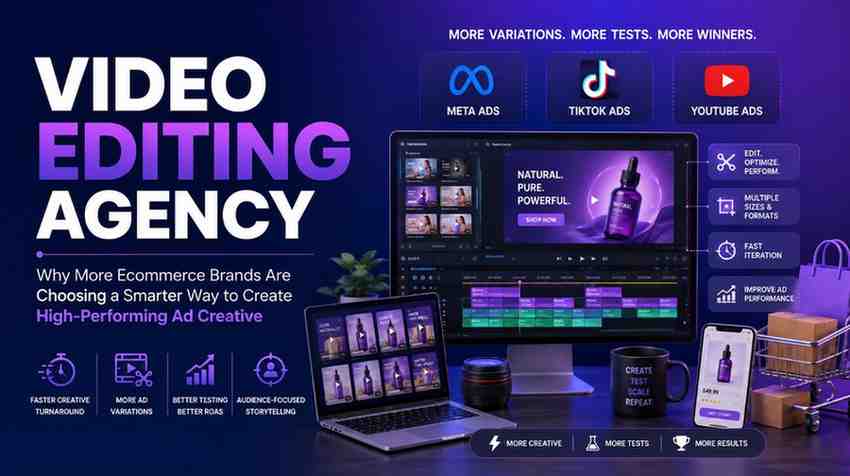
A few years ago, many ecommerce brands could get away with producing a handful of polished video ads every quarter. A major campaign shoot would generate enough content to support Facebook, Instagram, YouTube, email marketing, and website assets for months.
That approach is becoming harder to sustain.
Most performance marketing teams today are not struggling to create one great ad. They're struggling to create enough ads. The pace of paid media has changed. Consumer attention shifts quickly. Creative fatigue appears faster. Winning ads burn out sooner than many marketers expect.
This shift is one reason more brands are working with a video editing agency rather than relying entirely on traditional production workflows.
Traditional production models were built around large shoots, lengthy approval processes, and high production costs. They often focus on creating a small number of highly polished assets. While that still has value for brand campaigns, it doesn't always match the needs of modern ecommerce advertising.
Performance marketing teams running Meta Ads and TikTok Ads frequently need dozens of creative variations from the same source material. They need different hooks, offers, calls to action, audience angles, aspect ratios, and messaging approaches.
The challenge isn't filming every new ad from scratch.
The challenge is turning existing footage into enough creative assets to support ongoing testing.
A video editing agency focused on ecommerce performance can help bridge that gap. Instead of treating video as a one-time project, the focus shifts toward ongoing creative production, iteration, and testing.
This becomes especially important for brands managing multiple SKUs. A supplement company might have ten products. A beauty brand could have separate campaigns targeting new customers, repeat buyers, and seasonal shoppers. Each audience segment may require different messaging, even when the underlying product remains the same.
The amount of creative required grows quickly.
For many brands, the question is no longer whether they need video content. The question is whether they can produce enough of it to keep advertising performance moving in the right direction.
That reality is pushing ecommerce operators toward a more agile relationship with a video editing agency that understands paid media requirements rather than a production-first model built around occasional campaign shoots.
Most ecommerce teams pay close attention to advertising spend, return on ad spend, customer acquisition costs, and conversion rates.
Far fewer pay attention to the cost of waiting.
When creative production slows down, campaign performance often suffers long before the problem becomes obvious in reporting dashboards.
Imagine a brand spending $50,000 per month across Meta Ads and TikTok Ads. The marketing team identifies several promising ad concepts. Early data suggests certain hooks are outperforming others. New audience angles look promising. Product demonstrations are generating stronger engagement.
The team wants to test additional variations immediately.
But new creative takes three weeks to produce.
Those three weeks matter.
Consumer behavior changes. Competitors launch new campaigns. Existing ads accumulate frequency. Performance gradually declines. By the time fresh creative arrives, the opportunity may already be smaller than it was when the insight first appeared.
This is one of the most overlooked problems in ecommerce advertising.
A slow creative process doesn't just delay production. It slows learning.
Every week without new creative means fewer tests. Fewer tests mean fewer insights. Fewer insights reduce the chances of finding the next winning ad.
Meta Ads and TikTok Ads reward advertisers that can continuously experiment. The brands generating the highest volume of meaningful creative tests often gain valuable performance advantages over brands relying on slower production cycles.
That doesn't mean every new video will succeed.
Most won't.
But the ability to launch new creative quickly increases the likelihood of discovering the concepts that do work.
I've seen situations where a marketing team spends days debating audience targeting changes while ignoring the fact that their best-performing ad has been running for months without a meaningful refresh. In many cases, the creative itself becomes the biggest constraint.
A video editing agency helps reduce this friction by shortening the distance between idea and execution.
When teams can move from concept to edited asset quickly, campaign optimization becomes faster. New hypotheses can be tested sooner. Successful ideas can be expanded before market conditions change.
The result is not simply more content.
The result is more opportunities to learn what actually influences customer behavior.
Many people still think of a video editing agency as a company that takes raw footage and assembles it into finished videos.
That definition feels outdated.
Modern ecommerce advertising requires a much broader approach.
Today's performance marketing teams often need creative support across multiple channels, campaign objectives, audience segments, and stages of the customer journey. A single product launch may require dozens of edited assets tailored for different placements and customer awareness levels.
A modern video editing agency is increasingly involved in helping teams operationalize creative production at scale.
That can include editing product demonstrations, UGC style content, testimonial videos, founder messages, promotional offers, customer education assets, retargeting creatives, and social-first advertising formats.
The emphasis is often less about creating one perfect video and more about generating multiple versions that can be tested against one another.
For example, a skincare brand may have one customer testimonial video.
That single piece of content can become several unique advertising assets.
One version might lead with a problem-focused hook. Another may highlight before-and-after results. A third version could focus on ingredients. A fourth might emphasize social proof. A fifth could target first-time buyers with a promotional offer.
The source footage stays largely the same.
The editing strategy changes.
This is where a specialized video editing agency becomes valuable for ecommerce teams focused on growth.
Instead of viewing editing as a final production step, editing becomes part of the testing process itself.
Performance marketers often need rapid iterations based on campaign data. If a particular opening hook increases thumb-stop rates, additional versions can be developed around that insight. If a specific offer drives stronger click-through rates, that messaging can be incorporated into future creative.
The relationship between media buying and creative production becomes much tighter.
I might be wrong here, but many ecommerce brands still underestimate how much of their advertising success is tied to creative velocity rather than media buying tactics alone.
Targeting still matters. Budget allocation still matters. Landing pages still matter.
But when every advertiser has access to similar platform tools, creative often becomes one of the biggest variables influencing campaign outcomes.
That's why the role of a video editing agency continues to expand inside modern ecommerce organizations.
They're not simply delivering edited videos.
They're helping marketing teams create, test, learn, iterate, and scale creative ideas at a pace that better matches the demands of today's advertising environment.
As ecommerce brands grow, creative production becomes significantly more complicated.
A company selling one product to one audience has a relatively simple advertising challenge. A company selling twenty products across multiple customer segments is dealing with a completely different situation.
Many marketing teams eventually realize that campaign management is not what slows them down.
Creative production is.
A typical DTC brand may be promoting best sellers, new arrivals, subscription offers, seasonal bundles, limited-time discounts, and customer retention campaigns at the same time. Each initiative requires different messaging and often different creative assets.
Then audience segmentation enters the picture.
New customers need different messaging than repeat purchasers. High-value customers behave differently than first-time buyers. Some audiences respond to educational content while others react more strongly to social proof or promotional offers.
The number of creative combinations expands quickly.
A beauty brand running campaigns across Meta Ads and TikTok Ads could easily require dozens of unique video assets every month just to maintain healthy testing activity.
Without a reliable creative workflow, teams start prioritizing some campaigns while neglecting others. Product launches get delayed. Testing schedules slip. Marketing calendars become difficult to execute.
This is where a video editing agency often becomes part of the operational infrastructure rather than simply an external vendor.
Instead of producing a few isolated videos, the goal becomes supporting a continuous flow of creative assets across products, audiences, and campaign objectives.
The strongest ecommerce teams rarely rely on a single ad to carry performance. They build systems that allow multiple creative ideas to enter testing every week.
When creative production cannot keep up with advertising demand, growth eventually slows regardless of how skilled the media buying team may be.
Most media buyers have experienced the same frustrating pattern.
A new ad launches.
Performance improves.
Customer acquisition costs decline.
Conversion rates increase.
The campaign starts scaling.
Then results begin to weaken.
The audience has seen the creative too many times. Engagement drops. Click-through rates decline. Conversion efficiency starts slipping. What was working two weeks ago suddenly feels average.
Creative fatigue remains one of the most common challenges in ecommerce advertising.
The issue becomes even more noticeable when brands increase spending. Higher budgets often mean ads are shown more frequently, accelerating audience saturation.
Many teams initially assume the problem is targeting.
Sometimes it is.
But often the audience simply needs something new.
The reality is that customers do not care how much effort went into producing an advertisement. They respond to relevance, attention, timing, and messaging.
A beautifully produced video can become ineffective if people have already seen it repeatedly.
This creates an ongoing demand for fresh creative.
Not necessarily brand-new footage every week.
Fresh creative angles.
Fresh hooks.
Fresh edits.
Fresh messaging.
Even small changes can influence performance. Different opening sequences, revised captions, new offers, updated calls to action, alternate product demonstrations, or a new pacing style can help extend creative lifespan.
A video editing agency focused on performance marketing understands that creative refreshes are not occasional projects.
They are part of normal campaign maintenance.
Some brands treat creative production as something they do when performance declines. Others treat creative production as a continuous process designed to prevent decline from happening in the first place.
The second approach usually creates more stability over time.
One of the biggest differences between fast-growing ecommerce brands and struggling brands is often the number of meaningful creative tests being launched.
Not every test produces a winner.
In fact, most don't.
But teams that consistently test more creative ideas generate more opportunities to uncover valuable insights.
A video editing agency can help increase testing volume by turning existing content into a larger number of advertising assets without requiring constant reshoots.
Consider a brand selling fitness equipment.
The company already has customer testimonials, product demonstrations, founder videos, influencer footage, and user-generated content.
The raw material exists.
The challenge is transforming that material into enough variations to support testing.
One video can produce multiple hooks.
One testimonial can become several audience-specific ads.
One product demonstration can be edited for different customer pain points.
One creator video can be adapted across various placements and campaign goals.
The cumulative effect becomes significant.
Instead of testing two ads per month, a team might test twenty.
Instead of relying on assumptions, they can make decisions based on actual campaign performance.
A real-world scenario helps illustrate the point.
An ecommerce brand running Meta Ads was struggling to improve acquisition efficiency despite increasing spend. The team had quality products and strong customer reviews. What they lacked was testing volume.
Most creative resources were being allocated toward producing a few highly polished assets.
After shifting toward a workflow focused on generating multiple creative variations from existing content, the number of active tests increased substantially. Some variations failed immediately. Others delivered average results.
A handful significantly outperformed expectations.
Those winning concepts became the foundation for future iterations.
The improvement did not come from a breakthrough targeting tactic.
It came from creating more opportunities to discover what resonated with customers.
That distinction matters.
Few periods place more pressure on creative teams than product launches and seasonal campaigns.
Deadlines become tighter.
Advertising budgets increase.
Revenue expectations rise.
Marketing teams need creative assets ready before launch dates rather than after them.
A delayed creative workflow can create a chain reaction across the entire campaign.
Media buyers wait for assets.
Launch schedules shift.
Testing windows become shorter.
Optimization opportunities decrease.
This is particularly important during high-volume ecommerce periods such as holiday promotions, major sales events, and limited-time offers.
The brands that move fastest often gain valuable advantages.
Not because they spend more.
Because they can react faster.
A video editing agency helps create the flexibility required during these periods.
If an initial launch concept performs well, additional variations can be developed quickly.
If a promotional offer begins generating strong engagement, supporting assets can be produced before momentum fades.
If campaign performance reveals unexpected customer interests, new creative can be built around those insights.
The speed of execution becomes a competitive advantage.
This becomes even more important when scaling campaigns.
A common mistake occurs when brands increase budgets without expanding creative output.
The result is predictable.
Ad frequency rises.
Audience fatigue increases.
Performance eventually weakens.
Scaling advertising often requires scaling creative production at the same time.
The two are more connected than many businesses realize.
Many ecommerce teams understand the importance of creative testing.
The challenge is executing it consistently.
Internal teams are already managing campaign strategy, budget allocation, reporting, product launches, creator relationships, customer acquisition goals, and daily operational demands. Creative production frequently becomes another responsibility competing for attention.
That pressure grows as advertising programs expand.
More campaigns require more assets.
More testing requires more variations.
More products require more messaging approaches.
The workload compounds quickly.
Brahvo AI was built around helping brands address this challenge by increasing creative output without creating additional operational bottlenecks.
Rather than treating video editing as an isolated production task, the focus is on helping marketing teams maintain a steady flow of advertising creative that supports testing, iteration, and campaign execution.
For ecommerce brands running Meta Ads, TikTok Ads, YouTube campaigns, and other paid social initiatives, this means having access to creative production that can keep pace with the realities of modern advertising.
A single campaign may require multiple hooks, audience angles, offer variations, product-focused edits, UGC adaptations, and platform-specific formats.
Producing those assets consistently is often where internal teams face constraints.
Brahvo AI helps simplify that process by supporting the ongoing demand for performance-oriented creative rather than relying on occasional production cycles.
The practical benefit is straightforward.
Marketing teams can spend less time worrying about creative capacity and more time evaluating campaign data, identifying winning concepts, launching new initiatives, and making informed growth decisions.
Because at a certain point, the conversation is no longer about whether creative matters.
Most ecommerce operators already know it does.
The bigger question is whether their current production process can keep up with the volume of creative required to compete effectively as advertising platforms continue rewarding faster testing, faster learning, and faster iteration.
One of the biggest mistakes ecommerce brands make is evaluating creative partners using the wrong metrics.
Views can be useful.
Engagement can be useful.
Completion rates can provide insight.
But none of those metrics automatically translate into business growth.
The real value of a video editing agency is usually reflected much deeper in the advertising system.
For example, does the agency help the brand launch more creative tests each month?
Can the marketing team move from idea to live campaign faster?
Are winning concepts identified sooner?
Can successful ads be refreshed before performance begins declining?
Those outcomes often create a much larger business impact than vanity metrics.
A marketing director responsible for a seven-figure advertising budget is typically less concerned with whether a video received a certain number of likes and more concerned with questions such as:
Can we lower customer acquisition costs?
Can we improve conversion efficiency?
Can we increase advertising scalability?
Can we maintain performance as budgets grow?
Can we create enough creative to support ongoing testing?
Those are business questions.
And they are often connected directly to creative production capacity.
One useful way to think about a video editing agency is as a multiplier of learning speed.
The faster a team can test creative ideas, the faster it learns what customers respond to.
The faster it learns, the faster it can allocate budget toward stronger-performing concepts.
Over time, those small improvements compound.
A brand launching five meaningful tests per month and a brand launching fifty meaningful tests per month are operating at very different learning speeds.
The second team simply gathers more information.
That does not guarantee success.
But it increases the likelihood of finding successful creative before competitors do.
There is also an operational impact that is harder to measure.
Marketing teams spend less time chasing creative assets.
Media buyers spend less time waiting for revisions.
Campaign launches become more predictable.
Product launches become easier to coordinate.
Communication becomes less chaotic.
These improvements rarely appear in advertising dashboards, yet they influence performance across the entire marketing organization.
I have seen teams spend weeks discussing attribution models while overlooking the fact that their creative pipeline was breaking down. Sometimes the problem is more operational than strategic.
And sometimes it is both.
A good video editing agency helps reduce those operational bottlenecks while supporting the creative volume modern ecommerce advertising increasingly demands.
Not all creative partners are built for performance marketing.
Some are exceptional at brand storytelling.
Some specialize in cinematic production.
Others focus primarily on content creation.
None of those approaches are necessarily wrong.
The important question is whether they align with the realities of ecommerce advertising.
Before choosing a video editing agency, marketing leaders should look beyond visual quality alone.
The first question is often about production capacity.
Can the agency consistently support the volume of creative your business requires?
Producing a few polished videos each quarter is very different from supporting ongoing testing across Meta Ads, TikTok Ads, YouTube campaigns, product launches, retargeting efforts, and seasonal promotions.
The next question involves turnaround speed.
How quickly can new concepts become live creative assets?
Because in performance marketing, speed frequently influences results.
An excellent idea delivered six weeks late may be less valuable than a good idea delivered tomorrow.
Another important consideration is creative iteration.
Can the agency produce multiple variations from existing content?
Can hooks, offers, messaging angles, and audience-specific versions be developed efficiently?
Or does every new test require a completely new production cycle?
The answer matters.
Testing volume often determines how quickly brands discover winning creative concepts.
Marketing leaders should also evaluate how well the agency understands advertising environments.
Creating content for social media and creating content for paid acquisition are not always the same thing.
Performance-focused creative often requires different pacing, structure, messaging, and editing decisions than content designed primarily for engagement.
Communication processes deserve attention as well.
Many agency relationships struggle not because of creative quality but because approvals, revisions, asset requests, and project management become unnecessarily complicated.
Simple communication systems tend to support better execution.
There is also the question of scalability.
What happens when the business doubles its advertising spend?
What happens when five new products launch simultaneously?
What happens during major seasonal campaigns?
A video editing agency should be able to support growth rather than become another bottleneck.
Finally, marketing leaders should ask a straightforward question.
Will this partnership help us produce more effective creative at the speed our advertising strategy requires?
Everything else is secondary.
Because most ecommerce teams are not suffering from a shortage of ideas.
They are suffering from a shortage of execution capacity.
And as customer acquisition becomes more competitive across Meta Ads, TikTok Ads, and other paid media channels, the brands that can consistently generate, test, refine, and refresh creative at scale may have an advantage that becomes increasingly difficult for slower competitors to overcome.