Find the right video production agency for healthcare Los Angeles to create patient education, paid ads, social content, and AI video creative.
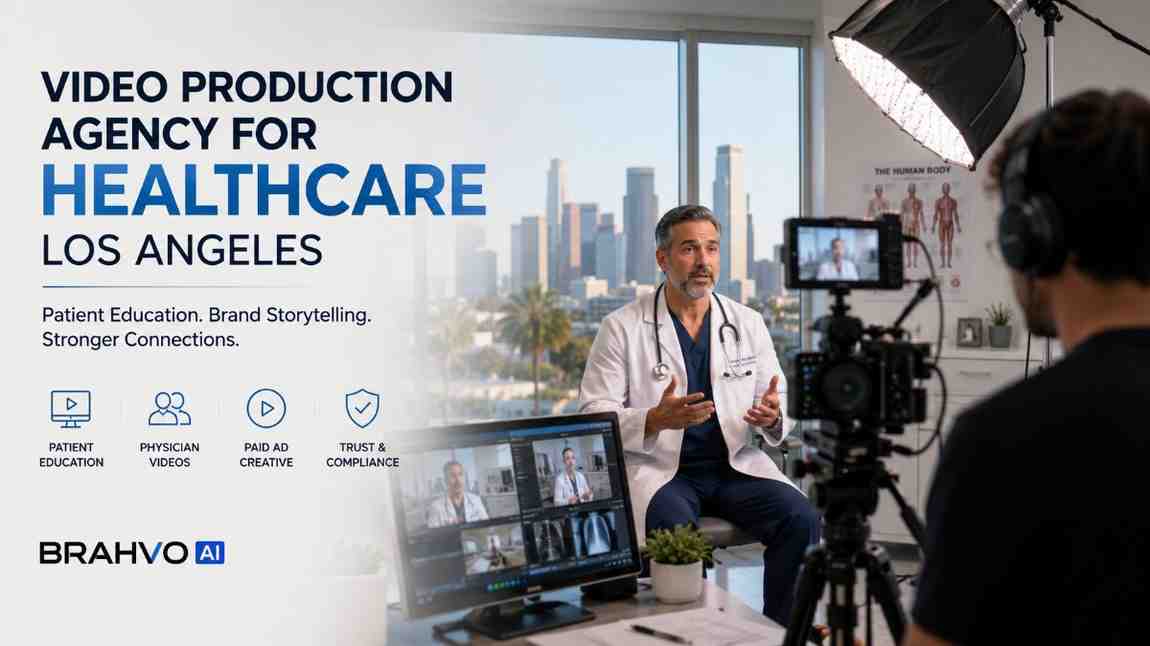
Healthcare marketing in Los Angeles has a particular problem. Patients have more choices, more information, and less patience for websites or ads that feel like corporate brochures.
A hospital group, specialty clinic, dental brand, med spa, telehealth company, or healthcare startup may have excellent doctors and services, but that does not automatically translate into compelling marketing. People want to understand what a provider does, what the experience feels like, and why they should trust the organization before they ever book an appointment.
Video has become one of the practical ways to answer those questions.
For a healthcare company, though, producing more videos is not as simple as putting a camera in front of a physician. The content has to communicate medical information accurately while remaining understandable to ordinary patients. It also needs to work across websites, YouTube, Meta Ads, TikTok, and other paid or organic channels.
That is where a video production agency for healthcare Los Angeles can become useful. The real value is not simply producing polished footage. It is understanding how healthcare audiences consume information and turning complicated services into content people can actually understand.
Los Angeles also creates a crowded marketing environment. A local cosmetic clinic might compete with dozens of similar providers. A specialty practice may be trying to reach patients across several neighborhoods. A healthcare startup could be competing nationally while still trying to establish credibility in its home market.
Video gives these businesses another way to communicate.
A physician explaining a procedure in plain language can do more for trust than several paragraphs of website copy. A short patient education video can answer a question before someone calls the office. A well-produced testimonial can show the human side of a healthcare experience.
But quantity matters too.
Healthcare brands often need different videos for different services, patient questions, locations, campaigns, and stages of the buying journey. Producing each one from scratch through traditional production can become expensive and slow.
This is one reason AI-assisted video production is getting more attention. It can help teams create variations from existing creative concepts, adapt messaging for different audiences, and keep video production moving without treating every new video as a major production.
That does not mean AI should replace medical expertise or human storytelling. It should not.
The better use case is helping a healthcare marketing team produce useful creative at a pace that matches modern advertising.
Healthcare marketing is different from selling a pair of sneakers or a subscription box.
The person watching an ad may not be looking for entertainment. They may be researching a diagnosis, considering an expensive procedure, helping a family member, or trying to understand whether a treatment is appropriate for them.
That changes how video needs to be produced.
A video production agency for healthcare Los Angeles needs to understand the difference between getting attention and building trust. A dramatic opening might increase views, but if the message creates confusion or makes a medical claim that cannot be supported, those views are not particularly useful.
The creative needs a reason to exist.
For example, consider a Los Angeles orthopedic practice offering several treatments for chronic knee pain. A generic brand video showing doctors walking through a modern facility may look professional, but it does not answer the questions patients are actually asking.
A better video might address a specific concern.
"When should you see a specialist for persistent knee pain?"
That question immediately gives the video a purpose. A physician can explain common warning signs, what an initial consultation involves, and why different causes of pain may require different approaches.
Now the content has educational value.
It can also be adapted into shorter versions for paid social. The opening question becomes the hook. The longer explanation can become a YouTube video or website resource.
This is where creative strategy starts affecting media buying.
Media buyers need enough creative variation to test different hooks, messages, visuals, and audience concerns. Healthcare marketers need those variations to remain medically responsible and consistent with the brand.
Those two requirements can pull in different directions.
A performance marketer might want ten new variations quickly. A healthcare team may need physicians, compliance teams, or legal reviewers involved before those variations can be published.
A good production process has to account for that reality from the beginning.
The same applies to UGC-style healthcare content. A direct-to-camera video can feel more natural than a highly produced commercial, but healthcare brands still need to think carefully about who is speaking, what they are claiming, and how the audience might interpret the message.
There is also a major difference between healthcare categories.
A cosmetic practice can often use visual storytelling around procedures and patient experiences. A mental health provider may need a much more sensitive approach. A pediatric practice speaks to parents while the service itself concerns children. A medical device company may need to explain technical information to clinicians rather than consumers.
One healthcare video strategy rarely fits all of these situations.
A video production agency for healthcare Los Angeles therefore needs to understand the business behind the content. Who is the audience? What service is being promoted? What does the patient need to know? Where will the video appear? Is the goal education, awareness, lead generation, appointment bookings, or support for an existing paid campaign?
Those questions affect the production itself.
Medical information can become difficult to communicate because healthcare professionals naturally use terminology that patients may not know.
That is not a criticism of physicians. They spend years learning their field. The problem appears when the same language is transferred directly into consumer marketing.
A patient may not understand a term, but they will understand a problem.
They may not search for the name of a clinical procedure. They may search for something like, "Why does my shoulder hurt when I sleep?"
That distinction matters when creating educational video.
A useful patient education video starts with the question the patient already has. It does not begin with everything the healthcare organization wants to say.
Suppose a Los Angeles dermatology practice wants to explain a treatment for acne scarring. A traditional medical video might spend the first minute explaining the technology, treatment mechanism, and clinical terminology.
A patient may leave before reaching the useful part.
Instead, the video could start with the problem.
"Acne may disappear, but the scars can stay around much longer. So what can actually be done about them?"
That sounds like a conversation rather than a lecture.
From there, the physician can explain the treatment in straightforward language, discuss who may be a candidate, explain what the process involves, and set realistic expectations.
The important part is not making the video simplistic. It is making the information easier to process.
Visuals can help here.
Simple animation can show how a treatment works. Motion graphics can clarify a process. On-screen text can reinforce important points for viewers watching without sound. B-roll can show the environment without distracting from the explanation.
AI video production can also be useful when a healthcare company needs multiple versions of educational content.
For example, one physician interview might produce a longer educational video, several short social clips, different opening hooks, and versions focused on separate patient questions. AI-assisted editing and production workflows can reduce some of the repetitive work involved in creating those variations.
Still, there is a line that should not be crossed.
Healthcare content should not become a collection of generic AI visuals with a synthetic voice reading medical information. Patients can sense when something feels disconnected from the actual organization.
The doctor, nurse, clinician, patient experience, or healthcare environment should still provide the human context.
That becomes especially important in Los Angeles, where healthcare brands are often competing for attention in visually crowded feeds. A polished video is not automatically credible. A human explanation delivered clearly can sometimes be far more effective.
I might be wrong here, but I do not think every healthcare brand needs more video simply because video is popular. Some brands need fewer videos with clearer purposes. The real production problem often appears when a company has plenty of footage but no useful creative variations built around actual patient questions.
That is where the role of a video production agency for healthcare Los Angeles becomes more strategic.
The goal is not to make healthcare look like entertainment.
It is to make healthcare information easier to understand, easier to trust, and easier to act on without making promises the brand cannot support.
A healthcare brand rarely has just one reason to produce a video. The same piece of content may need to educate a patient on the website, answer a question on YouTube, introduce a physician on social media, and eventually become part of a paid campaign.
That changes how production should be planned.
A video production agency for healthcare Los Angeles should think beyond the finished video and consider where that video will actually be used. A three minute physician interview may work well on a service page, but it may need several shorter edits before it makes sense for Meta Ads or TikTok.
For example, a Los Angeles fertility clinic could record a physician explaining the first consultation process. The long version can sit on the website for patients researching treatment. Short clips could answer individual questions such as what happens during the first appointment, when patients should consider seeking help, or what information they should bring.
YouTube can carry the longer educational version. Social media can use the shorter answers. Paid advertising can use the strongest opening around a specific patient concern.
The content stays connected, but the execution changes.
This is especially useful when a healthcare organization has several services. Instead of producing completely separate videos every time, the production team can capture interviews and footage with multiple uses in mind.
The website usually needs depth and clarity. Social platforms need faster communication. Paid advertising needs a clear reason for someone to keep watching.
Those are different jobs.
A video that performs well organically may not necessarily perform well as an ad. Paid media introduces another layer of testing. The first three seconds, opening statement, visual sequence, captions, call to action, and audience all matter.
This is why healthcare video production increasingly sits somewhere between content production and paid media creative.
Healthcare video has an obvious issue that many consumer brands do not have to deal with at the same level: trust can disappear very quickly.
A healthcare company cannot treat patient stories, medical claims, testimonials, or clinical information like ordinary advertising copy.
Patient privacy needs to be considered before production begins, not after the video has already been edited. If patients appear in footage, the organization needs appropriate permissions and processes for using that material.
The same care applies to testimonials.
A patient saying that a treatment "changed my life" may sound compelling, but the surrounding context matters. Healthcare marketers need to consider whether the statement could create unrealistic expectations or imply an outcome that other patients should expect.
Medical claims require similar caution.
A video production agency for healthcare Los Angeles should work closely with the healthcare organization to understand which claims have been approved and what language should be avoided. The production team is not there to decide clinical accuracy on its own.
This can affect the creative process more than people expect.
A media buyer may want a strong statement because strong statements often create attention. A physician may want more qualification because medical outcomes are rarely identical for every patient.
Neither side is necessarily wrong.
The production process needs room for both concerns.
There is also the issue of trust. Healthcare viewers are often skeptical of videos that look too much like advertisements. A beautifully lit clinic, slow motion footage, dramatic music, and a physician delivering a scripted statement can look polished while still feeling strangely distant.
Sometimes a simpler approach works better.
A doctor speaking directly to the camera about a common patient concern can feel more credible. Real clinic footage can establish context. Clear explanations can do more than elaborate visual effects.
AI can help with production, editing, subtitles, variations, and localization, but it should not be used to manufacture medical credibility.
That distinction matters.
Paid social creates a different problem for healthcare marketers.
You need enough creative to test, but healthcare content can take more time to approve. If every new ad requires a completely new shoot, the creative pipeline becomes difficult to maintain.
Meta Ads, TikTok Ads, and YouTube each reward different creative behaviors, even when the underlying message is similar.
A Meta ad might open with a patient question and quickly introduce the physician. A TikTok video may need a more conversational opening that feels native to the platform. A YouTube campaign can give viewers more time to understand a service or treatment.
The production team needs to account for these differences before filming.
Consider a Los Angeles plastic surgery practice launching a campaign around a specific procedure. Instead of producing one polished commercial, the team could capture several physician explanations, patient questions, clinic footage, procedure related visuals where appropriate, and different calls to action.
That material can support multiple creative concepts.
One version might lead with a question.
Another might focus on the consultation process.
Another might explain what patients should realistically expect.
Another could introduce the physician and explain their approach.
This gives the paid media team something to work with beyond changing the headline on the same video.
Creative fatigue is another problem.
An ad can perform well for weeks and then gradually lose efficiency. The audience has seen it too many times. The answer is not always to completely reinvent the campaign.
Sometimes the better move is to keep the underlying message while changing the opening, pacing, footage, speaker, or format.
That is where production and media buying need to communicate.
A video production agency for healthcare Los Angeles that understands paid advertising will ask different questions than a traditional production company. It will want to know which audience is being reached, what the campaign objective is, which creative has already been tested, and where the current bottleneck sits.
The answer may not be another expensive commercial.
It might be twenty short variations from one well planned recording session.
AI video production is particularly interesting for healthcare brands because the bottleneck is often not the lack of ideas.
It is production capacity.
A healthcare marketing team may know that it needs different videos for different services and audiences. The challenge is creating them quickly enough while keeping the messaging consistent.
AI-assisted production can help create variations from existing footage, generate different edits, adapt scripts, produce multiple versions of hooks, and handle repetitive post-production tasks.
For paid media, that matters.
Suppose a healthcare company has one physician interview that explains a treatment. Instead of treating the recording as one finished asset, the team can identify several useful moments and build different creative concepts around them.
One video may focus on the patient's initial concern.
Another may focus on how the consultation works.
A third may address a common misconception.
A fourth may explain what the treatment does and does not involve.
The underlying expertise comes from the healthcare professional. AI can help with the production workload around that expertise.
This can make creative testing more practical.
It also creates an important distinction between producing more videos and producing more useful videos.
More is not automatically better.
If ten variations all communicate the same idea with slightly different visuals, the media team may learn very little. Good creative testing changes something meaningful, such as the audience problem, opening hook, explanation, format, emotional angle, or stage of consideration.
I might be wrong here, but I do not think healthcare brands should chase creative volume simply because AI makes volume easier. If the underlying message is weak, producing fifty versions will not solve the problem.
AI is most useful when it removes repetitive production work and gives marketers more room to test ideas that are actually different.
Human review remains important, especially for medical information, patient stories, claims, and brand voice.
The goal is faster iteration without losing credibility.
This becomes complicated quickly for healthcare organizations operating across Los Angeles.
A multi-location provider may have different clinics, physicians, services, and patient demographics. A campaign for one location may not make sense for another. A service aimed at younger patients may need completely different creative from one aimed at older adults or caregivers.
Producing everything as one generic brand video creates limitations.
A video production agency for healthcare Los Angeles can help organize production around reusable content rather than isolated projects.
For instance, a healthcare group could record a central brand story, several physician interviews, service-specific explanations, location footage, patient education segments, and short answers to common questions during the same production period.
The footage then becomes a content library.
One location might need videos focused on a specific service. Another might need physician introductions. A paid campaign might need short educational clips. The website might need longer explanations.
This approach can reduce unnecessary reshoots.
It also helps when a healthcare organization adds new services. Instead of rebuilding its entire content system, the team can identify what is missing and produce only those assets.
There is a business consideration here too.
Healthcare marketing budgets are rarely unlimited. Spending heavily on a single brand film while the paid media team has no fresh creative for the next three months may not be the best allocation.
On the other hand, producing dozens of cheap videos that patients do not trust is not a smart use of budget either.
The practical question is where production quality actually affects the outcome.
A physician interview may need excellent audio and lighting because credibility matters. A short educational clip may not need elaborate cinematography. A website hero video may justify a larger production. A quick paid social variation may not.
The production plan should reflect those differences.
For healthcare brands, video is increasingly becoming part of the ongoing advertising system rather than a one-time marketing project. The challenge is figuring out how much creative the business actually needs, which audiences deserve separate messaging, and how much production work should happen before the next campaign starts.
Choosing a video production agency for healthcare Los Angeles should not start with a portfolio.
A portfolio can show attractive lighting, polished editing, and impressive camera work. It does not tell you whether the agency understands healthcare audiences, paid advertising, patient education, or the practical limitations that come with medical content.
The first question should be simple: can the agency understand what the video needs to accomplish?
A healthcare brand may need videos for several very different purposes. A hospital might need physician interviews and patient education content. A med spa may need short social ads. A dental group could need location-specific videos for several practices. A healthcare startup may need educational videos that explain a complicated service to consumers who have never heard of it.
Those requirements call for different production decisions.
A good video production agency for healthcare Los Angeles should also understand how the content will be distributed. If the videos are going into Meta Ads, TikTok Ads, and YouTube campaigns, production should account for those placements from the beginning.
Ask about creative variations too.
If an agency produces one polished video and considers the project finished, that may not be enough for a performance marketing team. Paid campaigns need new creative angles as audiences become familiar with existing ads.
You should also ask how the agency handles healthcare-specific review processes. Who provides medical information? How are patient stories handled? What happens when a physician wants to change a statement during review? How are claims checked before publishing?
These questions may sound operational, but they can save a lot of time later.
Another important consideration is how the agency approaches AI video production.
AI can be useful for editing, versioning, scripting support, captions, localization, and creating additional creative variations. But healthcare content still needs human judgment. An agency should be able to explain where AI fits into the workflow rather than presenting AI as a replacement for medical expertise.
Budget matters, obviously.
But comparing agencies only by the cost of producing one video can be misleading. A lower-cost production may require additional shoots every time the marketing team needs a new variation. A more planned production can sometimes create a larger library of usable content from the same shoot.
For example, imagine a Los Angeles healthcare brand has five services and three locations. Producing one video per service every few months could become expensive. A better production plan might capture physician interviews, facility footage, patient education topics, service explanations, and short-form material during fewer production sessions.
The resulting content can then be adapted for different channels.
That is the kind of thinking worth looking for.
You should also pay attention to how the agency communicates. Healthcare marketing often involves founders, physicians, compliance teams, marketing directors, creative teams, and media buyers. If feedback gets lost between those groups, production slows down quickly.
A capable agency should make that process reasonably clear.
The best video production agency for healthcare Los Angeles is not necessarily the one with the biggest production crew or the most cinematic portfolio. It is the one that understands why the video is being made, who needs to see it, what the audience needs to believe or understand, and how the finished content will actually be used.
Sometimes that means a major production.
Sometimes it means a physician, a camera, good audio, and a very clear question.
What does a video production agency for healthcare Los Angeles do?
A video production agency for healthcare Los Angeles creates video content specifically for healthcare organizations and their marketing needs. This can include physician videos, patient education content, social media videos, paid advertising creative, testimonials, brand videos, service explainers, and short-form video.
The work can also include scripting, filming, editing, motion graphics, captions, creative variations, and AI-assisted production.
Why do healthcare companies need specialized video production?
Healthcare content requires a different level of attention to medical accuracy, patient trust, privacy, and messaging.
A general production team may be excellent at filming and editing but may not understand how patients research healthcare services or how medical claims can affect advertising.
Specialized experience can make the production process easier to manage.
Can healthcare videos be used for Meta Ads and TikTok Ads?
Yes. Healthcare brands can create short-form video creative for paid social campaigns, provided the content follows applicable advertising requirements and the healthcare organization's own review standards.
The creative should also be produced with the platform and audience in mind. A long physician interview usually needs to be edited differently for a short paid social placement.
How can AI video production help healthcare marketing teams?
AI can assist with repetitive production tasks and creative versioning. Depending on the workflow, it can help create different edits, captions, scripts, voiceover variations, short clips, and other versions from existing content.
The important point is that AI should support the production process rather than replace clinical judgment.
How many healthcare videos should a brand produce each month?
There is no useful universal number.
A healthcare brand with one service and a small paid campaign may need relatively few assets. A multi-location healthcare company running several paid campaigns may need considerably more creative.
The better question is how many meaningful creative concepts the marketing team needs to test and maintain.
Should a healthcare brand use patient testimonials?
Patient testimonials can be valuable because they show a real human experience. But they require careful handling.
The organization should have appropriate permission and should review the testimonial for privacy, accuracy, and advertising considerations. Testimonials should not create the impression that every patient will receive the same result.
Is professional filming necessary for healthcare videos?
Not every healthcare video needs a large production.
For physician education content, clear audio, good lighting, accurate information, and a natural presentation can matter more than elaborate visuals. Higher production value can make sense for brand campaigns, facility videos, or major advertising launches.
The production quality should match the purpose of the video.
Can one healthcare video be used across multiple marketing channels?
Yes, but it usually should not be uploaded everywhere in exactly the same format.
A longer video can be used on a website or YouTube, while shorter sections can be adapted for Meta Ads, TikTok, or other social placements. Different openings and edits can also be created for different audiences.
That gives the original production more practical value.
What should a healthcare company ask before hiring a video production agency?
Ask about healthcare experience, creative testing, paid social production, patient privacy, medical review workflows, AI-assisted production, turnaround times, revisions, and how the agency plans to repurpose footage.
Also ask what happens after the first video is delivered.
If your paid media team needs fresh creative six weeks later, you want an agency that already understands how that next production cycle will work.
How much does healthcare video production cost in Los Angeles?
The cost varies significantly based on the number of filming days, locations, crew size, equipment, talent, editing requirements, animation, post-production, and the number of final assets.
A single physician video and a multi-location campaign can have completely different budgets.
It is usually more useful to discuss the number of assets and their intended uses than to ask for a price for "one video."
For a healthcare brand, that distinction can make the difference between buying a polished video and building a content library that the marketing team can actually keep using.