Video production for social media marketing that helps US brands test ad creatives, reach customers, and support ecommerce growth with Brahvo AI.
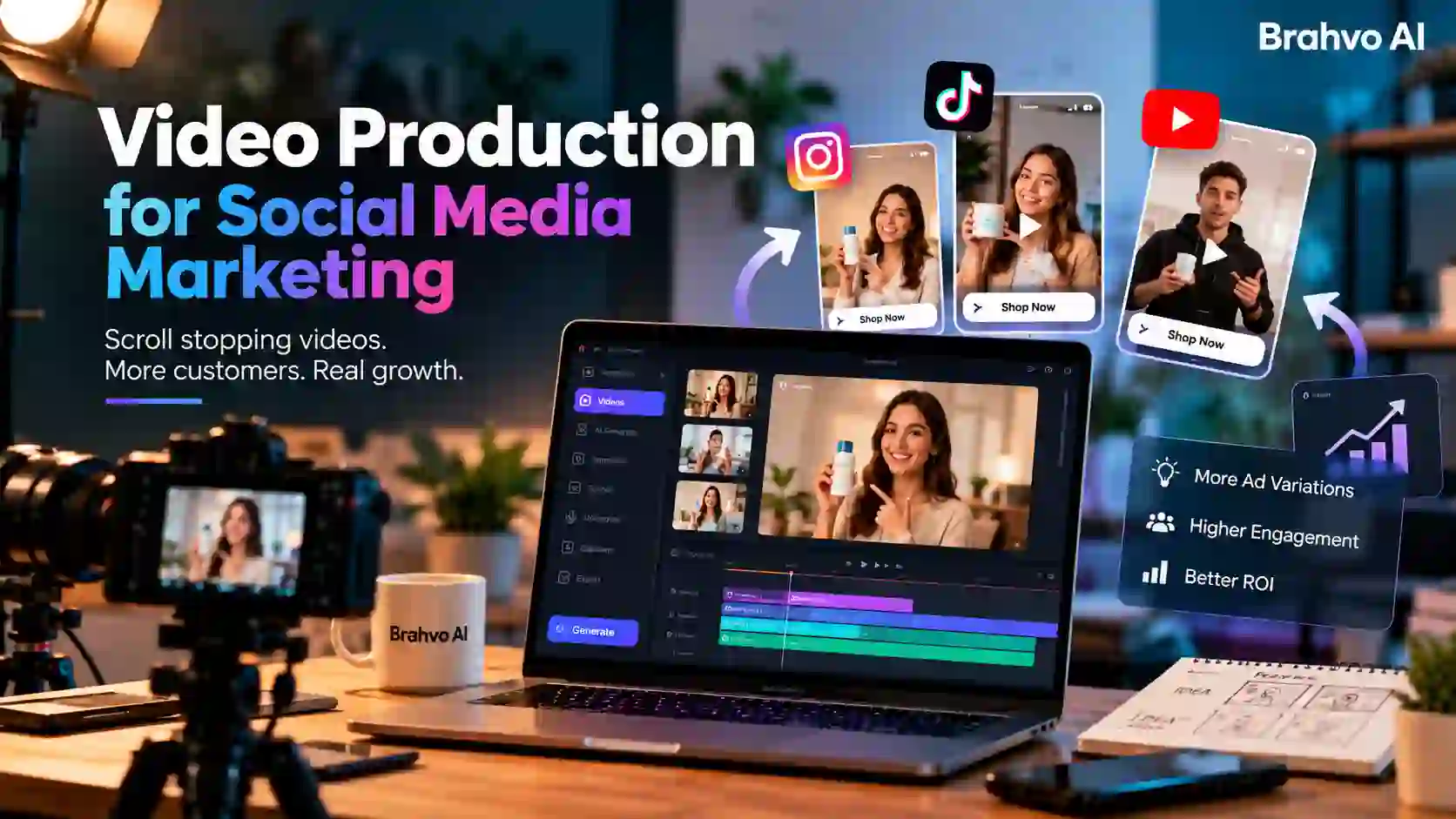
A US ecommerce brand can have a strong product, competitive pricing, and a well-managed ad account, yet struggle to turn paid traffic into sales. Often, the problem is not the audience or the offer alone. The creative itself may not give people a compelling reason to stop scrolling.
This is where video production for social media marketing becomes commercially important. Brands need videos that communicate product value quickly, address customer concerns, and give potential buyers a reason to take the next step. A polished brand film can look impressive, but it may not perform as well as a simple product demonstration showing exactly how an item solves a problem.
Consider a direct-to-consumer skincare brand spending thousands of dollars each month on Meta Ads. Its original video performs well for several weeks, but conversions begin to decline as the same audience sees the creative repeatedly. The marketing team increases spending, changes targeting, and adjusts placements. Yet the real opportunity may be to introduce fresh creative angles rather than keep changing the campaign settings.
This is one reason video production for social media marketing has become closely connected to paid media planning. Creative production is no longer just about making a brand look professional. It also supports testing, customer acquisition, and campaign decisions.
For US brands selling across multiple channels, the challenge is producing enough relevant content without allowing production costs and approval timelines to become difficult to manage. Product launches, seasonal promotions, new SKUs, and changing customer objections all create demand for fresh videos.
The goal is not to publish more videos simply to maintain activity. It is to produce videos that serve a clear purpose, whether that means introducing an unfamiliar product, demonstrating a feature, answering a buying objection, or encouraging an existing visitor to return.
People rarely make every purchase decision after seeing a single advertisement. A customer might first encounter a product through a short TikTok video, see a demonstration in a Meta ad a few days later, and eventually search for the brand after discussing the product with a friend.
Video production for social media marketing helps brands communicate across these different moments. Each video can answer a different question instead of repeating the same sales message.
For example, a US home organization brand selling modular storage products might need three distinct creative approaches. The first video shows a cluttered kitchen drawer and introduces the product as a practical fix. The second demonstrates how the compartments adjust to different utensils. The third addresses a common concern about whether the product fits standard kitchen drawers.
All three videos promote the same product, but they address different reasons a customer might buy or hesitate.
The most useful videos make the buying decision easier. They show the product in context, explain what makes it different, and remove uncertainty that might otherwise prevent a purchase.
This matters for customer acquisition costs, too. When an advertisement attracts clicks but fails to communicate the product clearly, the brand may pay for traffic that is unlikely to convert. A more relevant video can help qualify interest before a customer reaches the product page.
That does not mean video creative alone determines acquisition costs. Pricing, shipping fees, landing page quality, audience intent, and the checkout experience all play a role. A video cannot compensate indefinitely for a product page that hides important information or an offer that customers do not consider worthwhile.
There is also a difference between attention and buying intent. A funny video may generate millions of views without producing meaningful sales. A smaller demonstration video might attract fewer viewers but lead to more qualified product page visits.
For performance marketers, the important question is not simply whether a video gets attention. It is whether the attention comes from people who are likely to become customers.
A video that works on one social platform may need a different opening, pacing, or message to work on another. The product can remain the same, but the viewing context changes.
Video production for social media marketing should account for these differences before production begins. Otherwise, brands often end up resizing one finished advertisement for several channels and assuming the job is complete.
Meta Ads
Meta advertising on Facebook and Instagram can support product demonstrations, customer testimonial style creatives, lifestyle videos, founder led stories, and direct response advertisements.
The opening matters because viewers can move past an ad almost immediately. A home fitness brand, for instance, could begin with a common customer problem, demonstrate a compact exercise product, and finish with a clear explanation of its practical value.
Different openings can also test different motivations. One version might focus on saving time, while another emphasizes convenience for people working out at home.
TikTok Ads
TikTok often rewards creative that feels native to the viewing experience. This does not mean every advertisement must look amateur or imitate a viral trend.
A useful TikTok video might begin with a creator showing a problem, explaining a personal use case, or demonstrating a product in a believable setting. Strong pacing, readable captions, and a clear visual payoff can help viewers understand the message without requiring them to watch a long introduction.
For DTC brands, creator style content can be particularly useful when shoppers need to see how a product fits into everyday life.
YouTube Ads
YouTube offers room for different formats, including short advertisements, longer demonstrations, product explainers, and customer stories. The appropriate format depends on the campaign objective and placement.
A product that requires explanation, such as a subscription service or a technical consumer device, may benefit from a longer demonstration than a simple impulse purchase.
The first few seconds still matter, but the rest of the video needs to justify continued attention. If a brand spends too long introducing itself before showing the product, viewers may leave before reaching the information that matters.
The practical approach is to plan creative variations around the platform, placement, and intended audience. A shared campaign concept can inform several videos, but each execution should be built for its actual viewing environment.
A customer seeing a product for the first time has different questions from someone who has already visited the product page twice. Using the same advertisement for both audiences can leave important gaps in the buying process.
Video production for social media marketing becomes more effective when the message reflects the customer's level of familiarity with the brand.
For a new audience, the video may need to explain the problem and introduce the product. The message should be easy to understand without prior knowledge of the company.
For an interested shopper, the focus can shift toward product details, demonstrations, use cases, comparisons between product options, or answers to common objections. Someone who already understands the product category may need more specific information before deciding.
For audiences closer to purchase, a video can address practical concerns such as setup, compatibility, delivery expectations, product sizing, or how the product works after purchase. Promotional messaging can also be relevant when the offer is genuine and clearly explained.
Consider a US DTC brand selling premium travel luggage. A first-touch advertisement might show how the luggage fits into a busy travel routine. A follow-up video could demonstrate its compartments, wheels, and storage capacity. Another could explain the warranty or show how the bag fits into a typical overhead compartment, provided the claim is accurate for the specific model.
These videos serve different purposes while contributing to the same customer journey.
There is one important limitation. A marketing team should not assume every customer moves neatly from awareness to consideration and then purchase. People return to earlier questions, compare alternatives, delay purchases, and sometimes buy after seeing just one relevant advertisement.
The customer journey is a useful planning model, not a rigid sequence. Creative decisions should reflect observed customer behavior and campaign data rather than forcing every audience into a predetermined path.
Producing enough video creative is a recurring challenge for ecommerce marketing teams. A brand may manage dozens of SKUs, several customer segments, multiple promotional periods, and paid campaigns across Meta, TikTok, and YouTube. Each campaign creates new requests for product footage, hooks, edits, captions, and alternative messages.
Traditional production can become difficult to coordinate when every variation requires a new shoot, additional creator time, or several rounds of editing. This is where AI video production can help, provided the workflow is designed around real campaign needs.
AI video production can support tasks such as creating alternative scenes, adapting scripts, generating voiceovers, producing avatar led explanations, and preparing different versions of an existing creative concept. Depending on the workflow, teams can use these capabilities to test messaging without rebuilding every asset from scratch.
The main value is not simply faster editing. It is the ability to test more meaningful creative differences within a manageable production budget.
For example, imagine a US DTC brand selling a premium insulated water bottle. The team wants to test whether buyers respond more strongly to temperature retention, portability, or everyday convenience. Instead of producing three unrelated advertisements, the team can develop a shared visual concept and create distinct versions built around each message.
One version demonstrates how long the bottle keeps a drink cold, using only verified product claims. Another shows the bottle being carried during a commute. A third focuses on its use at a desk, in the gym, or while traveling.
The team can then assess which message attracts qualified traffic and which contributes to purchases. The results help inform the next production cycle.
Brahvo AI can be positioned around this practical requirement, helping brands approach AI video production as part of their social advertising workflow rather than as a separate creative experiment.
However, there are limits. AI generated visuals may misrepresent product details, create unnatural movements, or produce scenes that do not match the actual customer experience. This is particularly risky for products where dimensions, materials, packaging, or physical performance influence the buying decision.
Human review remains necessary. Product claims need verification, brand requirements need to be followed, and any generated representation should accurately reflect what the customer will receive.
I might be wrong here, but the biggest opportunity for many brands is not replacing every traditional production method. It is removing the production bottlenecks that prevent good creative ideas from being tested in the first place.
A team still needs a clear hypothesis, a relevant audience, and a way to evaluate results. Producing 30 versions of an unclear message will not necessarily outperform producing five well considered variations. The quantity only matters when the additional creative offers something worth testing.
A common problem in ecommerce advertising is that teams test campaigns more carefully than they test the actual message. They may change audiences, adjust budgets, or pause underperforming ad sets without understanding why one video attracts buyers while another fails to generate interest.
Creative testing should help answer specific business questions. Which product benefit matters most to customers? Does a demonstration work better than a creator explaining the product? Does the audience respond to convenience, price, durability, or a particular use case?
For brands investing in video production for social media marketing, these questions should influence what gets produced next.
Test the message before changing everything else
Suppose a US DTC brand sells ergonomic office chairs. Its current Meta Ads generate product page visits, but sales remain below expectations. The team creates three new videos.
The first focuses on back support during long workdays. The second demonstrates adjustments and seat positioning. The third shows the chair being used in a home office.
If all three videos use different offers, audiences, landing pages, and creative styles, interpreting the results becomes difficult. A better starting point is to keep the major campaign conditions reasonably consistent while testing a clearly defined creative difference.
This does not mean every variable must remain fixed in every experiment. It means the team should know what it is trying to learn.
Separate creative concepts from minor variations
Changing a headline or trimming two seconds from a video is not the same as testing a new creative concept.
A useful testing program distinguishes between three levels of variation:
Concept testing often deserves priority when a campaign has stopped producing useful results. Small editing changes may help, but they cannot fix a message that fails to address the audience's concerns.
Give each test a commercial purpose
A video can generate strong click through rates while attracting visitors who rarely buy. Another may receive fewer clicks but convert a higher proportion of the people who watch it.
For this reason, creative testing should consider the campaign's objective. Depending on the business, relevant measures may include cost per acquisition, conversion rate, return on ad spend, average order value, and contribution margin.
Teams also need to account for sample size and spending. A video with two purchases is not automatically better than one with three, particularly if the spend and traffic volumes differ substantially.
Consider a brand launching a new supplement organizer with several color options. Rather than immediately producing a separate advertisement for every color, the team might first test whether the strongest message is travel convenience, keeping medications organized, or simplifying a daily routine. Once a message performs well, the team can test whether product specific variations are worth producing.
The point is to learn something useful from each production cycle. If the team cannot explain what a test was intended to establish, the result may not help the next advertising decision.
Paid media budgets can disappear quickly when creative production is disconnected from campaign performance. The problem is not always poor video quality. Sometimes the video looks excellent but communicates the wrong message, arrives too late, or requires too much interpretation from the viewer.
Here are several mistakes worth examining before increasing production spending.
Spending too much time on the opening
A long logo animation, cinematic introduction, or extended brand statement can delay the moment when viewers understand the advertisement.
For a product demonstration, show the product or the customer problem early. A company selling a compact espresso machine, for example, could begin with the machine producing coffee in a small kitchen rather than opening with a lengthy sequence of lifestyle shots.
The opening does not need to be loud or exaggerated. It needs to give the intended viewer a reason to keep watching.
Producing videos without a clear customer problem
Some advertisements list features without explaining why those features matter.
A travel bag might have multiple compartments, reinforced stitching, and a lightweight design. Those details become more persuasive when the video demonstrates how they help someone organize a weekend trip or carry essential items comfortably.
Video production for social media marketing should connect product attributes to situations customers recognize. Otherwise, the advertisement risks becoming a product catalogue with background music.
Treating every platform as a distribution destination for the same edit
Repurposing footage can save time, but a video designed for one placement may not suit another. Text can become difficult to read, product demonstrations can be cropped awkwardly, and the pacing may feel slow in a different viewing environment.
Teams should plan appropriate aspect ratios, caption placement, safe areas, and opening sequences before final delivery. A single concept can support several versions without requiring every version to be identical.
Making too many creative changes at once
When a video underperforms, replacing the opening, offer, voiceover, product demonstration, and call to action simultaneously may produce a better result, but the team will not know which change mattered.
There are situations where a complete creative reset makes sense. Still, when the goal is to learn, isolating important differences can help teams make more informed decisions.
Confusing production quality with advertising effectiveness
A highly polished video can underperform a straightforward creator style demonstration. The reverse can also happen when a premium product requires a more refined visual presentation.
There is no universal rule that UGC style content always wins or that cinematic production is better for high priced products. The format should fit the product, audience, platform, and intended action.
Ignoring approval and revision costs
Production budgets include more than filming or editing. They also include scripting, stakeholder reviews, legal checks, product verification, revisions, and delivery management.
A campaign scheduled around a seasonal promotion can lose much of its value if creative approval takes several weeks. Establishing who approves claims, visuals, branding, and final edits before production begins can prevent avoidable delays.
These mistakes are rarely solved by making more videos alone. The production process and the advertising strategy need to work together.
For a brand running paid campaigns across multiple channels, creative production needs to support both the marketing calendar and the questions emerging from campaign results.
Brahvo AI can approach video production for social media marketing by connecting creative development with the practical demands of ecommerce advertising. The emphasis is on making videos that communicate a clear message, fit their intended placements, and support a useful testing process.
The process should begin with the product and its audience, not with an AI effect or a visual trend.
Start with the advertising objective
Before producing a video, the team needs to understand what the advertisement should accomplish. A product launch may require an introduction and demonstration. An established product with declining performance may need new creative angles. A seasonal campaign may need several versions that communicate different offers or use cases.
This decision influences the script, visual approach, video length, and production requirements.
Develop distinct creative directions
A single product can support several legitimate messages. A skincare brand may focus on the application process, product texture, ingredients, or its place in a daily routine. Each direction should reflect accurate product information and a meaningful customer motivation.
Brahvo AI's creative workflow can be built around these differences rather than generating multiple edits that look different but communicate essentially the same thing.
Use AI where it solves a production problem
AI video production can support script variations, voiceover development, scene generation, avatar based explanations, and adaptations for different placements. The appropriate use depends on the product and the campaign.
For example, a straightforward product explainer may be suitable for AI assisted production, while a product that depends on precise physical demonstrations may require actual footage or additional verification.
The aim is to use the production method that fits the job, rather than forcing every project into the same workflow.
Review every asset before delivery
AI generated scenes, spoken claims, captions, product details, and visual representations require careful review. If a video depicts a feature the product does not have, faster production becomes an expensive mistake.
Brand consistency matters as well. Colors, packaging, typography, and product appearance should remain accurate across variations. The final videos should also be checked against the specifications of their intended placements.
Keep campaign feedback connected to future production
Once videos are running, campaign results can help identify which concepts deserve further testing. A strong message may warrant additional openings, product demonstrations, or audience specific executions. A weak concept may need a different approach rather than another round of minor edits.
This creates a practical working relationship between production and paid media teams.
Brahvo AI's role is most useful when the work supports real advertising decisions, not simply when a large number of files can be delivered. The important questions remain what the customer needs to understand, what the brand needs to test, and what the campaign results suggest producing next.
Views, likes, comments, and shares can help explain how people respond to a video. However, these metrics do not always reveal whether the creative is contributing to business performance.
For brands investing in video production for social media marketing, measurement should connect attention to the next meaningful action.
A useful measurement approach considers several layers.
Measurement area
Metrics to consider
What it helps explain
Attention
Hook rate, average watch time, video retention
Whether the opening and message hold interest
Traffic quality
Click through rate, landing page views
Whether the video encourages relevant visits
Conversion
Conversion rate, cost per acquisition
Whether visits turn into customers
Revenue
Return on ad spend, average order value
Whether advertising generates sales value
Profitability
Contribution margin after advertising costs
Whether sales contribute enough toward business expenses
Metric definitions vary by platform, so teams should verify how each advertising account calculates them before comparing results.
Read the metrics together
Suppose a video receives a high click through rate but generates few purchases. The problem could involve a mismatch between the advertisement and landing page, an unclear offer, unexpected shipping costs, or traffic that lacks buying intent.
Producing another version of the same hook may not address the real issue.
Now consider a video with a lower click through rate but a stronger conversion rate and acceptable acquisition costs. It may be reaching a smaller group of people with more relevant purchase intent.
Neither situation can be understood through views alone.
Account for the economics of the product
A brand selling a $25 accessory has different acquisition economics from a company selling a $700 home appliance. Gross margins, repeat purchase rates, refunds, fulfillment expenses, and average order value can all change how much a business can reasonably spend to acquire a customer.
Return on ad spend is useful, but it does not equal profit. A campaign can generate substantial revenue and still produce weak margins after product costs, shipping, discounts, and other expenses.
Use measurement to make the next production decision
Campaign data should influence what the team creates next. If viewers leave before a demonstration begins, the next version might show the product earlier. If traffic is strong but purchases are weak, the team may need to investigate the offer or landing page before commissioning more creative.
Attribution also has limits. Customers may see several advertisements, return through organic search, or purchase after a delay. Platform reporting and website analytics may assign credit differently.
The practical goal is not to attribute every sale perfectly. It is to combine available evidence, business economics, and creative observations to make better decisions about future production and media spending.
1. What is video production for social media marketing?
Video production for social media marketing involves planning, creating, editing, and adapting video content for social platforms. For ecommerce brands, this can include product demonstrations, creator style advertisements, customer stories, brand videos, and paid social creatives.
2. How much does social media video production cost in the US?
Costs depend on the scope of production, number of deliverables, filming requirements, editing complexity, talent, licensing, and revision rounds. A simple product video and a multi-location commercial have very different budgets. Brands should compare the complete production scope rather than price alone.
3. How long should a social media marketing video be?
There is no single ideal length. A short advertisement may communicate a simple benefit quickly, while a product demonstration may need more time to explain its value. The right length depends on the placement, audience, product complexity, and campaign objective.
4. Is AI video production suitable for ecommerce brands?
Yes, in many cases. AI can support creative variations, voiceovers, product explainers, and certain visual scenes. Physical product details and performance claims still require verification, and some products benefit more from real footage than generated visuals.
5. How many video creatives should a brand test each month?
The number depends on advertising spend, audience size, campaign volume, production capacity, and how quickly meaningful results accumulate. A smaller number of distinct concepts may be more useful than dozens of minor edits that do not test different customer motivations.
6. What makes a social media advertisement effective?
An effective advertisement communicates a relevant message, earns attention, presents the product clearly, and gives the intended audience a reason to act. Results also depend on the offer, landing page, product economics, and campaign setup.
7. Should brands create separate videos for Meta Ads, TikTok Ads, and YouTube?
Not necessarily from scratch. Brands can reuse a central concept or selected footage, then adapt the opening, pacing, captions, format, and message for each placement. Some campaigns will benefit from distinct creative executions rather than simple resizing.
8. How can brands reduce creative fatigue?
Brands can monitor changes in creative performance and introduce genuinely different concepts, demonstrations, customer motivations, or openings. Creative fatigue is not the only reason performance declines, so teams should also check audience saturation, auction conditions, offers, and conversion issues.
9. How does Brahvo AI support video production for social media marketing?
Brahvo AI can support AI assisted video creation for social advertising, including creative variations and production workflows designed around campaign requirements. The specific deliverables, turnaround times, and review process should be confirmed for each project.
10. How can a brand tell whether its video production investment is worthwhile?
Compare production costs with campaign outcomes, including acquisition costs, conversion rates, revenue, and contribution margin. Also consider whether the creative generates useful learning that informs future campaigns. A video that produces sales at an acceptable cost or reveals a valuable customer insight may justify further investment.