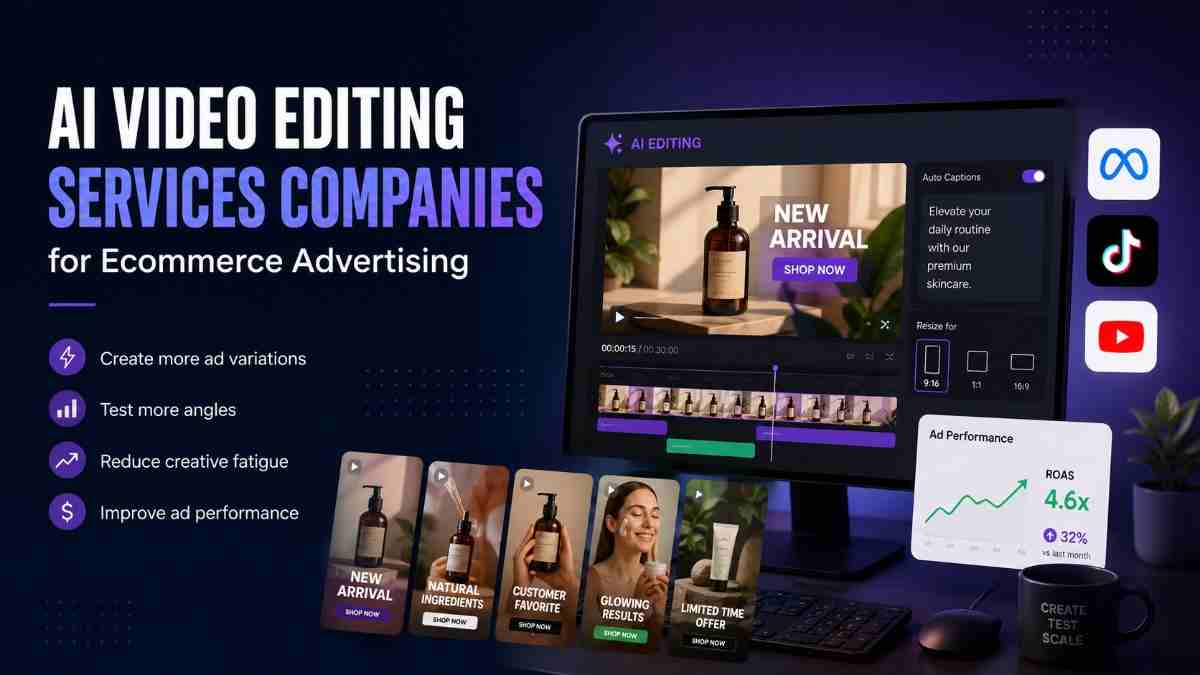
AI video editing services companies help ecommerce brands create, test, and scale paid social video ads more efficiently.
A paid social campaign can start strong and still become difficult to manage within a few weeks. One Meta ad performs well, the media buyer wants five variations, the creative team has three other products waiting, and the next product launch is already on the calendar. Then TikTok needs its own versions. Suddenly, the problem is not finding another ad idea. It is producing enough usable video to test those ideas properly.
That is where AI video editing services companies are becoming relevant for ecommerce teams.
The appeal is not simply that AI can make videos faster. Most experienced media buyers do not need another tool that creates something flashy in minutes. They need creative production that can keep pace with paid media testing without turning every new variation into a separate production project.
For a DTC brand spending heavily on Meta Ads, that distinction matters.
A winning ad concept rarely stays winning forever. Audiences become familiar with the hook, the opening shot loses its impact, competitors start using similar messaging, or the offer changes. Creative fatigue can show up as higher acquisition costs, weaker click through rates, lower engagement, or simply a campaign that stops scaling as efficiently as it did before.
The obvious response is to make more ads. The practical problem is making enough good ones.
AI video editing services companies can help ecommerce teams take existing footage, UGC, product demonstrations, testimonials, product photography, voiceovers, and other creative assets and turn them into multiple advertising variations. The work can include changing hooks, pacing, captions, framing, product sequences, calls to action, and other elements that affect how an ad is experienced.
That creates a different production model.
Instead of treating every ad as a completely new video project, a brand can treat creative as a collection of components that can be tested and recombined.
There is an important distinction here. More variations do not automatically mean better advertising. If a brand produces 50 weak versions of the same idea, it has not solved its creative problem. It has created more files to review.
The real value comes from increasing testing capacity while keeping the underlying creative quality under control.
For US ecommerce brands, this is particularly relevant because paid media teams are often managing several pressures at once. Customer acquisition costs may be rising. Product margins may be tight. New SKUs need launch support. Existing winners need fresh versions. Media buyers want more creative data. Founders want to know why spend is increasing without a corresponding increase in revenue.
Creative production sits right in the middle of all of that.
AI video editing services companies can give teams another way to handle the production workload without requiring a traditional shoot every time a campaign needs a fresh angle.
The phrase "AI video editing services companies" can make the work sound more complicated than it is.
At its core, the job is usually about taking raw or existing creative assets and turning them into advertising-ready video variations that fit the needs of a campaign.
That can mean editing a UGC video into several different openings. It can mean creating a tighter 15 second version from a longer product demonstration. It can mean testing a direct problem statement against a curiosity-driven hook. It can also mean adapting an existing creative for different placements and audiences.
For a paid media team, the useful question is not "Can AI edit a video?"
Of course it can.
The better question is "What parts of our creative production process are slowing down testing?"
Consider a skincare brand with 20 UGC videos from creators. The original videos may be useful, but they are not necessarily ready to become a structured testing library. One creator may explain the problem for 45 seconds before showing the product. Another may have a strong testimonial buried halfway through the footage.
An AI video editing workflow can help extract the strongest moments and create different versions around them.
One version could open with the customer's problem. Another could start with the product result. A third could lead with a testimonial. A fourth might use a shorter product demonstration followed by the offer.
The source material has not changed dramatically. The presentation has.
That matters because paid social creative testing often depends on relatively small changes.
The first three seconds can matter. So can the opening line, visual sequence, caption treatment, product shot, or timing of the CTA. You do not always need an entirely new production to learn something useful from a new creative.
AI video editing services companies may also handle format adaptation. A campaign might require different aspect ratios, durations, caption treatments, or versions for Meta Ads and TikTok Ads. Creating these manually can become repetitive, especially when a media team is running campaigns across multiple products.
This is where production volume becomes a business issue.
Suppose a brand has six active SKUs. Each product has several audiences. Each audience has different messaging. The media team wants new creative every week. The internal team is also handling landing pages, emails, promotions, influencer coordination, and reporting.
Nobody necessarily has enough time to edit every variation manually.
AI can take some of that repetitive work off the production team's plate.
But there is still a human decision layer that should not disappear.
Someone needs to understand the product. Someone needs to know which claims are acceptable. Someone needs to understand the offer. Someone needs to recognize when a video looks technically polished but makes a weak advertisement.
That last part gets overlooked.
A beautifully edited video can still fail because the opening does not create enough interest, the product appears too late, the message is unclear, or the viewer has no reason to keep watching.
AI video editing services companies are most useful when editing is connected to the actual advertising objective rather than treated as a standalone production task.
TikTok changes the editing conversation a little. A video that feels acceptable on Meta can feel slow on TikTok, especially when the opening takes too long to establish what the viewer is supposed to care about.
That is why ecommerce brands often need more than simple resizing when adapting creative across platforms. The pacing, captions, opening shot, visual changes, and overall rhythm may need to be reconsidered.
AI video editing services companies can help here by turning longer UGC recordings into several short form variations without asking the brand to start from zero every time.
Take a typical UGC creator video. The creator might record a two minute explanation of why they started using a product. There could be a strong 12 second section buried in the middle, followed by a useful demonstration and a customer objection near the end.
Instead of publishing the original recording as one long advertisement, the footage can become several creative assets.
One edit might focus on the problem. Another might centre on the product demonstration. Another could use the objection as the opening. A fourth might build the entire video around the creator's personal result.
That approach is particularly useful for TikTok Ads because native-looking creative often depends on immediacy. The viewer should understand quickly why the video is worth watching.
The same footage can also support Meta Ads. The difference is in how the creative is packaged.
There is a practical advantage here for brands working with UGC creators. Creator costs do not disappear just because AI editing is involved. The footage still needs to be commissioned, reviewed, and managed. But a brand can potentially get more advertising variations from each creator package.
For a growing DTC company, that changes the economics of content production.
A single creator shoot does not have to equal one finished ad.
It can become a source library.
The best teams are usually not asking for endless variations just because they can. They are looking at the footage and asking which moments could support different customer motivations.
That distinction keeps short form production from becoming a content factory that nobody has time to manage.
Creative testing becomes much more useful when the team knows what it is actually trying to learn.
An ecommerce brand might have a product that solves several problems. One customer buys because the product saves time. Another buys because it is easier to use. Someone else cares about the price. Another customer may respond to the product's design or convenience.
Those are different advertising angles.
If the brand only produces one general product video, it may never learn which motivation has the strongest relationship with acquisition.
AI video editing services companies can help turn those hypotheses into actual creative variations.
For example, a home organization brand might have existing footage showing the product being used in a messy kitchen. The same footage could support several angles.
One version could focus on saving time.
Another could focus on reducing clutter.
Another could highlight ease of installation.
Another could use a customer testimonial.
Another could lead with a common frustration and reveal the product as the solution.
The footage does not need to change dramatically for the message to change.
This makes creative testing more affordable because the team can test the idea before committing to a completely new production.
There is a catch, though. If every variation changes the hook, footage, voiceover, offer, captions, and CTA at the same time, the resulting performance data can be difficult to interpret.
A higher volume of ads is not the same thing as better testing.
Media buyers still need to decide what variable matters.
Sometimes the first three seconds deserve the test. Sometimes the message is the problem. Sometimes the offer itself is weak and no amount of editing will fix it.
That is why AI editing works best when it follows a clear advertising hypothesis.
The creative team produces the variation. The paid media team watches what happens. The next round is informed by those results.
It becomes a loop rather than a one-time production exercise.
Creative fatigue becomes especially frustrating when a brand has several products running at the same time.
A single-product company can concentrate its production resources around one core offer. A brand with 20 SKUs has a different problem. Every product has its own audience, positioning, promotional calendar, and creative needs.
Then there are seasonal campaigns, product launches, retargeting campaigns, prospecting campaigns, and different customer segments.
The creative workload grows quickly.
Meta Ads can continue spending money while the team is still waiting for fresh creative. By the time new versions are approved, the original campaign may already be showing signs of fatigue.
This is where a reusable editing workflow becomes valuable.
AI video editing services companies can help brands build variations from existing footage rather than treating every new ad as a completely separate production.
A product demonstration can be shortened. A testimonial can become a hook. A longer UGC recording can produce several openings. Product images can be combined with existing video. Older footage can be re-edited around a new offer.
That gives the brand more ways to refresh a campaign.
But there is another issue that gets less attention. Creative fatigue is not always caused by the same ad being shown too many times.
Sometimes the underlying idea is tired.
Changing the caption or background music will not suddenly make a weak concept interesting again. If consumers have seen the same promise from the brand repeatedly, the team may need a different customer angle altogether.
This is where AI editing has limits.
It can help the team move faster, but it cannot make an exhausted advertising proposition fundamentally new.
A useful workflow is to separate refreshes into different levels. A minor refresh might change the opening or pacing. A stronger refresh could change the narrative or customer objection. A major refresh might require new footage, a new creator, a new concept, or a different product demonstration.
Not every fatigue problem needs a full production.
But not every fatigue problem can be solved with editing either.
Speed is attractive until it starts creating review problems.
A performance marketing team may want 20 new variations this week. The brand team may look at those videos and reject half because the messaging feels off, the product is presented incorrectly, or the tone does not match the brand.
Now the supposed speed advantage has created another bottleneck.
AI video editing services companies need to work within clear brand rules. That can include approved messaging, visual standards, product positioning, disclaimers, fonts, captions, voice style, and acceptable claims.
This becomes particularly important for ecommerce brands that have invested heavily in their identity.
A premium beauty brand, for example, probably does not want every ad to look like a generic UGC template simply because that format is performing well elsewhere. The brand can use UGC while still maintaining a certain visual and verbal standard.
Creative control should not disappear because editing becomes faster.
The same applies to product accuracy.
If a product has specific features, measurements, ingredients, or usage instructions, those details need human review. AI can assist with editing, but a person still needs to make sure the final advertisement says what the business actually means.
The strongest setup is usually a balance.
AI handles repetitive production work. Humans handle the decisions that require context.
That can mean generating variations quickly while keeping final approval with the creative or marketing team.
There is also a temptation to over-edit. Fast cuts, animated captions, visual effects, and constant movement can make a video look energetic, but they can also distract from the product.
A direct response ad has a job to do.
If the viewer cannot understand what is being sold because the edit is trying too hard to hold attention, the creative has missed the point.
Sometimes the best edit is surprisingly simple.
Creative production should eventually connect back to business numbers.
Not every brand needs a complicated creative scoring system. But teams should know whether their increased production effort is helping paid media performance.
There are several useful questions.
How much does it cost to produce a new variation? How long does it take to get from creative request to launch? How many variations are actually tested? Which creative angles generate stronger click through rates? Which ones produce better conversion rates? Are winning concepts being scaled into additional versions?
The last question matters more than many teams realise.
A brand might discover that a particular UGC hook performs exceptionally well. The next step should not necessarily be to celebrate that one ad and move on. The team can ask what made the hook work and whether that insight can produce several related concepts.
This is where AI video editing services companies can contribute to advertising efficiency.
If an existing video can produce five meaningful variations at a lower production cost than five separate shoots, the economics are easier to justify.
But production cost should not be judged alone.
A cheap video that never gets tested has little value. A more expensive creative that produces a major improvement in customer acquisition economics may be worth far more.
Consider a hypothetical DTC brand spending $100,000 a month on paid social. Its creative team previously produced eight new ads per month. After changing its editing workflow, it can produce 25 variations from a similar amount of source footage.
The important question is not whether production increased from eight to 25.
It is whether those additional variations helped the media team identify stronger concepts, reduce wasted spend, or extend the life of successful campaigns.
If the answer is yes, the production process is doing something useful.
If performance remains unchanged while the team is simply producing more files, the workflow needs another look.
This is also why brands should be careful about judging AI video editing services companies purely on turnaround time.
Fast delivery is helpful. But the real commercial question is what happens after delivery.
Do the videos fit the campaign objective? Can the media buyer test clear hypotheses? Does the creative team have enough control? Can successful ideas be developed into new variations? Does the cost of production make sense relative to the media budget?
Those questions are harder to answer, but they tell you much more about whether the creative operation is actually working.
At some point, every ecommerce team has to decide how much creative production is enough. More is not always better. The better question may be whether the team is producing the right variations at the right moment, before the campaign gives them another reason to panic.
Choosing among AI video editing services companies should start with your advertising workflow, not the editing technology itself.
If your media buyer needs 15 new creative variations every week, the right partner should be able to handle that volume without making your team spend more time managing revisions than they did before. If you are launching a new product, they should understand how to turn product footage, UGC, testimonials, demonstrations, and existing creative assets into advertisements that actually support the launch.
The first thing to evaluate is how closely the company understands paid social.
Ask how they approach Meta Ads and TikTok Ads. Ask whether they understand hooks, creative fatigue, UGC pacing, testing angles, prospecting versus retargeting, and the difference between a video that looks good and one that gives a media buyer something useful to test.
That distinction matters.
A traditional editing workflow can focus heavily on making the final video polished. An ecommerce creative workflow has a different objective. The video needs to communicate the product quickly, hold attention, make the offer clear, and give the advertising team a reasonable hypothesis to test.
You should also look at how the company works with source material.
Can it repurpose existing UGC? Can one longer recording become several distinct ads? Can the team create different hooks without making every variation look identical? Can product footage be adapted for different campaigns?
These questions are more useful than simply asking how quickly a company can deliver a video.
Revision management matters too. If every small change requires several emails and another production cycle, the theoretical speed advantage disappears. A good workflow should make it relatively easy to request a new opening, adjust the pacing, change captions, test another CTA, or adapt an asset for another placement.
Brand control is another consideration.
Your advertising may be performance focused, but the creative still represents your company. The editing process should account for brand guidelines, approved claims, visual identity, product accuracy, and any category-specific requirements.
For a US ecommerce company, this becomes especially important when creative volume increases. More people touching the process can create more opportunities for inconsistent messaging.
Then there is cost.
Do not compare pricing only by the number of videos delivered. Compare the cost against the amount of useful creative testing you can actually get from the relationship.
Ten videos that are nearly identical may be less valuable than six genuinely different creative concepts.
The same applies to turnaround time. Fast production is useful only if the resulting assets are strong enough to enter testing.
A practical evaluation should look at four things: creative quality, testing usefulness, production efficiency, and communication.
Brahvo AI fits into this conversation by focusing on AI video production and editing for brands that need more creative output without treating every new advertisement as a completely separate production project.
For a DTC brand, that distinction can matter when the media team is already identifying new angles faster than the internal creative team can produce them.
The right question is not simply, "Can this company make videos?"
It is, "Can this company help us keep our paid media creative pipeline moving without losing control over what we publish?"
That is a much harder standard, and probably the more useful one.
What do AI video editing services companies do for ecommerce brands?
AI video editing services companies help ecommerce brands turn existing footage and creative assets into advertising-ready video variations. This can include UGC editing, product videos, short form ads, different hooks, captions, pacing changes, aspect ratio adaptations, and multiple versions of the same creative concept.
The useful part is not simply producing more videos. It is making it easier for paid media teams to test different creative ideas without starting production from scratch every time.
Are AI video editing services companies useful for Meta Ads?
Yes, particularly when a brand needs frequent creative variations.
Meta campaigns can experience creative fatigue, and media buyers often need new hooks, openings, product demonstrations, testimonials, and CTAs. AI-assisted editing can make it easier to create those variations from existing footage.
However, more variations do not automatically mean better performance. The creative still needs a clear advertising hypothesis behind it.
Can AI video editing services companies create TikTok Ads from UGC?
They can help turn longer creator footage into shorter TikTok-ready edits with different openings, pacing, captions, and messaging.
This can be useful when a brand has a large amount of UGC but only a small portion of it has been turned into actual advertising creative.
The editing approach still needs to respect the style of the platform and the expectations of the audience. Simply cutting a traditional commercial into a shorter video does not necessarily make it effective TikTok creative.
Can one UGC video become multiple ads?
Yes. One creator recording can contain several useful moments that support different advertising angles.
For example, the same recording might contain a strong problem statement, a product demonstration, a personal testimonial, and an objection that another customer may have. Those sections can potentially become separate creative variations.
The important thing is to create meaningful differences rather than producing several versions that are almost identical.
Do AI video editing services replace human video editors?
Not necessarily.
AI can handle many repetitive editing tasks, but human judgment remains important for brand tone, product accuracy, messaging, storytelling, creative strategy, and final quality control.
For ecommerce advertising, the best use of AI is often to reduce repetitive production work while keeping important creative decisions under human control.
How much creative should an ecommerce brand produce each month?
There is no universal number.
A brand spending $10,000 a month on paid social may have very different creative requirements from a company spending $500,000. Product category, audience size, campaign structure, creative fatigue, and the number of active products all matter.
The better question is whether your media team has enough fresh creative to test meaningful ideas without creating unnecessary production work.
Can AI editing help reduce creative production costs?
It can, particularly when a brand already has valuable source material.
If a company has paid for UGC, product footage, interviews, or demonstrations, AI-assisted editing can help turn that material into more usable advertising variations.
But lower editing costs do not automatically mean lower customer acquisition costs. The additional creative still needs to produce useful advertising outcomes.
How should brands judge the quality of an AI video editing company?
Look beyond turnaround time.
Evaluate the quality of the actual advertisements, understanding of paid social, ability to work with UGC, creative testing support, revision process, brand control, communication, and overall production economics.
A company that understands why an ad needs a different hook is generally more useful than one that simply knows how to change the hook.
Is AI video editing suitable for premium ecommerce brands?
It can be.
Premium brands may need tighter creative controls, but that does not mean AI-assisted editing is unsuitable. Existing footage can be repurposed while maintaining consistent visual standards, messaging, and product presentation.
The process simply needs stronger review standards.
A premium brand should not sacrifice its identity just to produce more ads.
What should a media buyer provide to an AI video editing company?
Useful inputs can include the original footage, winning ads, current campaign objectives, target audience information, product details, offers, brand guidelines, examples of creative that has worked, and specific testing hypotheses.
The more clearly the production team understands what the media team is trying to learn, the more useful the resulting variations are likely to be.
The bigger question for most ecommerce teams is not whether AI can edit a video. It is whether the creative operation can keep up with what the advertising account is asking for without turning every new test into another production headache.