Brahvo AI offers commercial 2D animation production services for ecommerce brands seeking engaging video ads for Meta, TikTok, and YouTube.
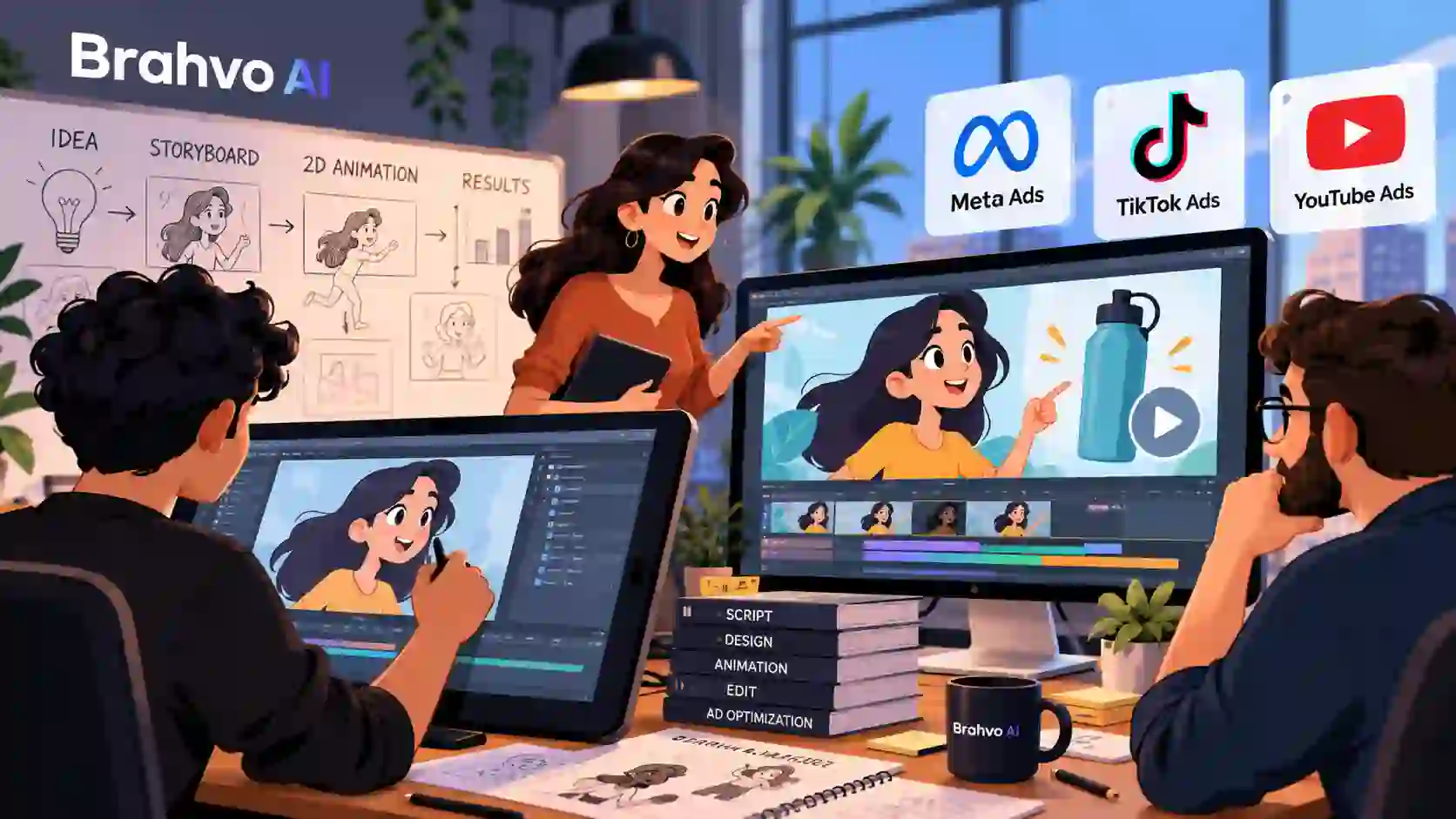
A paid ad can have a strong offer, a sensible audience, and a reasonable budget and still struggle to generate sales. Sometimes the problem is the creative itself. The product takes too long to explain, the opening frames look like every other ad in the feed, or the benefits are difficult to demonstrate with ordinary product footage. This is one reason more marketing teams are considering commercial 2D animation production services for their advertising campaigns.
For US ecommerce brands, animation offers a way to communicate product features, demonstrate how something works, and test different creative concepts without organizing a live shoot for every variation. A company selling a subscription service, for example, can animate the customer journey from sign up to receiving the finished product. A DTC skincare brand can use animated graphics to explain a product routine or highlight individual ingredients, provided its claims are accurate and appropriately supported.
The appeal is not simply that animation looks different. It gives marketers greater control over how a product story unfolds. Every scene can be planned around a particular benefit, objection, or buying decision.
Commercial 2D animation production services are particularly relevant when a business needs more than one polished brand video. Paid media teams often need a steady supply of creative variations, each built around a different message. One ad might focus on convenience, another on a common customer frustration, and a third on the product's distinguishing feature. Animation makes these variations easier to plan because the visual elements can be adapted without rebuilding an entire live production.
Cost is another consideration. A traditional commercial shoot may involve locations, equipment, talent, product samples, and reshoots. Animation has its own production costs, including scripting, illustration, storyboarding, motion design, voiceover, and revisions. It is not automatically cheaper in every situation. However, when the concept depends on abstract ideas, software demonstrations, or repeatable visual sequences, animation can be a practical production choice.
There is also a useful distinction between producing a commercial and producing advertising assets. A commercial might be designed to establish a brand's identity over several months. Advertising assets need to respond to campaign performance, product launches, seasonal offers, and changes in customer behavior. A single animation concept can potentially be adapted into several lengths, aspect ratios, and opening hooks, provided those versions are planned for the intended placements.
For Brahvo AI, the relevant opportunity is to approach commercial 2D animation production services as part of the advertising workflow, not just as an isolated creative deliverable. The business question is straightforward. Can the production process help a marketing team communicate its offer clearly and generate enough distinct creative options to test?
That is a more useful question than whether an animated commercial looks impressive.
Animation works best when the visuals explain something the audience needs to understand. Movement alone does not make an advertisement persuasive. The message, pacing, product relevance, and connection between the visual story and the offer matter much more.
Consider a company selling a home organization product. A conventional product image can show what the item looks like. A well planned animated commercial can demonstrate the problem it solves, show the product in use, and reveal the difference between the disorganized starting point and the finished result. The viewer does not have to work as hard to understand the value proposition.
This is where commercial 2D animation production services can be particularly useful. They allow a brand to control the sequence of information rather than relying entirely on footage captured in a physical environment.
Visual clarity matters more than visual complexity. If an animated ad introduces too many characters, transitions, colors, and messages, the audience may struggle to understand the offer. Strong advertising usually has one primary idea. Supporting details should help explain that idea rather than compete with it.
Making complicated products easier to understand
Some products are difficult to demonstrate with a camera. A B2B software company might need to explain how information moves between systems. A consumer subscription brand might need to show how an order progresses through several stages. A technology company may have a product whose most important features are invisible from the outside.
Animation can turn these abstract processes into understandable scenes. Icons, labels, simplified interfaces, diagrams, and character movements can explain what happens and why it matters.
The same principle applies to ecommerce products with features that are not immediately obvious. A product may have a space saving mechanism, a particular assembly process, or a specialized design feature. An animated sequence can isolate that detail and explain its practical relevance.
Accuracy remains important. Product demonstrations must represent the actual product and its capabilities. An animation that makes a feature appear more powerful than it is may attract attention initially, but it can also create disappointed customers and unnecessary returns.
Giving viewers a reason to keep watching
The opening seconds of an ad have a specific job. They need to establish relevance quickly enough that the viewer understands why the message deserves attention.
Commercial 2D animation production services can help create different opening approaches without changing the entire commercial. One version might begin with the customer's problem. Another could introduce the product immediately. A third might show the result before explaining how the product achieves it.
These are different creative hypotheses, not guaranteed winners.
For example, a DTC brand selling a portable coffee accessory could test an opening that shows a messy travel setup against one that immediately demonstrates the product's compact design. Both communicate the same product category, but they appeal to different motivations. Actual campaign results would determine which approach deserves more budget.
Maintaining a consistent visual identity
Animation also gives brands control over illustration styles, typography, colors, transitions, and character design. This can be valuable for businesses that want their ads to remain recognizable across several campaigns.
Consistency does not mean every ad should look identical. The visual language can remain familiar while the message changes. A brand can introduce new product benefits, seasonal offers, or customer use cases without starting from scratch each time.
Still, recognizable branding cannot compensate for an unclear offer. If viewers remember the animation but cannot explain what the product does, the creative has missed an important commercial objective.
Ecommerce teams often face a production problem that becomes more noticeable as their product catalog grows. Every SKU needs useful creative material, but the team cannot afford to organize a new shoot every time it wants to test another product benefit or audience segment.
Commercial 2D animation production services offer another way to build those assets. Instead of treating each commercial as a separate project, brands can develop reusable visual elements and adapt them to different products or campaign objectives.
Product launches and feature demonstrations
A new product launch usually requires several kinds of communication. Potential customers need to understand what the product is, how it works, why it is different, and whether it is relevant to their needs.
A single long video may not answer all those questions efficiently.
A better production plan might include a short product introduction, a feature focused animation, a comparison of use cases, and a version built around a specific customer concern. These assets can serve different stages of the buying process without repeating the same script.
For a DTC home goods company, the introduction might show the product in a familiar household setting. A feature focused version could explain its folding mechanism. Another creative could focus on storage limitations faced by apartment residents. The product remains the same, but the commercial message changes.
This approach is useful when the brand has evidence that customers care about different benefits. Without that evidence, producing numerous versions can become an expensive exercise in guesswork.
Supporting multiple SKUs without losing relevance
A company with a large catalog may have products that share a common use case but differ in features, sizes, or intended customers. Commercial 2D animation production services can help create a common visual framework that accommodates these differences.
For instance, a personal care brand could use the same animation style across several products while changing the packaging, product specific benefits, and demonstration scenes. Shared assets may reduce repeated illustration work, although each version still needs careful review.
The important decision is knowing what should be standardized and what should remain product specific. Reusing too much can make every commercial feel interchangeable. Rebuilding everything can create unnecessary production work.
Making paid creative testing more manageable
Paid media teams need to distinguish between changes that are genuinely meaningful and changes that are merely cosmetic. A new background color is not necessarily a new advertising concept. A different opening message or product benefit may be.
A practical testing plan for an ecommerce brand could separate creative variables into three groups:
Commercial 2D animation production services can support this process by making it easier to create variations from a shared creative foundation. However, the team still needs to determine which variable it wants to test. Changing the message, pacing, visuals, and offer simultaneously makes the results harder to interpret.
A practical ecommerce scenario
Consider a hypothetical US DTC brand selling modular desk accessories. Its Meta Ads campaigns have started to show signs of creative fatigue, and the team wants to introduce new concepts without arranging another product shoot.
The brand identifies three potential buying motivations. Customers want a less cluttered desk, easier access to everyday items, and a setup that fits into a small home office.
The production team creates three animated commercials. The first shows clutter gradually disappearing as the product is assembled. The second focuses on how individual components can be rearranged. The third demonstrates a compact workspace transformation.
Each ad uses the same core product assets, but its opening scene, narrative, and main benefit differ. The media team can then evaluate the results using the metrics relevant to its objective, including click through rate, conversion rate, acquisition cost, and the quality of resulting orders.
No particular outcome should be assumed in advance. One message may generate more clicks but fewer purchases. Another may attract fewer viewers while producing customers who spend more. The point is to give the team distinct creative ideas that can be evaluated against actual business results.
This is where commercial 2D animation production services become part of a larger marketing decision. Production creates the options. The campaign data helps determine which options deserve further investment.
The same commercial rarely performs identically across every advertising placement. People encounter ads in different contexts, and the platforms support different viewing habits. A creative asset that works as a short vertical product demonstration may not be the right choice for a longer YouTube placement.
Commercial 2D animation production services can help brands adapt the central idea to each channel while keeping the product message consistent.
Meta Ads: test the message before polishing every detail
Meta campaigns often require multiple creative concepts to address different customer motivations. A product focused animation may work for people who already understand the category, while a problem focused opening may be more useful for a colder audience.
For example, an animated ad for a kitchen storage product could open with an overcrowded cabinet, then show how the product creates more usable space. Another version might begin with the product itself and demonstrate how quickly it can be installed.
Both versions should make the product and its relevance clear. The team can then evaluate performance in the context of campaign objective, audience, budget, and purchase behavior.
A common mistake is assuming that a more polished animation will automatically outperform a simpler one. It might not. A direct demonstration can sometimes communicate value more effectively than a heavily stylized commercial.
TikTok Ads: make the creative feel native to the viewing experience
TikTok creative needs to communicate quickly and work in a vertical, sound enabled environment, while remaining understandable to viewers who have their sound turned off.
Animation can support that requirement through readable on screen text, quick product demonstrations, expressive movement, and a clear visual sequence. The commercial should not depend on a long logo introduction before explaining why the product matters.
A useful concept might begin with a recognizable customer problem, introduce the product within the opening moments, and use animation to demonstrate its most relevant feature. Captions and text overlays can reinforce the message without filling every part of the screen.
The creative still needs to feel appropriate for the placement. A highly formal corporate animation may be technically well produced but poorly matched to a casual consumer product ad. Style should follow the audience and the message, not the production team's preferences.
YouTube Ads: give the product story enough room
YouTube offers opportunities for both short direct response ads and longer product explanations. The appropriate format depends on the campaign objective, placement, and audience.
Commercial 2D animation production services can help create a concise version focused on one product benefit and a longer version that explains several features or addresses common objections.
A subscription service, for example, might use a short commercial to establish the central value proposition. A longer version could demonstrate the sign up process, explain what customers receive, and clarify how the subscription works.
That additional detail is useful only when the audience needs it. A longer video is not automatically more persuasive, and a short video is not automatically better for acquisition.
Adapt the creative instead of simply resizing it
Changing a horizontal video into a vertical format is not always enough. Important text may become too small, product details may fall outside the visible area, and the pacing may feel slow on a mobile screen.
A production plan should account for aspect ratio, safe areas, text readability, caption placement, and the amount of time needed to communicate the central message. The team should also confirm the current specifications of the intended advertising placement before delivery.
Commercial 2D animation production services are most useful here when format adaptations are considered during production rather than added as a last minute task.
For a brand running Meta Ads, TikTok Ads, and YouTube campaigns at the same time, this can mean developing one central concept with separate edits for each placement. The story remains recognizable, but the opening, timing, and layout are adjusted to fit how the ad will be seen.
The production process has a direct effect on how quickly a brand can turn an advertising idea into a usable asset. If the product message is unclear at the beginning, that confusion tends to appear later as script changes, new illustrations, revised scenes, and repeated approval requests.
Commercial 2D animation production services work best when the advertising objective is defined before detailed production begins.
Start with the customer problem and campaign objective
The first decision is not which animation style to use. It is what the viewer should understand or do after seeing the commercial.
A campaign might aim to introduce a new product, explain a complicated feature, generate qualified traffic, or encourage a purchase. Each objective calls for a different emphasis.
The team should identify the intended audience, the main product benefit, the offer if there is one, and the evidence supporting the claims. It should also decide how the finished creative will be evaluated.
Without these decisions, the production team may deliver a visually appealing commercial that does not address the campaign's actual needs.
Write a script that can be understood visually
A commercial script needs more than dialogue. It should establish what the viewer sees, what the narration or text communicates, and how the scenes connect.
For a product demonstration, the script might move from the customer's problem to the product's key feature, then to a practical use case and a clear next step.
Not every commercial needs a voiceover. Some concepts communicate more effectively through movement, short text overlays, sound design, and product visuals. The choice depends on the complexity of the message and the intended audience.
Develop a storyboard before full animation
A storyboard translates the script into a sequence of visual scenes. It gives the brand a chance to review the narrative, composition, product representation, and pacing before detailed animation work begins.
This stage is particularly valuable for ecommerce products with specific design details. Packaging, proportions, product colors, and visible functions should be checked before the team invests time in animating them.
A change to one storyboard frame is usually easier to manage than a major change to an already animated sequence.
Create the visual assets and animate the scenes
Once the storyboard is approved, the production team develops the illustrations, backgrounds, typography, characters, and other required elements.
The animation stage brings these assets together through movement, transitions, timing, and visual emphasis. Sound effects, music, and voiceover can be added where they serve the commercial.
Commercial 2D animation production services may involve different levels of complexity. A simple product explainer with animated shapes and labels has different production requirements from a character led commercial with multiple scenes and detailed movement.
The brand should agree on the intended visual standard early, since complexity affects both production time and revision requirements.
Review, revise, and prepare advertising versions
Before final delivery, the commercial should be reviewed for product accuracy, spelling, timing, readable text, audio levels, and consistency with the approved script. Any claims about product performance should receive the appropriate internal review.
The team should also confirm the required export formats, aspect ratios, caption versions, and file specifications for its advertising placements.
One practical consideration is revision ownership. If several stakeholders can request changes without a clear approval process, even small edits can create delays. Agreeing on a primary decision maker and collecting feedback in one place helps keep production manageable.
Plan for testing after delivery
A finished commercial is not necessarily the final stage of the creative process. For performance campaigns, it may be the beginning of the testing cycle.
The media team can compare different openings, messaging angles, lengths, and visual treatments to identify which elements appear to influence results. Successful concepts may then be adapted into additional versions, while weaker ones can be revised or retired.
This does not mean every ad needs dozens of variations. Production volume should reflect the available budget, the campaign's testing capacity, and the amount of meaningful creative learning the team expects to gain.
For Brahvo AI, the central consideration is how commercial 2D animation production services fit into this entire sequence, from the first advertising brief to the finished creative and its subsequent evaluation. The best production workflow is not necessarily the one that produces the most videos. It is the one that gives the marketing team usable creative assets, clear approval points, and enough flexibility to respond when campaign needs change.
AI is changing how creative teams approach commercial production, but the most useful changes are not always the most obvious ones. Generating an illustration or a rough visual concept in minutes can save time. Turning that concept into a consistent, accurate commercial that a US brand can run in a paid campaign is a different challenge.
For ecommerce companies producing ads across several products and placements, commercial 2D animation production services increasingly involve a mix of AI assisted work and conventional creative production. The value comes from deciding which tasks can be accelerated without sacrificing the quality of the final advertisement.
Faster concept development without skipping creative decisions
One of the more practical uses of AI is early concept development. A creative team can explore different visual directions, potential scenes, and ways to explain a product before committing to detailed production.
Suppose a DTC brand is preparing to launch a reusable water bottle. The team might explore an animation built around portability, another focused on everyday convenience, and a third showing how the product fits into a gym routine. AI assisted ideation can help the team explore these directions before selecting the concepts worth developing.
The important part is the selection process. A large collection of rough concepts is not necessarily useful if none of them communicates a convincing reason to buy the product.
Commercial 2D animation production services still require a clear creative brief, an understanding of the audience, and a decision about which product benefit deserves the most attention.
Reducing repetitive production work
AI assisted workflows may help with certain repetitive tasks, including early asset exploration, draft copy variations, reference organization, and parts of the preproduction process. Depending on the workflow, these uses can reduce the time required to prepare creative materials.
However, production teams still need to check the output. Generated product illustrations may contain incorrect packaging details, inconsistent proportions, or visual elements that do not match the actual item. Brand colors and typography may also require manual correction.
For an ecommerce business, these are not minor details. A customer who sees one product design in an ad and receives something different may lose confidence in the brand.
The practical approach is to use AI where it saves meaningful time, then retain human review for product accuracy, visual consistency, and advertising claims.
Creating more creative variations for paid campaigns
AI can also help teams explore different ways to communicate the same offer. A single approved concept might lead to variations in opening scenes, supporting copy, visual emphasis, or audience specific messaging.
Commercial 2D animation production services can use these variations to support creative testing on Meta Ads, TikTok Ads, and YouTube campaigns.
For example, a subscription box company might test whether convenience, product variety, or personalization makes a more compelling opening message. Each version should present a genuinely different reason to consider the offer rather than simply changing a background or transition.
There is a limit, though. Producing fifty variations does not mean a team has fifty useful ideas. If the underlying message is weak, AI can help reproduce that weakness at a much greater volume.
I might be wrong here, but the biggest long term advantage of AI in animation production may not be faster asset creation. It may be the ability to explore more creative directions before a company commits a large part of its advertising budget to one concept.
Keeping the final commercial consistent
AI assisted production can introduce inconsistencies between scenes, particularly when characters, products, lighting, or visual styles change from one generated asset to another.
A finished commercial needs to feel like one coherent piece of communication. The product should remain recognizable, movement should feel intentional, and each scene should support the same central message.
That is why commercial 2D animation production services need a defined visual system, clear asset references, and a review process. AI can contribute to the workflow, but it does not remove the need for art direction.
Brands should also consider confidentiality, rights to supplied assets, and the terms governing generated content before using AI in commercial production. These questions become particularly important when working with unreleased products, proprietary designs, or licensed brand material.
AI is useful when it removes friction from production. It becomes less useful when the time saved early on is lost through repeated corrections later.
A commercial can look professional and still struggle to generate sales. Sometimes the issue is the concept. Sometimes the message is unclear. In other cases, the production process creates an asset that does not fit the placement or the campaign objective.
Commercial 2D animation production services need to account for these problems before they become expensive revisions or wasted media spend.
A visually attractive ad with no clear buying reason
Animation can encourage creative experimentation, but that freedom can also lead to unnecessary complexity. A commercial may contain polished transitions, detailed characters, and impressive movement while failing to explain why the product matters.
This often happens when the creative brief focuses on what the brand wants to show rather than what the customer needs to understand.
Consider an animated commercial for a home fitness product. If the ad spends most of its runtime introducing a character and establishing a fictional setting, the viewer may not understand the product's purpose until too late.
A more direct approach might show the customer problem immediately, demonstrate the product, and explain the relevant benefit. The right balance depends on the product and audience, but every scene should have a reason to exist.
Creative fatigue and repetitive concepts
Creative fatigue becomes a concern when an audience sees similar advertising repeatedly and the campaign begins to lose effectiveness. Frequency alone does not prove fatigue, so marketers should also examine engagement, conversion trends, audience saturation, and other campaign signals.
Commercial 2D animation production services can help teams produce fresh creative concepts, but new visuals do not automatically mean a new advertising idea.
Changing the color palette while keeping the same opening, message, and product demonstration may not address the problem. A more meaningful change could involve a different customer objection, a new use case, or a benefit that the original creative did not communicate.
The goal is to give the audience a relevant reason to pay attention, not simply to make the next ad look different.
Too many revisions and unclear approvals
Production delays often begin before animation starts. A founder may want to emphasize product quality, a marketing director may prefer a price focused message, and a product manager may insist on explaining technical features.
All three perspectives may be valid. Trying to fit every priority into one short commercial is usually the problem.
Commercial 2D animation production services benefit from a single agreed campaign objective and a clear approval process. The brand should decide which message is essential, which details can be removed, and who has final approval.
A storyboard review is a useful place to resolve these disagreements. Revising the message at this stage is generally more manageable than rebuilding several completed scenes.
Poor adaptation across advertising placements
A commercial designed for a wide YouTube placement may not translate cleanly into a vertical TikTok ad. Text can become difficult to read, product details can disappear, and the original pacing may feel slow on a mobile screen.
Resizing alone rarely addresses every issue.
The production brief should identify the intended placements and specify the required versions. Commercial 2D animation production services can then account for different compositions, caption placement, scene timing, and text sizes from the beginning.
Brands should also avoid assuming that one version will work equally well for prospecting, retargeting, and existing customers. These audiences may need different levels of product explanation.
Confusing click performance with business performance
A visually striking animation might generate a high click through rate while attracting visitors who do not purchase. Another creative might produce fewer clicks but bring in more qualified customers.
Neither result should be judged in isolation.
Paid media teams need to consider the campaign objective, conversion rate, acquisition cost, order value, and contribution margin where reliable data is available. They should also account for attribution limitations and differences between advertising platforms.
The production team does not control every factor behind these results. Pricing, the landing page, product availability, audience selection, and the checkout experience all influence what happens after someone sees an ad.
This is an important distinction when evaluating commercial 2D animation production services. The creative should be assessed for the job it was designed to perform, without attributing every campaign outcome to animation alone.
For a brand investing in commercial animation, the production relationship matters almost as much as the finished asset. A team may need to explain a new product, prepare several ad variations, coordinate feedback across departments, and deliver files for different paid media placements within a fixed launch window.
Brahvo AI's approach to commercial 2D animation production services should be evaluated around how well the production process supports those needs. The objective is to create advertising creative that communicates the product clearly and fits the brand's campaign requirements.
Begin with the advertising objective
The first discussion should establish what the commercial needs to achieve. A product launch, a feature demonstration, and a retargeting ad have different communication requirements.
The brief should identify the intended customer, the product's main benefit, the message the viewer should remember, and the action the commercial should encourage. Existing campaign insights can also help identify objections, common questions, or messages that deserve testing.
If the brand has already run paid campaigns, those findings can inform the creative brief. If it is launching a new product with little historical data, the initial concepts may need to explore several plausible customer motivations.
Neither situation requires the same production plan.
Build the concept around the product
The visual approach should follow the product and the message. A straightforward product demonstration may be suitable for a practical household item, while a more illustrative narrative could help explain an abstract service or a complicated process.
Brahvo AI's commercial 2D animation production services should be planned with this distinction in mind. The production brief, script, and storyboard need to establish how the product will be represented and which scenes are essential.
This also gives stakeholders an opportunity to check factual details before animation begins. Product claims, packaging, interface elements, and demonstrations should match the actual offering.
Plan for paid media requirements early
If the finished commercial will run across Meta Ads, TikTok Ads, and YouTube, the intended placements should be considered before the visual assets are finalized.
A single concept may require separate edits with different opening scenes, pacing, text placement, and aspect ratios. Planning these requirements early helps avoid unnecessary reconstruction during delivery.
For brands testing several advertising angles, the brief should also distinguish meaningful creative variations from simple formatting changes. This makes it easier for the media team to understand what each asset is intended to test.
Keep review and delivery practical
An effective production workflow should define the review stages, feedback process, revision expectations, and final delivery requirements. Stakeholders need to know when they are approving the script, when they are approving the storyboard, and when the finished commercial is ready for final checks.
This matters particularly for brands working toward product launches, promotional periods, or seasonal campaigns. Delayed approvals can leave the media team with too little time to prepare and evaluate the finished creative.
For Brahvo AI, commercial 2D animation production services can be positioned around this practical production discipline, alongside the creative work itself. The exact scope, timelines, deliverables, and revision terms should be confirmed for each project rather than assumed.
Connect production with campaign learning
The final asset should give the marketing team something useful to evaluate. If a commercial is designed to test a particular product benefit, the campaign should measure the outcomes relevant to that objective.
The team may later decide to create additional versions, revise the opening, or explore a different customer motivation. Those decisions should come from the evidence available, not from an assumption that every campaign needs more animation.
No production approach can guarantee a particular acquisition cost or conversion rate. Brahvo AI's role in the process is to develop the creative assets according to the agreed brief and production requirements, while the brand and its media team assess campaign performance in the context of the wider customer journey.
For a prospective client, the most useful questions concern the actual work involved. How will the product be represented? What will the review process look like? Which advertising formats will be delivered? How will changes be handled if the campaign direction shifts?
Clear answers to those questions are more useful than broad promises about advertising performance.
What are commercial 2D animation production services?
Commercial 2D animation production services involve creating two dimensional animated content for advertising, product demonstrations, brand communication, and promotional campaigns. Depending on the project, the work can include scripting, storyboarding, illustration, motion design, sound, editing, and preparation of advertising files.
How much do commercial 2D animation production services cost in the US?
Pricing depends on the length of the commercial, visual complexity, number of scenes, character design, voiceover, sound requirements, revisions, and the number of versions required. A simple animated explainer generally involves different production demands from a detailed character led commercial. Requesting a quote based on a clear brief is the most reliable way to establish project cost.
How long does it take to produce a commercial 2D animation?
The timeline depends on the scope of the work and how quickly the client approves each stage. Script development, storyboarding, illustration, animation, sound, revisions, and final exports all require time. A project with several versions or multiple approval stakeholders may take longer than a straightforward commercial.
Are 2D animated commercials suitable for ecommerce brands?
Yes. They can be useful for demonstrating product features, explaining how something works, introducing a new product, and addressing customer questions. Their suitability depends on whether animation communicates the product more effectively than other available creative formats.
Can animated commercials be used for Meta Ads, TikTok Ads, and YouTube?
Yes. Commercial 2D animation production services can deliver assets for different placements, including vertical, square, and horizontal formats. The creative should be adapted for each placement rather than simply resized, with attention to pacing, text readability, and the intended viewing experience.
Can AI reduce the cost of commercial 2D animation production services?
AI may reduce time spent on some early creative and repetitive production tasks. However, the effect on total cost depends on the project. Detailed animation, product accuracy checks, art direction, revisions, and final quality control still require appropriate production work.
How many animated ad variations should a brand produce?
There is no universal number. A brand should start with the number of distinct concepts it can test meaningfully within its budget and campaign volume. Three genuinely different messages may provide more useful information than dozens of versions with only minor visual changes.
How do you measure the success of an animated commercial?
The metrics depend on the campaign objective. Awareness campaigns may focus on reach and video engagement, while ecommerce acquisition campaigns may prioritize purchases, conversion rate, customer acquisition cost, and return on ad spend. The landing page and the wider customer journey also influence results.
What should a business provide before starting an animation project?
Useful materials include product information, brand guidelines, packaging images, approved product claims, the intended audience, campaign objectives, reference assets, and placement requirements. Existing ad performance data can help inform creative decisions, but it is not essential for every new campaign.
How can a business evaluate Brahvo AI's commercial 2D animation production services?
A business should review relevant work samples, confirm the proposed production process, discuss deliverables and revision terms, and establish how the finished assets will fit its advertising requirements. It should also clarify timelines, communication expectations, and the final file formats before approving the project.