Commercial video production in Los Angeles costs more than the invoice. See how DTC brands pair LA shoots with AI video to test more ads.
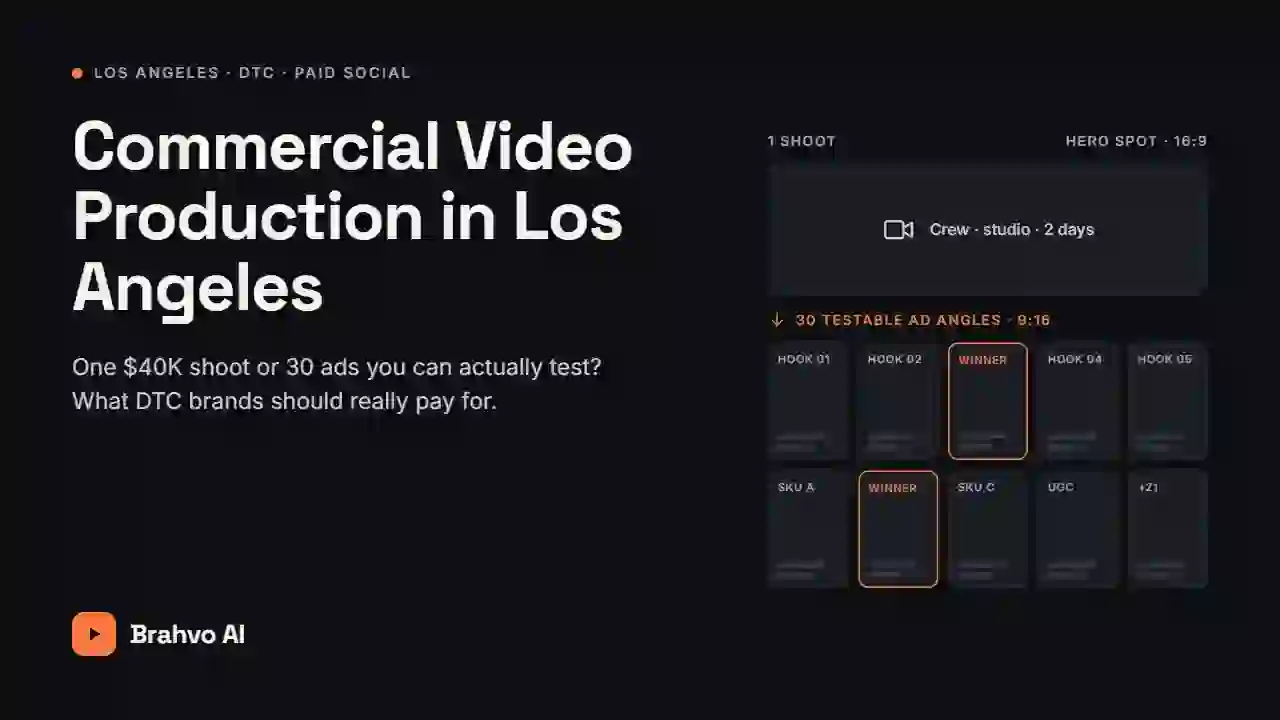
Here's a conversation I've had more times than I can count. A founder books a two-day shoot in Culver City or somewhere in the Arts District. Good director, real crew, a couple of talent, a stylist who actually understands the product. The footage comes back and it's beautiful. Everyone on the Slack channel is excited. Then the media buyer gets the final cuts, and six weeks later there's a quiet question: "Do we have anything new?"
They don't. They have a 30-second hero spot, a 15-second cutdown, a handful of 9:16 versions, and maybe eight usable clips the editor can rearrange. On Meta, that's maybe two weeks of real testing before frequency climbs and CPMs start creeping up on the same faces. The shoot wasn't bad. It just answered a different question than the one the ad account was asking.
That gap is where most of the frustration with commercial video production in Los Angeles comes from. The production world here is built for making one great thing. Paid social rewards brands that can make thirty decent things, learn which three work, and do it again next month. Those are not the same job, and a lot of brands pay for the first while needing the second.
Pricing is all over the place, and anyone who gives you a single number is guessing. But there are some patterns worth knowing before you get on a call with a production company.
For a DTC brand, a lean commercial shoot in LA usually lands somewhere between $15,000 and $50,000 for one to two days. That covers a director or DP, a small crew, basic lighting and grip, a location or stage, a couple of talent, and post. Once you add a bigger crew, union talent, a stage with a cyc wall, hair and makeup, product styling, and a proper colorist, $60,000 to $120,000 isn't unusual. National broadcast spots go well past that, but most ecommerce brands reading this aren't making those.
What surprises founders isn't the day rate. It's everything around it:
Cost area
What usually gets underestimated
Pre-production
Scripting, casting, location scouting, and permits through FilmLA can take two to four weeks before anyone touches a camera
Talent usage
Paid social usage rights often expire, and renewing them for a winning ad can cost almost as much as the original booking
Post-production
Every additional cut, aspect ratio, and hook variation is more editor hours
Reshoots
If the product changes, the packaging changes, or the offer changes, the footage can become unusable
The talent usage one catches people constantly. You find a winner in month three, want to scale it for six more months, and then you learn the usage window was 90 days. Now you're negotiating a renewal on an ad that's printing money, and the talent's agent knows it.
So when people ask what video production in LA costs, the honest answer is the invoice plus the shelf life of what you get. A $35,000 shoot that feeds your account for four months is a very different deal from a $35,000 shoot that gives you three weeks of usable creative. Same price, but the value is miles apart.
Most production budgets are scoped around deliverables: one 30, two 15s, six social cutdowns. That made sense when a commercial ran on a media plan for a quarter. It makes much less sense when the platform algorithm is your biggest creative critic and it gets bored fast.
On Meta and TikTok, the variable that moves results most is usually the creative itself, specifically the first two or three seconds. The hook, the opening frame, the first line of on-screen text. A brand might need to test five different openings on the same product before finding the one that drops CPA by 30%. Then they need variations of that winner, because the winner fatigues too.
Think about a mid-sized LA apparel brand with 40 SKUs, two seasonal drops a year, and a growth target that assumes CAC stays flat. That brand doesn't need one commercial. It needs a steady supply: new angles for the bestsellers, launch creative for new styles, retargeting ads that speak to people who already bounced, and enough volume that the media buyer isn't recycling the same video for the fourth time.
Traditional commercial video production in Los Angeles can deliver that volume. It just gets expensive fast, because every new angle is more script time, more shoot time, more editing time. Agencies try to solve it with bigger shoot days, capturing as much B-roll and alternate takes as they can. That helps, a little. But you're still guessing in advance which angles will matter, and the account almost always wants an angle nobody filmed.
Then there's UGC. Plenty of brands turned to UGC creators to fill the gap, and it works, until managing twenty creators becomes its own part-time job. Briefs get misread. Half the videos come back with bad audio or the wrong product shade. Turnaround is two to three weeks if the creator is reliable, and longer if they're not. I've watched marketing teams spend more time chasing creator deliverables than actually analyzing what the ads were telling them.
Which is the real problem. The bottleneck stopped being the budget at some point. It's speed.
My honest take: for most DTC brands spending under $200K a month on paid social, a big polished hero spot is a brand asset, not a performance asset. It's great for your homepage, a launch moment, retail buyers, investors. It's rarely what scales your Meta account.
Polished ads tend to look like ads, and on platforms where people scroll past ads by reflex, that's a disadvantage. A lot of the top-performing creative I've seen in ecommerce accounts is lower-fi. Tight framing, fast cuts, a clear problem in the first second, product in hand. Not cinematic. Just clear.
I might be wrong here, but I think a lot of brands keep booking big LA shoots partly because it feels like real marketing. There's a crew, a call sheet, a craft services table. It feels like progress in a way that sixty test variations in Ads Manager doesn't, even when the variations are what actually moves revenue.
Now, the part where this doesn't hold. Some categories really do benefit from premium production: luxury skincare, high-end furniture, anything above roughly a $300 average order value where the customer needs to trust the product before they buy it. Production quality is part of the pitch there, and cheap-looking creative can actively hurt conversion. Same goes for brands that sell heavily through YouTube or connected TV, where longer, well-made video holds attention differently than a Reel does. So "skip the hero spot" is good advice for a $45 supplement brand, and probably bad advice for a $1,200 mattress.
The better question isn't whether you should do a hero spot. It's what share of your creative budget should go to the one thing, and what share goes to the many things. Most brands I talk to have that ratio backwards.
This is where the conversation usually gets either overhyped or dismissed, and neither helps much.
AI video doesn't replace a skilled director or a real shoot when you need real people using a real product in a real place. Where it fits is the middle of the workflow, in the space between "we have some footage and product assets" and "the media buyer needs 25 new ads by Friday." That space is where most LA brands lose weeks.
In practice, this is how teams use it. The brand has product photography, maybe some existing footage, a few winning ads, and data on which angles converted. An AI video platform like Brahvo AI takes those inputs and produces new variations quickly: different hooks, different openings, different on-screen messaging, formats sized for Reels, Stories and TikTok, versions for each SKU. The media buyer tests them. The winners get more budget, more variations, or occasionally a proper shoot to make a premium version of the angle that already proved itself.
That last part matters more than people expect. When AI-driven creative testing tells you which angle works before you spend $40,000 filming it, you've flipped the risk. You're not betting on a concept in the pre-production meeting anymore. You're filming the concept the market already picked.
There are still things to watch. Brand consistency takes work. Someone on your side needs to own quality control, because volume without judgment just gives you more mediocre ads, faster. And platform policies on AI-generated content keep changing, so disclosure rules are worth checking with whoever runs your accounts.
But for a brand trying to keep CAC from climbing while launching products and feeding three platforms at once, speed is often what decides whether testing actually happens or just gets talked about in the Monday meeting.
You start with what you already have. That means product shots, any existing footage, past winning ads, your reviews, and the objections your customer service team hears every week. Most brands sit on far more usable material than they think. It just never makes it into new creative because nobody has time to rework it.
Brahvo AI uses those inputs to build variations around different reasons to buy. One serum can be framed around fast results, ingredient transparency, a dermatologist angle, a price-per-use comparison, or a "my skin was a mess before this" story. Each angle then gets several hooks, several opening frames and several lengths, sized for Reels, Stories and TikTok. One product brief can become 30 or 40 ads you can actually test, in days rather than weeks.
The volume isn't the point, though. Your media buyer stops waiting and starts learning. When three angles come back with CPAs 40% below the rest, you know something real about your customer, and that insight should shape your next shoot, your landing page and your email flows.
Here's a composite scenario based on a pattern I've seen more than once. An LA skincare brand launches a new vitamin C serum. The launch date is fixed because the retail partner set it. Their agency quoted three weeks to script, cast, shoot and edit a launch package, and the founder had just over ten days.
So they went the other way. Using existing product photography, a short clip from an older shoot and their top customer reviews, the team built 30 variations across five angles. Fourteen were live on Meta and TikTok within the first week. By day ten, two angles were clearly carrying the account: before-and-after texture shots, and a blunt comparison against the price of in-office facials. The other three were mediocre. One was honestly embarrassing.
The interesting part came later. With the winning angle proven, the brand booked a single half-day shoot built entirely around it. It was cheaper and faster, and the brief was specific because the data had already made the decision. The money went toward the idea that worked instead of toward guessing.
I said earlier that hero spots are mostly brand assets. I still believe that, but there are clear moments when commercial video production in Los Angeles is the right call, and skipping it is false economy:
The smartest LA brands I've worked around treat the shoot as a periodic investment and AI-driven creative as the ongoing engine. They shoot once or twice a year with a clear list of the angles that have already proven themselves, then use that fresh footage to feed months of variations.
Will AI-generated ads hurt my brand?
They can if nobody is reviewing them. Bad creative hurts brands whether a crew made it or software did. Approval needs a real owner on your team.
Do AI video ads actually convert on Meta?
Some do and some don't, which is true of every ad. The advantage is testing enough variations to find the ones that do.
How much should I spend on commercial video production in Los Angeles versus AI creative?
There's no universal split. A lot of performance-focused DTC brands lean heavily toward ongoing variation and keep a smaller share for one or two proper shoots a year. If you're a premium brand, flip that.
Can I use my old shoot footage?
Usually, yes. Check your talent usage rights first. That catches more brands than anything else.
Does this replace my agency?
Not necessarily. Many agencies use faster creative production to run more tests for the same retainer. If your agency pushes back on testing more, that tells you something about the agency.
What about UGC creators?
UGC still has a place, especially for authentic testimonials. The issue is speed and consistency at volume, not quality.
How quickly can I see results?
Expect a meaningful read within one to two weeks of steady spend. Faster than that, you're mostly reading noise.
Is it only for big brands?
Arguably it helps smaller brands more, since they can't absorb a $40K shoot that misses.
Do I need to label AI content?
Meta and TikTok both have disclosure policies for AI-generated or altered content, and they keep evolving. Check the current rules before launching.