Corporate video production for social media that helps brands create engaging content, test creative ideas, and support paid social campaigns.
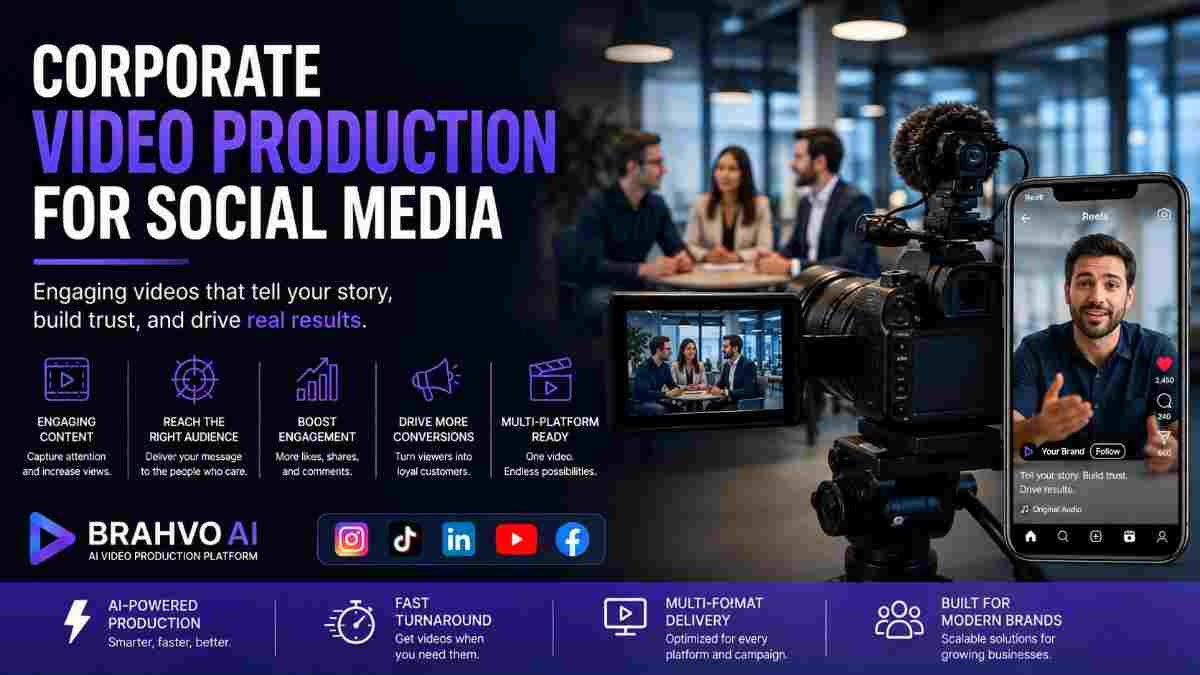
A lot of corporate video still gets made as if someone is going to sit down and watch it from beginning to end.
That is usually not how social media works.
A founder may approve a polished two minute company video, only to discover that most viewers leave within the first few seconds on Instagram or TikTok. A marketing team might spend weeks producing a brand story, then realize the footage does not give them enough short clips for paid campaigns. And when Meta Ads start showing signs of creative fatigue, the team is suddenly asking the same question again: what can we launch next?
This is where corporate video production for social media becomes a different kind of production problem.
The goal is not simply to make a professional corporate video. The goal is to create video content that can communicate a business idea quickly, fit the way people consume content on social platforms, and give the marketing team enough creative material to work with.
For a US ecommerce company, this could mean introducing the people behind the brand, explaining how a product is made, showing customer results, answering a common objection, or giving customers a reason to trust the company. For a B2B company, it could mean turning a complex service into a 30 second explanation instead of sending prospects to a long corporate presentation.
The production mindset changes when social media is part of the brief from day one.
A useful corporate video may still look polished. It just cannot depend on polish alone.
Corporate video now has to compete with the feed
People scrolling through LinkedIn, Instagram, TikTok, or YouTube are not necessarily looking for a corporate video.
They are looking for something interesting.
That distinction matters.
A company can have a strong story, experienced executives, impressive facilities, and a legitimate reason for customers to choose it. None of that guarantees somebody will stop scrolling.
The opening has to earn attention.
That might be a founder making a surprisingly direct statement. It might be a product problem shown immediately. It could be a customer question appearing as on screen text. It could even be a quick behind the scenes shot that feels less polished than the company's usual content.
For corporate video production for social media, the first few seconds often carry more practical importance than a beautiful closing sequence.
This does not mean every corporate video needs to behave like a TikTok trend. That would create another problem. A financial services company, software company, manufacturer, and consumer brand have different expectations around tone and trust.
The point is to understand the environment where the video will appear.
A video designed for a company website can afford to explain more before asking for attention. A social video usually cannot.
One of the biggest mistakes is treating every social video as a completely separate production.
A corporate shoot can create much more useful material than one finished video.
Consider a hypothetical US skincare company launching a new product line. The original production might include a founder interview, product demonstrations, customer questions, packaging footage, employee clips, manufacturing shots, and several product closeups.
The main corporate video could tell the larger brand story.
But the same production could also produce short videos answering common customer questions, founder clips for LinkedIn, product demonstrations for Instagram, vertical videos for TikTok, and shorter paid social variations.
That changes the economics of production.
Instead of asking, "How much does this video cost?" the marketing team can ask, "How many usable creative assets can this production give us?"
That is a much more useful question when paid media is involved.
A Meta campaign can require multiple creative angles because one message rarely performs equally well with every audience. One group may respond to a product demonstration. Another may care about the founder story. Someone else may need a direct explanation of the problem the product solves.
The production needs to support that testing process.
The best corporate video does not always look corporate
This is probably one of the harder ideas for internal marketing teams to accept.
Corporate does not have to mean stiff.
A polished executive sitting behind a desk and reading a carefully approved script may communicate credibility. It may also produce a video that people skip.
For social media, authenticity often comes from small details. A founder speaking naturally. An employee explaining how something actually works. A product being handled in a real environment. A quick shot from the warehouse. A customer question answered without excessive editing.
That does not mean production quality should be ignored.
Poor lighting, unclear audio, bad framing, or distracting editing can make a legitimate company look careless. The balance is between professional production and content that still feels native to the platform.
Corporate video production for social media works best when those two things are not treated as opposites.
There is no single social video format that works equally well everywhere.
A company might take the same source footage and create four different edits depending on where the video is going. The message can remain consistent while the presentation changes.
LinkedIn needs context and credibility
LinkedIn is often a strong environment for corporate storytelling, particularly for B2B companies, professional services brands, technology companies, and founders.
That does not mean long corporate presentations suddenly work.
A short founder explanation can perform better because it gives the viewer a person to connect with. A manufacturing company might show how its production process works. A software company might explain a problem its customers regularly face. A CEO could comment on a change affecting the industry.
The video still needs a reason to watch.
A useful LinkedIn video might be 30 to 90 seconds, depending on the subject. Captions matter because many people encounter social video without sound. The opening should quickly establish why the viewer should care.
For a corporate marketing team, LinkedIn can also be useful for employee focused content, recruiting videos, customer stories, event clips, and executive communication.
Instagram rewards visual clarity
Instagram gives brands several ways to use corporate video.
Reels can carry short educational content, product stories, founder clips, behind the scenes footage, and customer focused messages. Stories can support more immediate updates or informal communication.
The visual standard can also be higher.
That does not mean every Reel needs a commercial production budget. It means the first frame, composition, product presentation, and editing deserve attention.
For an ecommerce brand, a corporate video can introduce the people behind the company without becoming a traditional "about us" film.
For example, instead of opening with a logo animation and a long company history, the video could begin with the founder explaining why the company created the product in the first place.
That gives the viewer a reason to stay.
TikTok needs a different level of directness
TikTok can be particularly unforgiving of content that feels like an advertisement pretending not to be an advertisement.
A corporate brand entering TikTok with a formal presentation may struggle even if the production quality is excellent.
Short explanations, founder commentary, customer questions, demonstrations, reactions, and behind the scenes material can feel more natural.
AI video production can also help here when teams need variations quickly. But speed should not become the entire strategy.
I might be wrong here, but some teams put too much emphasis on generating dozens of versions simply because AI makes it possible. More variations do not automatically mean better creative. If the underlying idea is weak, twenty versions of it are still weak.
The better use of AI is often to help the team explore different executions around a strong message.
YouTube allows more room to explain
YouTube is different because the viewer can intentionally choose to watch.
That creates room for longer corporate videos, interviews, product explainers, customer stories, educational content, and detailed demonstrations.
Short form content still matters on YouTube, particularly through Shorts. But the platform can support a broader content ecosystem.
A company might produce one 8 minute founder interview, then turn sections of that interview into shorter clips for other platforms.
This is where corporate video production for social media becomes less about making isolated videos and more about creating a usable library of content.
The biggest creative challenge is often not production.
It is translation.
Corporate teams tend to communicate in corporate language because that language makes sense internally. Customers do not necessarily think that way.
A company might say it provides "end to end solutions for businesses seeking operational efficiency."
A customer might be thinking, "Why does this process take three weeks when it should take three days?"
The second idea is much easier to build a video around.
Social content needs a human problem, question, curiosity gap, demonstration, or useful piece of information.
That does not mean every corporate video needs to be entertaining.
It needs to matter.
A good way to develop corporate video production for social media is to start with the questions customers already ask.
What causes people to hesitate before buying?
What do prospects misunderstand?
What makes the product different?
What does the founder know that customers do not?
What happens behind the scenes?
Why was a particular product created?
What mistake do customers commonly make?
These questions can become video concepts without forcing the company into a completely different brand voice.
The message should change before the edit does
Suppose a DTC supplement brand wants to promote a new product.
One corporate message might be:
"We developed this product after years of research into customer needs."
That sounds reasonable, but it is not a particularly strong social concept.
A more useful message might be:
"We kept hearing the same complaint from customers, so we changed how we formulated this product."
Now there is a reason to listen.
The video could open with the complaint, show the development process, introduce the product, and explain the change.
The same brand story is still there. The difference is that it starts from the audience's perspective.
That distinction becomes important when videos are used in paid campaigns.
A media buyer does not just need a beautiful video. They need creative that gives the platform and audience something different to respond to.
One version might focus on the problem.
Another could focus on the product.
Another could use the founder.
Another could address an objection.
Another might demonstrate the product in use.
That is where corporate video production for social media starts becoming part of the advertising system rather than simply a branding exercise.
And that can change how a marketing team thinks about production.
Short form video creates a strange problem for corporate marketing teams. The shorter the content becomes, the easier it is to strip away everything that makes the company recognizable.
A 20 second video can quickly become a logo, a generic stock clip, three lines of text, and a call to action. Technically, it is a corporate video. It just does not feel like the company anymore.
The answer is not making every short video longer. It is deciding what part of the brand actually needs to survive when the format gets compressed.
For some companies, that might be the founder's personality. For others, it could be a specific visual style, a direct way of explaining products, a particular sense of humor, or the way employees talk about their work.
That becomes especially important when producing corporate video for social media at scale. A brand may need ten or twenty pieces of content in a month, but viewers should not feel like they are watching the same video repeatedly.
One useful approach is to build short videos around different communication jobs.
A founder clip can build familiarity. A product demonstration can explain value. A customer question can address hesitation. A behind the scenes clip can make the company feel more human.
The production style can remain consistent while the reason for watching changes.
This matters on TikTok and Instagram, but it also applies to LinkedIn. A B2B company does not need to turn itself into a consumer brand to create engaging short form content. It needs to stop assuming that every message needs a formal presentation.
A 30 second explanation from a subject matter expert can sometimes do more than a two minute corporate film.
AI video production is changing the production equation for companies that need a steady stream of social content.
The biggest benefit is not simply that AI can make a video faster. The more interesting benefit is that it can make experimentation less expensive and less cumbersome.
Traditional corporate production can involve scheduling people, booking locations, writing scripts, shooting footage, editing, reviewing, making revisions, and exporting different formats.
That process makes sense for major brand films.
It becomes harder to justify when the marketing team wants to test five different hooks for the same campaign.
AI can help with parts of that workflow. Teams can develop multiple script variations, test different openings, adapt content for different audiences, create visual treatments, and turn existing material into new edits.
For corporate video production for social media, that flexibility can be valuable.
Consider a US ecommerce brand launching a new product. The team may already have a polished product video. Instead of sending that single asset into Meta Ads and hoping it works, the team could create several versions.
One starts with the customer problem.
One starts with the product demonstration.
One starts with a founder statement.
Another focuses on a common objection.
The underlying product remains the same, but the creative entry point changes.
That is a better use of AI than simply producing a large number of visually different videos with no clear reason for the difference.
There is also a quality control issue.
AI can generate content quickly, but speed does not remove the need for brand judgment. A strange voiceover, inaccurate product detail, unnatural movement, or inconsistent visual can damage trust very quickly.
The marketing team still needs to decide what should be said, what should be shown, and what should never be automated.
AI is useful here as a production layer. It should not become the brand strategy by accident.
Paid social changes the way corporate video should be evaluated.
A traditional corporate video might be judged by whether it looks professional, communicates the company story, and receives positive feedback from internal stakeholders.
A paid social video has another job.
It needs to generate a response.
That response could be a click, purchase, lead, product page visit, video engagement, or another meaningful action depending on the campaign.
This is why creative testing matters.
Imagine a DTC company spending $50,000 a month across Meta and TikTok. Its current winning ad has been running for several weeks. The cost of acquisition starts climbing. Frequency rises. The media buyer suspects creative fatigue.
The obvious reaction is to make another version of the same ad.
That may not be enough.
The team should ask what actually made the original creative work.
Was it the opening line?
The product demonstration?
The founder's credibility?
The customer pain point?
The offer?
The editing style?
Once that question is answered, corporate video production for social media can be used to create genuinely different creative angles.
For example, if a product demonstration is working, the team could test a faster demonstration, a problem first version, a customer objection version, and a founder explanation.
The goal is not to create random variations.
It is to isolate ideas.
This is one reason corporate video can become surprisingly valuable to performance marketing teams. Good source footage gives media buyers more options when campaigns need new creative.
And there is a practical relationship between production and media buying that companies sometimes overlook.
If the production team takes six weeks to create one new video, the paid media team is forced to work with whatever is already available. If production can create useful variations more quickly, media buyers have more room to test.
That does not guarantee better advertising performance. It does give the campaign more opportunities to find something that works.
A corporate shoot should rarely produce only one finished video.
If the team knows that social media will be a major distribution channel, the shoot can be planned around multiple content outputs from the beginning.
Take a fictional US apparel company preparing for a major product launch.
The company records an interview with its founder, films product demonstrations, captures employees packing orders, shoots closeups of the new collection, and records several customer questions.
The obvious output is a polished launch video.
But that is only the first asset.
The founder interview could become several LinkedIn clips. Product demonstrations could become Instagram Reels. The customer questions could become TikTok videos. Short product clips could support Meta Ads. Behind the scenes footage could be used during the launch period.
The original production now supports several campaigns.
This approach is especially useful when the company has multiple SKUs.
A brand with 20 products does not necessarily need 20 completely separate production days. Some footage can be reused across products while the messaging changes.
For example, the same founder introduction might work across several product campaigns. Different product demonstrations can be inserted after the opening. Customer questions can create separate variations.
The production team should think about this before filming.
Get clean shots without text burned into the footage. Capture vertical footage when appropriate. Record multiple takes of important statements. Collect product closeups. Capture natural employee interactions. Leave enough clean footage for editors to work with.
Small decisions during production can make repurposing much easier later.
There is also a limit.
Not every piece of footage needs to be reused five times. If a viewer sees the same clip repeatedly across different campaigns, it can start to feel repetitive.
Repurposing works when the audience sees a different reason to watch.
This is where the conversation gets more difficult.
Every marketing team wants high quality, fast turnaround, and lots of creative while spending less money.
Those goals can conflict.
A high-end corporate production may produce exceptional footage, but it might take months to plan and approve. A rapid AI-assisted workflow may produce dozens of assets, but not all of them will deserve to run.
The right balance depends on what the video needs to accomplish.
A major company announcement probably deserves more production attention than a short paid social test.
A new campaign angle may not need a three day shoot.
A flagship brand film might justify a larger budget. A creative fatigue problem might need five new concepts next week.
That distinction should influence the production model.
For corporate video production for social media, it can be useful to think in terms of creative tiers.
A high production tier can handle major brand stories, launches, executive communications, and important corporate campaigns.
A middle tier can support product explainers, interviews, customer stories, and recurring social content.
A faster production tier can support creative testing, paid social variations, short educational videos, and quick reactions.
Not every video deserves the same treatment.
One of the more expensive mistakes is applying the highest production standard to every piece of content. It can make the content calendar too slow to support the media strategy.
The opposite mistake is also common. Producing huge amounts of low quality content because the team has decided that volume is the answer.
It is not.
A media buyer needs enough creative to test meaningful ideas. A brand needs enough consistency to remain recognizable. The audience needs a reason to keep watching.
Those three things have to coexist.
For Brahvo AI, this is where AI video production can fit into a broader corporate video production for social media workflow. The useful question is not simply how quickly a video can be created. It is whether the production process gives marketing teams enough usable creative to keep testing without sacrificing the company's voice.
There will always be a tradeoff.
Sometimes the best decision is to spend more time on one important video. Other times, getting five credible creative concepts into the ad account this week is more valuable than polishing one asset for another month.
That judgment usually comes down to where the campaign is in its lifecycle, how much budget is behind it, and what the existing creative data is saying.
And sometimes the answer is simply to make fewer videos, but make the ones that actually give the media team something new to learn.
A corporate video can get 100,000 views and still do very little for the business.
That sounds harsh, but it happens.
A LinkedIn video might collect comments from employees and industry contacts while generating almost no qualified conversations. An Instagram Reel can receive thousands of views without moving product sales. A paid Meta video might get a strong click through rate but attract customers who rarely purchase.
This is why measuring corporate video performance requires more than looking at views.
The right metric depends on what the video is supposed to accomplish.
For organic social content, engagement, watch time, retention, shares, saves, profile visits, and meaningful comments can help show whether the content is connecting with the audience.
For paid social, the questions become more commercial. Is the creative generating efficient traffic? Are people converting? Is customer acquisition cost moving in the right direction? Does the video produce better results than the creative it replaced?
A company investing in corporate video production for social media needs to connect those numbers back to the original business objective.
Organic content is useful for more than maintaining a social presence.
It can also reveal which messages deserve additional creative development.
Suppose a B2B technology company publishes three founder videos. One explains the company's history. Another discusses a common customer problem. The third explains a technical feature.
The history video gets reasonable engagement.
The customer problem video gets significantly more watch time and shares.
The technical feature video gets fewer views but generates several detailed comments from potential buyers.
Those are different signals.
The second video may have stronger broad audience appeal. The third may have stronger commercial relevance.
A marketing team should not automatically declare the second video the winner just because it received more views.
This is where context matters.
Watch time and retention can help reveal whether people stayed with the content. Shares and saves can indicate that viewers found the information useful enough to keep or pass along. Profile visits may show interest in the company itself.
None of these metrics should be treated as proof of revenue on their own.
Paid social needs a harder standard
When corporate video production for social media supports Meta Ads, TikTok Ads, or YouTube campaigns, performance expectations become more direct.
The creative may be evaluated against metrics such as click through rate, landing page behavior, conversion rate, cost per acquisition, return on ad spend, and overall campaign efficiency.
But even here, there is a trap.
A video with a higher click through rate is not automatically the better ad.
It may generate curiosity clicks without attracting serious buyers.
Imagine two videos for a $120 ecommerce product.
Video A generates cheap traffic but converts poorly.
Video B generates fewer clicks, but the people who click purchase at a much higher rate.
If the marketing team only looks at the click through rate, Video A appears to be winning. Once revenue enters the discussion, the picture changes.
That is why creative performance should be considered alongside the full customer acquisition path.
The video gets attention. The landing page continues the argument. The product needs to meet expectations. The offer has to make sense.
Video cannot fix every problem downstream.
Creative testing should produce learning, not just winners
Testing corporate video is often described as finding the winning creative.
That is only part of it.
A good test should also help the team understand why something worked.
If a founder led video outperforms a product focused video, the team should ask whether the founder's credibility made the difference.
If a problem focused opening beats a product focused opening, perhaps the audience responds more strongly when the pain point appears first.
If a 15 second version beats a 45 second version, that may suggest the message can be communicated more efficiently.
These observations can guide the next production cycle.
For example, a media buyer might tell the creative team that videos opening with a customer problem are consistently producing stronger results. The next production can then create several problem led concepts rather than producing another generic brand video.
That is where measurement starts affecting production decisions.
The best corporate video production for social media is not simply measured after the campaign ends. Performance feedback can shape what gets created next.
For companies producing social video regularly, one of the biggest challenges is not necessarily coming up with a single strong concept.
It is keeping the creative pipeline moving.
Marketing teams may have multiple products, several customer segments, different campaign objectives, and separate organic and paid social calendars. A traditional production process can struggle when all of those demands arrive at the same time.
Brahvo AI approaches corporate video production for social media with that production reality in mind.
The emphasis is on creating video content that can work within the pace of modern social campaigns while maintaining a professional brand presentation.
That can be particularly relevant for companies that need different creative versions rather than one finished corporate film.
A single message might need several openings. A product explanation may need shorter edits. A founder statement may need to be adapted for different platforms. Existing footage may need to be turned into additional social assets.
AI assisted production can make those variations more practical to produce.
The important part is knowing where variation is useful.
If five videos communicate exactly the same idea with slightly different transitions, the marketing team has not learned much.
If five videos test different hooks, objections, demonstrations, or customer motivations, the creative team has something meaningful to evaluate.
That distinction keeps corporate video production for social media connected to actual marketing needs.
Production should fit the campaign, not the other way around
A company should not create video simply because video is expected on social media.
The production should have a job.
A brand launch may need a polished story.
A paid campaign experiencing creative fatigue may need new angles quickly.
A founder led campaign may need several short clips.
A product education campaign may require demonstrations and customer questions.
A recruiting campaign may need employee stories.
These are all corporate video projects, but they should not necessarily follow the same production process.
This is where Brahvo AI can fit into the workflow for brands that need more flexibility from their video production.
The objective is not to replace creative judgment with automation. It is to reduce some of the friction involved in getting usable video from an idea to a finished social asset.
That distinction matters because marketing teams still have to make the difficult decisions.
Which message is worth testing?
Which audience should see it?
What should the first few seconds communicate?
What claims can the brand responsibly make?
Which creative deserves additional budget?
Which one should be retired?
AI can help with production speed, but those decisions still belong with the people who understand the brand, product, customer, and campaign.
The real value is often creative capacity
There is a practical difference between producing one excellent corporate video and having enough creative capacity to support an active paid social program.
The first is a production achievement.
The second is a marketing capability.
For a growing ecommerce company, that difference can become important when customer acquisition costs start rising and previously successful ads lose effectiveness.
The media team may know that fresh creative is needed.
The creative team may know what they want to test.
The bottleneck is getting the assets produced, reviewed, revised, and launched.
A more flexible production workflow can reduce that bottleneck.
It does not guarantee that every new video will perform.
Some will fail. Some will be average. A few may become the next creative the media team builds around.
That is normal.
The goal is not to eliminate failed creative. It is to make the process of testing, learning, and creating the next useful asset less painful.
For US brands investing seriously in corporate video production for social media, that may ultimately be the more important question.
Not how impressive one video looks.
How consistently can the company produce useful creative without losing the personality and credibility that made people care about the brand in the first place?