Find the right video production company in New York for ecommerce ads, creative testing, Meta Ads, TikTok Ads, and faster video production.
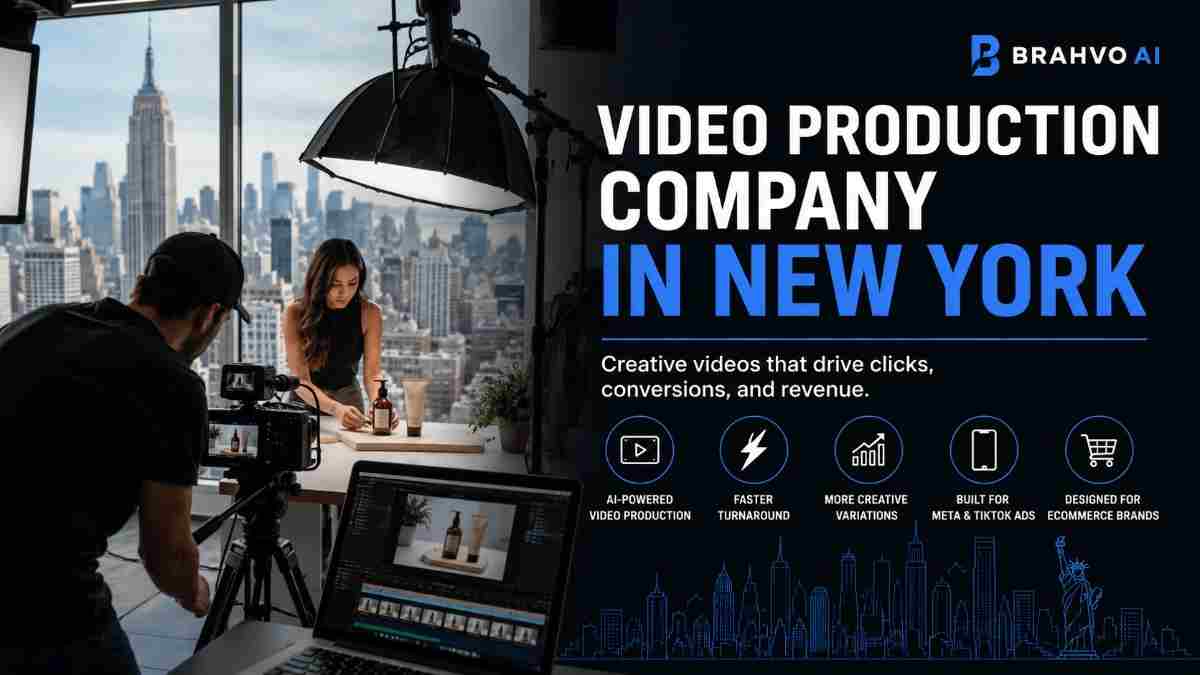
A New York ecommerce brand can have a strong product, a clear offer, and a healthy paid media budget, yet still run into the same frustrating problem: there simply are not enough usable video creatives ready when the media team needs them.
That is where choosing the right video production company in New York becomes more complicated than looking at a portfolio.
A polished brand film might look impressive on a website. It does not necessarily mean the production team understands what makes a 15 second Meta ad work. A beautifully shot product video may not give a media buyer enough variations to test different hooks, offers, audiences, and messages.
For ecommerce teams, video production is increasingly tied to advertising performance. The creative has to communicate quickly, show the product clearly, fit different placements, and give the paid media team enough material to test.
New York makes this even more interesting. The city has a huge creative ecosystem, but that does not automatically make every video production company in New York a good fit for a DTC advertising operation.
A founder launching a skincare brand, for example, may need 20 or 30 creative variations over a few months. The requirement is not necessarily 30 completely different productions. It could be several concepts built around the same footage, different opening hooks, product demonstrations, customer objections, testimonials, text treatments, and calls to action.
That requires a different production mindset.
The question is not simply, "Can this company make a good video?"
It is, "Can this company consistently create video that gives our advertising team something useful to test?"
That distinction matters once spending increases.
A media buyer can only work with the creative available to them. If the same three videos have been running across Meta Ads for weeks, performance can start becoming harder to maintain. The team may know they need fresh creative, but production can take too long.
Then the campaign starts waiting on the production calendar.
That is usually when the relationship between video production and paid media becomes a real business issue.
The basic expectation is obvious. A video production company in New York should produce high quality video.
For ecommerce advertising, though, quality has several meanings.
The footage needs to look professional, but it also needs to be usable. A 30 second product demonstration can be more valuable than an expensive cinematic sequence if the demonstration gives the viewer a clear reason to care.
The production process also needs to account for where the video will be used.
A video for a YouTube campaign may need a different pacing and storytelling approach than a TikTok creative. A Meta ad may need the product or problem shown almost immediately. A landing page video can take more time to explain the product because the viewer has already shown some interest.
A capable video production company in New York should understand these differences before production starts.
It should also understand that ecommerce creative is rarely a one video project.
Consider a DTC apparel brand preparing for a new product launch. The team may need:
Product demonstrations
Founder or expert messaging
UGC style concepts
Lifestyle footage
Short paid social variations
Different opening hooks
Multiple calls to action
Vertical versions for social placements
The smart production decision may be to capture footage that can support all of those needs instead of producing one finished video and starting again from zero a few weeks later.
This is where production planning becomes important.
The creative team needs to think about how footage will be reused, edited, shortened, rearranged, and adapted. A single shoot can create a much larger creative library when the production is planned around future advertising needs.
That does not mean every brand should produce dozens of variations just for the sake of having more assets.
Quantity without a reason can create another problem. Marketing teams end up with a folder full of videos but no clear understanding of what each asset is supposed to test.
The better approach is to connect production with the questions the media team is trying to answer.
Is the offer strong enough?
Does the product demonstration work?
Does a problem focused opening outperform a product focused opening?
Does a customer story work better than a polished brand presentation?
Does a short video hold attention better than a longer explanation?
Those are useful production questions because they connect creative work with actual advertising decisions.
Traditional video production is not inherently a problem.
For certain projects, it is exactly what a brand needs. A major product launch, corporate story, premium commercial, or high profile campaign may require professional crews, locations, lighting, actors, directors, and detailed post production.
The problem starts when that same process is used for every piece of ecommerce advertising.
A paid social team may need new creative every week. Traditional production workflows often move at a completely different pace.
First there is the concept.
Then approvals.
Then scheduling.
Then casting or creator coordination.
Then production.
Then editing.
Then revisions.
Then final exports.
By the time the creative reaches the advertising account, the campaign may have already moved in another direction.
This creates a frustrating situation for media buyers. They can see that creative fatigue is becoming a problem, but they cannot simply create new assets themselves. They have to wait for the production pipeline.
A New York DTC brand spending heavily on Meta Ads might have a media team that identifies a winning product angle on Monday. If the creative team needs three weeks to produce new variations around that idea, the opportunity can lose momentum.
The issue is not necessarily that the production team is inefficient.
The production model itself may be too heavy for the frequency of modern paid social testing.
AI video production changes part of this equation because certain creative assets can be produced, edited, and adapted without treating every variation as an entirely new production.
That can be particularly useful when the goal is testing rather than producing a flagship brand film.
I might be wrong here, but I do not think every ecommerce brand needs to replace traditional production with AI video. That would oversimplify the problem. Premium brand storytelling still has a place, and some products genuinely benefit from real production environments and human performance.
The more practical question is where AI can remove unnecessary production friction.
If a brand already has strong product footage, UGC, photography, scripts, or existing campaign assets, there may be opportunities to turn that material into more advertising variations without scheduling another full shoot every time.
And that matters because paid social is not a one time creative exercise.
A winning concept eventually needs new versions.
A new product needs fresh angles.
A different audience may respond to a different message.
A seasonal promotion may require different creative.
The production system has to keep up with those changes.
Take a hypothetical New York supplement brand that has found one Meta ad performing well around convenience. The original video shows the product, explains how it fits into a busy routine, and finishes with the offer.
The media buyer does not necessarily need another completely different commercial.
They might need five variations of the winning idea.
One could open with the customer's daily problem. Another could lead with the product demonstration. A third could use a stronger offer focused opening. Another could be built around a customer objection. The final version could use a faster UGC style presentation.
The underlying idea stays similar while the creative execution changes.
That is a much more practical use of production resources.
It also changes how brands should evaluate a video production company in New York. The right partner should not only ask about the final video. They should understand what the marketing team needs to test next, how quickly those assets need to be produced, and how much creative variation the existing budget can realistically support.
Because once paid media spending reaches a meaningful level, creative production is no longer just a content task.
It becomes part of the campaign's operating system.
And if every new ad requires another long production cycle, the media team may find itself making decisions based on yesterday's creative simply because today's version is still waiting in post production.
Paid social testing used to be heavily constrained by how quickly a brand could produce new creative. That constraint is still there for many ecommerce teams, but AI video production is changing what is practical.
The important part is not simply making videos faster. It is being able to test more creative ideas without treating every test like a major production project.
For a media buyer running Meta Ads, creative testing usually involves more than changing the headline. The opening few seconds can change. The product demonstration can change. The offer can change. The emotional angle can change. Even the way the same customer problem is presented can produce a different response.
AI video production can make these variations easier to create.
Suppose a DTC brand has one strong product video. Instead of using that same asset across every campaign, the team can develop multiple versions around different creative hypotheses. One version might focus on the problem. Another could explain the product. A third could address a common objection. A fourth could use a more direct sales message.
This gives the paid media team more useful material to work with.
There is an important distinction here. More creative does not automatically mean better advertising. If a team creates 50 variations without knowing what each one is testing, the extra volume can become noise.
The useful approach is to connect production with the testing plan.
If the media team believes a product is being misunderstood, produce creatives that explain it differently. If the team thinks the offer is not clear, test stronger offer focused openings. If customer comments reveal a recurring objection, create videos that address that objection directly.
That is where AI video production becomes more interesting for ecommerce brands.
It can shorten the distance between a media buying insight and a new creative asset.
For a video production company in New York working with performance focused brands, that shift matters. The production process needs to support ongoing experimentation rather than only delivering finished brand assets.
Meta Ads and TikTok Ads have different creative environments, but both reward brands that can keep testing fresh ways to communicate the same underlying value.
That does not mean a brand needs a completely new concept every day.
Sometimes the best creative testing comes from taking one proven idea and changing one meaningful element.
A skincare brand might have a winning video based on a common skin concern. The next round could keep the product demonstration but test different openings.
"Why does your skin still feel dry after moisturizing?"
"This is what I changed in my routine."
"If your moisturizer disappears in an hour, try this."
The rest of the video can remain relatively similar.
That is a much more controlled test than changing everything at once.
TikTok Ads can create another challenge. The creative often needs to feel native to the platform rather than like a traditional commercial. Fast pacing, direct language, creator style presentation, demonstrations, reactions, and strong opening moments can all matter.
A video production company in New York serving ecommerce brands needs to understand that platform context.
A polished production is not automatically better for TikTok.
Sometimes a simple product demonstration recorded in a natural setting can communicate more effectively than an expensive commercial. The same brand may still need premium video for its website or YouTube campaign. Creative requirements depend on the job.
AI video production can help fill the gaps between those different needs.
A brand can create variations from existing product footage, images, scripts, creator content, and other source material. The objective is not to make every video look artificial or identical. The objective is to create enough usable creative to support testing across campaigns.
There is also a practical budgeting issue.
If a brand spends $100,000 a month on paid social but has only a handful of new creatives entering the account each month, the production budget may not be aligned with the media operation.
That does not necessarily mean the brand should spend more.
It may mean the production process needs to produce more usable outputs from the assets already available.
Creative production becomes much harder when a company has more than one product.
A brand with one hero SKU can build a fairly focused creative library. A brand selling 20 products has a different problem.
Every product can need its own demonstrations, customer objections, benefits, offers, hooks, and seasonal messages. Then there are bundles, promotions, new product launches, and different audiences.
Without a production system, the creative workload grows quickly.
Imagine a DTC beauty company selling eight products. The paid media team wants three new concepts for each product this month. That is already 24 concepts before accounting for variations, resizing, edits, creator content, or promotional changes.
Traditional production can become expensive and slow at that scale.
This is where a video production company in New York needs to think beyond individual projects.
The production team should understand the brand's entire creative library and identify where footage can be reused intelligently.
One product demonstration might support several ads. A customer testimonial could become multiple short clips. Product photography can be incorporated into motion based creative. A long form explanation could produce several shorter paid social assets.
The goal is not to make every asset look recycled.
The goal is to avoid unnecessarily recreating material that already exists.
AI video production can be useful here because it can support the adaptation of existing creative into new formats and variations. That can be particularly valuable when the media team needs assets for several products at the same time.
There is also a coordination benefit.
When product launches, promotional calendars, creator partnerships, and paid campaigns all operate independently, video production becomes reactive. Someone always needs something urgently.
That is usually a sign that production and media planning are not connected closely enough.
The better question is not just, "What videos do we need this week?"
It is, "Which products and campaigns will need creative support over the next several weeks, and which assets can be built from what we already have?"
That small change in thinking can make the workload much easier to manage.
This is probably one of the hardest decisions for an ecommerce marketing team.
You want good production quality.
You also want creative quickly.
And you do not want every new variation to become expensive.
Those three priorities can conflict.
A high production commercial may take significant time and budget. A simple social creative can be produced much faster. Neither is automatically the right choice.
The decision should depend on what the video is supposed to accomplish.
If the asset is a major brand film that will appear across the website, retail presentations, YouTube, and launch campaigns, investing in production quality may make sense.
If the goal is testing whether a specific hook can improve a Meta campaign, spending heavily on a single video may not be the best allocation.
This is where some ecommerce teams make a common mistake. They evaluate creative based on how impressive it looks before asking whether it gives the media team something useful to test.
A video can look expensive and still fail to communicate the product.
On the other hand, a relatively simple video can generate strong advertising results because the message is clear.
I might be wrong here, but I think the best production setup for many DTC brands is not choosing between premium production and fast AI production. It is using each where it makes sense.
Use high quality production when the asset deserves it.
Use faster production methods when the goal is iteration.
Use existing footage when it already communicates the message.
Use AI video production when it can help turn one creative idea into several useful executions.
The budget should follow the role of the asset.
For paid media teams, this distinction can have a direct effect on testing velocity. If a campaign needs fresh creative but production costs make every variation difficult to approve, the media team may end up testing fewer ideas than the budget allows.
That can become expensive in a different way.
The opportunity cost of not testing a strong creative angle can be difficult to see on a production invoice, but it still exists.
Choosing a video production company in New York should start with the type of video your business actually needs.
Do not begin with the portfolio alone.
Ask how the company approaches ecommerce creative. Ask how it handles revisions. Ask how quickly new variations can be produced. Ask whether the production process can support multiple products and campaigns.
Most importantly, ask what happens after the first video is delivered.
For a performance marketing team, that question is critical.
A strong production partner should understand that the first creative may not be the final answer. It may simply reveal which message deserves more testing.
You should also look at how the company handles source material.
Can existing footage be reused?
Can one concept produce several formats?
Can videos be adapted for Meta Ads and TikTok Ads?
Can creative be refreshed without rebuilding everything?
Can the team work around changing offers and product launches?
These questions reveal more about operational fit than a collection of polished portfolio pieces.
For a New York ecommerce brand, communication is another practical consideration. Paid media teams often work quickly. Creative priorities can change after campaign data comes in. A production partner that requires long approval cycles for every minor adjustment can become difficult to work with.
Cost matters, but the lowest production quote is not necessarily the cheapest option.
If a $2,000 production gives you one final asset while another workflow gives you several usable variations from the same underlying concept, the comparison should not stop at the invoice.
Look at what the media team actually receives.
There is also a question of creative judgment.
A good video production company in New York should be willing to challenge a brief when something does not make sense. If every request is accepted without questioning the purpose of the asset, the brand can end up producing content simply because someone asked for another video.
That is not always productive.
The right partner should understand the relationship between production, creative testing, paid media, customer acquisition costs, and the broader economics of the campaign.
For brands considering Brahvo AI, this is where the conversation around AI video production becomes practical. The value is not simply producing video through AI. It is creating a production workflow that can support the pace at which ecommerce advertising actually operates.
Because when a media buyer says, "We found a new angle that is working," the next question is usually not whether the team can celebrate the result.
It is how quickly they can create enough good creative around that idea before the audience gets tired of seeing it.
For ecommerce teams, the biggest production problem is often not coming up with ideas. It is turning those ideas into usable advertising creative quickly enough.
A media buyer might notice that a certain customer objection is getting strong engagement. A founder might want to test a new product angle. A campaign manager may need fresh variations because an audience has seen the same creative too many times.
That creates pressure on the video team.
Brahvo AI approaches this problem around the needs of performance focused ecommerce advertising. Instead of treating every video as an isolated production project, the focus is on creating useful video assets that can support ongoing testing across paid social campaigns.
That can include different hooks, product presentations, messaging angles, formats, and variations built around a common creative concept.
For a brand working with Meta Ads or TikTok Ads, this matters because creative requirements can change quickly. A video that made sense at the beginning of a campaign may need to be adapted once the team sees how customers are responding.
The production workflow has to leave room for that.
AI video production can also make existing brand assets more useful. Product photography, existing video footage, scripts, customer messaging, and other approved creative materials can potentially become inputs for additional advertising content.
That gives ecommerce teams more options without assuming every new asset requires a completely new shoot.
The distinction is important.
Brahvo AI is not simply about producing more videos for the sake of having a larger content library. The goal is to support the creative testing process behind paid advertising.
A product may need several different ways of being explained. A winning hook may need new executions. A new SKU may need creative that fits an existing campaign style. A seasonal offer may require quick changes to otherwise successful assets.
Those are production problems tied directly to advertising.
For a video production company in New York serving ecommerce brands, being able to work within those realities can be more valuable than producing one exceptionally polished video and waiting weeks for the next one.
Speed also has to be balanced with quality.
Paid social creative still needs to represent the brand properly. Product details need to be accurate. Messaging needs to match the offer. The final asset needs to feel intentional rather than like something produced simply because AI made it possible.
That balance is where an AI focused production workflow can make sense.
The best use case is not replacing every traditional production process. It is reducing the amount of production friction that prevents marketing teams from testing and refreshing creative at a reasonable pace.
For an ecommerce brand spending consistently on paid acquisition, that can become an important part of how the creative operation is managed.
What should I look for in a video production company in New York?
Look beyond the portfolio. For an ecommerce brand, ask how the company handles creative variations, revisions, paid social formats, production timelines, multiple SKUs, and ongoing campaign requirements.
A strong portfolio shows production ability. It does not necessarily show whether the company can support a performance marketing workflow.
How much does a video production company in New York cost?
There is no useful single price because production requirements vary considerably.
A simple paid social creative, a UGC style video, a product demonstration, and a large commercial production can have very different costs.
The better question is what you receive for the production budget. If one project creates several usable advertising assets, the economics may look very different from paying for one finished video.
Can a video production company help with Meta Ads and TikTok Ads?
Yes, if the production team understands the creative requirements of those platforms.
The important part is not simply exporting a video in the correct dimensions. The creative itself may need different pacing, hooks, messaging, and presentation depending on where it will run.
A production company working with ecommerce brands should understand those practical differences.
Is AI video production good enough for paid advertising?
It can be, depending on the creative and how it is produced.
AI video production is particularly useful for certain types of creative variation, adaptation, concept testing, and production workflows. It does not mean every campaign should use AI generated video.
Some products still benefit from real footage, real creators, professional shoots, or highly controlled demonstrations.
The question is whether AI helps the brand create useful advertising creative more efficiently.
Does my ecommerce brand need a new video production company if creative is already performing?
Not necessarily.
If your existing production workflow is giving the media team enough strong creative at the right pace, there may be no reason to change it.
The issue usually becomes visible when creative demand starts exceeding production capacity. If winning concepts cannot be refreshed quickly, new products are waiting for assets, or media buyers repeatedly run out of usable creative, the production model may need to change.
How many video ads should an ecommerce brand produce?
There is no universal number.
It depends on ad spend, product range, audience size, campaign objectives, creative fatigue, and how aggressively the team tests.
A better approach is to determine how many creative hypotheses the media team needs to test and then build production around those priorities.
Producing 50 videos that test nothing meaningful is less useful than producing a smaller number of clearly differentiated concepts.
Can one video be turned into multiple ad variations?
Often, yes.
Existing footage can sometimes be edited into different openings, lengths, formats, demonstrations, or messaging angles. Product images and other approved assets can also become part of new creative executions.
This is one area where an AI supported production workflow can be useful.
The important limitation is that variations should still have a purpose. Changing a few words or moving a clip around does not automatically create a meaningful creative test.
Should I choose traditional production or AI video production?
It depends on the job.
For major brand campaigns, premium product films, complex shoots, and situations where real environments or performances are essential, traditional production can make sense.
For ongoing paid social testing, creative refreshes, multiple variations, and situations where speed matters, AI supported production may be more practical.
Many ecommerce teams can benefit from using both approaches rather than treating them as mutually exclusive.
What should I ask a video production company before hiring them?
Ask about turnaround times, revision processes, creative variations, paid social experience, existing asset reuse, production scalability, and how they handle changing campaign requirements.
Also ask what happens when your media team finds a winning creative angle.
That answer can tell you a lot about whether the production company is built for ongoing ecommerce advertising or mainly for one off video projects.
Is a New York based production company always better for a New York ecommerce brand?
Not necessarily.
Being in the same city can be useful for certain shoots, local production requirements, meetings, and access to creative resources. But location alone does not determine whether a production partner is a good fit.
For many ecommerce teams, workflow, creative understanding, turnaround time, communication, and the ability to support ongoing advertising needs may matter more.
A New York brand still needs to ask whether its production partner can keep pace when the media team says the next creative test needs to happen now, not three weeks from now.