Explainer animation production in New York can top $25K per video. See how DTC brands get testable ad cuts with Brahvo AI.
The quote usually shows up as a nicely designed PDF. Sixty seconds of custom 2D animation, a scriptwriting phase, two rounds of storyboard revisions, a professional voiceover, delivery in seven to nine weeks. The total lands somewhere north of what the founder spent on Meta ads last month. Then they look at their ad account, where the creative launched three weeks ago is already showing frequency above 3 and a click-through rate sliding every few days, and the math stops making sense.
That's the tension behind most searches for explainer animation production in New York. It isn't that brands don't value good animation. A lot of them do, especially if they sell something that needs explaining: a supplement that works through a specific mechanism, a sleep device with three different modes, a subscription box with a customization flow that confuses people at checkout. Animation can show that in ways a UGC creator holding the product up to a ring light can't. The problem is that the traditional production model was built for a world where a brand made one hero video, put it on the homepage and maybe ran it as a pre-roll ad for a quarter. Paid social doesn't work like that anymore. Your best ad has a shelf life measured in weeks, sometimes days if you're spending aggressively.
So the founder is stuck choosing between a beautiful asset that may be fatigued before the invoice clears and a pile of cheap, fast content that doesn't explain anything. Neither feels right.
Pricing is all over the place, and studios aren't always clear about why. Industry pricing guides published this year put most motion graphics and animation at $1,000 to $5,000 per finished minute from a freelancer and $5,000 to $25,000 per minute from a studio, with a median quote of $9,680 for a 60-second custom explainer. At the top end, a commissioned explainer video can cost $50,000 or more for premium custom animation. New York studios tend to sit in the upper half of those ranges. Some of that is talent, and some of it is plain rent. Several pricing guides make the same point: you could be overpaying simply because you're working with a top-tier agency, especially if they're located in high-cost cities like New York.
The number on the quote matters less than what it actually buys. Here's roughly how a traditional explainer animation production budget breaks down:
Production stage
What you're paying for
Why it matters for ad buyers
Discovery and script
Strategy calls, messaging, one approved script
Usually locks you into a single angle
Storyboard and style frames
Visual direction, scene-by-scene layout
Revisions here are cheap; later they're not
Illustration and asset design
Custom characters, product renders, backgrounds
The most reusable part, if you own the source files
Animation
Motion, transitions, timing
The most expensive stage and the hardest to change
Voiceover and sound design
Talent fees, licensing, mixing
Usage rights can limit where you run the ad
Revisions
Typically two or three rounds
Extra rounds are billed separately
The row most brands skip is asset design. If you're paying a New York studio to build custom illustrations of your product, characters and environments, make sure you get the layered source files and the rights to reuse them in paid media. I've watched more than one brand learn, six months in, that their contract covered "the video" and nothing else, so cutting a new 15-second version meant going back to the studio and paying again. Voiceover usage rights catch people out the same way. Some talent agreements cover web use but not paid broadcast-style placements, and nobody reads that clause until legal does.
For cold traffic on Meta or TikTok? No, not really.
People scroll through feeds fast and decide within the first couple of seconds whether to keep watching. A 90-second explainer that opens with a logo animation and a gentle "Meet the new way to..." is built for a viewer who already chose to press play. That's a homepage viewer, or someone who clicked through from an email. It isn't someone half-watching Reels on the subway at 8:40 a.m. The structure that makes a long explainer good, with its setup, problem, solution, features and call to action, is the same thing that makes it a bad cold-prospecting ad. The payoff comes too late.
I'd say that confidently for most DTC categories. There are exceptions, though, and they're worth knowing. Higher-priced products with longer consideration windows can support longer cuts, especially in retargeting: a $300 skincare device, a mattress, a piece of home fitness equipment. Someone who has already visited your product page twice is in a different mindset than a cold viewer, and sometimes the 60- or 90-second version is exactly what gets them over the line. YouTube in-stream is also a different environment from the Reels feed. So it's less "long explainers are dead" and more that the long explainer should be one deliverable in the package rather than the entire package. That's a different brief from the one most studios are set up to quote.
This is where most of the money gets lost, and it rarely shows up in the conversation with the studio.
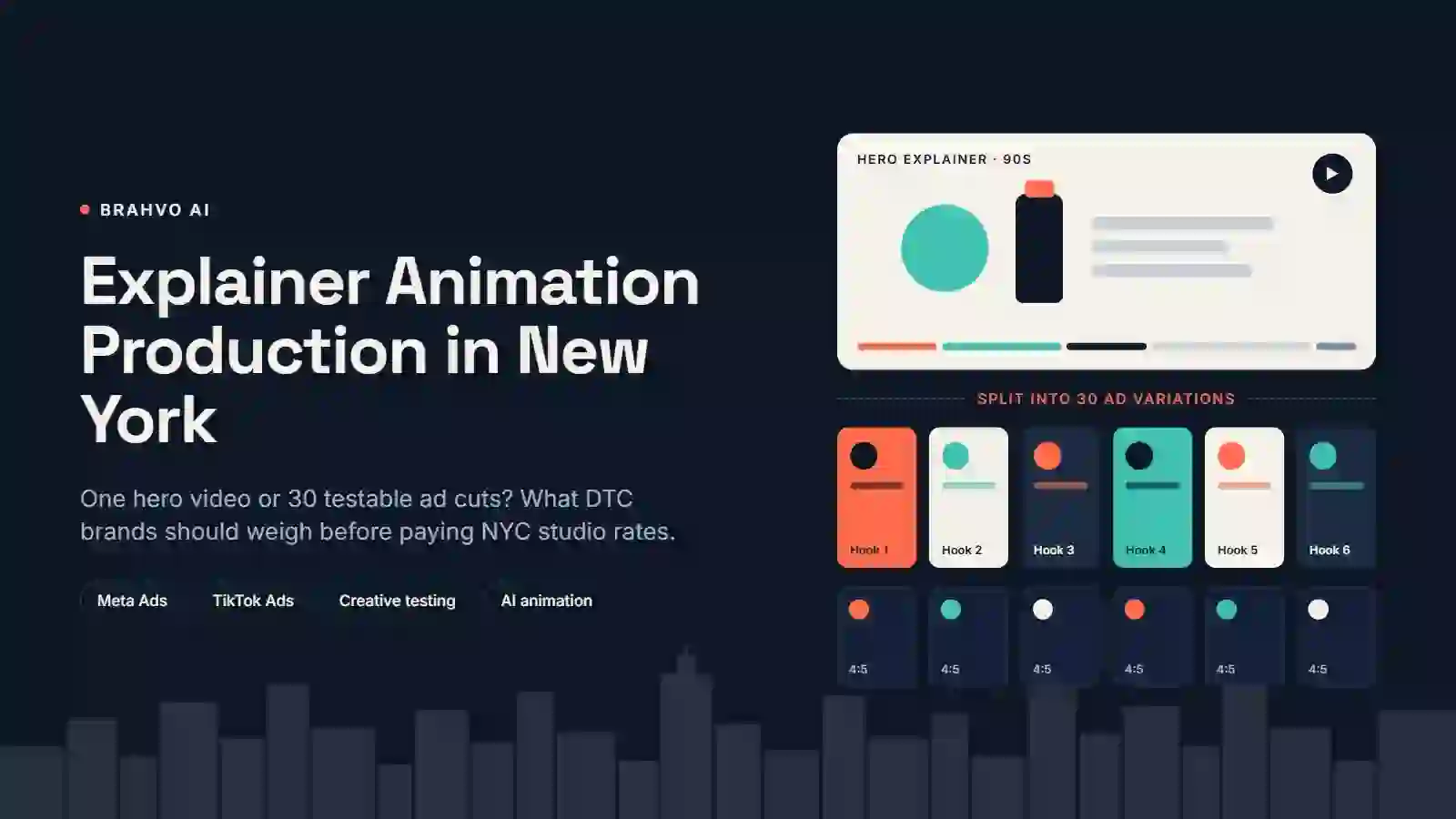
A media buyer running a serious account doesn't think in "videos." They think in hooks, angles and formats. Maybe five different opening hooks: a problem statement, a surprising stat, a before-and-after, a "you're doing this wrong" callout, a product-in-hand shot. Then three angles on the core message, such as convenience, price compared with the alternative, and an ingredient or mechanism story. Then at least two aspect ratios, because a 9:16 cut for Reels and TikTok and a 4:5 cut for feed placements perform differently and you want both. Five times three times two is 30 variations, and that's a modest testing matrix before you've even gotten to seasonal versions or offer-specific cuts for Black Friday.
Now try to get those 30 variations out of a traditional explainer animation production process. Each new hook means reanimating the opening. Each new angle means new script sections, new scenes and probably new voiceover. Most studios will do it, but they price it as new work, and the timeline stretches from weeks into months. So brands do the rational thing and don't test. They run the one explainer with maybe two edits, watch it fatigue and go back to UGC.
Picture a home goods brand with 14 SKUs heading into Q4. It's not unusual. Their best-selling skillet has a clear story, but the other 13 products each need at least a few variations to find out whether there's anything to scale. Under the old model, that's either 14 separate explainer projects, which nobody can afford, or one brand explainer that tries to cover everything and ends up selling nothing in particular. Most teams pick the second option, then wonder why the ad drives brand-search lift but not much purchase volume. (I've also noticed that the brand explainer almost always ends up autoplaying on the About page, where roughly nobody watches it.)
The real cost of this bottleneck isn't the production invoice. It's the creative testing you never run. Every week your account runs on fatigued creative, your CPMs hold steady while your CTR falls, your CPA creeps up, and the algorithm has less fresh signal to optimize on. A brand spending $80,000 a month on Meta that lets CPA drift 20% higher because it couldn't refresh creative fast enough loses more than most explainer budgets cost. That loss just never appears on a single invoice, so nobody blames the production model for it.
The useful shift isn't "AI makes videos cheaper." That's true, but it's the less interesting part. The bigger change is that it moves the unit of cost from the finished minute to the testable concept.
When the core assets exist in an AI-assisted pipeline, including product renders, character styles, scene templates and brand motion rules, a new hook stops being a new production. It's a new arrangement of things you already own. Swapping a problem-statement opening for a before-and-after opening becomes a same-day change instead of a change order. You can generate the 9:16 and 4:5 cuts together. And when the performance data comes back and says the ingredient angle is beating the convenience angle by a wide margin, you can push more variations of the winner into the account while it's still winning, instead of waiting six weeks for a studio slot.
That's how we approach explainer animation production at Brahvo AI. We start from the ad account and the testing plan, not from a single storyboard, and treat the explainer as a system of reusable parts rather than one locked file. The long-form explainer still gets made, for the homepage and for retargeting, but it's built from the same asset library that produces the short testable cuts. One investment covers several jobs.
I might be wrong here, but I think a lot of New York brands still undervalue the speed part compared with the cost part. The cost savings are easy to put in a budget meeting. The speed is harder to quantify, but it's probably where most of the upside is, because creative velocity compounds. Brands that can launch, read, kill and iterate weekly build an understanding of their customer that slower brands simply don't have, and that knowledge carries over into email, landing pages and product launches. Whether that advantage holds once everyone has access to the same tools is a fair question and
Then again, the tools are only as good as the creative thinking behind them. A fast pipeline producing 30 variations of a weak idea gets you 30 weak ads, faster.
The setup was familiar. A mid-sized skincare brand selling a three-step retinol system had paid for a polished 75-second explainer, with animated skin layers, a calm voiceover and a nice molecular sequence showing how encapsulated retinol releases over time. It looked great on the homepage. As a cold ad on Meta it fatigued within about two weeks, and the team went back to running UGC testimonials, which converted fine but couldn't explain why the product was different from the $12 drugstore option.
Instead of commissioning a new explainer, they broke the existing one into parts. The molecular sequence became a standalone 6-second hook. The "why your retinol burns" problem section was cut down and paired with three new openings. The skin-layer animation was reused under a UGC voiceover, which no one had planned for, and it ended up being one of the stronger performers. Within the first month they had more than 20 live variations in the account, built mostly from assets they already owned.
The surprise wasn't that the modular cuts beat the original. It was which ones won. The mechanism hook, the piece the founder assumed was "too technical for TikTok," outperformed the testimonial-style openings on new-customer purchases. Nobody would have tested that under the old model, because building it as its own ad would have meant a new production.
I said earlier that speed is where the real upside is. I still mostly believe that, but not for every brand.
If you're launching a brand-defining campaign, such as a TV-adjacent spot, a big investor-facing piece or a launch film where the craft itself is the message, a top New York explainer animation studio with a senior illustrator and an art director who has been arguing about kerning for fifteen years will often produce something AI-assisted workflows don't match yet. Highly specific character animation, complex 3D product work with accurate physics, and anything that needs a very distinctive hand-drawn style still benefit from people doing it frame by frame. Regulated categories are another case. If every claim in a supplement or medical device ad needs legal review, generating 30 variations means 30 reviews, and the speed advantage shrinks fast.
So the honest answer is that a lot of brands need both: a studio-grade anchor piece every year or so, and a fast, modular system for everything that runs in the ad account.
The usual explainer brief assumes one product and one story. Catalog brands don't have that luxury, and briefing them like they do produces an expensive video that represents nobody.
What works better is briefing at the category level. Group 40 SKUs into maybe four or five families that share a problem and a mechanism. A cookware brand might split nonstick, cast iron, storage and utensils. Build one shared visual system per family, then let SKU-specific details such as size, colorway and price sit on top as swappable layers. Your top two or three sellers get dedicated hooks. The long tail gets templated variations, enough to see whether any of them can scale on paid social at all. Most won't, which is useful information too.
Before you approve any quote for explainer animation production in New York, ask a few things a pricing page won't tell you:
The last question tells you the most. A partner who has never looked at a Meta Ads breakdown will brief, cut and revise differently from one who has.
How much does explainer animation production in New York cost?
For a custom 60-second piece from an established studio, expect anywhere from high four figures to well over $25,000, depending on style, complexity and revisions. Premium 3D or character-heavy work can go much higher.
How long does a traditional explainer take?
Usually six to ten weeks from kickoff to final delivery. Rush timelines exist, but they generally cost more.
Is AI-generated explainer animation good enough for paid ads?
For most DTC paid social, yes, as long as the creative strategy is solid. The bigger risk is a weak hook, not visual quality.
Should my explainer be 60 or 90 seconds?
Probably neither for cold traffic. Build the long version for your homepage and retargeting, and cut 6- to 20-second versions for prospecting.
Can I reuse my existing explainer for TikTok Ads?
Often, yes. Breaking an existing explainer into hooks and short segments is one of the cheapest ways to get new testable creative, if you own the source files.
Does it matter if my animation partner is based in New York?
Less than it used to. Being close is useful for in-person shoots and workshops, but most animation work is remote now. What matters more is whether they understand how your ads are bought and measured.
How many ad variations should I test per month?
It depends on spend. A brand spending $20,000 a month needs far fewer than one spending $200,000. Fresh creative every one to two weeks is a reasonable starting point for most growth-stage accounts.
Is animation better than UGC for DTC brands?
That's the wrong comparison. UGC builds trust, and animation explains things a creator can't show. The strongest accounts usually run both, and sometimes combine them in the same ad.