Brahvo AI helps ecommerce brands create AI driven video content and multimedia assets for paid ads, product launches, and social campaigns.
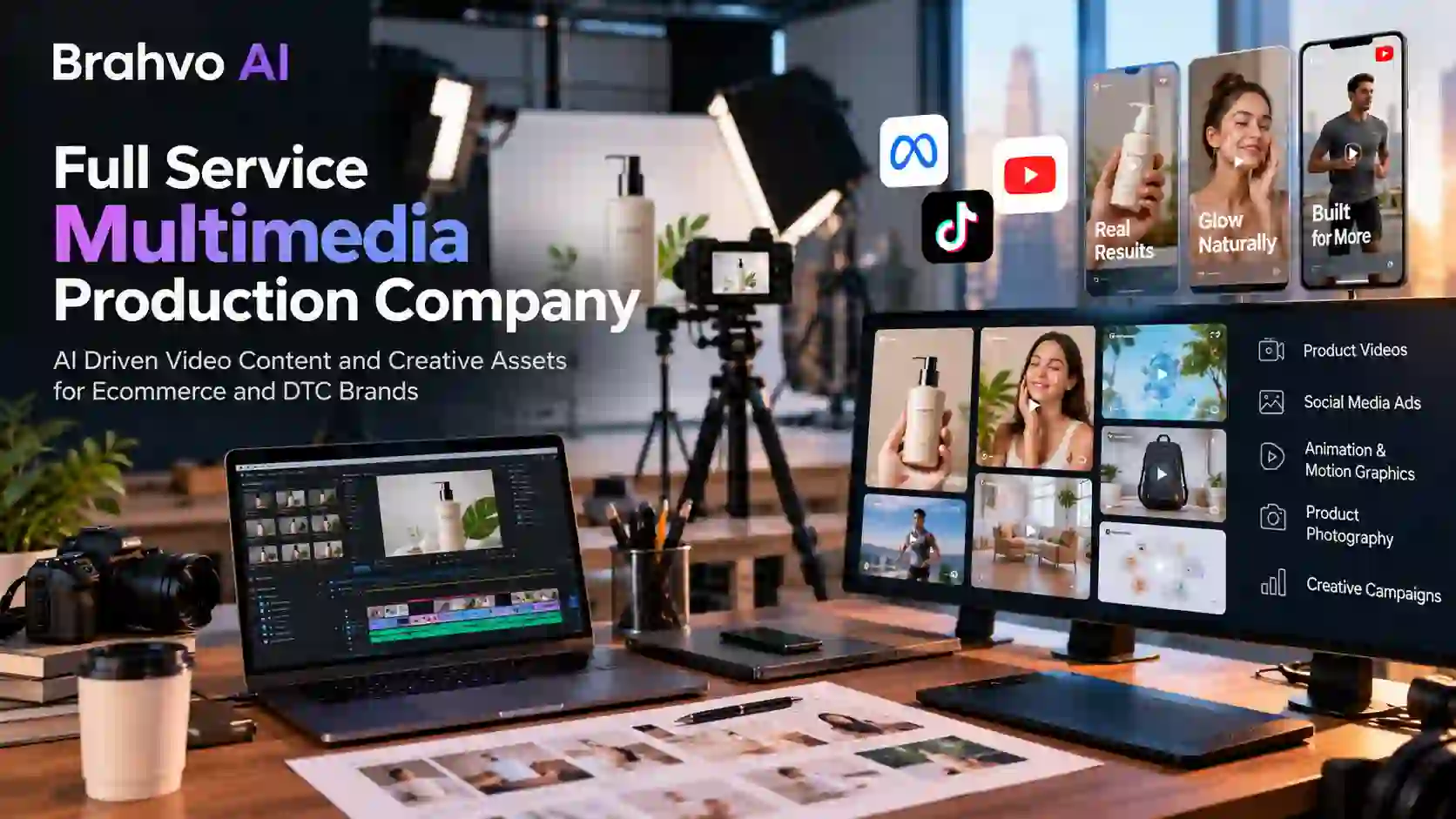
A full service multimedia production company manages different forms of visual content under a connected production workflow. Depending on the brand's requirements, this may include video production, product photography, animation, motion graphics, promotional content, social media assets, and advertising creatives.
The value comes from coordinating these formats rather than producing each one in isolation.
Consider an American skincare company preparing to launch a new serum. The marketing team might need a product demonstration for its website, short videos for paid social, ingredient animations, lifestyle images for email campaigns, and a series of educational clips explaining how the product fits into a daily routine.
Producing each asset independently can create inconsistencies. The product may appear differently across shoots, the messaging may change between channels, and the launch date may depend on several separate production schedules.
A coordinated multimedia production process starts with the campaign's objective and identifies the assets needed to support it.
For example, the production requirements might include:
Not every brand needs every format. A business selling a simple household product may benefit more from demonstration videos and product photography than from elaborate animation.
This distinction is important when selecting a full service multimedia production company. The goal should be to match production resources to the campaign, not to create the largest possible collection of assets.
For modern brands, the production partner also needs to understand how content will be used after delivery. A video intended for a product page has different requirements from a six second paid social ad. The first may need to answer detailed questions, while the second must communicate its central idea quickly.
Brahvo AI focuses on AI driven video creation and related creative production needs, making the connection between production and marketing use an important part of its approach.
Traditional video production can be valuable when a campaign requires original footage, controlled lighting, physical demonstrations, or a particular visual style. The challenge appears when an ecommerce brand needs a steady stream of different creatives rather than one polished video.
A direct-to-consumer company may launch several products in a quarter. Each launch can require product introductions, feature demonstrations, social ads, retargeting creatives, and updates to existing campaigns. Seasonal promotions create another layer of work.
The pressure is particularly noticeable when paid advertising teams need new creative concepts while existing campaigns are still running.
Imagine a US home organization brand selling storage bins, kitchen organizers, and closet accessories. Its media buyer identifies an opportunity to advertise the same product around three customer needs: saving space in small apartments, organizing children's rooms, and making moving easier.
One general product video might not communicate all three benefits effectively. The team needs different openings, scenarios, product demonstrations, and calls to action.
A full service multimedia production company can help coordinate these requirements, but the production model must support the actual pace of the marketing team.
AI assisted video production can be useful here. It may help with selected tasks such as creating product focused scenes, developing visual variations, producing certain presenter led videos, or adapting approved concepts for different placements. The exact possibilities depend on the footage, product, creative brief, and production method.
It is not a universal replacement for physical filming. A product with a distinctive texture, moving parts, or a complicated assembly process may still require real footage to demonstrate its features accurately.
I might be wrong here, but many brands do not necessarily have a content shortage. They have a shortage of usable creative concepts. Producing another ten versions of an ad will not solve the problem if all ten communicate the same message.
The better approach is to decide what each asset needs to test before production begins.
For example, one creative might demonstrate the product's convenience, another might address a common objection, and a third might focus on the result customers want to achieve. This gives the paid media team meaningful differences to evaluate.
For ecommerce operators, the practical advantage of working with a full service multimedia production company is the ability to coordinate creative requirements without losing sight of the campaign's purpose.
A creative that performs well in one placement does not automatically work everywhere else. Meta Ads, TikTok Ads, and YouTube campaigns can involve different viewing behaviors, formats, audience expectations, and stages of purchase consideration.
A multimedia production plan should account for these differences before the editing process begins.
On Meta, ecommerce brands often test several creative approaches within the same campaign. A product demonstration may appeal to shoppers who already understand the category, while a problem focused video may introduce the product to people who have not considered buying it.
TikTok creative often benefits from a natural, platform appropriate presentation. A video that feels like a conventional television commercial may struggle to hold attention in a feed where viewers expect immediate context and a clear reason to keep watching.
YouTube supports a wider range of viewing situations. A brand might use a short advertisement to introduce a product or a longer demonstration to explain how a more complicated product works.
These differences affect production decisions, including pacing, opening scenes, captions, visual framing, and the amount of information presented.
Meta Ads
Creative variations and product focused messaging
Brands can test different hooks, benefits, demonstrations, and customer objections. The important part is to make the variations meaningfully different rather than changing only the headline.
TikTok Ads
Native feeling creative and fast communication
Product demonstrations, relatable situations, and creator style storytelling can help a brand explain its offer without making every advertisement feel like a conventional commercial.
YouTube Ads
Product education and clear storytelling
Brands can use shorter ads for initial awareness and longer demonstrations when customers need more information before purchasing.
The production workflow should also account for technical delivery requirements. Aspect ratios, safe text areas, caption readability, audio levels, and video length all affect whether an asset is ready for its intended placement.
A single master video can be a useful starting point, but it should not be treated as the final answer for every channel.
Consider a furniture brand advertising a compact standing desk. Its website video could show assembly, dimensions, and adjustments. A paid social version could focus on reclaiming space in a small home office. A YouTube advertisement might explain the product's practical features in more detail.
The underlying product remains the same, but the communication changes with the viewing context.
This is where a full service multimedia production company can support paid media teams. It connects creative planning, production, editing, and delivery so the marketing team has assets designed for their intended use.
Brahvo AI's AI driven production approach can support the creation of marketing videos and creative variations where the brief and source material allow. The media buying team still needs to decide which concepts to test and how to interpret the results.
Creative production becomes more complicated when several business priorities overlap.
An ecommerce team might be preparing a holiday promotion while launching a new product and refreshing ads for an existing bestseller. Each project has its own messaging, deadlines, approval requirements, and asset list.
Without a shared production plan, urgent requests tend to take priority over strategically important work. The newest product may receive all the attention, while the established products that generate most of the revenue continue running the same tired creatives.
A full service multimedia production company can help organize these competing requirements around a common calendar.
The first step is to separate production needs by business purpose. A launch campaign needs introductory content and product education. A seasonal campaign may require promotional messaging and deadline specific creative. An evergreen campaign needs a supply of useful concepts that can be tested and refreshed over time.
These needs should not automatically receive equal production budgets.
For instance, a brand generating most of its revenue from two established products may need more creative support for those products than for an experimental item that has not yet demonstrated demand. The right allocation depends on sales contribution, inventory, campaign performance, and launch priorities.
A practical workflow begins with a campaign brief that identifies the audience, core message, required formats, approval owner, and delivery date. The production team then maps the main concept to the assets required for each channel.
This helps reduce unnecessary revisions. If the product's primary benefit changes after several videos have been completed, the team may have to revisit scripts, visuals, captions, and calls to action. Resolving the message early can save substantial production time.
Consider a fictional US DTC brand preparing a Black Friday campaign for a kitchen appliance. The team needs a product demonstration, promotional ads, comparison visuals, and short videos showing the appliance in everyday use.
Instead of commissioning each asset as a separate project, the company could plan the campaign as one coordinated production effort. The core demonstration would establish the product's features, while separate creative concepts would address convenience, gifting, and the seasonal offer.
The result is not simply a larger asset library. It is a clearer relationship between the campaign objective and each deliverable.
There are limits, though. A central workflow will not eliminate delays if product information arrives late, stakeholders disagree about messaging, or legal approval is required for claims that have not been substantiated. Production planning can expose these problems earlier, but it cannot make them disappear.
For brands working with Brahvo AI, defining the intended use of each video before production is an important starting point. It helps determine which assets may benefit from AI assisted creation and which require more specific visual or production treatment.
AI is changing how certain multimedia assets can be developed, adapted, and produced. For ecommerce brands, its most useful role is often in selected parts of the creative workflow rather than replacing every production task.
AI driven video production can support suitable use cases such as presenter led product explainers, selected visual scenes, concept development, and creative adaptations. AI assisted animation and motion graphics may also help communicate product features or simplify explanations that would otherwise require more elaborate production.
The practical value depends on the job.
A company selling a subscription box might need a series of videos explaining how the service works, what customers receive, and how they can customize their orders. AI assisted production could help create certain presenter led explanations or produce variations of approved messaging.
A furniture manufacturer demonstrating the stability of a chair or the movement of a mechanical component faces a different challenge. Customers need to see how the actual product behaves. Generated visuals that misrepresent its construction or operation could create confusion and undermine trust.
This distinction matters because AI generated content can look convincing without necessarily being accurate.
A sensible production process starts with approved product information, existing brand assets, the campaign objective, and a clear understanding of what viewers need to see. The team then determines where AI can assist and where authentic footage, manual editing, or specialist animation is more appropriate.
Quality control remains essential. Product appearance, packaging, logos, on screen text, voice delivery, and factual claims should be checked before publication. Brands should also review the relevant usage rights and disclosure requirements for their content.
Another consideration is creative consistency. If a company produces dozens of AI assisted videos, small differences in product appearance, tone, or messaging can become noticeable across the campaign. More output does not necessarily mean better communication.
Brahvo AI focuses on AI driven video creation for marketing and commercial content needs. For ecommerce brands, the relevant question is how this production capability fits into their existing campaign process, including briefing, creative review, revisions, and final delivery.
The strongest use case is often a specific bottleneck. A team may need more product explainers, faster development of suitable creative variations, or additional video concepts for upcoming campaigns. Starting with that requirement makes it easier to assess whether AI assisted production is appropriate.
AI can reduce some production constraints, but it does not decide which customer problem deserves attention, which claim is credible, or which message is likely to persuade a shopper. Those decisions still require business context and informed creative judgment.
And when a brand is spending thousands of dollars testing ads, that distinction matters. A faster production process is useful only when the resulting assets give the team something meaningful to learn.
Producing more ad creatives sounds straightforward until the media buying team has to test them. A brand might have 20 new videos ready for Meta Ads, but if most use the same opening, product demonstration, and message, the team may learn very little from the exercise.
This is one of the most common problems with scaling creative production. The number of deliverables increases, but the number of genuinely different ideas does not.
For a full service multimedia production company, the challenge is to help brands produce creative assets that serve distinct testing objectives. That requires more thought than changing a few words on screen or shortening an existing video.
A useful starting point is to separate creative variables into a few practical categories.
These variables give the production team a reason for creating each asset.
Take a fictional US DTC brand selling premium travel organizers. Its current Meta Ads campaign has started losing efficiency, and the media buyer suspects creative fatigue. Rather than producing 15 nearly identical videos, the team develops three distinct concepts.
The first shows how the organizer fits into a crowded carry on bag. The second demonstrates how its compartments keep electronics and travel documents separate. The third addresses the frustration of unpacking and repacking during a multi stop trip.
Each concept communicates a different benefit. If one attracts more qualified traffic or generates stronger purchase results, the team has a clearer starting point for further testing.
These are illustrative scenarios, not reported campaign results. Actual performance would depend on the product, pricing, audience, offer, media spend, and execution.
There is another issue worth considering. A new creative can appear to be a winner simply because it received more favorable delivery conditions or was tested against a weaker comparison. Creative performance needs to be evaluated in the context of the campaign setup, spend, conversion volume, and measurement window.
That is why a full service multimedia production company should understand the purpose of a creative test without pretending to control the advertising results. The production team creates the assets. The media team determines how to test them and whether the results justify further investment.
AI assisted production can help develop variations when the underlying concept is sound. However, generating 30 versions of an unconvincing message will not make that message persuasive.
The better production question is simple. What does the team need to learn from the next batch of creative, and what is the most efficient way to produce assets that answer that question?
Ecommerce brands rarely need video content for its own sake. They need assets that explain products, communicate value, support campaign launches, and give marketing teams creative options to test.
Brahvo AI focuses on AI driven video production for commercial content needs. For ecommerce and direct to consumer brands, the production process should begin with the intended business use rather than a predetermined video format.
A product launch video, a paid social advertisement, and a short product explainer have different jobs. Identifying those jobs early helps determine the messaging, visual approach, length, and variations required.
Starting with the product and customer
The first consideration is what the product does and why someone would buy it. This includes the product's features, its practical use, the customer's likely objections, and the claims the brand can substantiate.
For example, a company selling ergonomic desk accessories may need to explain adjustability, workspace compatibility, and everyday convenience. Those details can inform the script and visual concept more effectively than a generic brief asking for an attractive promotional video.
Planning assets around campaign requirements
The next step is to identify where the content will appear. A product page may need a clear demonstration, while a paid social campaign may need several short concepts built around different customer motivations.
This is also where AI assisted video creation can be considered. Depending on the source materials and production requirements, selected assets may be developed or adapted using AI. Other requirements may call for original footage, manual editing, or additional visual work.
Keeping production and review connected
A production workflow needs clear approval points. Product details, scripts, brand elements, and final visuals should be reviewed before the content is published. This is particularly important for brands working across multiple product categories, where an incorrect feature or outdated offer can create costly confusion.
For a business with dozens of SKUs, the challenge is not merely producing an attractive video for each product. It is maintaining accurate product information while deciding which products deserve priority and which creative formats are appropriate.
Delivering content that has a defined use
Every final asset should have a clear purpose. The team should know whether it is intended for customer education, prospecting, retargeting, a product page, or a seasonal promotion.
Brahvo AI's role in this process is centered on AI driven video production and related creative requirements. Brands should establish the scope, deliverables, revision process, expected turnaround, and usage rights before work begins.
It is also worth being realistic about what AI production can achieve. It can help with selected production tasks, but it does not replace accurate product information, sound creative judgment, or a well managed approval process.
For a DTC team, the useful outcome is a production workflow that fits its actual marketing needs rather than a collection of videos that looks impressive but has no clear place in the campaign.
A production partner can be a good fit for one campaign and a poor fit for ongoing work. The difference often becomes apparent after the first delivery, when the brand needs revisions, new product assets, or additional creative concepts on a recurring schedule.
When evaluating a full service multimedia production company, start by examining how the provider handles the work before and after production.
Scope and deliverables need to be specific. Ask which formats are included, how many versions will be delivered, what counts as a revision, and whether resizing or adapting an asset is included in the agreed scope. Vague promises about producing multiple creatives can create disagreements later.
The creative process should be clear. Find out how briefs are developed, who approves scripts and visuals, how feedback is handled, and what happens when product information changes. A clear process is especially important when several people from ecommerce, brand marketing, and paid media are involved.
Production capacity should match demand. A brand running frequent promotions may need predictable delivery schedules and the ability to manage overlapping projects. A smaller company launching one major campaign every quarter may value a different arrangement.
AI use should be transparent. If AI assisted production is part of the service, understand which parts of the work use AI, how outputs are reviewed, and what limitations apply. Ask how product accuracy, brand consistency, voice usage, and content rights are handled.
Commercial terms should leave little room for confusion. Clarify ownership of final assets, licensing, permitted usage, source files, revision charges, and any restrictions that could affect future campaigns.
The pricing model deserves attention as well. A fixed project fee can work for a defined launch, while recurring production arrangements may suit brands with ongoing creative requirements. Neither model is automatically cheaper. The right comparison is the total cost of obtaining the deliverables the team actually uses.
Suppose a brand commissions 25 video assets in a month but only has enough budget to test five concepts properly. The remaining assets may create a production backlog without helping the business make better advertising decisions.
This is why the scope should reflect the media plan, not just the requested volume.
For companies considering Brahvo AI, it makes sense to begin discussions with a specific campaign or recurring production requirement. A clear brief makes it easier to assess the production approach, deliverables, and fit with the team's existing workflow.
Long term value depends on more than fast delivery. It depends on whether the content remains accurate, the process is manageable, and the production investment serves a genuine business purpose.
Views, watch time, and engagement can help explain how people interact with video content. However, they do not automatically tell an ecommerce brand whether the content is contributing to sales.
The right measurement depends on the asset's role in the customer journey.
A short product advertisement designed to attract new customers should not necessarily be evaluated in the same way as a detailed explainer intended to answer purchase questions. One is designed to generate initial interest. The other may help shoppers understand the product before they buy.
For paid advertising, useful measures can include click through rate, cost per click, landing page activity, conversion rate, customer acquisition cost, and return on ad spend. The specific metrics should reflect the campaign objective and the reliability of the available data.
Here is how a brand might interpret some common signals.
Metric
What it can help explain
What it cannot prove alone
Video watch time
Whether viewers continue watching
Whether viewers intend to buy
Click through rate
Whether the creative encourages clicks
Whether those clicks lead to profitable orders
Conversion rate
How often measured visits result in conversions
Whether the creative alone caused the result
Customer acquisition cost
How much acquisition costs under the chosen measurement method
Which creative variable caused the change
Return on ad spend
Revenue attributed to advertising relative to spend
True incremental profit or total business profitability
A high click through rate with a weak conversion rate deserves investigation. The creative may be attracting the wrong audience, the landing page may not deliver on the advertisement's promise, or the price and offer may not meet customer expectations.
Similarly, a video with modest engagement may still contribute to sales if it communicates a product benefit clearly to people who are ready to buy.
The brand should also distinguish between attributed results and incremental impact. Advertising platforms use their own attribution methods, and reported conversions do not necessarily mean every sale was caused by an ad. Comparing results across campaigns requires consistent measurement assumptions and enough data to support a reasonable judgment.
Creative testing should account for spending levels, audience overlap, campaign objectives, and the time needed for results to become meaningful. A small difference in performance from a handful of conversions is not necessarily a reliable signal.
For a full service multimedia production company, these measurements are useful feedback for future production. If product demonstrations consistently generate more qualified traffic than abstract lifestyle visuals, the brand may decide to invest in more demonstration concepts. If several creatives attract clicks but fail to convert, the next step might be to revisit the message or landing page rather than commission more videos.
Brahvo AI can support the production side of this process by creating marketing video assets for brands to use and evaluate. Performance interpretation still depends on the brand's campaign data and measurement practices.
The important commercial question is not how many videos were delivered or how many people watched them. It is whether the production work gave the marketing team useful creative options and helped it make better decisions about where to spend the next advertising dollar.
What is a full service multimedia production company?
A full service multimedia production company coordinates multiple forms of commercial content, such as video, photography, animation, motion graphics, and advertising creatives. The exact services vary by provider, so brands should confirm which formats and production tasks are included.
How is multimedia production different from video production?
Video production focuses on creating video content. Multimedia production can cover video alongside still images, animation, graphics, and other visual assets. A company may offer both, but the scope depends on its actual capabilities.
Why do ecommerce brands need multimedia production?
Ecommerce brands use visual content to demonstrate products, answer customer questions, promote offers, and support advertising campaigns. A coordinated production process can help teams manage these requirements across product pages, paid social, email, and other marketing channels.
Can AI replace traditional video production?
Not in every situation. AI can assist with selected creative and production tasks, but physical product demonstrations, complex interactions, specific visual requirements, and certain brand campaigns may still need original footage or specialist production work.
How does a full service multimedia production company support Meta Ads and TikTok Ads?
It can help create and adapt advertising assets for different placements and messaging objectives. The useful work includes developing distinct creative concepts, preparing suitable formats, and delivering approved assets that the media team can test.
Is AI video production suitable for small DTC brands?
It can be, particularly when a brand needs product explainers, promotional videos, or creative variations but has limited production resources. Suitability depends on the product, budget, required quality, and whether the intended visuals can be created accurately.
How much does a full service multimedia production company cost?
Pricing depends on the number and type of assets, production complexity, revision requirements, turnaround time, and licensing terms. AI assisted production may change the cost of certain tasks, but it does not make every project inexpensive.
How should brands evaluate a multimedia production company's results?
Start by checking delivery reliability, asset quality, brand accuracy, and whether the content meets the agreed brief. For advertising work, also review relevant campaign metrics, while recognizing that production is only one factor affecting performance.
What should a company prepare before starting a multimedia production project?
Prepare product information, brand assets, campaign objectives, target audience details, required formats, key messages, deadlines, and an approval process. Clear inputs reduce avoidable revisions and help the production team understand what each asset needs to accomplish.
Why consider Brahvo AI for multimedia production?
Brahvo AI focuses on AI driven video creation for commercial marketing needs. Brands evaluating its services should discuss their campaign requirements, the formats they need, production timelines, revision terms, and how the resulting assets will fit into their existing workflow.