Get video production services for brands in Southern California built for ecommerce, DTC, paid ads, social media, and creative testing.
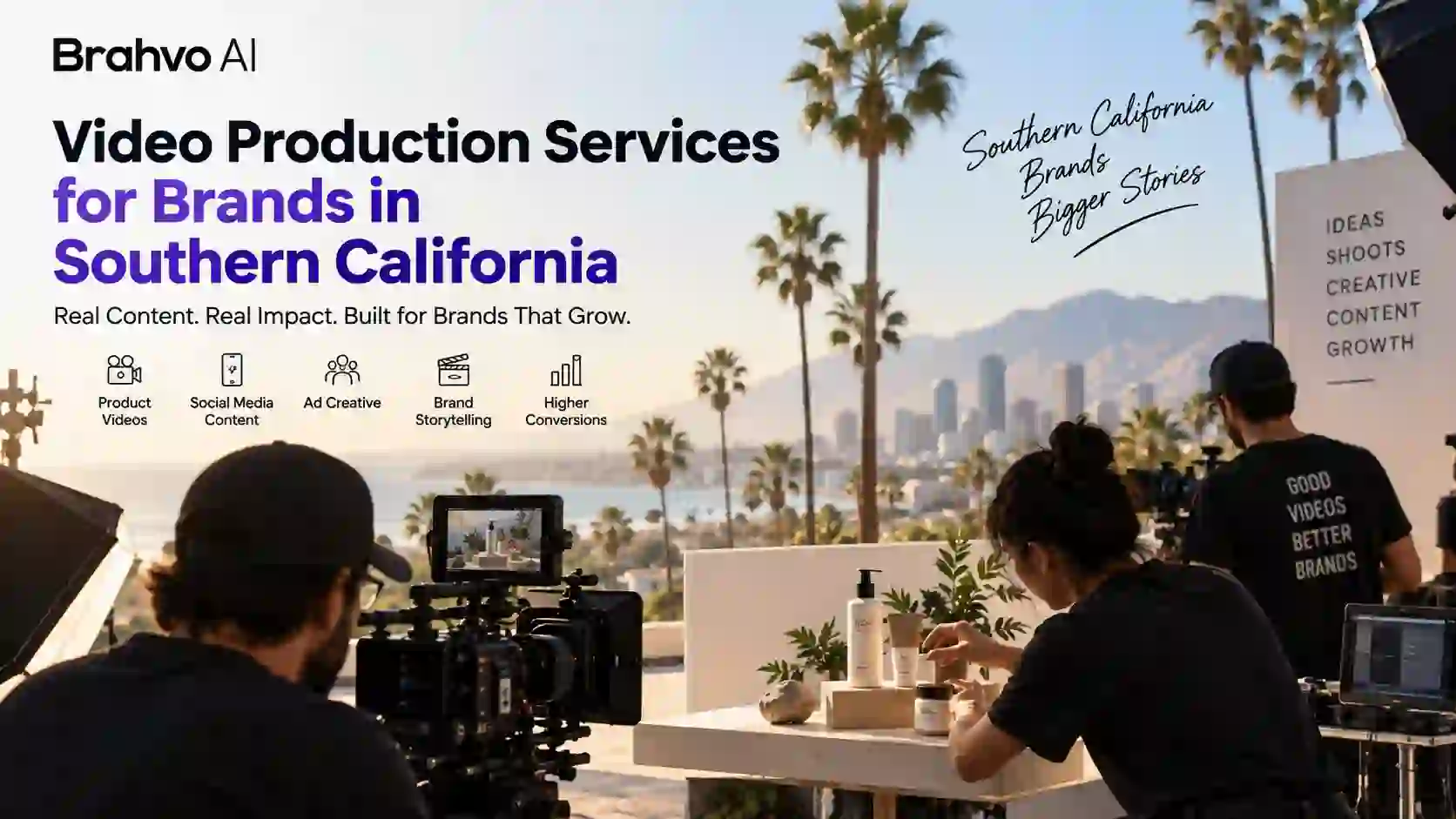
For many Southern California brands, the problem is not knowing that video works. The problem is keeping enough good video in rotation.
A DTC brand may have several products, multiple customer segments, seasonal promotions, and paid campaigns running at the same time. One creative might perform well for three weeks, then suddenly start producing weaker click through rates or higher acquisition costs. The media buyer asks for new variations. The creative team asks for more time. The founder asks why the same winning concept cannot simply be scaled.
That cycle is common.
Brands selling into competitive categories such as beauty, apparel, food and beverage, wellness, consumer electronics, home products, and lifestyle products need a steady flow of useful creative. This is where professional video production services for brands in Southern California become more important than simply producing an occasional polished brand film.
The role of video has also changed. A single product video is rarely expected to do everything anymore. A brand may need a short product demonstration for Meta Ads, vertical social content for TikTok, testimonial style footage, product detail shots, founder content, lifestyle scenes, and longer form material for YouTube.
The creative workload grows quickly.
Southern California also gives brands access to a wide range of visual environments, production talent, locations, and production styles. That creates opportunities, but it also means brands need to make practical decisions about what actually supports their marketing goals.
A beautiful video that cannot produce enough usable advertising variations may not be the best production investment.
Southern California has a distinctive visual culture. Brands can produce content that feels polished, lifestyle driven, cinematic, casual, or highly commercial without necessarily leaving the region.
But location alone does not make a video effective.
The bigger issue is how the production is planned around the brand's actual customer acquisition strategy.
Suppose an ecommerce company spends $15,000 producing one hero video. It looks excellent. The product is beautifully presented. The footage is professionally lit and edited.
Then the paid media team discovers that the first three seconds are not stopping the scroll.
That creates a frustrating situation. The production succeeded visually but failed as advertising creative.
Video production services for brands in Southern California need to account for this distinction. Brand content and performance creative can overlap, but they are not always the same thing.
For paid social, production teams may need to capture multiple hooks, opening shots, product demonstrations, customer problems, benefits, objections, testimonials, and calls to action during the same shoot.
That changes how the production should be approached from the beginning.
There is also the practical side. Southern California productions can involve studio work, controlled product shoots, outdoor locations, lifestyle environments, actors, UGC style creators, voiceovers, animation, and AI generated elements. Each option affects cost, scheduling, editing requirements, and how much content can ultimately be produced.
A strong production plan starts with what the brand needs after the shoot, not just what should happen during it.
Not every product needs a cinematic commercial.
Sometimes a straightforward demonstration performs better because customers want to see how the product works. A skincare brand might need close up application footage. A kitchen product may benefit from a before and after demonstration. An apparel company may need movement, fit, texture, and multiple styling combinations.
The right video style depends heavily on the buying decision.
For ecommerce brands, product clarity matters. Customers cannot physically touch the product before purchasing. Video can compensate for some of that missing experience by showing scale, texture, functionality, packaging, usage, and results.
DTC brands have another consideration. Their video often has to introduce the problem before introducing the product.
A paid social creative might open with a customer frustration, move into the product demonstration, address a common objection, and finish with a simple reason to purchase. Another creative for the same product might skip the problem entirely and lead with a strong visual demonstration.
Both can come from the same production session if the shoot is planned properly.
For Meta Ads, vertical video is often central to creative testing. TikTok Ads can require a more native, less traditionally commercial feeling. YouTube may allow more room for explanation and storytelling.
That does not mean brands should create completely separate production systems for every platform.
The smarter approach is often to capture footage that can be edited into different formats and creative concepts.
This is particularly useful for brands managing several SKUs. A single shoot can potentially produce product focused videos, lifestyle clips, short demonstrations, paid social variations, and supporting footage for future campaigns.
The production becomes an asset library rather than one finished video.
A video cannot completely hide a weak product experience.
If packaging looks cheap, the product feels poorly finished, or important details are difficult to understand, professional lighting and editing will only take the content so far.
On the other hand, a well designed product can become much more persuasive when the camera captures the details customers care about.
Packaging is a good example.
For many consumer brands, the unboxing moment is part of the product experience. Showing the box, opening sequence, inserts, bottle, texture, labels, accessories, and final product presentation can help customers understand what they are actually buying.
Lighting becomes important here.
Glossy packaging can create unwanted reflections. Transparent containers can be difficult to shoot. Small text can disappear on camera. Metallic finishes can look completely different under different lighting conditions.
These details sound minor until the footage reaches the edit.
Product video also needs consistency when multiple SKUs are involved. If one product is shot with a particular camera angle and lighting setup while another looks completely different, the resulting campaign can feel disconnected.
That matters when brands are building a recognizable visual identity across paid campaigns, social media, product pages, and other customer touchpoints.
There is another practical consideration. Production teams should know which product features need close ups before the shoot begins.
Otherwise, someone notices during editing that an important feature was never properly filmed.
And then everyone is looking for a way to fix it.
Generic content can be useful when a brand needs something quickly. But there are situations where custom video production makes considerably more sense.
Consider a DTC brand launching a new product into an established category.
The company already has a customer base. It knows the main objections. It knows which benefits matter. It has existing ad data showing which hooks attract attention and which ones lead to purchases.
Creating custom video around those insights gives the production a clear commercial purpose.
The same applies when a brand has reached creative fatigue.
Imagine a Southern California apparel brand spending $80,000 a month on paid social. Its top performing creatives have been running for several weeks. Frequency is rising, acquisition costs are moving upward, and the media buyer needs fresh concepts.
Producing another version of the same ad may not be enough.
The team could instead create several creative directions during one production session. One focuses on product details. Another demonstrates different use cases. A third follows a customer problem. A fourth uses creator style footage. Short clips can then be combined with different hooks, captions, voiceovers, and offers.
This is where AI video advertising can become useful.
AI can help create additional variations from approved footage, adapt creative concepts, generate different versions for testing, and reduce some of the repetitive production work. But it should not automatically replace real product footage.
I might be wrong here, but I do not think every ecommerce brand needs more AI generated video. Some need better creative decisions first.
If the underlying concept is weak, producing twenty variations of it simply creates twenty weak variations.
The better question is what the media team needs to learn from the next batch of creative.
If the brand wants to test different customer problems, product benefits, visual hooks, or offers, the production should capture enough material to make those tests practical.
That is one reason custom video production can have value beyond the finished video itself. The real asset may be the collection of footage and creative possibilities created during the production process.
For a brand working with Brahvo AI, this can also create a connection between traditional production and AI assisted creative workflows. Instead of treating video production as a single deliverable, the content can be planned around how the footage will eventually be edited, adapted, tested, and used across paid media.
The production team and performance marketing team need to understand each other.
Otherwise, the final video may look great sitting in a folder while the media buyer is still asking, "What else can we test?"
Budget is usually the first constraint discussed in a video project, but it should not be the only one.
A Southern California ecommerce brand might have $5,000 available for a product campaign, while another may allocate $50,000 or more. Neither budget automatically determines whether the resulting content will perform well.
The real question is what the brand needs to produce within that budget.
A smaller production may focus on one location, a limited number of products, a small cast, and a tightly defined set of deliverables. A larger project might involve multiple locations, professional talent, extensive product styling, custom sets, animation, sound design, and several rounds of editing.
Timelines matter just as much.
A product launch scheduled for six weeks from now creates a very different production situation from an evergreen campaign that can be planned over several months. If products, packaging, talent, locations, or scripts are not ready, even a highly experienced production team can lose valuable time.
Location is another practical consideration.
A lifestyle shoot might benefit from a real Southern California home, beach setting, retail environment, office, studio, or other location that fits the brand. But every location introduces logistical questions such as permits, availability, travel, lighting conditions, noise, weather, and setup time.
For ecommerce brands, there is also the SKU question.
Shooting ten products is not simply ten times the work of shooting one product. Each item may require styling, setup, demonstrations, close ups, packaging footage, and multiple angles.
That is why production requirements should be discussed before the creative direction is locked.
The most useful budget conversation is often not "How much does a video cost?" It is "How much usable creative do we need from this production?"
That changes the economics considerably.
AI video production has become particularly interesting for performance teams because creative volume has become a serious operational problem.
A paid media team may know exactly what it wants to test, yet the production process can take weeks. By the time new footage is approved, edited, reviewed, and delivered, the campaign conditions may have already changed.
AI can reduce some of that friction.
For example, a brand could take approved product footage and create different versions around several hooks. One version could focus on convenience. Another could highlight a specific product benefit. Another could address an objection. Different voiceovers, text treatments, pacing, or opening sequences can then be tested.
This gives media buyers more creative combinations to work with.
But there is a line that should not be crossed.
If the product itself is being represented inaccurately, AI generated visuals can create more problems than they solve. Ecommerce customers expect the product they see in an ad to resemble what arrives at their door.
Brand consistency matters too.
A luxury skincare company probably does not want every AI generated variation to suddenly look like generic social content. A premium consumer electronics brand may have strict requirements around product proportions, materials, colors, and interfaces.
The best use of AI video production is not necessarily to generate everything from nothing.
In many cases, it works better as part of a larger production workflow. Real product footage provides authenticity. AI can help create variations, adaptations, or additional creative treatments around that source material.
That can be especially valuable when a brand is testing Meta Ads and TikTok Ads at scale.
Suppose five creative concepts are working reasonably well. Instead of producing an entirely new commercial for every variation, the team can identify which elements actually need changing.
Maybe the opening hook needs to change.
Maybe the product demonstration is too slow.
Maybe the testimonial needs a different framing.
Maybe the same footage can support a different customer problem.
Those are creative decisions first. AI is useful after those decisions are clear.
A polished portfolio is useful, but it does not answer every question a brand should ask.
The bigger issue is whether the production partner understands how the content will actually be used.
For a brand spending heavily on paid media, ask how the production team thinks about creative variations. Can one shoot generate enough footage for multiple ads? Do they understand vertical formats? Can they accommodate different hooks and edits? Do they consider the first few seconds of an ad when planning the shoot?
These questions matter because production and media buying are connected.
A beautiful thirty second video might be perfectly suitable for a website but difficult to use as a performance ad. On the other hand, a collection of shorter clips may give a media buyer far more options.
Communication is another area worth examining.
Agency-client communication issues rarely appear in a portfolio. They appear when the product shipment is late, a location becomes unavailable, a script changes, or the founder wants another version after seeing the first edit.
A production partner should be able to explain what is realistic, what will affect the budget, and what can be changed without restarting the entire project.
Ask about deliverables too.
"One video" can mean very different things.
It could mean one finished thirty second edit. Or it could mean a hero video plus short cutdowns, vertical versions, product clips, alternate hooks, social edits, and raw footage.
For performance marketing, the second option may be considerably more useful.
Creative testing should also be part of the conversation before filming begins, not added as an afterthought.
Brahvo AI approaches video production with an understanding that modern brands often need more than one finished piece of content.
For ecommerce and DTC companies, the production process can be connected to the realities of paid advertising, social media, product launches, and ongoing creative testing.
That means the content requirement can be considered at the planning stage.
A brand may need product focused videos for its website, short form ads for Meta, vertical content for TikTok, longer videos for YouTube, or multiple creative variations for testing. Each use case changes what should be captured during production.
Brahvo AI can also bring AI video production into the workflow when it makes practical sense.
The goal is not to make every video look artificially generated. Real product presentation, brand identity, and customer trust still matter. AI can instead be used where it provides a useful production advantage, such as creating variations, adapting existing content, supporting different creative concepts, or helping teams produce more versions from existing assets.
For a Southern California brand, this can be particularly useful when the marketing team needs a steady supply of content rather than a single campaign video.
Consider a consumer brand launching three new SKUs.
Instead of thinking about three isolated videos, the team can think about the full creative system. Product demonstrations, detail shots, lifestyle footage, customer problems, benefits, hooks, creator style concepts, and supporting clips can all contribute to future advertising.
The same production session can potentially feed several channels.
That matters because creative demand does not stop after launch.
A winning ad eventually needs another version. A new product needs its own creative. A seasonal promotion changes the message. A media buyer finds a new audience angle worth testing.
The production partner has to understand that reality.
Brahvo AI sits at that intersection between video production and AI assisted creative workflows, with the focus remaining on producing useful content for brands rather than creating video simply for the sake of having more video.
What are video production services for brands in Southern California?
They include the planning, filming, editing, and delivery of video content for businesses operating or marketing in Southern California. Depending on the project, this can include product videos, commercials, social media videos, ecommerce content, UGC style creative, corporate videos, animations, and paid advertising assets.
How much should a Southern California brand budget for video production?
There is no useful universal number. Product count, location, talent, crew size, equipment, animation, editing requirements, and the number of final deliverables can all change the budget. A better starting point is to define how much usable creative the marketing team actually needs.
Can one video shoot create multiple advertising creatives?
Yes. In fact, this can be one of the most practical reasons to plan a shoot carefully. Different hooks, product angles, demonstrations, customer problems, calls to action, and formats can be captured during the same production.
Is AI video production suitable for ecommerce advertising?
It can be, particularly for creative variations and production workflows where speed and volume matter. But AI should not be used blindly. Product accuracy, brand consistency, and customer expectations still need to be protected.
Should brands prioritize polished videos or UGC style content?
It depends on the product and the audience. A premium product may benefit from polished production, while a creator style video may feel more natural in a social feed. Many brands can benefit from testing both rather than deciding that one format must always win.
How does video production affect Meta Ads performance?
Production affects the number and variety of creative assets available for testing. Strong production planning can give media buyers different openings, product demonstrations, messages, and edits to test instead of forcing the entire campaign to depend on one creative.
Does TikTok require a completely different production process?
Not necessarily. The editing and creative treatment may differ, but footage from one production can often be adapted for TikTok alongside Meta Ads and other channels. The important part is capturing enough flexible material.
How long does a typical brand video project take?
It depends on the scope. A simple product shoot can move quickly, while projects involving locations, talent, multiple products, custom sets, animation, or several rounds of approvals can take considerably longer. Product readiness and client approvals often affect timelines as much as filming itself.
What should brands provide before production begins?
At minimum, the production team should understand the product, audience, core message, intended channels, deliverables, brand requirements, and timeline. Existing ad performance data can also be useful when the goal is performance creative rather than purely brand content.
Can Brahvo AI help brands produce video content for paid advertising?
Yes. Brahvo AI can support video production workflows for brands that need content for ecommerce, social media, and paid advertising. AI assisted production can also be incorporated where it makes sense for creative variations and content volume, while keeping the brand and product presentation consistent.