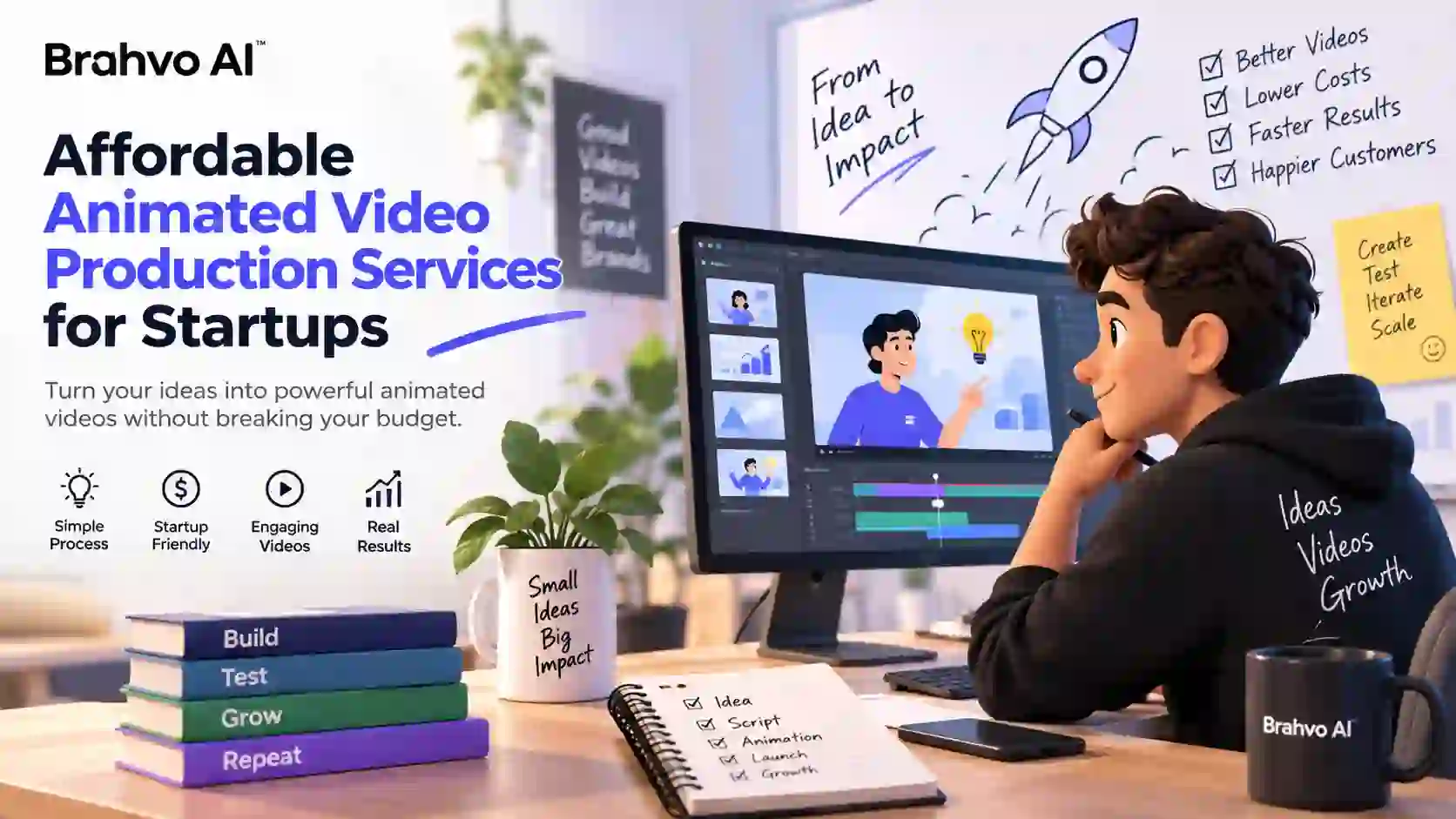
Affordable animated video production services for startups using AI to create flexible, engaging videos for ads, websites, and social media.
Startup marketing teams rarely have unlimited creativebudgets. Even companies that have raised significant funding tend to be carefulabout where production money goes, especially when paid acquisition is alreadyexpensive.
A DTC brand might need five new ad concepts this monthbecause its Meta Ads performance is slipping. A SaaS startup may need anexplainer for its homepage, a product video for a sales deck, and several shortversions for paid social. An AI company might need to explain a workflow thatwould be difficult and expensive to demonstrate through traditional filming.
That creates a production problem.
One polished video is not necessarily enough.
Creative fatigue is real. An ad that worked well six weeksago may gradually lose response as the same audience sees it repeatedly. Themarketing team then needs new hooks, new visual treatments, different openings,or entirely new concepts.
This is one reason startups are searching specifically for affordableanimated video production services for startups rather than treating videoas a one time branding expense.
Animation can provide more control over production. Aproduct interface can be recreated visually. A complicated process can besimplified. Different scenes can be changed without reshooting an entireproduction.
There is also a practical advantage for startups withproducts that are difficult to film.
Suppose a company sells cybersecurity software. Showing aperson sitting at a laptop for 60 seconds does not necessarily communicate whythe product is useful. Animation can show a threat entering a network, thesoftware identifying it, and the system responding. It gives the viewer avisual explanation rather than asking them to understand a technical paragraph.
The same applies to fintech, health technology, logistics,enterprise software, AI products, and many subscription businesses.
Still, animation is not automatically cheaper in everysituation. A highly detailed 3D production with custom characters, complexmotion, and extensive revisions can become expensive very quickly.
The savings usually come from choosing the right productionapproach for the job.
The word "affordable" needs some context.
For a startup, affordable does not necessarily mean choosingthe lowest possible production price. It means getting enough creative outputand flexibility from the budget to support the actual marketing requirement.
A company spending its entire video budget on one elaboratetwo minute animation may end up with a beautiful asset that has very littletesting value.
Another company could use that same budget to produce a coreproduct video plus several shorter adaptations for paid social.
The second approach may be more useful.
Production costs are affected by several factors:
Production factor
Why it affects startup budgets
Video length
Longer videos usually require more scenes and animation work
Animation complexity
Detailed character or 3D work takes more production time
Number of concepts
Multiple creative ideas require additional scripting and design
Voiceover
Different voice styles and languages can change production requirements
Revisions
Extensive changes after animation begins can add time and cost
Formats
Square, vertical, landscape, and other versions require adaptation
Custom assets
New illustrations, characters, interfaces, and environments add work
A startup should therefore decide what the video needs toaccomplish before discussing production details.
For example, a 20 second TikTok or Meta Ads creative has avery different job from a 90 second product explainer. The first needs toestablish relevance quickly. The second has more room to explain a workflow.
This distinction matters when evaluating affordableanimated video production services for startups.
A good production decision starts with the distributionplan.
If the primary destination is paid social, the creativeshould be designed around that environment from the beginning. If the video ismainly for a landing page, the storytelling can give more attention to productexplanation and objections.
There is little value in producing a video first andfiguring out where to use it later.
Some products are easy to demonstrate.
A consumer skincare product can be shown being applied. Akitchen product can be used on camera. A clothing brand can show someonewearing the product.
Then there are products where the actual value exists behindthe screen.
That is where animation becomes particularly useful.
Consider an early stage B2B startup offering an automatedfinancial reporting platform. Its value is not the dashboard itself. The valueis what happens before the dashboard appears. Data comes from differentsources, gets processed, categorized, checked, and eventually becomes a report.
Trying to explain all of that through talking head footagecan become awkward.
An animated video can show the journey visually.
Data enters from several sources. The system processes it.Errors are identified. The final report appears. The viewer understands thebasic mechanism without needing a technical explanation.
That does not mean every complex product needs an explainervideo. Sometimes a simple product demonstration works better.
I might be wrong here, but startups can sometimesoverestimate how much information their audience needs. A video does not haveto explain every feature. It may only need to make one important idea obvious.
That is especially important for paid advertising.
A Meta Ad may only have a few seconds to make the viewercare. A TikTok creative may need a strong visual interruption before theproduct explanation begins. A YouTube ad can give the viewer more context, butthe opening still matters.
For startups, animated video production can also help whenthe product is constantly changing.
Imagine an AI SaaS company launching new features every fewmonths. A traditional video showing a specific interface could become outdated.An animation focused on the broader workflow may remain useful for longer.
There is a tradeoff, though.
If the product experience itself is the strongest sellingpoint, hiding it behind animation may not be wise. Showing the real product cancreate more credibility.
The right choice depends on what customers need to believebefore they take the next step.
There is no universal "startup animation style."
The visual treatment should follow the product and audience.
A consumer app targeting younger customers may benefit fromenergetic motion, bold typography, quick transitions, and a social firstformat. A B2B cybersecurity company may need something calmer and moretechnical. A healthcare startup may need visual clarity and restraint becausethe subject itself requires trust.
Common approaches include:
2D motion graphics
Useful for explaining processes, statistics, productconcepts, and technology. It can also work well for paid social because scenescan move quickly without requiring complicated production.
Character animation
Helpful when the story involves a customer problem or arecognizable situation. It can make abstract problems feel more relatable,although characters should have a purpose rather than simply filling thescreen.
Product focused animation
Useful for SaaS and technology companies where the productworkflow needs to be demonstrated without relying entirely on a screenrecording.
Typography driven animation
This can work particularly well for short ads where themessage needs to be understood without depending heavily on voiceover.
Hybrid animation
A startup can combine product footage, screen captures,illustrations, typography, and motion graphics. This can be useful when theactual product experience needs to remain visible while animation explains whatis happening around it.
The mistake is choosing an animation style because it looksimpressive in a portfolio.
The better question is simpler.
Will this visual style help the intended customer understandthe message quickly?
One of the strongest reasons to consider affordableanimated video production services for startups is the possibility ofgetting more than one marketing asset from a single creative concept.
A startup could develop a central product story and thenadapt it for different channels.
On a landing page, the video might run for 60 to 90 secondsand explain the problem, product, workflow, and key outcome.
For Meta Ads, the same concept could become several 15 to 30second creatives with different openings.
For TikTok Ads, the visual treatment may need to feel fasterand more native to vertical video.
For YouTube, the startup could use a longer version thatgives the viewer more context before the call to action.
This is where creative testing becomes interesting.
Suppose an ecommerce startup has one product and threecustomer motivations. One group cares about convenience. Another cares aboutprice. A third cares about product quality.
Instead of producing three completely unrelated videos, theteam could develop one visual system and test three different angles.
The first ad opens around saving time.
The second focuses on the product problem.
The third starts with a common customer frustration.
The animation does not have to change completely. Theopening scene, script, pacing, and supporting visuals can change.
That makes the production budget work harder.
A similar approach can be used when a startup has multipleSKUs. Rather than creating every asset from scratch, reusable visual componentscan help the team produce variations without rebuilding the entire creative.
This matters when paid media budgets grow.
At $10,000 a month in paid advertising, a small creativelibrary may be enough for a very early test. At $100,000 a month, the creativerequirements become much more demanding. More audiences are being reached, morecampaigns are running, and fatigue can appear faster.
The production model has to keep up.
That does not mean producing videos endlessly. It meansunderstanding which creative variables are worth testing.
Hook.
Offer.
Customer problem.
Visual opening.
Product demonstration.
Proof.
Call to action.
Changing all of these at once makes it difficult to know whyperformance changed. Changing one or two elements can give the media buyer aclearer signal.
AI video production is making this process more practicalfor some startups because parts of production can be handled with greater speedand flexibility. Scripts can be developed faster, visual concepts can beexplored earlier, and variations can be planned around the advertising strategyinstead of being treated as separate projects.
But speed can create another problem.
Too many mediocre variations.
A startup does not need 50 animated videos simply becauseproduction has become easier. It needs creative ideas worth testing.
Consider a hypothetical DTC brand spending $30,000 a monthon Meta Ads. Its best performing creative is a simple animated product story.The team initially assumes the animation style is the reason it works. Afterseveral tests, they find something else. The winning factor is actually thefirst five seconds, where the ad directly addresses the customer's biggestfrustration.
That changes the next production decision.
Instead of making every new video look different, the teamkeeps the visual language and tests stronger openings.
That is a much better use of a limited budget.
And sometimes the cheapest video is not the affordable one.It is the video that can actually be reused, tested, adapted, and connected toa clear acquisition objective.
AI is changing animated video production in afairly practical way. It is not simply about generating a finished video from asentence and calling the job done.
For startups, the more useful change ishappening behind the scenes.
Ideas can be explored faster. Scripts can beadjusted without restarting an entire project. Different visual directions canbe tested earlier. Voiceovers, scene concepts, storyboards, and short creativevariations can be developed with less manual production work.
That matters because startup marketing rarelystays still.
A company may launch a new feature on Monday,change its positioning two weeks later, and then realize that its strongestcustomer segment is different from the one it originally expected. Traditionalvideo production can make these changes frustrating because even a smallmessaging shift may require additional production.
AI assisted production can make the processmore flexible.
For example, a SaaS startup could begin with a60 second animated explanation of its product. After running paid campaigns,the team may find that customers respond more strongly to one particular usecase. Instead of treating the original video as finished, the team can use thatlearning to develop shorter versions centered on the stronger use case.
This is particularly relevant to affordableanimated video production services for startups because productionefficiency matters when budgets are limited.
There is another side to this, though.
AI can make it easier to produce weak creativetoo.
If a team can generate ten concepts in anafternoon, that does not mean all ten deserve to become ads. The hard part isstill deciding what the audience should see, what problem should be addressed,and what claim the company can actually support.
AI can help with production. It cannot removethe need for good judgment.
For Meta Ads and TikTok Ads, that distinctionbecomes obvious. A technically impressive animation can still fail if theopening takes too long to reach the customer problem. A simple animated conceptwith a sharp first sentence can outperform something far more elaborate.
The production process should therefore startwith the advertising idea, not with the animation technology.
Startup founders often face an uncomfortabledecision when paid media starts spending more money.
Do you put more budget into the campaigns thatare already working, or do you keep producing new creatives to protectperformance?
There is no perfect answer.
If the team keeps scaling the same winning ad,creative fatigue can eventually become an issue. If the team spends too muchmoney producing new videos, there may not be enough media budget left toproperly test them.
This is where affordable animated videoproduction services for startups can fit into a broader creative testingprocess.
The goal should not be to make more videossimply for the sake of having more videos. It should be to create enoughmeaningful variations to learn something.
For example, a startup could test threedifferent customer problems with the same product:
The first creative focuses on wasted time.
The second focuses on unnecessary cost.
The third focuses on a complicated processthat the product simplifies.
The visual identity can remain consistentwhile the central message changes.
That makes the test easier to interpret.
A media buyer can then look at metrics such asthumb stop rate, video engagement, click through rate, landing page behavior,conversion rate, and customer acquisition cost. The exact metric that mattersmost depends on the campaign objective, but the broader point is simple.Creative production should generate useful marketing information.
A hypothetical ecommerce startup illustratesthis well.
Suppose the company sells a new kitchenproduct and is spending $25,000 a month across Meta Ads. Its existing productdemonstration has started losing efficiency. Instead of producing one expensivereplacement, the marketing team creates several short animated concepts.
One starts with the customer's problem.
Another demonstrates a product feature.
A third focuses on the product's everyday use.
After testing, the third concept generatesstronger purchase behavior even though the first concept gets more initialengagement.
That tells the team something important.
Attention and conversion are not always thesame thing.
The startup can then put more productioneffort behind the creative angle that is actually helping the business, ratherthan assuming the most watched video is automatically the winner.
There is a budget discipline here that getsoverlooked.
If a $2,000 production creates one video,while a slightly different production process creates a core video plus severaluseful adaptations, the second option may have greater practical value. Notbecause more assets are always better, but because paid media teams need enoughcreative variation to keep learning.
The first mistake is starting with the videoinstead of the customer.
A founder may say, "We need an animatedexplainer." That sounds clear, but it is not really a creative brief.
What does the customer currentlymisunderstand?
What objection is stopping the purchase?
What should someone understand after watchingthe first ten seconds?
What action should the viewer take next?
Those questions are more useful.
Another common mistake is trying to explaineverything.
Startups often have a long list of featuresthey are proud of. The resulting video becomes a sequence of productcapabilities rather than a story about why the customer should care.
A 60 second video does not need to contain theentire website.
It needs one clear idea.
A third mistake is producing only one version.
This can be especially limiting when the videowill be used for paid social. Meta Ads and TikTok Ads involve differentaudiences, placements, hooks, and viewing environments. A single master videomay not give the marketing team enough flexibility.
That does not mean creating ten completelydifferent productions.
Small changes can matter.
The first three seconds can change. Theheadline can change. The voiceover can change. The customer problem can change.The call to action can change.
A fourth mistake is overlooking revisions.
Animated production involves decisions thatbecome more expensive to change later. A script revision before animation isvery different from a major story change after several scenes have already beenproduced.
Startups should establish the approval processearly.
Who approves the script?
Who approves the visual direction?
How many revision rounds are expected?
Which changes are considered minor?
These questions sound boring until a projectis already behind schedule.
Another mistake is assuming that AIautomatically makes production inexpensive.
AI can reduce certain production tasks, butcreative direction, editing decisions, brand consistency, storytelling, andquality control still require time.
Cheap production can become expensive if thefinal asset is difficult to use.
And one low value observation worthmentioning: sometimes a startup spends more time debating animation styles thandeciding what the opening line should say.
That usually has the priorities backwards.
Brahvo AI approaches affordable animatedvideo production services for startups around the practical needs ofcompanies that have to make creative decisions with limited resources.
The starting point is the communicationproblem.
Before worrying about visual effects, theproduction needs to establish what the viewer should understand and why thatinformation matters. A startup selling software needs a different creativetreatment from a DTC brand launching a physical product.
The same production formula cannot workequally well for both.
For a startup, the process can involvedeveloping the central concept, shaping the script, defining the visualdirection, creating the animation, and adapting the final creative for relevantmarketing placements.
The important part is keeping the advertisinguse case in mind throughout production.
If a video is eventually going to run as aMeta Ad, the opening should not be designed as if the viewer has already agreedto watch a presentation. The first moments need to earn attention.
If it is intended for a landing page, theremay be more room to explain the product and address customer questions.
If it is being used for TikTok, the pacing andvisual treatment may need to feel more immediate.
This is also where AI assisted production canbe useful for startups. Creative concepts can be explored without committingimmediately to a large production. Variations can be considered earlier.Shorter versions can be developed from the central idea.
For an early stage company, that flexibilitycan matter as much as the production itself.
Brahvo AI can also approach animation as partof a larger creative testing process rather than treating every video as anisolated branding asset.
That distinction matters.
A startup may not need a cinematic brand film.It may need six useful creative variations that answer different customerquestions and give its paid media team something meaningful to test.
At the same time, not every startup shouldproduce a large volume of animation.
I might be wrong here, but there are caseswhere one well made video is enough to validate the idea before investing in alarger creative library. If the message itself has not been validated,producing more variations can simply multiply the uncertainty.
The production budget should follow the stageof the company, the product, and the advertising objective.
That is the practical reason affordableanimated video production services for startups should be evaluated onusefulness, adaptability, and creative testing potential rather than productioncomplexity alone.
1. What are affordable animated videoproduction services for startups?
They are animation production servicesdesigned around startup budgets and practical marketing requirements. The focusis usually on producing useful videos without unnecessary productioncomplexity, while allowing the creative to be adapted for different channelsand campaigns.
2. Can AI reduce the cost of animated videoproduction?
It can reduce the time involved in certainproduction tasks. AI can assist with ideation, scripting, visual development,voice production, and creative variations. The actual cost still depends on thelevel of human creative direction, animation complexity, editing, revisions,and final quality requirements.
3. Are animated videos effective for startupadvertising?
They can be, particularly when the product orcustomer problem is difficult to demonstrate through traditional footage.Performance still depends on the message, hook, offer, audience, creativeexecution, and media strategy.
4. How can startups use animation for MetaAds?
A startup can use short animated creatives totest different hooks, customer problems, product benefits, and calls to action.Vertical and square versions can also be created when appropriate for differentplacements.
5. Should a startup use the same animatedvideo on TikTok and Meta Ads?
The core concept can remain the same, but theexecution may need changes. TikTok and Meta users can respond differently topacing, opening shots, captions, voiceover, and creative style.
6. Is animation suitable for DTC ecommercebrands?
Yes, although it depends on the product.Animation can explain product benefits, demonstrate concepts, introduce offers,or create attention grabbing ad openings. For products where physical use isthe main selling point, real product footage may still be important.
7. How many animated videos should a startupproduce?
There is no useful universal number. A startupshould consider its advertising budget, campaign volume, audience size,creative fatigue, and testing requirements. Five purposeful variations can bemore useful than twenty videos that communicate essentially the same thing.
8. Can one animated video be turned intoseveral ad creatives?
Often, yes. A longer core concept can providematerial for shorter versions, alternative hooks, different openings, andplatform specific edits. The amount of reuse depends on how the original videowas planned and produced.
9. What should startups prioritize whenworking with a limited video budget?
Prioritize the message, opening hook, audienceproblem, visual clarity, and ability to adapt the creative. Spending heavily oncomplex animation while leaving the core message unclear is rarely a goodtrade.
10. Are affordable animated video productionservices only useful for early stage startups?
No. Larger startups can also use thisproduction model when they need a steady flow of creative variations or need totest new product messages. The difference is usually the scale and volume ofproduction rather than the basic need for efficient creative development.