Find the right video production partner for your business with practical insights on services, AI video production, creative testing, and client needs.
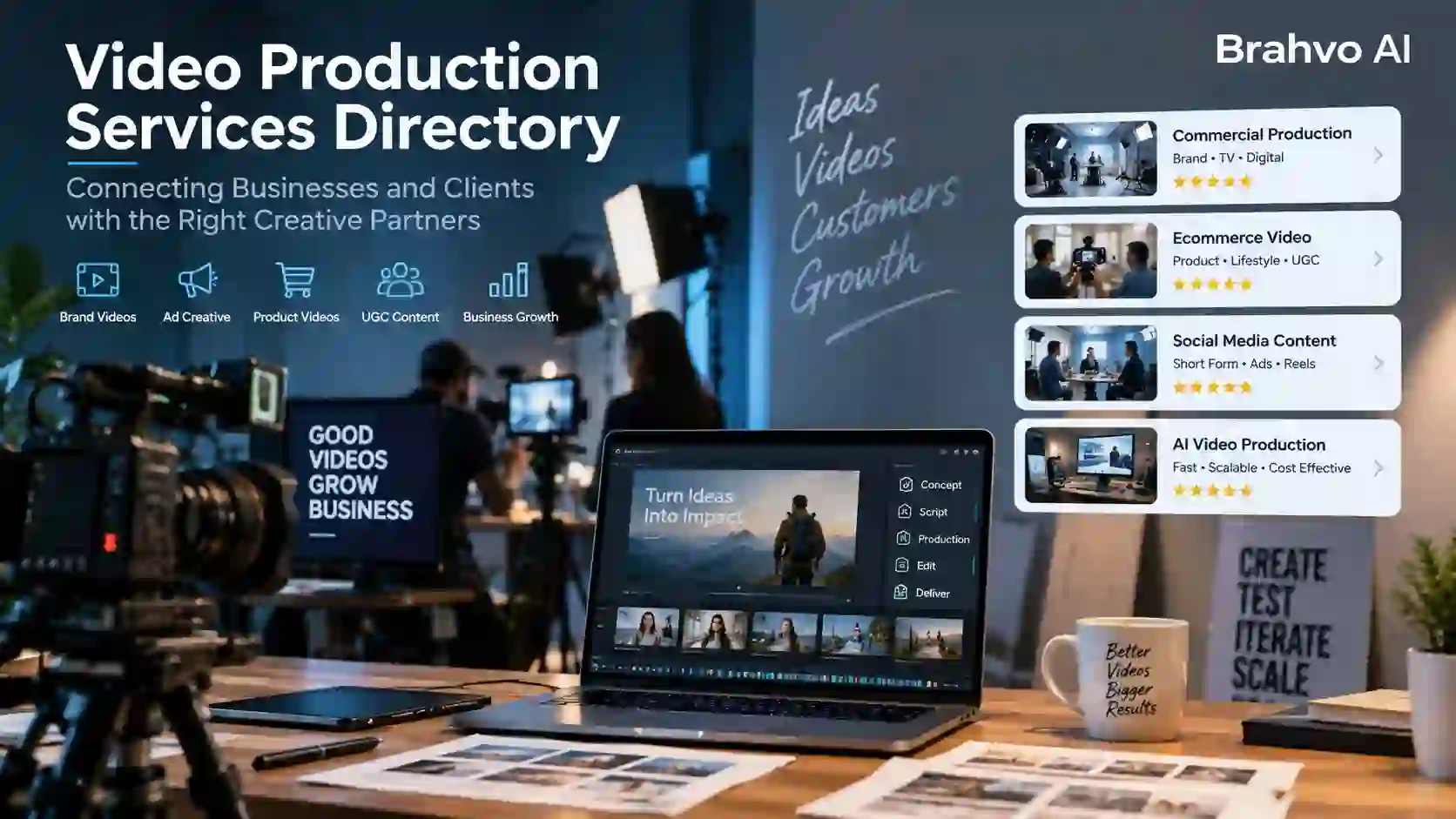
A marketing team can know exactly what kind of video it needs and still waste days finding the right production partner.
A DTC brand may need 15 short product videos for Meta Ads. An ecommerce company launching a new SKU might need product demonstrations, UGC-style creative, and a few polished brand videos. A SaaS company may want an explainer video, while a larger consumer brand could be looking for commercial production.
The problem is not a lack of video production companies. There are plenty of them. The problem is figuring out which one actually fits the project.
That is where a video production services directory businesses clients can use becomes useful. Instead of starting with random searches, referrals, social media profiles, or old agency contacts, businesses can use a directory to narrow the field based on production capabilities, project requirements, creative needs, and business fit.
This matters more now because video has become part of everyday paid media operations. A brand running Meta Ads or TikTok Ads is not necessarily looking for one beautiful brand film. It may need a steady supply of different creative concepts every month.
That changes the buying decision.
A video production services directory businesses clients use is less about finding the biggest production company and more about finding a production partner capable of handling the actual requirement.
For example, a seven-person ecommerce team launching a skincare product may not need a traditional commercial production. They may need product demonstrations, multiple hooks, vertical videos, lifestyle scenes, creator-style footage, and variations for testing.
The right production capability depends heavily on that use case.
The first thing most businesses look at is not necessarily video quality.
It is relevance.
A production company may have beautiful work in its portfolio, but that does not automatically mean it can produce effective ecommerce advertising creative. A company known for corporate films may not be the right fit for a DTC brand that needs dozens of short-form videos.
This is one reason a video production services directory businesses clients search can be useful. It gives buyers a starting point for matching production capabilities with the project.
A paid media team might ask questions such as:
Can the production team create vertical video?
Can they produce multiple concepts from one product?
Can they work with UGC creators?
Can they handle product demonstrations?
Can they create videos designed for Meta Ads?
Can they produce content quickly enough for ongoing creative testing?
Can they work with existing brand guidelines?
Can they deliver different aspect ratios and versions?
These questions are very different from simply asking whether a company produces high-quality videos.
For ecommerce brands, production volume can also become important.
Consider a fashion brand with 40 SKUs. If the marketing team wants three creative concepts per product, the requirement can quickly become much larger than a single production project. The team needs a workflow that can support repeated content creation without making every new video feel like a major production.
Budget is another obvious consideration, but businesses often look at budget in the wrong way.
A lower production cost is not automatically cheaper if the resulting creative cannot be used effectively in advertising. On the other hand, spending heavily on every video can create its own problem if the media team needs constant creative variation.
There is a middle ground.
The production approach needs to match the role the video will play.
A $20,000 brand film and a $500 performance ad are solving different problems. Treating them as the same type of video can lead to poor budget decisions.
This is particularly relevant when businesses use a video production services directory businesses clients rely on to compare potential providers. The directory should help the buyer understand what each production option is actually suited for.
Creative capability matters too.
Some businesses want cinematic storytelling. Others need simple product-focused videos. Some want animation. Others want AI-generated scenes or AI-assisted editing. Some need human presenters, while others want a voiceover-led format.
The best choice depends on what the audience needs to see and what the campaign needs to communicate.
Once a business has shortlisted a few production companies, the evaluation becomes more practical.
The portfolio gets examined closely.
Not just the polished homepage reel. Buyers usually want to see work that resembles their own requirement.
A consumer brand selling supplements, for instance, may want to see how a production company handles product education, testimonials, lifestyle footage, and short-form advertising. A furniture company may care more about product detail, room environments, demonstrations, and visual storytelling.
The question becomes simple.
"Have they done something close to what I need?"
A video production services directory businesses clients use can reduce the initial search effort, but the buyer still needs to inspect the actual work.
There is another factor that is often overlooked: communication.
A client may have a strong creative idea but explain it badly. A production partner needs to ask useful questions rather than simply accept a brief and start producing.
That becomes especially important for paid advertising.
Suppose a media buyer says, "We need five new creatives because our Meta Ads are getting expensive."
That is not really a complete creative brief.
The production team should want to know what has already been tested. Which hooks worked? Which ones failed? Is the problem thumb-stop rate, click-through rate, conversion rate, or simply creative fatigue? Are customers responding to demonstrations, testimonials, comparisons, or founder-led messaging?
Without that context, the production team may create five attractive videos that solve the wrong problem.
I have seen this happen in different forms. A brand thinks it needs "more videos" when the real issue is that every existing video communicates the same product benefit in almost the same way.
More content does not automatically mean more creative variety.
Clients also evaluate turnaround times, revision processes, production capacity, pricing, licensing requirements, and ownership of final assets.
For US ecommerce teams, those operational details can matter just as much as the portfolio.
If a product launch is scheduled for three weeks from now, a beautiful production company that cannot meet the timeline is not really an option.
That sounds obvious, but it gets missed surprisingly often.
Video quality still matters. It just does not mean what it used to mean.
For a television commercial, production quality may involve cinematography, lighting, set design, sound, talent, locations, and extensive post-production.
For a TikTok or Meta ad, the viewer may respond better to something that feels less polished.
This creates an interesting tension for businesses looking through a video production services directory businesses clients can access.
They are often comparing companies based on visible production quality, while their actual advertising results may depend on creative relevance, speed, variety, and the strength of the concept.
A highly polished video can fail.
A simple product demonstration recorded in a believable environment can outperform it.
That does not mean production quality is irrelevant. Poor lighting, bad audio, confusing editing, or weak visuals can hurt the viewer experience. The point is that production quality needs to serve the creative idea.
For ecommerce advertising, several capabilities can be particularly useful.
Short-form production
Brands running Meta Ads and TikTok Ads often need videos that establish the product or problem quickly. The opening seconds matter, but the rest of the edit still needs to support the claim.
Product-focused video
Showing how a product works can be more persuasive than simply showing attractive footage of it. Demonstrations can answer questions that static images cannot.
UGC-style creative
UGC does not always mean handing a phone to a creator and asking them to say a script. Strong UGC-style creative can involve different hooks, customer objections, demonstrations, testimonials, comparisons, and personal experiences.
Animation and motion graphics
These can be useful when the product is difficult to demonstrate physically or when the message involves concepts that need visual explanation.
AI-assisted production
AI can change how quickly certain types of video content can be developed. It can support ideation, scripting, visual generation, voice work, editing, localization, and creative variation depending on the production workflow.
The important part is knowing where AI actually helps.
I might be wrong here, but I do not think AI video will make traditional production irrelevant for every brand. There are still situations where physical products, real people, locations, and authentic customer experiences matter enormously.
But for performance marketing teams that need to test many ideas, AI video production can reduce some of the friction between an idea and a usable creative asset.
That has financial implications.
If a media buyer wants to test ten creative angles, the business does not necessarily need ten completely different production projects. A smarter workflow may involve developing a core concept and creating multiple variations around different hooks, audiences, product benefits, or visual treatments.
This is where production capability starts influencing media buying.
The media team can test more ideas when the content operation can actually supply those ideas.
AI video production is changing the criteria businesses use when evaluating production partners.
Previously, a buyer might ask whether a company had the right cameras, studio, crew, editors, and production equipment.
Those things still matter for many projects.
But now the buyer may also ask how quickly the team can turn a creative concept into several usable variations.
That is a different question.
For an ecommerce company spending $100,000 a month on paid social, creative testing can become a recurring operational problem. The media team may identify new customer objections, winning angles, seasonal offers, and audience segments, but the creative team still needs to turn those insights into actual videos.
AI can help shorten that gap.
Brahvo AI sits within this broader shift toward AI-assisted video production. For businesses and clients searching through a video production services directory businesses use to identify suitable production capabilities, AI video production can represent another way to approach creative volume and variation.
Think about a simple example.
A US DTC company sells a $75 kitchen appliance. Its Meta Ads team has tested product demonstrations and polished lifestyle videos. After several weeks, performance starts slipping. Customer acquisition costs rise, and the team suspects creative fatigue.
Instead of immediately increasing the media budget, the team decides to test new creative angles.
One video focuses on the biggest customer frustration. Another demonstrates a feature that customers often misunderstand. A third uses a comparison format. Another focuses on a specific use case. Several versions have different opening hooks.
The objective is not to make every video look completely different.
The objective is to give the advertising system genuinely different creative ideas to evaluate.
AI video production can make this process more practical in certain cases because the production workflow can support more iterations without treating every variation like a traditional shoot.
That can be valuable for brands with multiple SKUs too.
A company selling 30 products may not have the budget or internal resources to create a full custom production for every SKU every time it wants new advertising creative. AI-assisted workflows can potentially help generate variations around existing product assets, messaging, scenes, scripts, and concepts.
Still, there is a catch.
More creative does not necessarily mean better creative.
A business can easily produce 50 mediocre videos faster than it could produce five thoughtful ones. If the underlying strategy is weak, AI simply allows the team to produce weak ideas at a higher volume.
That is why the relationship between creative strategy and production capability matters.
The best use of AI is not simply "make more videos."
It is closer to "make it easier to explore more relevant creative ideas, then learn from what happens."
For clients evaluating a video production services directory businesses clients can use, this means production capability may increasingly include both conventional video skills and AI production knowledge.
A modern production partner may need to understand the difference between a brand asset and an advertising asset. It may need to think about hooks, retention, product education, audience objections, creative fatigue, and testing requirements.
That is a very different production conversation from simply asking, "Can you make us a video?"
And for a founder looking at next month's media budget, that distinction can become expensive if it is missed.
Finding a video production partner often starts with a very broad search.
A company may know it needs video, but the actual requirement can be surprisingly unclear. The marketing director might say the team needs "more social content." The ecommerce manager may want product videos. The paid media team may be asking for 20 new creatives because existing Meta Ads have started losing traction.
Those are three different production requirements.
A video production services directory businesses clients use can make the initial discovery process more organised by helping buyers identify production companies according to their capabilities, project types, creative formats, and areas of experience.
This is especially useful when there is no existing production relationship.
A founder launching a new DTC brand may not know whether they need a traditional production crew, an animation team, UGC production, AI video production, or some combination. Starting with a directory can help turn a vague requirement into a shortlist of relevant options.
Project discovery also becomes easier when businesses can compare production capabilities against the actual job.
For example, an ecommerce brand launching a new beauty product might need:
Product demonstrations
Short-form advertising
Lifestyle footage
UGC-style videos
Multiple creative hooks
Different aspect ratios
Paid social variations
A company searching a video production services directory businesses clients rely on can evaluate providers against those specific requirements rather than choosing purely on reputation or visual style.
There is a practical benefit here too. Marketing teams often do not have much time to investigate ten or twenty production companies individually.
A directory can shorten the first stage of that process.
It does not remove the need for due diligence. It simply makes the starting point more useful.
A strong portfolio is a good starting point, but it should not be the final decision.
The first thing to check is whether the production partner understands the type of content the business actually needs.
A company selling industrial equipment has very different requirements from a fashion DTC brand. A SaaS company launching a new platform has a different problem again.
The production style needs to fit the audience and the distribution channel.
Look beyond the showreel
Showreels are designed to look impressive. That is their job.
Clients should also ask to see individual projects and understand what the production team actually handled.
If the requirement is paid social advertising, look for evidence of short-form creative, product demonstrations, direct response storytelling, UGC-style formats, and creative variations.
If the requirement is corporate video, evaluate interviews, storytelling, visual consistency, sound, and post-production.
The best-looking work is not always the most relevant work.
Ask how creative testing works
For ecommerce brands, this question can reveal a lot.
Suppose a brand says it wants 12 videos.
The production partner should ideally ask why 12.
Are these 12 different concepts? Twelve versions of one concept? Six hooks with two edits each? Videos for different products? Ads for different stages of the customer journey?
Those details change the production process.
A media buyer may know that a brand's current ads are struggling because the opening is repetitive. A production team that understands performance creative can respond to that information more effectively than one that simply produces another polished product video.
Check production capacity
Capacity becomes important when the business has multiple products or frequent campaign launches.
A production partner may be excellent at producing one major campaign but unsuitable for a company that needs fresh creative every week.
Ask about timelines, revision rounds, asset delivery, format requirements, and how multiple projects are managed.
This is not glamorous stuff.
It is also where many client relationships get difficult.
Understand the role of AI
If AI video production is part of the requirement, businesses should understand exactly where AI enters the workflow.
Is it being used for concept development? Script creation? Visual generation? Voiceovers? Editing? Background creation? Product scenes? Creative variations?
The answer matters because "AI video" can mean very different things.
A business should also ask where human review happens. AI can generate content quickly, but speed does not replace judgement.
The final video still needs to make sense, represent the product accurately, and fit the brand.
Brahvo AI approaches video production from the perspective that modern businesses often need more than a single finished video.
They need creative assets that can be adapted for different campaigns, audiences, products, and platforms.
That distinction becomes important for ecommerce and DTC companies.
A brand might have one product but several customer segments. The same product could be positioned around convenience for one audience, performance for another, and affordability for a third.
The production requirement is no longer simply "make a product video."
It becomes a question of how many relevant creative ideas can be developed around the product.
Brahvo AI can support businesses looking at AI video production for areas such as advertising creative, product-focused content, social media videos, explainer content, AI avatar videos, and creative variations.
For a paid media team, the appeal is not simply producing content faster. The bigger opportunity is reducing the production friction that often prevents teams from testing enough ideas.
Consider a hypothetical US ecommerce brand selling a home fitness product.
Its Meta Ads team notices that demonstration videos are producing better engagement than polished lifestyle ads. Instead of producing another single demonstration, the team could test different messaging angles.
One version could focus on saving time.
Another could focus on small-space living.
Another could address a common customer objection.
Another could use a customer story.
The product stays the same. The creative argument changes.
AI-assisted production can make these kinds of variations more practical when the underlying concept and assets are suitable for the workflow.
Brahvo AI also fits businesses that need content across several channels. A video created for a paid social campaign may need to be adapted into different formats for TikTok, Instagram, YouTube, landing pages, or other placements.
That does not mean every asset should simply be resized.
The edit, pacing, opening, captions, and message may need to change depending on where the viewer sees it.
For clients working with a video production services directory businesses clients use to identify production partners, this kind of flexibility is becoming an increasingly relevant consideration.
A production partner is not only producing a file.
It is helping the business create usable communication assets.
And sometimes the most useful asset is not the most visually impressive one.
One common mistake is choosing a production company because its portfolio looks impressive.
A beautiful portfolio can create the wrong expectation.
If a DTC brand needs 30 short-form ad variations and the production company specialises in occasional high-budget commercial shoots, there may be a mismatch even if the work looks fantastic.
Another mistake is asking for video production before defining the advertising objective.
"We need 10 videos" does not say much.
"We need five new concepts to test because our current Meta Ads have become repetitive" is much more useful.
The second statement gives the production team a reason behind the request.
Treating every video like a brand film
This can become expensive quickly.
Performance creative often needs speed and iteration. A video intended to test a customer objection does not necessarily need a major production setup.
The production level should match the purpose.
Producing variations that are not actually different
Changing the background or music does not necessarily create a new creative idea.
If five videos use the same hook, same message, same demonstration, and same pacing, they may look different while communicating almost exactly the same thing.
Creative variety is about the idea, not just the edit.
Ignoring distribution
A video intended for TikTok should not automatically be treated exactly like a YouTube commercial.
Platform context affects pacing, framing, length, captions, opening, and viewer expectations.
Production decisions should happen with distribution in mind.
Forgetting about revisions
Some businesses focus heavily on the initial production quote and barely discuss revisions.
That can create problems later.
Clarify how many rounds of revisions are included, what counts as a revision, who provides feedback, and how quickly approvals need to happen.
Expecting AI to solve a weak creative concept
This is probably the easiest mistake to make right now.
If the concept is weak, producing it faster does not solve the underlying issue.
AI is useful when it supports a good production and creative process. It is not a substitute for understanding the customer.
A media buyer can have ten new videos and still have no idea why the campaign is not working.
What is a video production services directory?
A video production services directory is a resource that helps businesses and clients find video production companies based on their services, capabilities, project types, and creative requirements.
Why would an ecommerce business use a video production directory?
Ecommerce businesses often need specific types of content, such as product demonstrations, social ads, UGC-style videos, animations, or short-form creative. A directory can help narrow the initial search.
Does a video production directory guarantee that a company is suitable?
No. A directory can help with discovery, but businesses should still review portfolios, production capabilities, communication processes, pricing, timelines, and project experience.
What should a business ask a video production company before hiring them?
Ask about relevant portfolio work, production timelines, creative development, revisions, formats, asset ownership, distribution requirements, and experience with the type of content you need.
Is AI video production suitable for ecommerce advertising?
It can be, particularly when a brand needs creative variations, rapid concept testing, product-focused content, or certain types of social advertising. The suitability depends on the product, audience, creative concept, and production requirements.
Can AI video replace traditional video production?
Not in every situation. Real products, real customers, physical locations, complex shoots, and certain brand campaigns still benefit from conventional production. AI is better viewed as another production capability rather than a universal replacement.
How many videos should an ecommerce brand produce each month?
There is no useful universal number. A brand running heavy paid social may need frequent creative testing, while another business may have longer creative cycles. The right volume depends on ad spend, product range, campaign activity, and how quickly creative performance changes.
Should businesses prioritise video quality or creative variety?
Neither should automatically win. A technically excellent video with a weak concept can fail, while a highly varied set of poorly made videos can also waste budget. The useful balance depends on the campaign objective.
What makes a video useful for paid social?
The video needs a clear idea, an appropriate opening, relevant messaging, understandable product communication, and a format suited to the platform. It should also give the media team something meaningful to learn from when testing it.
How can Brahvo AI help businesses with video production?
Brahvo AI supports modern video production requirements using AI-assisted approaches for advertising creative, social media content, product videos, explainer videos, AI avatar content, and creative variations. The appropriate workflow depends on the client's product and campaign requirements.