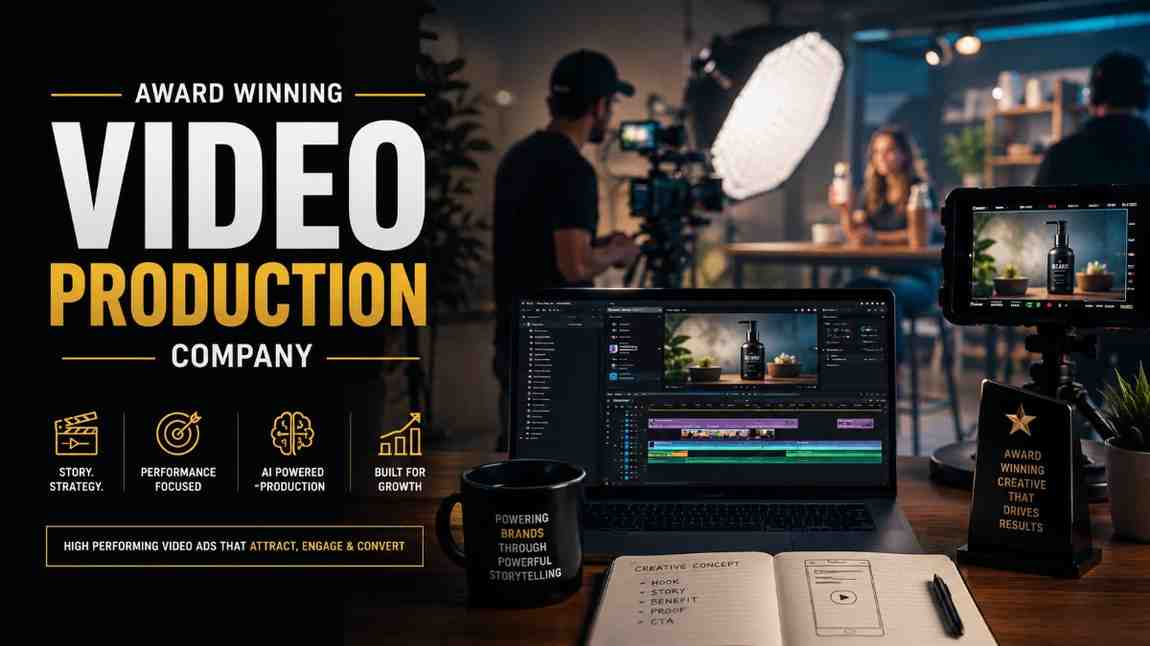
Find an award winning video production company for ecommerce brands creating high performing video ads with AI powered production and creative testing.
A lot of ecommerce brands reach the same point after running paid social for a while. The media buying team knows what it is doing. The landing pages are converting reasonably well. The targeting has been tested. Budgets are available.
Then performance starts slipping.
The first reaction is often to look at the campaign settings. But the real issue can be the creative. The same few ads have been running for too long, audiences have seen similar hooks repeatedly, and new concepts are taking weeks to get from an idea to a finished video.
That is where an award winning video production company can become relevant.
The value is not simply having attractive footage or impressive production equipment. For ecommerce and DTC brands, video has to work inside an advertising system. A video might look great and still produce weak results if the first few seconds do not earn attention, the product benefit is unclear, or the creative does not match the buying stage of the audience.
Performance teams are also under pressure to produce more variations. One product can require several hooks, different opening scenes, multiple calls to action, testimonial versions, product demonstrations, founder led concepts, lifestyle edits, and short form cutdowns. Multiply that across several SKUs and the creative workload becomes substantial.
An award winning video production company is often considered because brands want production quality without losing sight of what the video is supposed to accomplish.
For a growing DTC company, that distinction matters.
A polished brand film may be useful for a website homepage or a major product launch. A paid social campaign usually needs something different. The video may need to communicate the problem in two seconds, demonstrate the product immediately, show proof, handle an objection, and give the viewer a reason to act before they scroll away.
Those are very different production challenges.
There is also the issue of creative fatigue. Meta Ads can work extremely well when a strong creative concept is introduced, but that does not mean the same ad will remain effective indefinitely. Once frequency rises and engagement falls, media buyers need fresh creative. TikTok and YouTube create their own demands because audiences respond differently to pacing, framing, storytelling, and presentation.
This is one reason production has moved closer to the center of performance marketing.
A brand does not necessarily need more videos for the sake of having more videos. It needs more useful creative options.
Consider a hypothetical skincare brand spending $150,000 a month across paid social. One product is responsible for a large share of revenue, but the team has only four major video concepts in rotation. Two begin showing declining performance. The obvious response might be to increase spend behind the remaining winners. But that can put even more pressure on those creatives.
A better production question is different: what can be learned from the existing winners, and how many new versions can be developed from those underlying ideas?
That is where an experienced award winning video production company can provide value beyond traditional filming. The production process becomes connected to testing, campaign objectives, customer objections, audience segments, and the realities of paid media.
The goal is not making one perfect video.
It is making creative that gives the media team something useful to test.
The phrase award winning video production company sounds impressive, but an award alone does not tell a brand whether the company is right for its marketing needs.
Awards can recognize cinematography, storytelling, animation, direction, editing, production design, or creative concept. Those accomplishments matter. But ecommerce brands often need to evaluate another layer.
Can the production team understand the commercial reason behind the video?
That question is easy to overlook.
For a DTC company, an effective production partner should understand that a product demo for a cold audience may need a completely different opening from a testimonial aimed at customers who already know the product. The same product can require multiple creative treatments depending on the platform and campaign objective.
A strong production company also understands the difference between production quality and advertising effectiveness.
High resolution footage does not automatically make an effective Meta Ad. A sophisticated camera movement does not replace a clear proposition. A beautifully scripted voiceover does not matter much when the opening fails to create curiosity.
That does not mean production quality is unimportant. It means quality has to serve the idea.
An award winning video production company should be capable of maintaining strong visual standards while adapting the creative to the environment where it will actually be consumed.
There is another practical issue. Ecommerce teams rarely work on one project at a time.
A brand may be launching a new product while refreshing ads for an existing SKU and preparing holiday creative. Marketing may want a founder video. Paid media may need ten new hooks. The social team may request vertical edits. Someone else may need short clips for email or the website.
Production has to handle that reality without becoming a bottleneck.
The best work often comes from a process where the creative team understands what needs to stay consistent and what can change.
The product may remain the same.
The hook can change.
The customer problem can change.
The demonstration can change.
The proof point can change.
The offer can change.
The format can change.
That gives the paid media team a larger creative testing pool without requiring an entirely new production concept every time.
AI is also changing this equation. AI video production can help teams create variations, experiment with formats, and move from a proven concept to multiple executions much faster. But speed does not automatically create good advertising.
There is a point where generating more versions simply creates more noise.
An award winning video production company that understands AI assisted production should still have strong creative judgment. Someone needs to decide which concepts deserve development, which variations are worth testing, and when an idea has simply been changed for the sake of producing another asset.
I might be wrong here, but I think this is one area where traditional production discipline remains important. AI can accelerate parts of the process, but it does not remove the need for a good creative idea.
That matters particularly when a brand is spending serious money on paid acquisition.
A video created for Meta Ads should not automatically be treated as a TikTok Ad with a different export setting.
The platforms may all support video, but the creative environment is different.
Meta Ads often require brands to compete with a wide range of content while making the product proposition understandable quickly. TikTok can reward a more native, less polished feel in certain categories, especially when creator style content is involved. YouTube gives brands more room for longer storytelling, but that does not mean viewers will tolerate a slow opening.
For an award winning video production company, the challenge is to understand those differences without producing three completely disconnected creative strategies.
Take a supplement brand launching a new product.
For Meta, the team might test a direct problem based hook, followed by the product demonstration and a customer proof point. A TikTok version might use a creator style opening that starts with a personal experience. A YouTube version could spend more time explaining the product mechanism, showing the routine, and addressing common objections.
The underlying product story remains consistent.
The execution changes.
This becomes especially important when brands begin testing creative systematically. Media buyers may want five hooks using the same core product demonstration. Another campaign may need three opening scenes aimed at different customer pain points. A winning testimonial might need several cutdowns and alternative introductions.
This is where AI video production can become particularly useful.
Instead of treating every ad as a completely new production project, teams can think in terms of creative components. Hooks, product shots, demonstrations, testimonials, objection handling, social proof, captions, voiceovers, and calls to action can be assembled into different combinations.
That creates more opportunities to learn.
Suppose one Meta Ad has a strong click through rate but a mediocre conversion rate. Another has fewer clicks but better purchases. The answer is not necessarily to choose one and abandon the other. The team can examine what is happening at the creative level.
Maybe the first ad has a stronger opening but attracts lower intent viewers.
Maybe the second explains the product better.
Maybe the winning element is not the headline at all. It could be the demonstration that happens around the eight second mark.
These observations can inform the next production round.
An experienced award winning video production company should be comfortable working with that kind of feedback loop. The production team should not exist separately from what happens after the video goes live.
For ecommerce brands, the most useful question is rarely, "Do we like this video?"
The more important question is, "What are we learning from this video?"
That changes how creative gets produced.
Instead of spending an entire production budget on one elaborate concept, a brand may decide to create a stronger mix of hero assets and testable variations. Some videos may be designed for broad brand storytelling. Others may exist specifically to test a hook, objection, product benefit, or customer segment.
There is a practical tradeoff here. More creative does not always mean better performance. A media team can become overwhelmed when dozens of variations are launched without a clear testing hypothesis.
So the production process has to remain selective.
That is especially important for brands managing multiple SKUs. One product might need education. Another may already have strong awareness and simply need new creative angles. A newly launched product may need foundational assets before performance testing even begins.
The production strategy should reflect those differences.
For Meta Ads, TikTok Ads, and YouTube Ads, the most effective video work tends to sit somewhere between creative craft and commercial discipline. It needs to look right, but it also needs to say the right thing, to the right audience, at the right point in the buying process.
And sometimes the winning version is not the one the creative team expected. That is part of paid media.
Creative testing sounds simple until a paid media team actually has to produce the assets.
A media buyer may identify six new hooks worth testing on Monday. By Wednesday, the team has refined the concepts. Then comes scripting, production, editing, approvals, revisions, captions, exports, and platform formatting. By the time the ads are ready, the campaign may have already moved in another direction.
This is where AI video production can change the pace.
For an award winning video production company, AI does not have to mean replacing traditional production. It can mean reducing the time between a creative idea and a usable asset.
That distinction matters.
A DTC brand might already know that a particular product demonstration works. Instead of recreating the entire production for every variation, the team can use AI assisted workflows to test different openings, voiceovers, visual treatments, scripts, pacing, or audience specific messaging.
The production team can then spend more time on the creative decisions that actually require judgment.
This becomes valuable when paid media teams are testing several hypotheses at once.
One ad might lead with the customer's problem. Another might lead with the product result. A third might address an objection. A fourth could use social proof. The underlying product remains the same, but the reason for watching changes.
That creates a much richer testing environment than simply making another version of the same ad.
There is a catch, though.
AI can make it very easy to produce mediocre creative at scale. If every idea gets turned into ten variations without a clear reason, the brand ends up with a larger asset library but not necessarily better advertising.
The useful application of AI video production is therefore not "make more videos."
It is "test more meaningful creative ideas without making production the bottleneck."
More variations can create a strange problem for ecommerce teams.
The paid media department wants volume. The brand team wants consistency. Creative directors want quality. The founder wants the ads to feel like the company. The agency may want faster turnaround.
All of those expectations can be reasonable at the same time.
They can also collide.
An award winning video production company working with a DTC brand needs to understand what should remain consistent across creative and what can change.
Brand identity should not disappear simply because the team is producing short form ads.
Visual language, product presentation, tone, typography, messaging principles, and overall positioning can provide a consistent foundation. Within that foundation, the actual advertising concept can change considerably.
For example, a premium skincare company could test a founder story, a customer testimonial, a product demonstration, a problem solution ad, and a creator style video. Those assets can feel different without making the brand feel fragmented.
The mistake is treating consistency as making every video look identical.
That usually limits testing.
A better approach is to define the non negotiable brand elements and allow the creative execution to move around them.
AI assisted production can help here by making certain variations faster to create. A proven script can be adapted for different audiences. A product demonstration can be repackaged into several short form edits. A long form explanation can provide material for shorter paid social assets.
The creative team still needs to decide which versions deserve production.
That human decision becomes more important, not less, when production gets faster.
A useful testing library might include different hooks, proof points, customer stories, objections, offers, demonstrations, and calls to action. It might also include different pacing and visual structures.
Not every variation needs to be radically different.
Sometimes changing the first three seconds is enough to learn something important.
Sometimes the opening is not the problem at all. The offer may be unclear. The product demonstration may arrive too late. The testimonial may lack a specific result. The audience may simply not care about the angle being tested.
Production should help the marketing team isolate those variables.
Creative fatigue becomes harder to manage as an ecommerce company grows.
A brand with one product and one acquisition campaign has a manageable creative workload. A brand with eight SKUs, several customer segments, multiple offers, and campaigns running across Meta, TikTok, and YouTube has a completely different problem.
There are more ads to refresh.
There are more audiences to consider.
There are more campaign objectives.
And there is more pressure on the creative team to keep everything moving.
An award winning video production company can help by approaching creative production as an ongoing system rather than a series of isolated shoots.
Imagine a DTC apparel brand has five products that consistently generate sales. One product has been running the same three Meta Ads for several months. The click through rate has fallen, frequency has climbed, and the media buyer is starting to reduce spend.
The obvious answer is new creative.
But "make new creative" is not enough of a brief.
The team should ask what has already worked.
Was the winning element the product styling? The customer reaction? The opening line? The before and after comparison? The price point? The creator?
Once that is understood, the next batch can build from the evidence instead of starting from zero.
This is particularly useful when several campaigns share the same product.
A strong concept from one campaign may reveal a customer concern that was not being addressed elsewhere. A successful testimonial structure may work for another SKU. A product demonstration may provide the foundation for a new seasonal campaign.
Creative fatigue is not always about needing something completely new.
Sometimes the brand needs a new way to communicate something that already works.
That is a much more efficient production problem.
For ecommerce brands, video production has a direct relationship with customer acquisition because the creative is often the first serious interaction a potential customer has with the product.
That makes the production decision more commercially important than it may appear.
An award winning video production company brings production expertise, but the stronger value comes when that expertise is connected to how people actually buy online.
A customer watching a product video may have never heard of the brand. Another viewer may have visited the product page twice. Someone else may already know the product but needs a reason to purchase now.
Those people do not need the same message.
A cold audience may need a simple explanation of the problem and why the product exists. A warmer audience may respond better to proof, comparison, demonstration, or an offer.
This is where video production and paid media become closely connected.
A media buyer can tell the creative team that a particular angle is generating purchases but losing efficiency at higher spend. The production team can then develop new executions around the same underlying customer insight.
That is more useful than simply asking for "five new videos."
It also helps with budget allocation.
If a brand has $100,000 available for monthly paid acquisition, the creative team should not think of production as an expense sitting separately from that budget. Creative affects how effectively the media budget can be used.
If the campaign cannot find fresh creative, scaling becomes harder.
If the brand has enough creative but weak messaging, additional production will not solve the problem.
If the product has strong demand but poor demonstrations, better video may help.
The answer depends on what is actually limiting the campaign.
This is why an award winning video production company needs to understand ecommerce economics, not just production quality.
Customer acquisition cost, conversion rate, creative fatigue, average order value, repeat purchase behavior, and contribution margin all influence how much creative experimentation makes sense.
A high production budget might be justified for a major launch. It may make less sense for a small campaign where the team needs ten quick creative tests to identify a viable angle.
Production quality should match the job.
That is an important distinction.
Finding one winning ad is useful.
Knowing what made it work is much more valuable.
Suppose a DTC brand discovers that a video beginning with a specific customer problem consistently outperforms product focused openings. The team now has an opportunity.
The concept can be adapted.
The same underlying insight might work for a different audience. The opening can be rewritten around another pain point. The product demonstration can be changed. The offer can be adjusted. The testimonial can come from a different customer type.
This is how creative scaling becomes more than simply spending more behind the same ad.
An award winning video production company can help turn a winning creative idea into a family of related assets.
For example, imagine a supplement brand finds that a video centered on a common daily frustration generates strong purchases. Instead of making a completely unrelated campaign, the team could develop:
A direct response version for Meta.
A creator led version for TikTok.
A more educational version for YouTube.
A testimonial variation for retargeting.
A shorter product demonstration for mobile placements.
A version built around a promotional offer.
The core customer insight stays intact.
The presentation changes.
That gives the media team more options without throwing away what it has already learned.
The same principle applies across SKUs.
A brand might have one hero product generating most of its sales and several newer products that have not yet found their strongest creative angle. Lessons from the hero product can provide useful starting points, but they should not be copied blindly.
The customer motivation may be different.
The objections may be different.
The purchase timeline may be different.
The creative needs to reflect that.
This is also where production teams can work more closely with media buyers. Instead of the media team reporting that "creative is tired," they can provide more specific observations.
The hook is losing attention.
The testimonial is still converting.
The product demo has a strong purchase rate.
The offer works better with returning customers.
The founder video gets engagement but weak direct response.
Those details give production a much better starting point.
An award winning video production company should be able to turn that feedback into new creative concepts rather than simply requesting another round of generic assets.
There is still no guarantee every variation will work. Paid advertising does not offer that kind of certainty.
Some ideas that look strong in production will fall flat once they meet a real audience.
Some rough looking creator style ads will outperform expensive productions.
Some polished videos will generate strong engagement but few purchases.
That is normal.
The job of production is not to predict every winner perfectly. It is to create enough thoughtful creative opportunities for the marketing team to learn, iterate, and eventually put more budget behind what actually works.
And once a brand has found a concept that works, the next question becomes uncomfortable but necessary: how long can that idea keep working before the audience has simply seen enough of it?
For a performance focused ecommerce brand, video production cannot exist in a separate corner of the marketing operation.
The media team needs creative. The creative team needs performance feedback. The brand team needs consistency. Founders want the content to represent the company properly. And everyone wants the next batch of assets sooner than the last one.
That is the environment Brahvo AI is built around.
As an award winning video production company, Brahvo AI approaches video with the understanding that a strong looking asset is only one part of the job. The video also needs to give a paid media team something useful to test.
That can mean developing multiple hooks around one customer problem, adapting a winning concept for different audiences, creating variations for different platforms, or using AI video production to shorten the distance between an approved idea and a finished asset.
The process starts with the commercial purpose of the video.
Is the brand trying to introduce a new product?
Is an existing campaign suffering from creative fatigue?
Does the media team need fresh variations around a winning concept?
Is the company trying to explain a product that requires more education?
Does the campaign need more creator style content, testimonials, demonstrations, or direct response creative?
Those questions influence the production approach.
For example, a new DTC product may need several different creative directions before the brand knows which message resonates. Producing one highly polished video and putting the entire budget behind it creates a very narrow learning opportunity.
A better approach can be to develop a group of related concepts with different hooks, messages, and executions.
AI can make that process more practical.
Brahvo AI can use AI assisted production workflows to help create variations while maintaining the core brand message and visual identity. This is particularly useful for paid social, where creative volume and iteration can have a direct effect on how quickly a media team can test new ideas.
The important part is that AI does not replace creative judgment.
It supports it.
A production team still has to understand why a concept should exist, what customer insight it is based on, and what the audience should understand after watching it.
That matters because more creative is not automatically better creative.
A media buyer does not need 50 random videos. They need a useful set of creative hypotheses.
One video may test a pain point.
Another may test a product benefit.
Another may test social proof.
Another may challenge an objection.
Another may introduce the product through a customer story.
That creates a clearer relationship between production and performance.
Brahvo AI also recognizes that the same creative idea may need different treatment across Meta, TikTok, and YouTube. A short vertical ad designed to stop a scroll is not simply a shorter version of a longer brand video.
The pacing, opening, framing, storytelling, and amount of product explanation can all change.
For a performance focused brand, those details matter because the creative is competing directly for attention.
There is also a practical advantage in building around reusable creative concepts.
If one ad performs well, the next production cycle does not have to start from zero. The team can identify what appears to be working and develop related versions.
Perhaps the hook is strong.
Perhaps the product demonstration is responsible for the conversion lift.
Perhaps the testimonial creates trust.
Perhaps the offer is doing most of the work.
The next round can isolate those elements and test them in new ways.
This makes video production more connected to the realities of paid acquisition.
It also helps brands manage multiple products. A company with several SKUs cannot afford to treat every creative request as a completely new production exercise. The team needs a way to create useful content across products without making everything look repetitive.
That is where production discipline becomes important.
Brahvo AI's role is not simply to make videos faster. It is to help performance focused brands develop creative that can keep pace with the demands of modern ecommerce advertising.
Sometimes that means polished production.
Sometimes it means fast AI assisted creative.
Sometimes it means a simple variation of something that already works.
The right choice depends on what the campaign actually needs.
And that is probably the more important question for any brand considering an award winning video production company: not how impressive the production looks in isolation, but whether the company can help the marketing team keep learning after the first video goes live.
What should I look for in an award winning video production company?
Look beyond awards and production quality. For an ecommerce brand, the company should understand paid social, creative testing, customer psychology, platform specific video formats, and the difference between brand content and direct response advertising.
A strong production partner should also be comfortable working from performance feedback.
Does an award winning video production company need to specialize in ecommerce?
Not necessarily, but ecommerce experience can be extremely valuable when most of your video budget goes toward customer acquisition.
Ecommerce advertising has different requirements from corporate or purely brand focused video. The creative often needs to communicate a product benefit quickly and give media buyers multiple testing opportunities.
Can an award winning video production company create Meta Ads and TikTok Ads?
Yes. The important issue is whether the production team understands how creative needs to change between platforms.
A video designed for Meta may need a different opening and pacing from one created for TikTok. YouTube may allow more room for explanation, but the opening still needs to earn attention.
How does AI video production fit into professional video production?
AI can support ideation, variation, editing, localization, and other parts of the production process.
It should not remove creative judgment. The strongest results usually come when AI is used to accelerate useful production work rather than simply generating large quantities of content without a testing purpose.
Can AI video production reduce creative fatigue?
It can help a brand produce fresh variations faster, which can make creative refreshes easier.
But creative fatigue is not solved by changing a few visual elements repeatedly. If the underlying message has stopped resonating, the brand may need a different customer insight, hook, offer, or creative concept.
How many video variations should an ecommerce brand produce?
There is no universal number.
It depends on the number of products, campaigns, audiences, platforms, budget, and testing strategy. Five purposeful variations can be more useful than 30 versions created without a clear hypothesis.
Should every paid social video have high production value?
No.
This is one area where brands can easily overspend.
Some audiences respond well to polished production. Others may respond better to creator style content, testimonials, demonstrations, or footage that feels more native to the platform.
Production quality should support the message rather than become the message.
Can an award winning video production company help with creative testing?
It should be able to, particularly if it understands performance marketing.
The production team can take media feedback and turn it into new hooks, concepts, variations, demonstrations, testimonials, and platform specific executions.
That creates a stronger connection between what happens inside the ad account and what gets produced next.
Is working with an award winning video production company expensive?
The answer depends heavily on the type of production.
A major brand film and a batch of performance focused short form ads require very different resources. Brands should consider the role the creative plays in their acquisition budget rather than evaluating production cost in isolation.
A lower cost production is not automatically better if the resulting creative gives the media team little to test.
How does Brahvo AI approach video production for ecommerce brands?
Brahvo AI focuses on the connection between creative production and performance marketing. The approach can combine professional video production with AI assisted workflows to help brands develop more creative variations, test different concepts, and refresh advertising creative without treating every new asset as a completely separate production project.
The objective is practical: give ecommerce and DTC marketing teams creative they can actually use across their advertising campaigns, while keeping the brand recognizable and the production process manageable.