Healthcare video production company Los Angeles creating engaging, compliant, and scalable video content for healthcare brands and providers.
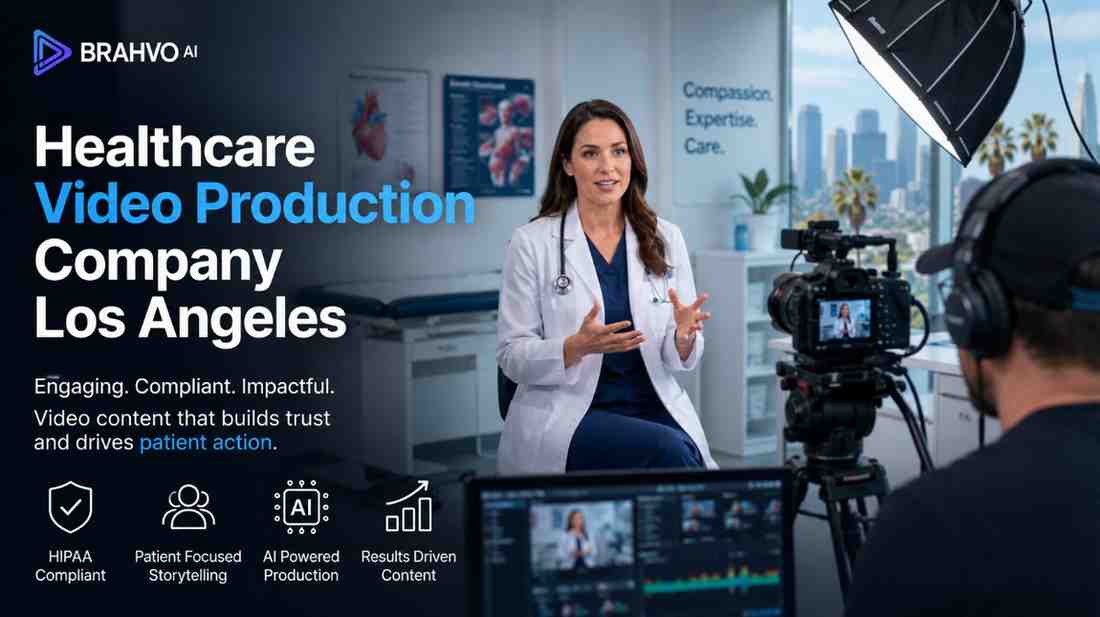
Healthcare video production is not simply about makingpolished footage and adding a logo at the end. For hospitals, clinics, medicalpractices, health technology companies, wellness brands, and healthcarestartups, video often has to do several jobs at once.
It needs to explain a service clearly, make patients feelcomfortable, represent medical information responsibly, and still holdattention in an environment where viewers scroll quickly. That combinationmakes healthcare content different from ordinary ecommerce or lifestyleadvertising.
A healthcare video production company Los Angeles shouldunderstand that the audience is often making a high trust decision. Someoneconsidering a treatment, diagnostic service, specialist consultation, orhealthcare product may spend only a few seconds with the content, but theirdecision can carry far more weight than a typical consumer purchase.
This changes the production process.
The first question should not be, "How can we make thislook impressive?" It should be, "What does the viewer need tounderstand before they can take the next step?"
That usually means starting with the audience and thepurpose of the video. A hospital may need physician introduction videos,patient education content, facility walkthroughs, or service explainers. Ahealth startup may need short paid social videos explaining a new product. Aclinic may need testimonial style creative, educational reels, and videos thatanswer common patient questions.
The production style can vary, but clarity should remainconstant.
A practical healthcare video production company Los Angelesalso needs to think about where the content will be used. A three minuteeducational video on a website has very different requirements from a 20 secondMeta ad. A YouTube explainer can afford more context. A TikTok or Instagramplacement needs the core message much sooner.
This is where production experience matters. The sameunderlying message often needs several executions instead of one master video.
For example, a Los Angeles dermatology clinic promoting anew treatment might produce one longer physician led explanation, then cut thatidea into short videos covering the treatment process, common questions,expected experience, and post treatment care. The creative is more usefulbecause each version answers a different concern.
The better production teams think about these downstreamuses before filming begins.
That also affects scripting. Healthcare audiences tend torespond poorly when every sentence sounds like a commercial. Patients want toknow what something means, what they should expect, and why the informationmatters to them.
A script that says, "We provide advanced solutionsusing the latest technology" does very little.
A script that explains what happens during the appointment,how long it usually takes, what the patient may experience, and who the serviceis intended for gives the viewer something useful.
That distinction becomes especially important when ahealthcare brand is paying for distribution. Paid media teams are underconstant pressure to find stronger hooks and better creative. The video has toearn attention without crossing the line into sensational claims.
A healthcare video production company Los Angeles shouldtherefore work closely with the brand's internal marketing team, medicalreviewers, and compliance stakeholders where needed. Production can becomepainfully slow when nobody decides who owns approvals.
This is one of the practical bottlenecks that getsoverlooked.
A concept may be approved by marketing on Monday, revised bya clinical reviewer on Wednesday, sent back to the production team on Friday,and then completely reframed the following week because legal has concernsabout a phrase in the opening. Suddenly a simple video has become a month longproject.
The production partner should help reduce that confusion bybuilding a realistic review process into the workflow.
Healthcare marketing has an unusual problem. The contentneeds to feel human, but the information still needs to be handled carefully.
A video can be visually beautiful and still fail because theviewer does not trust the message. On the other hand, a highly clinicalpresentation can be accurate but difficult to watch.
The middle ground is where most effective healthcare videolives.
Trust often comes from simple production choices. A realphysician speaking directly to camera can feel more credible than a heavilyscripted corporate presentation. Authentic footage of a facility can help apatient understand the environment before an appointment. Patient stories cancreate emotional context when they are handled respectfully and withappropriate permissions.
Clarity comes from reducing unnecessary complexity.
Medical teams often communicate in language that makes senseinternally. Patients may not understand those terms, even when the informationis technically correct. A healthcare video production company Los Angeles hasto translate complicated subjects without oversimplifying them to the point ofbecoming misleading.
That may mean using visual demonstrations, on screen text,simple graphics, animation, diagrams, captions, or short examples.
The goal is not to remove the medical substance. It is tomake the substance easier to understand.
Compliance adds another layer.
Healthcare organizations have to pay attention to privacy,patient permissions, medical claims, advertising standards, and internal reviewrequirements. The exact requirements vary depending on the organization and thetype of content, so production teams should not treat compliance as a quickcheckbox at the end.
For example, a patient testimonial may sound powerful in acreative meeting, but the production team needs to know exactly whatpermissions have been obtained and what can be shown. A physician statement mayneed review if it contains clinical claims. Before and after visuals may raisedifferent concerns depending on the service and how they are presented.
The safest approach is not to make every video soundcautious and lifeless. It is to build a review process that catches meaningfulissues while the creative idea is still manageable.
This is where experienced production workflows can make adifference.
Another important consideration is the difference betweenorganic content and paid advertising. A clinic may publish a detailededucational video on YouTube with a broader explanation. The paid media versionmay need a much tighter opening because the viewer has less patience and noreason to keep watching.
The content can still be responsible.
It just needs a stronger first few seconds.
For example, instead of opening a paid video with a logoanimation and a generic introduction, the first line might answer a questionpatients are already asking.
"How long does recovery usually take after thisprocedure?"
That creates immediate relevance.
There is also a common misconception that healthcare videomust always feel serious. I might be wrong here, but some healthcare brandsstill overcorrect on this point. A professional tone is important, butprofessional does not have to mean stiff.
A warm physician, a natural patient interview, a well pacedexplainer, or even a lightly conversational social video can make the brandfeel more approachable without reducing credibility.
The key is knowing where personality helps and where itdistracts.
Patient focused storytelling begins with the patient'sproblem, not the organization's message.
That sounds obvious, but many healthcare videos are stillstructured around the company itself. They introduce the organization, listcredentials, explain services, and end with a call to action.
From the viewer's perspective, the more useful question isoften much simpler.
"Can you help me with the problem I am trying tosolve?"
A healthcare video production company Los Angeles can buildstronger creative by finding the tension behind that question.
A patient may be nervous about an upcoming procedure. Aparent may be looking for a pediatric specialist. Someone managing a chroniccondition may want a clearer explanation of treatment options. A consumerresearching a wellness product may want to know whether it fits their routine.
Those concerns can become the foundation of the story.
Consider a fictional Los Angeles orthopedic clinic launchinga campaign for a sports injury program. The first idea from the marketing teammight be a polished facility tour. That is useful, but it may not be thestrongest campaign concept.
A patient focused story could instead follow a recreationalrunner who stopped training because of recurring knee pain. The physicianexplains how the assessment works, what the treatment process involves, andwhat recovery may look like. Short clips can then focus on specific questionsfrom the larger story.
The clinic still gets to demonstrate expertise. Thedifference is that the expertise is presented through a problem the audiencealready understands.
That usually makes the content easier to watch.
It also creates more opportunities for creative testing.
A single patient story can produce several different hooks.One version could focus on the emotional frustration of missing activities.Another could focus on the diagnostic process. Another could feature thephysician answering a common question. Another could use a short patient quoteas the opening.
The production team is not simply making one video anymore.It is creating a useful library of creative assets from the same coreproduction.
This is especially valuable for healthcare brands runningMeta Ads, TikTok Ads, or YouTube campaigns because creative fatigue can happeneven when the underlying offer has not changed.
A campaign that relies on one polished video eventuallybecomes predictable. Frequency rises, engagement falls, and acquisition costscan start moving in the wrong direction.
That does not always mean the campaign strategy is broken.
Sometimes the creative simply needs another angle.
AI video production can help here, particularly when thebrand needs more variations without repeating a full shoot every time. AIassisted workflows can support scripting, editing, versioning, motion graphics,visual adaptation, and rapid creative iteration. That can be useful forhealthcare companies that need to produce multiple messages for differentservices and audience segments.
Still, AI should not replace the human parts of healthcarestorytelling that depend on credibility and context.
A generated visual might explain a concept efficiently. Areal physician may still be better at answering a sensitive patient question. Areal patient story may carry an emotional weight that synthetic content doesnot.
That balance matters.
The strongest healthcare video production company LosAngeles approach is therefore not simply "use more AI." It isdeciding where speed and variation are useful and where real human presence ismore persuasive.
For a healthcare marketing team, the commercial question isoften straightforward. How many useful creative variations can the team producebefore quality starts slipping?
That number is different for every business.
A clinic with three core services may need a modest contentlibrary. A national healthcare brand with multiple service lines, customersegments, and paid channels may need dozens of versions running through testingcycles.
The production model needs to match that reality.
A healthcare video production company Los Angeles shouldalso understand that patient focused storytelling does not always meanemotional storytelling. Sometimes the most useful video is simply a clearexplanation.
A diagnostic company might produce a 45 second video showinghow a test works.
A telehealth brand might explain what happens during avirtual consultation.
A dental practice might answer whether a procedure requiresdowntime.
These videos may not have dramatic narratives. They stillsolve a real information gap.
And that is often the point.
When healthcare content consistently answers the questionspeople are already asking, it becomes easier for paid media teams to testhooks, easier for social teams to maintain publishing volume, and easier forpotential patients to understand what the brand actually does.
At some point, the production conversation moves beyond"Do we need another video?"
The better question becomes, "Which patient questionare we still failing to answer?”
Healthcare organizations rarely need just one type of video.A hospital may need physician introductions, service explainers, patienteducation videos, recruitment content, facility tours, and paid advertisingcreative. A specialty clinic may need short videos answering common patientquestions. A health brand might need product demonstrations, educationalcontent, testimonials, and social ads.
The challenge is making all of these videos feel like theybelong to the same organization while still giving each piece a clear purpose.
A healthcare video production company Los Angeles needs tounderstand that educational and promotional content have different jobs.Educational video should help the viewer understand something. Promotionalvideo has to connect that understanding with a reason to take action.
The two can overlap, but they should not be treated asidentical.
For example, a clinic offering a specific treatment couldcreate a three minute physician led educational video explaining who maybenefit from the treatment, what the process involves, and what questionspatients should ask during a consultation. From that same shoot, the marketingteam could create shorter paid social videos focused on individual questions.
One video answers a broad question. The others answernarrower ones.
That approach is particularly useful for hospitals andlarger healthcare organizations with multiple departments. Instead of producingunrelated videos every time a department requests content, the production teamcan think in terms of a reusable content library.
A cardiology department might need videos about preventivecare, common symptoms, diagnostic procedures, and physician expertise. Awomen's health department may need a completely different set of subjects andtone. The audience, concerns, and buying journey are not the same.
The production process has to account for those differences.
There is also a practical consideration around attention.Educational healthcare videos do not need to be boring simply because thesubject is serious. A physician can explain a complex topic in a conversationalway. Motion graphics can simplify a process. B roll can show the environment orprocedure without turning the video into a corporate presentation.
For promotional content, the first few seconds become evenmore important.
A paid video introducing a clinic with a logo animation,location shot, and generic greeting may look professional, but it can lose theviewer before the actual message begins. A stronger version might start withthe question the patient is already searching for.
"Wondering whether this treatment requiresdowntime?"
Now there is a reason to keep watching.
That does not mean every healthcare video needs a dramatichook. It means the viewer should quickly understand why the content isrelevant.
For brands working with a healthcare video productioncompany Los Angeles, the production brief should therefore define the audience,intended action, channel, approval requirements, and key message before filmingbegins. This sounds basic, but unclear briefs are one of the easiest ways tocreate unnecessary production rounds.
A hospital video intended for its website has differentrequirements from a 15 second vertical ad. A physician interview for YouTubeneeds different pacing from a short Instagram Reel.
The production should reflect that from the beginning.
Healthcare companies often face an uncomfortable productionproblem. There is never a shortage of topics, but there can be a shortage oftime, people, and usable creative assets.
Marketing teams may know they need more videos for paidsocial, but every new concept can require scripting, filming, editing, review,captions, graphics, resizing, and approvals.
That process becomes difficult when the brand has multipleservices or locations.
AI video production can help reduce some of this workload.
It can support tasks such as creating initial scriptvariations, adapting messaging for different audiences, generating motiongraphics, producing visual concepts, editing footage into different formats,creating captions, and developing multiple versions of an approved concept.
The value is not that AI magically produces a finishedhealthcare campaign.
It is that some repetitive production work can happenfaster.
For example, suppose a healthcare brand has one physicianinterview explaining a treatment process. Instead of treating that recording asone finished video, an AI assisted production workflow can help identifyseveral useful sections and turn them into shorter creative assets.
One version might focus on the treatment process.
Another might answer a frequently asked question.
Another could explain who the service is intended for.
Another might focus on what patients should expect duringtheir first appointment.
The underlying source material remains consistent, but thecreative output becomes more flexible.
That matters when paid media teams need fresh content.
Still, there are limits.
Healthcare is not the place to let automation make uncheckedclinical claims. A production workflow may help generate a draft, but medicalaccuracy and brand compliance still require appropriate human review.
The same applies to patient stories, physician statements,treatment outcomes, and sensitive subjects.
A healthcare video production company Los Angeles using AIresponsibly should know where automation makes sense and where it should stop.
This is also where AI can become less useful than peopleexpect. If a healthcare brand has weak messaging, simply producing more videoswill not solve the underlying problem.
Twenty variations of a weak idea are still weak creative.
The better use of AI is to increase the number of viableexecutions around a clear concept.
That distinction can save a marketing team a lot of wastedproduction time.
It also allows teams to react faster when a campaign revealssomething unexpected. If one particular patient question produces unusuallystrong engagement, the brand can create additional content around that subjectinstead of waiting weeks for an entirely new production cycle.
That speed can be useful, but accuracy still comes first.
Healthcare advertising becomes much more interesting oncevideo is treated as a testing variable rather than a finished asset.
A media buyer may see that a campaign is underperforming andimmediately look at audience targeting, budget allocation, or bidding. Thosefactors matter, but creative can be the issue.
If the same video has been running for several weeks, theaudience may simply have seen it too many times.
Creative fatigue is particularly noticeable on paid social.
A healthcare video production company Los Angeles workingwith performance marketing teams should understand the difference betweenproducing more content and producing useful creative variations.
Changing the background music does not necessarily create anew idea.
Changing the opening problem, message, proof point, oraudience concern can.
For example, a healthcare clinic could test four openingsfor the same service:
"Not sure what happens during your firstappointment?"
"Still putting off treatment because you are worriedabout recovery?"
"Here is what patients should know beforescheduling."
"Three questions to ask before choosing thistreatment."
The underlying service has not changed. The entry point has.
This is where Meta Ads, TikTok Ads, and YouTube Ads can eachrequire slightly different creative thinking.
Meta placements often benefit from quick context and strongvisual communication. TikTok can reward a more conversational and nativepresentation, although healthcare brands still need to stay appropriate for thesubject. YouTube gives brands more room for educational storytelling,particularly when the viewer is actively looking for information.
One production shoot can support all three channels, butsimply exporting the same video into three sizes is not always enough.
The pacing and opening may need to change.
Testing should also go beyond click through rate. Ahealthcare campaign may need to consider video retention, landing pagebehavior, qualified leads, appointment requests, cost per acquisition, andultimately the quality of those conversions.
A cheap lead is not automatically a good lead.
This is especially important for specialized medicalservices where the number of potential customers is smaller and the patientdecision takes longer.
A video may generate fewer immediate conversions but attractpeople who are much more qualified. Another video may generate plenty of clicksbut poor appointment quality.
The media team needs enough data to distinguish thosesituations.
I might be wrong here, but I think some healthcare brandstest creative too narrowly. They change one headline, one visual, or oneopening and call it a new concept. Sometimes the more meaningful test is theangle itself.
Test the fear of delaying care.
Test convenience.
Test education.
Test physician expertise.
Test the patient experience.
Test a specific question.
Those are different reasons to watch.
The production system then needs to make those variationsaffordable enough to test without turning every experiment into a major shoot.
Scale becomes complicated when a healthcare company stopsmarketing one service to one audience.
A hospital might serve families, older adults, athletes,expectant parents, and patients with chronic conditions. Each audience hasdifferent questions and different levels of familiarity with medicalterminology.
The same message cannot always serve everyone equally well.
A healthcare video production company Los Angeles can helporganize production around content themes rather than treating every request asan isolated project.
Consider a healthcare organization with five major servicelines. Each one could have a core educational video, physician content, shortquestion and answer clips, paid social variations, testimonial content whereappropriate, and supporting visual assets.
That creates a production ecosystem rather than a collectionof random videos.
It also makes planning easier.
The team can identify which content needs a physical shootand which pieces can be produced from existing footage. It can determine whichmessages need physician review and which are straightforward brandcommunications.
This matters because production costs can rise quickly whenevery asset requires the same level of effort.
A two minute physician interview should not be treated likea television commercial.
A short social video may only need a simple edit, captions,a strong opening, and clear branding.
A detailed patient education piece may justify more filming,animation, graphics, and post production.
The formats should follow the communication need.
Vertical video has become particularly important becausemuch healthcare content now reaches people through mobile feeds. But horizontalvideo still has a place across websites, YouTube, presentations, and connectedTV environments.
The goal is not to produce every possible format for everyvideo.
That becomes expensive very quickly.
Instead, production teams should identify which formats havea real distribution purpose.
There is another issue that often gets ignored: assetmanagement.
Once a healthcare brand has hundreds of clips, physicianinterviews, animations, patient stories, graphics, and edited versions, findingthe right footage can become a problem itself. A well organized content librarycan reduce unnecessary reshoots and make future campaigns easier to produce.
The value of a production partner is partly measured by whathappens after the first video is delivered.
If every new campaign starts from zero, the organization hasnot gained much production efficiency.
High production quality matters in healthcare becauseviewers make judgments about credibility quickly. But spending more money onevery video is not necessarily the right answer.
A polished production with no useful message is still a poorinvestment.
The better question is where production quality actuallychanges the viewer's perception or understanding.
A major hospital brand introducing a flagship service mayjustify a professionally filmed hero video with physicians, patients, locationfootage, interviews, and custom graphics.
A short paid social response to a frequently asked questionmay not need that level of production.
It might work better as a straightforward physician videowith clean audio, strong lighting, captions, and thoughtful editing.
This is where a healthcare video production company LosAngeles needs to understand production economics as well as creative.
A brand running a large paid media program may need 20 or 30creative variations each month. If every variation costs as much as atraditional commercial, testing becomes difficult.
A smarter approach can be to separate production intolevels.
High value brand pieces receive more production attention.
Core educational content receives a moderate level ofproduction.
Testing creative uses a lighter production model.
AI assisted editing and versioning can then help expand theoutput from the footage that has already been created.
For example, a single physician shoot could produce a longform interview, several educational clips, multiple paid social hooks, verticalversions, captioned edits, and short question and answer videos.
The shoot itself remains a meaningful expense, but its valueincreases because the footage serves multiple purposes.
This does not mean brands should endlessly recycle oldfootage. Audiences eventually notice repetition. It means production planningshould consider how one filming day can support several weeks or months ofuseful content.
Budget allocation should also be connected to performance.
If one type of healthcare video consistently generatesqualified appointments at a reasonable acquisition cost, the brand has a reasonto produce more variations around that concept.
If another format receives views but produces no meaningfulbusiness action, its role may need to be reconsidered.
That does not mean every video must sell somethingimmediately. Healthcare content can support awareness, education, trust, andconsideration.
But someone should know why the video exists.
A healthcare video production company Los Angeles can playan important role here by connecting creative production with the actual mediaand business objectives. The production team does not need to become the mediabuying team. It simply needs to understand what happens to the video once itleaves the editing timeline.
That connection is becoming more important as healthcarebrands produce content across websites, social platforms, paid campaigns,patient education channels, and other digital touchpoints.
The difficult question is not really whether healthcarebrands need more video.
Most already know they do.
The harder question is how to produce enough useful creativeto keep campaigns fresh, patients informed, and brand standards intact withoutturning the production budget into an endless line item.
Choosing a healthcare video production company Los Angelesis not simply a matter of comparing portfolios and asking how much a videocosts.
For a healthcare organization, the more important questionis whether the production partner can keep delivering useful content after thefirst project is finished.
That distinction matters because healthcare marketing rarelyruns on one campaign. Hospitals, clinics, health technology companies, medicalpractices, and wellness brands usually have an ongoing need for educationalcontent, physician videos, social media creative, paid advertising assets,patient focused stories, and service specific explainers.
A production partner that can deliver one excellent videobut struggles with the next ten may not be the right long term fit.
The first thing to assess is whether the company understandshealthcare communication. Medical content has different expectations from astandard commercial. The audience may be anxious, unfamiliar with medicalterminology, or trying to make a decision that has significant personalconsequences.
The video needs to communicate clearly without making theviewer feel like they are being sold to.
A healthcare video production company Los Angeles shouldalso understand the difference between educational content and advertisingcontent. A physician explaining a procedure on a website may need more contextthan a 20 second paid social video. A hospital brand film may focus onreputation and trust. A short TikTok style video may answer one patientquestion.
These should not all be produced using the same creativeformula.
Another useful consideration is whether the productioncompany can think beyond the final edited file.
Suppose a healthcare organization films a physicianinterview. A traditional workflow might produce one three minute video and moveon to the next project. A more useful production approach could identifyseveral short educational clips, paid social variations, vertical edits,question and answer segments, and supporting footage from the same session.
That makes the original production investment work harder.
This becomes especially important when the organization ismanaging multiple services. A hospital may have dozens of departments. Ahealthcare technology company may serve physicians, patients, employers, andhealthcare administrators. Each group may need different messaging.
A long term production partner needs a system for handlingthat complexity without making every project feel like a completely newengagement.
Ask How They Handle Creative Testing
Healthcare brands running Meta Ads, TikTok Ads, or YouTubecampaigns should ask how the production team thinks about testing.
If the answer is simply, "We make high qualityvideos," that does not tell you much.
The more useful question is whether the team understandscreative variation.
A paid media team may need five different hooks for the sameservice. It may want one version focused on convenience, another on education,another on physician expertise, and another addressing a common concern.
The production company does not necessarily need to managethe advertising account. But it should understand that the video willeventually be tested in a performance environment.
This changes how footage is captured and edited.
For example, a physician interview should not be filmed onlyfor one polished final cut if there is an obvious opportunity to create severaluseful pieces from it.
Creative fatigue is another reason this matters. Ahealthcare brand may have a strong performing video that eventually startslosing effectiveness because the same audience has seen it repeatedly. Thesolution is not always a new campaign.
Sometimes the campaign needs new creative angles.
A long term production relationship gives the marketing teama better chance of responding to that need without starting from scratch everytime.
Look at Their Approach to AI Video Production
AI is becoming useful in healthcare video production,particularly for editing, versioning, scripting assistance, captions, motiongraphics, content adaptation, and creative iteration.
But a healthcare brand should be careful about what itexpects AI to do.
The right question is not whether a healthcare videoproduction company Los Angeles uses AI.
The better question is where it uses AI and where humanreview remains essential.
Medical claims, physician statements, patient stories,sensitive information, and clinical explanations need appropriate oversight. AIcan help with production efficiency, but it should not be treated as anauthority on medical accuracy.
For example, a production team could use AI assistedworkflows to turn a physician's approved interview into multiple short videos.That can reduce repetitive editing work and help the brand produce morecreative for paid social.
The physician's actual expertise remains the source of themessage.
That is a much more practical use of AI than trying to makeevery healthcare video entirely synthetic.
Consider Production Capacity, Not Just Portfolio Quality
A portfolio can tell you whether a production company canmake attractive videos.
It does not always tell you whether it can support a busymarketing organization.
Ask what happens when you need 15 short videos instead ofone long video. Ask how revisions are handled. Ask how quickly new creative canbe produced when a campaign needs fresh assets.
These questions become important when marketing activityincreases.
A healthcare brand may start with one campaign andeventually need content for several services, locations, audiences, andchannels. The production partner needs to be able to grow with that demandwithout quality becoming inconsistent.
This does not mean bigger production is always better.
A small, focused production team can sometimes move fasterthan a large operation with multiple layers of approval. What matters iswhether the workflow fits the organization's actual needs.
Pay Attention to Communication and Approval Processes
Healthcare content can involve marketing teams, physicians,compliance reviewers, executives, legal teams, and sometimes externalstakeholders.
That means communication can become a production issue.
A video can be creatively approved by marketing and thensent back for major changes because a clinical reviewer was not involved earlyenough.
A strong production partner should have a clear process forcollecting feedback and identifying who has final approval.
This sounds like administrative detail.
It is not.
A disorganized approval process can turn a simple video intoseveral weeks of revisions.
For long term work, ask who manages communication, howfeedback is collected, how many revision rounds are normally included, and whathappens when the scope changes.
The answers can reveal more about the working relationshipthan a polished showreel.
Evaluate Whether They Understand Your Audience
A healthcare video production company Los Angeles should beable to understand that different patients have different concerns.
A patient researching cancer care is in a very differentmindset from someone looking for a cosmetic treatment. Someone comparingtelehealth options may prioritize convenience. A parent choosing a pediatricprovider may care about trust and communication.
The video should reflect that context.
This is where patient focused storytelling becomes useful.Instead of starting with everything the organization wants to say, theproduction team can start with what the viewer is likely trying to understand.
That could be a practical question.
It could be uncertainty about a procedure.
It could be concern about cost or recovery.
It could simply be a lack of understanding about what aparticular service actually does.
When content addresses those concerns directly, the videohas a clearer reason to exist.
Think About the Economics of Ongoing Production
Long term content production needs a realistic budget.
A healthcare organization should not commit to a productionmodel that looks impressive but becomes difficult to maintain after a fewmonths.
A useful approach is to decide which content deservespremium production and which content can use a lighter workflow.
A flagship hospital video may justify a larger shoot.
A physician question and answer video may need little morethan good lighting, clean audio, a strong script, and careful editing.
Short paid social variations can often be created fromexisting footage.
AI assisted production can help create additional versionswhere appropriate.
The goal is not to make every video inexpensive.
The goal is to spend more where production quality genuinelymatters and avoid spending heavily where it does not.
That becomes particularly important for healthcare brandsinvesting heavily in customer acquisition. If paid media requires a steadystream of creative, production costs need to make sense alongside advertisingspend.
A beautiful video that cannot be tested because it consumedthe entire creative budget is not necessarily a smart investment.
Look for a Partner That Can Think Beyond One Campaign
A long term relationship works better when the productionteam understands what happened to previous creative.
Which videos performed well?
Which topics generated strong engagement?
Which patient questions kept appearing?
Which formats became difficult to produce?
Which concepts produced qualified leads rather than justviews?
These questions can help shape future production.
A healthcare video production company Los Angeles does notneed to own the media buying strategy to benefit from this information. Itsimply needs enough understanding of the marketing context to produce bettercreative the next time.
That creates a feedback loop between production andperformance.
It also prevents the common problem of producing contentjust because the content calendar says another video is due.
Sometimes the right decision is to produce less.
Sometimes the right decision is to make five variations ofone strong idea.
Sometimes an existing video needs a new opening rather thana completely new shoot.
Those decisions are difficult to make when production isdisconnected from the business.
For a healthcare organization looking for a long termcontent partner, that connection may ultimately matter more than the size ofthe production crew or the number of impressive shots in a portfolio.
The real test comes several months into the relationship,when the brand needs fresh creative, the media team needs new angles, thephysicians have limited availability, and the next campaign is already waiting.
That is when production capability becomes much more thanvideo quality.
What does a healthcare video production company LosAngeles typically produce?
It can produce physician interviews, patient educationvideos, service explainers, hospital and clinic videos, testimonials, brandfilms, social media content, paid advertising creative, animation, and shortform educational videos.
The exact mix depends on the organization's audience andmarketing goals.
How is healthcare video production different from regularcommercial video production?
Healthcare content usually requires greater attention toaccuracy, patient privacy, medical claims, approvals, and audience trust.
The creative still needs to be engaging, but it cannotsacrifice clarity simply to create a stronger advertising message.
Can a healthcare video production company create videosfor Meta Ads and TikTok Ads?
Yes. Short form healthcare advertising can be createdspecifically for paid social environments.
The important part is adapting the creative rather thansimply resizing a longer video. Hooks, pacing, captions, framing, and messagingmay need to change depending on the platform and audience.
Can one healthcare video be turned into multiple piecesof content?
Yes, and this can be one of the more practical ways tocontrol production costs.
A physician interview, for example, can potentially become alonger educational video, several short question and answer clips, verticalsocial videos, paid advertising variations, and supporting content.
The footage needs to be planned with those uses in mind.
How can AI video production help healthcare brands?
AI assisted production can help with tasks such as editing,captioning, scripting variations, content adaptation, motion graphics, andcreating different versions of approved creative.
It should not replace appropriate medical review or humanjudgment.
Does every healthcare video need to look highly produced?
No.
A flagship brand film may need substantial production value.A physician answering one patient question may work better when it feels directand natural.
Production quality should support the purpose of the videorather than become the purpose itself.
How often should a healthcare brand create new video ads?
There is no universal schedule.
The right frequency depends on audience size, ad spend,campaign performance, creative fatigue, and the number of services beingpromoted.
A brand spending heavily on paid social may need newvariations much more frequently than a local clinic relying primarily onorganic search and referrals.
What should healthcare companies look for when choosing ahealthcare video production company Los Angeles?
Look beyond the portfolio.
Consider healthcare communication experience, productioncapacity, revision processes, understanding of paid media, ability to createmultiple formats, AI assisted workflows, audience understanding, and thecompany's ability to support ongoing content needs.
The working process matters as much as the final video.
Can healthcare video production support patientacquisition?
It can support the acquisition process, particularly whenvideos answer specific questions, communicate expertise, explain services, andaddress concerns that prevent people from taking the next step.
But video alone does not guarantee patient acquisition.Landing pages, offers, targeting, follow up, reputation, and the overallpatient experience also affect what happens after someone watches the video.
Is a healthcare video production company Los Angelesuseful for smaller clinics?
It can be, provided the production model matches theclinic's budget and actual content needs.
A smaller clinic may not need large commercial shoots everymonth. It may get more value from focused physician videos, educationalcontent, short form social creative, and reusable footage that can supportseveral campaigns.
The question is less about how much video a clinic canproduce and more about whether each video has a useful job.