Find a corporate video production company in New York for professional, AI assisted video content built for sales, marketing, and growth.
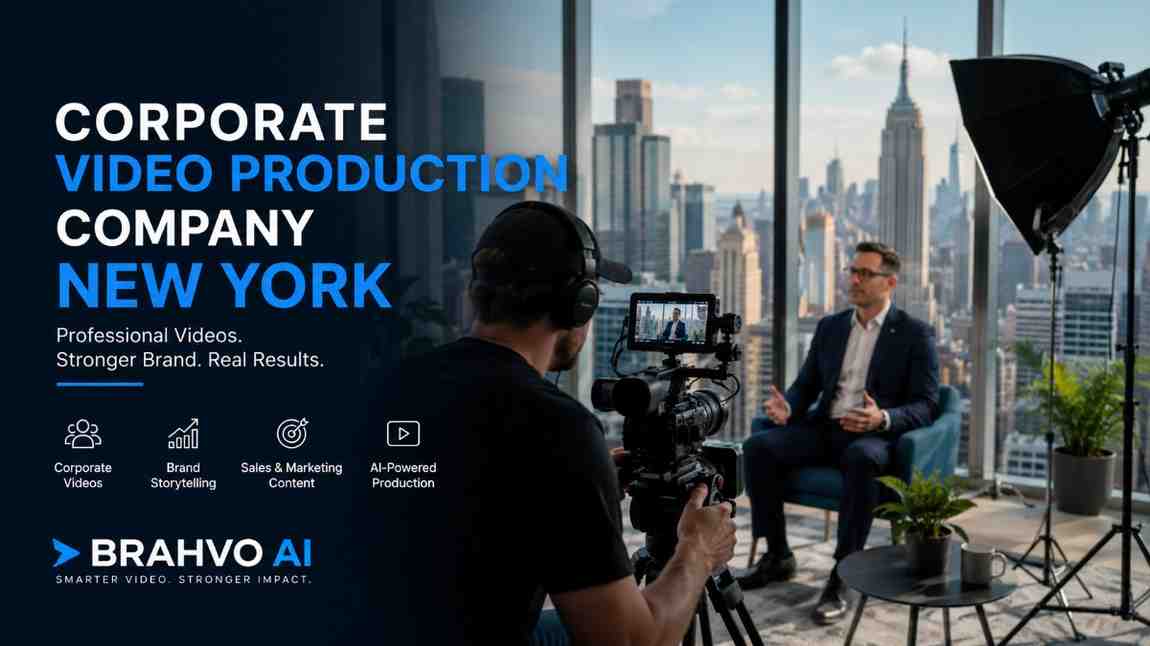
A few years ago, a corporate video could sit on a company website for three or four years without anyone questioning it. That is harder to get away with now.
A New York company may have a polished website, a strong sales team, and a recognizable brand, yet the video on its homepage still looks like it was produced for a completely different market. The problem becomes obvious when the company starts pitching larger clients, recruiting senior talent, raising capital, or trying to explain a complicated product in a crowded market.
This is one reason businesses are paying closer attention to what a corporate video says about them.
For many companies, the challenge is not simply making a video. It is making something that feels credible, current, and useful to the people who actually influence the business. A corporate video production company in New York may be brought in for a brand film, executive interview, company overview, customer story, recruiting video, product presentation, or a series of short videos for digital campaigns.
The shift is also partly about where corporate video is being consumed. A business video is no longer limited to a company homepage or an annual presentation. Pieces of the same production can appear across LinkedIn, YouTube, sales presentations, landing pages, investor communications, recruitment campaigns, and paid advertising.
That changes how the production needs to be planned.
A company spending heavily on one polished five minute video may get less practical value than a company that plans one production around several useful pieces of content. A founder interview, for example, might become a long form corporate video, several short social clips, sales content, recruitment material, and supporting footage for future campaigns.
That does not mean every business needs dozens of videos.
It means the production decision has become more connected to the way the business communicates.
When companies search for a corporate video production company in New York, they sometimes focus first on cameras, studios, lighting, locations, and editing.
Those things matter, but they are only part of the job.
A professional production process usually starts much earlier. The production team needs to understand what the company is trying to communicate, who will watch the video, where the video will appear, and what action or impression should follow.
For example, a financial services company speaking to institutional clients has very different communication needs from a New York ecommerce company trying to recruit creative talent. A technology company explaining its platform to enterprise buyers has another set of requirements.
The production itself can involve creative planning, scripting, interview preparation, location planning, filming, directing, sound recording, lighting, editing, motion graphics, animation, color correction, sound design, subtitles, and multiple content versions.
For some businesses, executive interviews are central to the project. For others, the product or workplace needs to carry the story.
This is where experience matters.
A corporate video can look technically impressive and still fail because the message is too vague. Someone watches it and still cannot explain what the company does, who it serves, or why it should matter to them.
That is a costly mistake.
A good corporate video production company in New York should be able to work through those communication problems before the camera starts rolling.
There is also a practical production issue that companies often underestimate. Employees and executives are busy. Getting a CEO, sales leader, product executive, customer, and creative team into the same location can take serious coordination.
If the production process is poorly managed, the company loses more than money. It loses executive time.
A well-planned shoot can capture several useful assets during the same session. One interview may support the main corporate film while also providing material for short videos, internal communications, recruitment content, or sales presentations.
This is especially useful for companies with multiple teams or product lines.
Corporate video often works best when the viewer needs to decide whether a company feels credible.
That could be a prospective client evaluating a vendor. It could be an investor researching a management team. It could be a strategic partner trying to understand a company's capabilities. It could even be a senior candidate deciding whether the company looks like a serious place to work.
In those situations, a corporate video does something a written page cannot always do as quickly. It gives people a sense of the company behind the claims.
People can see the leadership team speaking. They can see the workplace. They can see products being developed, employees working, facilities operating, or customers interacting with the business.
Those details can carry a lot of weight.
Consider a New York B2B technology company preparing to approach larger enterprise accounts. Its website explains the platform well, but the sales team keeps hearing the same concern from prospects: "Can we trust this company with something this important?"
A corporate video could address that concern by showing the people behind the platform, explaining the company's experience, showing the product in use, and allowing senior leadership to communicate directly.
The video does not magically create trust.
It gives the viewer more evidence from which to form an opinion.
That distinction matters.
Investors and business partners may also respond to a different type of corporate storytelling. They may care about leadership, company history, operational scale, market position, technology, facilities, or long term direction.
A generic promotional video may not answer those questions.
A carefully planned corporate film can.
For client acquisition, the same principle applies. A potential customer is often asking several questions at once.
Can this company actually deliver?
Does the team understand my problem?
Do they have the people and infrastructure to handle the work?
Will working with them feel straightforward?
A corporate video cannot answer every question, but it can reduce uncertainty before the first serious sales conversation.
That is particularly useful for businesses selling services where the customer cannot evaluate the product simply by looking at it.
Professional services firms, technology companies, manufacturers, construction companies, financial firms, healthcare businesses, and other B2B organizations often fall into this category.
The challenge is making the video believable.
Overproduced corporate language can work against the company. If every sentence sounds like it came from a boardroom presentation, viewers notice.
The strongest videos often allow executives and employees to speak in a more natural way. The production quality can still be high, but the people on camera should sound like actual people who know their business.
That balance is not always easy.
A corporate video production company in New York also has to work within the visual expectations of the market. New York businesses compete for attention with sophisticated brands, agencies, media companies, technology firms, and global organizations. A video that feels dated or generic can make a company appear smaller or less established than it really is.
At the same time, expensive visuals alone do not solve the problem.
A beautifully shot video with weak messaging is still a weak business asset.
The better approach is to connect the production quality with a clear reason for every major creative decision.
If the video is aimed at enterprise buyers, the visuals should support credibility and clarity. If it is intended for recruitment, the workplace and people may need more attention. If it is being used in paid advertising, the opening seconds and pacing become much more important.
This is where corporate video starts to overlap with performance marketing.
A company may produce one central corporate film and then create shorter versions for Meta Ads, LinkedIn, YouTube, landing pages, email campaigns, or sales outreach.
AI video production is also changing this equation.
AI can help teams produce variations, create supporting visuals, adapt formats, and develop additional creative concepts without treating every new asset as a completely separate production. But AI should not replace the parts of corporate video that require real people, real locations, genuine interviews, and authentic business experiences.
That is where I would be careful about the assumption that more AI automatically means better video.
It does not.
If a company has a weak story, AI can help produce more versions of a weak story. That is not necessarily useful.
The more interesting opportunity is using AI alongside traditional production so that a single shoot can support a larger content system.
For a New York company with several products, multiple customer segments, or an active sales team, that can make a meaningful difference.
Brahvo AI approaches corporate video production with this broader content requirement in mind. The goal is not simply to create one finished film and move on. Corporate video can become much more useful when the original production is planned with future content needs in mind.
A company may need one major brand video today, but six months later the marketing team may need shorter executive clips, product explainers, recruitment content, social videos, or new versions for a campaign.
Planning for those needs early can prevent another expensive production cycle later.
There is also a human side to corporate video that should not be overlooked.
Executives often dislike being on camera. Employees may not know how to answer interview questions naturally. Clients may be uncomfortable participating in filmed case studies. A good production team has to manage those situations without making everyone feel like they are performing for a television commercial.
Sometimes the best interview answer happens after the official question has already been answered.
That small moment can become the most useful part of the video.
For New York businesses, the bigger question is therefore not simply whether they need corporate video. Many already do.
The question is what the video needs to accomplish, who needs to believe the message, and how much useful content can be created from the production effort.
A corporate video production company in New York that understands those business pressures can contribute much more than filming and editing. It can help a company communicate its people, capabilities, products, and credibility in a format that clients, investors, partners, employees, and prospects can actually spend time with.
And for a founder looking at the budget, that may be the real calculation: not how much one corporate video costs, but how much useful communication the entire production can create once the cameras are packed away.
For many New York companies, video has moved well beyond the homepage.
Sales teams use short executive clips during outreach. Marketing teams add customer stories to landing pages. Product teams create demonstrations for prospects who do not want to sit through a long sales call. Paid media teams test short video concepts across Meta Ads and other social campaigns.
The useful part is that the same production can support several stages of the buying process.
A corporate video can introduce the company to someone who has never heard of it. A shorter product video can answer a specific question later in the buying journey. An executive interview can give a prospect more confidence before a sales meeting. A customer story can help remove doubt when the prospect is comparing vendors.
This is particularly important for B2B companies with longer sales cycles.
A buyer might see a company through LinkedIn, visit the website, watch a product video, speak with sales, and later share a corporate video internally with another decision maker. Video can travel through that process without requiring the sales team to explain the same thing repeatedly.
The key is not producing video simply because video is popular.
The content needs a job.
A New York technology company selling enterprise software may need a polished company film for its website, but its sales team might get more practical value from several shorter videos explaining individual features, customer outcomes, implementation, and the people behind the product.
The same principle applies to marketing campaigns.
Instead of treating one corporate film as a finished asset, companies can create different cuts based on where the viewer encounters the brand. A longer version may work on a website while a 30 second version gives a paid campaign a stronger starting point.
That also changes how creative teams think about production.
They are no longer asking only, "What should this video look like?"
They are asking, "Where will this video be used, and what does the viewer need to understand at that point?"
That is a much more useful question.
A large established company and a startup rarely approach video in the same way.
A startup may have limited brand recognition and little existing content. It needs to explain what it does quickly while making the business look credible enough for customers, investors, employees, and potential partners.
For a startup, one strong production can sometimes cover several needs.
A founder interview can introduce the company. Product footage can demonstrate the offering. Office footage can support recruitment. Customer interviews can provide social proof. Short clips can later be used by the marketing team.
The production does not have to look enormous.
It needs to make the company feel real.
Growing ecommerce brands face another challenge. They often need more creative content than their teams can produce internally.
A DTC company may be launching a new product while also managing several existing SKUs. The paid media team needs fresh concepts. The social team needs content. The website needs product demonstrations. The founder wants brand content. Meanwhile, creative fatigue is starting to show in Meta Ads.
That is a lot of demand for one production team.
A corporate video production company in New York can help when the brand needs higher quality production but does not want every piece of content to become a major film project.
For example, an ecommerce company could organize a single production day around a product launch. Instead of filming only one polished brand video, the team could capture product demonstrations, founder commentary, customer use cases, lifestyle footage, behind the scenes material, vertical clips, and supporting visuals.
Now the production has more life after the launch.
This matters because creative testing rarely stops at one winning concept. A media buyer may discover that customers respond strongly to a specific problem or use case. The creative team then needs new versions of that idea.
That is where a production library becomes useful.
A company with strong original footage has more options when new campaigns need to be developed.
There is a practical limitation, though. Not every growing company needs premium production for every campaign. Sometimes a simple founder video shot in the right environment will outperform something that took weeks to produce.
I might be wrong here, but I think businesses sometimes confuse production value with marketing value.
They are related, but they are not the same thing.
The production needs to match the purpose.
A recruitment film may benefit from polished interviews and workplace footage. A product education video may need screen recordings and demonstrations. A paid social creative may need a much faster opening and a more direct message.
The strongest corporate video production decisions usually start with the business objective rather than the camera setup.
AI video production is becoming particularly useful for companies that need more content from the same creative investment.
That does not necessarily mean replacing traditional filming.
For corporate video, real people and real environments still have an important role. An actual executive explaining why the company exists can feel very different from an artificial spokesperson. Real customers, employees, offices, products, and facilities can provide evidence that generated visuals cannot fully reproduce.
AI becomes more interesting after the core content has been created.
A company might film a detailed executive interview and then use AI assisted workflows to identify useful sections, adapt concepts for different audiences, develop variations, create supporting visual treatments, or prepare content for different formats.
For marketing teams, this can reduce the distance between one major production and the next round of creative needs.
Suppose a New York SaaS company produces a corporate film around its annual brand campaign. Six weeks later, the sales team wants a short video for a specific industry. The recruiting team wants another clip. Marketing wants several short pieces for social channels.
Without a content plan, the company may start scheduling new shoots.
With a smarter production process, some of those needs can be handled from the original footage.
AI video production can also help companies experiment with creative concepts before committing to larger shoots. Teams can explore different messaging directions, visual treatments, and versions of a concept.
But there is a line.
If the output begins to feel artificial, the efficiency is not worth much. Corporate communication depends heavily on credibility, and viewers are increasingly sensitive to content that feels manufactured.
For Brahvo AI, the more useful role of AI is not simply making corporate videos faster. It is helping businesses get more usable creative content from their video investment.
That distinction becomes important for companies with active marketing teams.
The goal is not to generate hundreds of videos.
Nobody needs that.
The goal is to create enough useful variations to support sales, marketing, recruitment, customer communication, and paid media without constantly starting from zero.
Every corporate video project eventually reaches the same conversation.
How much should we spend?
There is no universal answer.
A company raising a major funding round may have a very different budget from a startup preparing its first enterprise sales campaign. A national brand may need multiple locations and a larger crew. A smaller company may need one focused filming day.
The mistake is treating production cost as the only financial consideration.
Time also has a cost.
If a video takes three months to produce, it may miss the product launch it was intended to support. If the production requires executives to spend several full days preparing and filming, that time needs to be considered as well.
Turnaround matters when the content is connected to a campaign or launch.
At the same time, rushing every project creates problems. Poor planning often leads to additional editing rounds, missing footage, weak interviews, and expensive reshoots.
A useful production decision usually sits somewhere between perfection and speed.
For example, a company launching a new product might allocate more budget toward the hero video while keeping supporting social clips simpler. Another company might invest heavily in a customer story because enterprise prospects need that proof before signing a contract.
The budget should follow the business importance of the content.
That sounds obvious, but it gets missed.
Companies also need to consider how much content they can realistically use. Producing 40 videos when the marketing team can only distribute 10 of them is not necessarily efficient.
Sometimes fewer, better planned assets make more sense.
The first question should not be, "How much does the video cost?"
Start with what the company needs the video to accomplish.
Ask where the video will be used. Who will watch it. Whether it is intended for sales, brand positioning, recruitment, investor communication, paid advertising, or several of these at once.
Then look at how the production company thinks about the project.
A strong corporate video production company in New York should be interested in the business problem behind the video. It should ask about the audience, messaging, distribution, internal stakeholders, production schedule, and expected use of the final assets.
The portfolio matters too, but not simply because the videos look attractive.
Look at whether the company has handled situations similar to yours.
Can it work with executives who are not comfortable on camera?
Can it film in working business environments without disrupting operations?
Can it handle customer interviews?
Can it create different versions for digital channels?
Can it work within a fixed launch date?
These questions are often more important than whether a demo reel has impressive transitions.
You should also ask about the production process.
Who handles creative development? Who directs interviews? How are scripts approved? How many revision rounds are included? How will footage be organized? Can the production create vertical and horizontal versions when needed?
For ecommerce and performance marketing teams, ask one more question.
Can the production team think beyond the hero video?
A beautiful corporate film has value, but marketing teams often need smaller pieces that can actually be tested and distributed.
That might include short executive clips, product demonstrations, customer stories, behind the scenes footage, social edits, and paid media variations.
A production company that understands this can help a business get more practical use from the same filming day.
Brahvo AI brings AI video production into that conversation by combining traditional video production thinking with AI assisted creative workflows. For companies that need corporate content across sales, marketing, recruiting, and digital channels, the focus is on making the production useful beyond a single finished video.
That is probably the question worth asking before signing anything.
Not just, "Will this video look good?"
Ask what the company will actually be able to do with the footage six months after the shoot.
Corporate video production can become expensive very quickly. There is the creative work, filming, editing, executive time, locations, revisions, and then the question of what happens after the final video is delivered.
Brahvo AI approaches the process with a broader view.
Instead of treating a corporate video as one isolated piece of content, the production can be planned around the different ways a business communicates with its audience. A company may need a primary brand film, but its sales team may also need short executive clips. Marketing may need product videos. Recruitment may need employee focused content. Paid media teams may need shorter variations.
The original production can be planned with those future requirements in mind.
This matters for New York businesses because the same company may be speaking to several audiences at once. A technology company could be selling to enterprise buyers while recruiting technical talent and presenting itself to investors. A DTC brand may need brand storytelling alongside product focused creative for paid campaigns.
Brahvo AI combines traditional video production with AI assisted creative workflows to support these different needs.
AI does not replace the value of real footage. Real executives, employees, products, customers, offices, facilities, and locations can provide credibility that generated content cannot simply manufacture.
Instead, AI can help extend the usefulness of the original production.
A longer interview can become several shorter pieces. A corporate video can be adapted into different formats. Supporting creative concepts can be developed for specific campaigns. Marketing teams can have more material to work with without starting an entirely new production every time.
The idea is fairly simple.
Make the original shoot count for more than one deliverable.
For a company investing significant time and money into corporate video production, that can be a much more practical way to think about the production budget.
What does a corporate video production company in New York typically do?
A corporate video production company in New York can handle creative planning, scripting, interviews, filming, directing, lighting, sound, editing, motion graphics, animation, color correction, and final delivery.
The exact scope depends on the project. Some businesses need a single corporate film, while others need several videos for sales, marketing, recruitment, product education, or investor communications.
How much does corporate video production cost in New York?
There is no single price because production requirements vary considerably.
A simple interview based video may require a small crew and limited filming time. A larger corporate production could involve multiple locations, executives, actors, extensive travel, specialized equipment, animation, and several rounds of editing.
The better question is what the video needs to accomplish and how many useful assets can come from the production.
How long does it take to produce a corporate video?
A straightforward project can move from planning to final delivery relatively quickly, while larger productions can take several weeks or longer.
The schedule usually depends on creative development, approvals, filming logistics, editing, feedback, and revisions.
If the video supports a product launch or major campaign, the production schedule should be planned backward from the actual launch date.
Should a corporate video be professionally filmed or can a company use existing footage?
Existing footage can be useful, especially when it shows real customers, employees, products, facilities, or events that would be difficult to recreate.
However, professional filming is often worthwhile when the video represents the company at an important point in the sales or marketing process.
A combination can work well. Professional footage can establish the main story while existing material adds authenticity and context.
Can one corporate video be used for social media and paid advertising?
Yes, but the original video should be planned with different placements in mind.
A five minute corporate film is unlikely to work exactly the same way as a short paid social video. The messaging, pacing, framing, and opening need to reflect where the viewer encounters the content.
During production, it can make sense to capture enough material for shorter edits, vertical versions, executive clips, and other supporting content.
How can AI video production help a corporate video project?
AI can help with parts of the creative and post production process, including developing variations, adapting content, creating supporting visuals, and producing additional versions from existing material.
It should not automatically replace real filming.
For corporate communication, real people and real business environments often provide an important level of credibility. AI is more useful when it helps the company create more usable content from a strong original production.
Is corporate video useful for startups?
It can be, especially when a startup needs to establish credibility quickly.
A startup may use video to explain its product, introduce its founders, show how the business operates, support investor communication, recruit employees, or help sales teams explain a complex offering.
The production does not necessarily need to be large. A focused concept with strong messaging can be more useful than an expensive video that says very little.
What should I look for when choosing a corporate video production company in New York?
Look beyond the visual quality of the portfolio.
Consider whether the production company understands your audience, business model, sales process, distribution channels, and timeline. Ask how it handles executive interviews, customer stories, multiple formats, revisions, and content created for digital marketing.
If your company needs ongoing content, also ask whether the production can generate several useful assets from the same filming session.
Can corporate videos help sales teams?
They can support sales by answering questions that prospects commonly have before or during the buying process.
A sales team might use an executive introduction, customer story, product demonstration, or company overview during outreach and follow up.
Video does not replace a sales conversation, but it can give prospects something concrete to review and share internally.
How does Brahvo AI approach corporate video production differently?
Brahvo AI looks at corporate video as part of a wider content requirement rather than treating every production as a single finished film.
The process can combine professional video production with AI assisted workflows to create additional content from the original production. This can be useful for companies that need material across websites, sales presentations, social media, recruitment, product marketing, and paid campaigns.
The goal is not simply to produce more videos.
It is to make each production more useful to the business after filming is finished.