Choose a Los Angeles corporate video production company for AI powered video content, creative testing, paid ads, and brand storytelling.
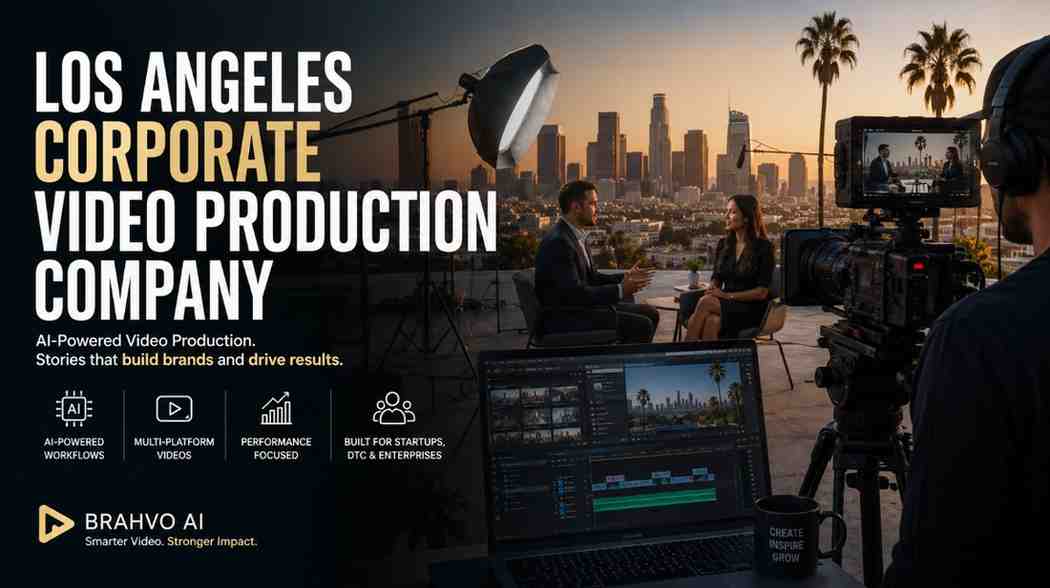
A corporate video used to have a fairly predictable job. Introduce the company, show the office, let an executive talk to the camera, add some polished footage, and finish with a logo. That approach can still work for certain internal communications or formal company presentations. But it is not always enough for brands competing for attention across websites, LinkedIn, YouTube, Meta Ads, and other digital channels.
For many Los Angeles companies, video now has to do several jobs at once. It may need to explain a complicated product, introduce a leadership team, support sales conversations, communicate a new launch, recruit employees, or give paid media teams creative assets to test.
That changes what businesses should expect from a Los Angeles corporate video production company.
The real challenge is not simply producing one impressive video. It is producing useful video content that fits the way people actually consume information. A two minute corporate film might be appropriate for a website homepage, while the same story may need to become several shorter pieces for social media, paid advertising, or sales outreach.
This is where the old production model starts becoming restrictive.
A business can spend weeks planning a single shoot, coordinate executives, locations, cameras, lighting, editing, voiceover, and approvals, then discover that the final video has limited use outside one page on its website. The production may look excellent, but the content system around it is weak.
For ecommerce brands and DTC companies, the problem is even more obvious. Creative fatigue can appear quickly in paid social campaigns. A video that performs well on Meta may lose its effectiveness after repeated exposure. Media buyers need new hooks, new openings, different product demonstrations, testimonials, and variations without restarting the entire production process every time.
That is one reason AI video production is becoming part of the conversation around corporate content.
AI does not remove the need for creative judgment. It changes how quickly a team can explore and produce different versions of an idea. A strong concept can be adapted into multiple formats without treating every variation as an entirely new production project.
A Los Angeles corporate video production company working with modern marketing teams therefore needs to understand more than cameras and editing. It needs to understand where the video will be used, who will see it, what action the viewer should take, and how the content can continue producing value after the first version is published.
Choosing a Los Angeles corporate video production company is not only about reviewing a portfolio and picking the videos that look the most expensive.
The better question is whether the production team understands the business problem behind the video.
Suppose a technology company wants a corporate video explaining a complicated software platform. A beautiful office shoot may create a polished impression, but if prospects still do not understand what the software does within the first few seconds, the video has missed an important part of the assignment.
The production process should start with the message.
What does the company need the audience to understand? What objections are preventing a purchase? Is the video intended for sales, recruitment, brand awareness, investor communication, paid media, or a product launch? Where will the video appear?
Those questions affect everything from the script to the visual treatment.
A good Los Angeles corporate video production company should also understand the difference between producing one video and producing a useful library of content.
For example, a single corporate shoot could potentially generate a primary brand video, executive clips, customer focused segments, product demonstrations, social cuts, short educational videos, and paid advertising variations. The exact deliverables depend on the project, but the thinking matters.
This becomes particularly important when marketing and production teams work together.
A media buyer may need several versions of an opening hook. A social team may need vertical edits. The sales team may want a short product explanation. A recruiting team may need employee focused content. If production is planned around only one final video, those requests can become expensive and slow.
AI can help with parts of this process, especially when brands need more creative variations without producing every asset from scratch.
But there is a limitation worth acknowledging. I might be wrong here, but some companies can become too focused on production speed and forget that the underlying idea still matters more than the number of videos produced.
Ten weak variations do not become a strong campaign simply because they were produced quickly.
The production company still needs people who understand storytelling, pacing, audience psychology, brand positioning, and advertising creative.
Cost is another consideration.
Los Angeles production can involve studios, crews, locations, equipment, talent, travel, post production, and multiple approval rounds. For a large corporate campaign, that investment may make sense. For a growing DTC brand testing several messaging angles, it may not.
The right production approach depends on the intended use of the content and the economics behind it.
Startups, DTC brands, and established companies can all need corporate video production, but they rarely need exactly the same type of content.
A startup may need to explain what it does before anyone has heard of the company. It might use video on its website, in investor presentations, during sales calls, and across LinkedIn. The biggest challenge is often clarity.
A DTC company has a different problem.
It may already have a clear product but needs creative that can compete inside crowded paid social feeds. The company could be running Meta Ads and TikTok Ads while constantly searching for new ways to present the same product.
One week, the strongest angle might be a customer problem. Another week, it might be a product demonstration. Then a founder story, a comparison, a testimonial, or a visual explanation.
The product has not changed. The creative context has.
Consider a Los Angeles based skincare brand launching a new product. The company could commission one polished corporate brand video explaining the product and its positioning. That might work well on the website.
But the paid media team may need fifteen or twenty different creative concepts around the same launch.
Some might open with a customer pain point. Others might focus on ingredients, product use, before and after expectations, founder credibility, or customer reactions. Different lengths and formats may also be required for Meta and TikTok.
This is where traditional production can become difficult to scale.
If every creative variation requires a full shoot, the cost and turnaround time can quickly become a problem. By the time new assets are ready, the campaign may already have moved into another testing cycle.
An AI video production approach can make certain parts of this process more flexible.
For example, a company could create a core brand story and then develop additional video variations around different messages. AI generated elements, editing workflows, voice options, motion graphics, product visuals, and format adaptations can sometimes reduce the amount of traditional production required.
That does not mean every corporate video should be generated with AI.
There are situations where real locations, real employees, professional actors, physical products, and conventional cinematography are exactly what the project needs. A manufacturing company showing its facility, for example, may benefit from authentic footage that AI cannot simply replace.
The decision should come back to the purpose of the video.
For a leadership interview, authenticity may matter most. For a product explainer, clarity may matter more. For a paid social campaign, testing velocity can become a major consideration.
This is also why corporate video production increasingly overlaps with performance marketing.
The old separation between brand video and advertising creative is becoming less useful for many companies. A corporate story can introduce a brand, but pieces of that story can also support paid campaigns. A product demonstration can educate a prospect and become a retargeting asset. An executive interview can produce short clips for LinkedIn while also supporting sales outreach.
The production process needs to account for these possibilities from the beginning.
Brahvo AI approaches this space with that broader content requirement in mind. Instead of treating corporate video as a single finished asset, the focus can be on creating video content that has practical use across the channels where modern brands communicate and advertise.
That matters because production is rarely the only bottleneck.
Approval cycles can slow projects down. Creative teams can run out of fresh concepts. Executives may be difficult to schedule. Agencies may need additional assets after a campaign launches. A new product may require content before a traditional shoot can be arranged.
Sometimes the issue is not that a company lacks ideas. It simply cannot turn those ideas into enough usable creative at the pace its marketing team needs.
And that leaves an uncomfortable question for any brand investing heavily in video: how much of the production budget is going toward making one impressive video, and how much is helping the marketing team create the range of content it will actually need over the next few months?
AI video production is changing what companies expect from corporate content, particularly in a market like Los Angeles where brands have access to a large creative ecosystem but also face intense competition for attention.
The biggest shift is not simply that AI can generate a video. It is that teams can explore more creative directions before committing significant production resources.
A traditional corporate video might begin with a script, move into pre production, involve a shoot, and then go through editing and revisions. That process still makes sense for many projects. But when a marketing team wants six different messaging angles or multiple versions for paid media, the traditional process can become slow and expensive.
AI can help fill that gap.
A company can start with a core message and test different openings, narration styles, visual treatments, lengths, and formats. Some versions may be used for social content. Others may become product explainers, sales assets, or advertising concepts.
For a Los Angeles corporate video production company, this creates a different production question.
Instead of asking only, "What should the final video look like?" the team may also ask, "How many useful pieces of content can this production create?"
That is a much more practical question for marketing teams.
There are also situations where AI video production can help before conventional production begins. A creative team can use early concepts to decide which story is worth producing rather than spending heavily on a concept that looked good on paper but does not communicate clearly once visualized.
Still, AI has limits.
A company with a recognizable physical location, complex manufacturing process, real employees, or highly specific product experience may need authentic footage. Generated visuals cannot automatically replace the credibility of showing the actual business.
So the useful approach is not AI versus traditional video production. It is knowing which parts of a project genuinely benefit from each method.
One corporate video rarely has one audience anymore.
A company may publish a main video on its website while the marketing team needs shorter versions for LinkedIn. The sales department might want a concise explanation for prospects. YouTube may require a different edit, while the paid media team could need several short versions for Meta Ads or TikTok Ads.
That means the original production needs to consider distribution from the beginning.
A website video can take more time to explain a company's positioning. A LinkedIn clip might need to get to the main point much faster. A paid social video usually has even less room for setup because the viewer did not actively search for the content.
The same underlying story can work across these channels, but it cannot always be copied and pasted.
For example, imagine a Los Angeles software company launching a new enterprise product.
The main corporate video could introduce the company, explain the problem it solves, show the product, and include comments from the leadership team. From that project, the company could create shorter clips focused on specific customer problems.
One clip might explain the problem.
Another might demonstrate the product.
Another could feature the founder discussing why the company was created.
A fourth could address a common objection.
The value comes from creating a connected set of assets rather than treating the corporate video as a single finished file.
YouTube can support longer explanations and educational content. LinkedIn often works well for executive perspectives, company announcements, customer stories, and industry commentary. Paid advertising requires a more direct approach because every second has an economic cost attached to it.
This is where AI video production can be useful.
When the core creative material already exists, AI assisted workflows can help create alternate versions without rebuilding the entire project each time. A marketing team can test different hooks or formats and learn which message deserves more investment.
For companies spending significant amounts on paid acquisition, that flexibility can matter more than having one exceptionally polished corporate video.
There is a natural tension between corporate storytelling and performance marketing.
Brand teams often want the company to feel distinctive and credible. Performance marketers usually care about whether the creative gets attention, communicates the offer, and generates a measurable response.
Neither side is wrong.
The problem appears when one goal completely takes over.
A corporate video that feels like a sales ad may weaken the company's credibility. On the other hand, a beautifully produced brand story that takes ninety seconds to explain why the viewer should care may struggle in a paid social environment.
The better approach is to understand where each piece of video will be used.
A brand video can take its time.
An advertising variation usually cannot.
A useful production process can create both without forcing one asset to perform every job.
This becomes particularly important when creative fatigue starts affecting Meta Ads performance. A campaign may still have a strong product, competitive offer, and reasonable landing page, but the same creative has been shown to the same audience too many times.
The media buyer then needs fresh creative.
That does not necessarily mean inventing a completely different brand message. Sometimes the team needs a new opening, a different customer problem, a different demonstration, or a different way to frame the same benefit.
AI video production can make these variations easier to explore.
But I would not assume that producing more variations automatically solves creative fatigue. Sometimes the problem is the offer. Sometimes the audience is too narrow. Sometimes the landing page is creating the real bottleneck.
Video is only one part of the acquisition system.
A strong Los Angeles corporate video production company should understand that distinction. Production should support the marketing objective rather than pretending that better visuals can fix every performance problem.
Format planning sounds simple until a company actually has to produce the assets.
A single campaign may require horizontal website footage, vertical social videos, shorter paid advertising cuts, square versions, interview clips, product demonstrations, and different lengths for different placements.
If those requirements are considered after production is finished, the editing process can become unnecessarily complicated.
The better approach is to think about formats during production.
Framing matters. Important visual information needs enough room to survive different crops. Interviews may need to be captured in ways that allow useful vertical edits. Product demonstrations need to remain understandable when the video is shortened.
Even the script can be written with multiple versions in mind.
A long corporate explanation can contain several smaller ideas that can stand independently. Those segments can later become short videos instead of forcing the editor to cut randomly from a longer piece.
For a DTC company, this can be especially useful.
Imagine a company selling a premium home fitness product. Its main corporate video explains the product, introduces the founders, demonstrates how it works, and discusses the customer experience.
The paid media team may later need a fifteen second product demonstration.
The social team may need a founder clip.
The website may need a longer explanation.
The sales team may want a customer story.
Instead of producing each asset separately, the original project can be planned around these eventual uses.
AI can support this process by helping teams generate or adapt certain creative elements and variations. It can also make experimentation less dependent on another full production cycle.
Still, there is a point where too many formats create clutter.
A company does not need every possible version simply because it can make them. The useful formats are the ones connected to actual distribution and audience behavior.
That distinction can save both time and budget.
Video budgets become easier to understand when production is connected to the business purpose.
A company spending $30,000 on one corporate video should not evaluate the project only by asking whether the final video looks worth $30,000. It should also consider where the asset will be used, how long it will remain relevant, how many derivative assets it can produce, and whether it supports sales and marketing activity.
The same logic applies to smaller projects.
A $5,000 production that produces one useful video may be perfectly reasonable for a specific purpose. But if the marketing team needs twenty creative variations every month, a different production model may make more financial sense.
Timing matters too.
Traditional corporate production can involve planning, location coordination, talent, filming, editing, revisions, approvals, and final delivery. None of those steps are necessarily bad. They simply require time.
For a product launch with a fixed date, that timeline can become a serious consideration.
Suppose an ecommerce company plans to launch a new product in six weeks. The marketing team needs website video, social clips, paid advertising creative, and several concepts for testing.
Waiting until the launch week to discover which creative works is not ideal.
The team needs enough material early enough to learn from it.
This is where AI video production can change the economics of creative testing. Instead of treating the first video as the final answer, a company can produce variations, put them into campaigns, monitor audience response, and decide which concepts deserve additional production investment.
That does not mean every variation needs to be expensive.
Some can be simple edits. Others may need new visuals, new scripts, or new footage. The point is to match production effort with the value of the test.
For media buyers, this creates a useful conversation with creative teams.
Instead of saying, "We need more videos," the request becomes more specific.
"We need three new hooks for this product angle."
"We need a version aimed at first time buyers."
"We need a stronger demonstration in the first five seconds."
"We need a shorter version for TikTok."
Those requests are much easier to act on.
A Los Angeles corporate video production company working with modern marketing teams has to understand this reality. Video is no longer only a finished corporate asset sitting on a website. It can become part of an ongoing creative testing process.
And that raises another budget question that many companies overlook.
If a video performs well, can the team create more content around the winning idea quickly enough to take advantage of it?
Because sometimes the most expensive video is not the one with the biggest production budget. It is the one that took so long to produce that the marketing opportunity had already moved on.
Corporate video production has changed because the demands placed on video have changed.
A company may still need a polished brand film, but it may also need short social clips, product explainers, paid advertising variations, founder videos, customer focused content, and launch assets. Those requirements can quickly turn one production project into a much larger content workload.
Brahvo AI approaches corporate video production with this broader requirement in mind.
The focus is not simply on producing one polished video and handing over the final file. The more useful question is how the video can support the company's wider marketing activity.
For a Los Angeles brand, that can mean creating content that works across a website, LinkedIn, YouTube, Meta Ads, TikTok Ads, sales presentations, and other customer touchpoints.
AI video production can make certain parts of this process more flexible. Creative teams can explore different concepts, messaging angles, visual treatments, lengths, and formats without treating every variation as an entirely new production project.
That can be particularly useful for companies that already have a clear brand identity but need more video content than their traditional production schedule can comfortably provide.
Brahvo AI can also fit into situations where a company needs to move quickly.
A product launch may require several advertising concepts. A company announcement may need different edits for social platforms. A corporate story may need to become a series of shorter pieces rather than remaining one long video.
The objective is not to create content simply because AI makes production easier.
The content still needs a reason to exist.
For a DTC brand, that reason might be testing a new product angle. For a B2B company, it might be explaining a complicated service. For a growing company, it might be introducing the founders or communicating a new direction.
This distinction matters because AI can make production faster, but it cannot decide what the audience actually needs without good creative thinking behind it.
Brahvo AI therefore fits best when AI assisted production is used as part of a broader creative process rather than treated as the entire strategy.
There are also practical advantages for teams working across multiple campaigns.
A marketing director may have one video requirement today and five more next month. A media buyer may find a particular message working well and want new variations around it. A founder may suddenly need video content for an upcoming announcement.
Traditional production can handle these situations, but the timing and cost can become difficult when every request requires a new shoot.
AI assisted workflows can give teams another way to respond.
That flexibility is especially relevant for brands that treat creative as an ongoing part of customer acquisition rather than a one time branding project.
What does a Los Angeles corporate video production company typically produce?
A Los Angeles corporate video production company can produce brand videos, company profiles, product demonstrations, executive interviews, customer stories, recruitment videos, training content, event videos, and advertising creative.
The exact production mix depends on where the content will be used and what the company wants the video to accomplish.
How much does corporate video production cost in Los Angeles?
There is no useful single price for corporate video production.
Costs can vary based on the number of filming days, locations, crew requirements, talent, equipment, scripting, animation, editing, revisions, and final deliverables.
A simple corporate video can have a very different budget from a large production involving multiple locations and professional talent.
For businesses, the more useful question is what the production needs to accomplish and how many usable assets it should generate.
Is AI video production suitable for corporate videos?
Yes, for certain types of corporate content.
AI video production can be useful for concept development, creative variations, product explainers, social content, advertising assets, and projects where speed and flexibility matter.
It may not be the right choice for every project. Some brands need authentic footage of their employees, facilities, customers, products, or physical operations.
The production method should follow the purpose of the video.
Can one corporate video be used for Meta Ads and TikTok Ads?
It can, but simply uploading the exact same video everywhere is not always the best approach.
Meta Ads and TikTok Ads have different viewing environments and creative expectations. A longer corporate video may need to be shortened, reframed, or rebuilt around a stronger opening for paid social.
The underlying story can remain consistent while the execution changes.
Why do ecommerce companies need so many video variations?
Creative fatigue is one reason.
A video that performs well initially may become less effective after repeated exposure. Media buyers may then need new hooks, visuals, demonstrations, customer angles, or offers to keep testing.
The product may stay the same while the creative needs to change.
That is one area where AI assisted video production can be useful because teams can explore more variations without rebuilding every project from the beginning.
Can corporate videos also support performance marketing?
Yes.
A corporate video can contain material that becomes useful for paid campaigns, social content, retargeting, sales outreach, and product education.
The important part is planning for those uses before production is finished.
If a company knows that paid media will be part of the distribution plan, the production team can capture and create content with those requirements in mind.
How long does it take to produce a corporate video?
The timeline depends heavily on the production.
A straightforward project may move relatively quickly, while a larger production can require several weeks because of scripting, planning, filming, editing, revisions, and approvals.
AI assisted production can shorten certain stages, especially when the project requires multiple variations or rapid creative testing.
That does not mean every project becomes instant.
Creative decisions, approvals, and revisions still take time.
What should a company ask before hiring a Los Angeles corporate video production company?
Ask where the video will be used, how many deliverables are required, who owns the final assets, what the revision process looks like, what the expected timeline is, and whether the production team can create versions for different channels.
It is also worth asking how the team handles additional creative requests after the original project is delivered.
That question often reveals whether you are buying one video or building a more useful content system.
Should a startup invest in a large corporate video production?
Not necessarily.
A startup may get more value from a focused video that explains the product clearly and produces several useful short assets than from an expensive brand film.
Budget should reflect the company's stage, audience, distribution channels, and immediate business needs.
A large production can make sense when the video has a long shelf life and will be used across important customer or sales touchpoints. It may not make sense when the company is still testing its positioning.
What makes a corporate video effective for a modern brand?
Clarity is usually more important than production complexity.
The viewer should understand what the company does, why it matters, and what makes the message relevant to them.
For brands running paid campaigns, the video also needs to earn attention quickly. For corporate websites, it may have more room to build context.
The strongest production choice is usually the one that fits the audience, message, channel, and business objective rather than simply looking impressive.
For many Los Angeles companies, the bigger question now is not whether they need corporate video. It is how much useful creative they can produce from each production investment, and how quickly that content can keep pace with everything else the marketing team is already testing.