Explore the best enterprise video production services for scalable AI video creation, ecommerce advertising, creative testing, and brand growth.
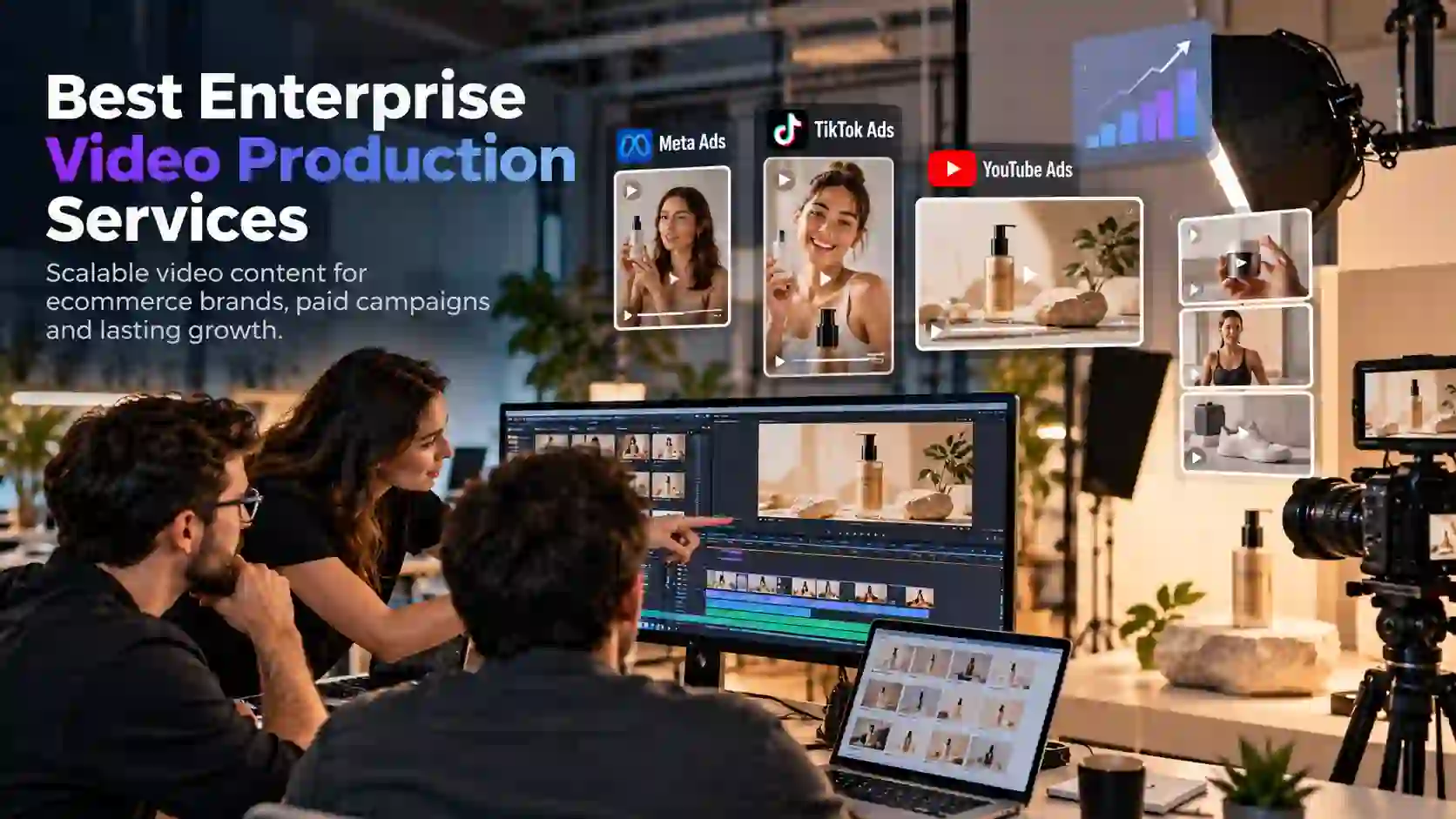
Enterprise ecommerce teams rarely have a shortage of ideas. Their bigger problem is turning those ideas into finished creative assets quickly enough to keep campaigns moving.
Consider a US based direct to consumer skincare company selling 25 products. Its marketing team wants videos for a new product launch, fresh variations of its best performing Meta Ads, TikTok creatives built around customer concerns, and YouTube videos explaining the product range. Each campaign has different requirements, and several products may need new creative at the same time.
A traditional production schedule can become difficult to manage. The team must coordinate scripts, talent, filming, editing, revisions, approvals, and delivery formats. By the time a video is ready, the campaign brief may have changed.
The best enterprise video production services help address this operational pressure by making production more organised and repeatable. Instead of treating every video as a separate project, the business can develop a production process that supports ongoing campaigns.
Three problems usually make this need especially clear.
Creative fatigue is affecting paid media performance. An ad that worked well last month may no longer attract the same attention. The audience has seen it repeatedly, competitors have introduced new messaging, or the offer no longer feels as relevant. Marketing teams need fresh angles, not simply a different crop of the same video.
Product catalogues keep expanding. A brand with several product lines may need demonstrations, benefit focused videos, comparison creatives, and launch assets for each product. Producing every asset from scratch makes the process expensive and difficult to scale.
Internal teams are spending too much time coordinating production. Marketing directors often find themselves chasing approvals and managing revision requests instead of evaluating campaign performance. When every video requires a separate chain of communication, the workload grows quickly.
The business case for enterprise video production is therefore practical. Teams need a reliable supply of usable creative assets while maintaining brand standards and reasonable production costs.
There is one important distinction, though. Producing more videos does not automatically lead to better advertising results. A business can generate dozens of assets and still struggle if the underlying messaging, offer, or audience understanding is weak.
A standard marketing video project often starts with a brief and ends when the final video is delivered. Enterprise production usually involves a longer relationship between creative development, campaign execution, brand governance, and ongoing content requirements.
The difference becomes obvious when a company needs to produce video across multiple departments or markets.
A corporate marketing team may require executive communications, product explainers, recruitment videos, and brand storytelling. Its ecommerce team may need product demonstrations, paid social ads, customer testimonials, and promotional videos. Both teams need professional production, but their approval processes, creative objectives, and publishing requirements are different.
The best enterprise video production services must account for these differences without forcing every department into an identical workflow.
Consistency matters across every asset. Brand colours, typography, product claims, voice, visual identity, and messaging must remain recognisable even when videos are created for different channels. This is particularly important for businesses with established brand guidelines and legal review requirements.
Production must accommodate several formats. A campaign may require vertical videos for TikTok, square assets for selected placements, landscape videos for YouTube, and shorter edits for other advertising placements. These versions should be planned during production rather than treated as an afterthought.
Approvals need to be manageable. Enterprise teams may involve brand managers, performance marketers, product specialists, legal teams, and regional stakeholders. Clear review stages reduce the risk of conflicting feedback and repeated editing.
The production partner needs to understand commercial priorities. A brand film designed to communicate company values is different from a product video designed to answer a specific objection before checkout. Both can be valuable, but they should not be evaluated using the same criteria.
This is why the best enterprise video production services are not necessarily the ones producing the most visually elaborate work. For many ecommerce businesses, dependable delivery, clear communication, flexible creative development, and accurate execution are just as important.
Brahvo AI focuses on AI driven video creation that can support brands needing more video assets across their marketing activities. The suitability of that approach depends on the project. AI generated scenes may work well for certain product narratives, while products requiring precise physical demonstrations, specialised filming, or highly specific human interactions may need a different production approach.
A common mistake in ecommerce advertising is asking every video to do the same job. Some videos need to introduce a product to someone who has never heard of the brand. Others need to explain how the product works or resolve a concern that is preventing a purchase.
The best enterprise video production services account for these different customer needs when developing creative assets.
At the awareness stage, the objective is to earn attention and establish relevance. A video might introduce a common problem, show a relatable situation, or demonstrate why a product category deserves consideration. It does not need to explain every feature.
For example, a home organisation brand could open with a cramped kitchen drawer and show how its storage system creates more usable space. The demonstration gives viewers a reason to keep watching without requiring a long explanation of the product specifications.
During consideration, shoppers are more likely to ask practical questions. How does the product work? What makes it different? Will it fit their needs? Videos at this stage can explain product features, demonstrate usage, address objections, and clarify differences between product options.
A premium supplement brand, for instance, may need separate videos explaining its ingredient choices, serving format, and product positioning. Any health related claims must be accurate, substantiated, and compliant with applicable advertising rules.
At the conversion stage, creative content can focus on the offer, product value, purchase friction, and reasons to act. This might include a concise product demonstration, an explanation of what comes in a bundle, or a reminder of a genuine promotional offer.
Post purchase videos also deserve attention. Setup instructions, product care, usage demonstrations, and onboarding content can help customers understand what they bought and use it correctly.
For enterprise teams, the practical benefit is that one product can support several distinct creative concepts instead of relying on a single generic advertisement.
Brahvo AI can help businesses develop video content for different messaging needs and campaign formats. The key is to begin with the audience's question and the intended outcome, then determine the production method.
Producing a video once and publishing it everywhere sounds efficient. In practice, it often creates mediocre results because the platforms have different viewing contexts, creative conventions, and audience expectations.
The best enterprise video production services account for those differences while maintaining a consistent campaign message.
Meta Ads require a steady flow of testable concepts
On Meta, ecommerce teams often test different hooks, product benefits, demonstrations, offers, and creative styles. A product video that opens with a broad brand message may perform differently from one that immediately addresses a customer's frustration.
A practical production plan might include three distinct concepts for the same product: one focused on a common problem, another showing the product in use, and a third explaining why the product is different from familiar alternatives.
The point is to test meaningful differences. Changing only the background music or text colour may produce a new file without giving the media buying team much new information.
TikTok Ads need a natural viewing experience
TikTok creative often benefits from direct openings, visual demonstrations, conversational language, and a clear reason to keep watching. The content should feel appropriate to the platform rather than like a traditional commercial squeezed into a vertical frame.
For brands using AI video production, this creates an important quality check. Generated visuals and voiceovers need to feel coherent, and the message should arrive quickly enough to hold attention.
YouTube supports deeper explanations as well as short ads
YouTube can accommodate short promotional videos, product demonstrations, longer explainers, and campaign storytelling. A viewer watching a detailed product comparison may be willing to spend more time with the content than someone encountering an ad while scrolling through a social feed.
That does not mean every YouTube video should be long. The right duration depends on the objective, placement, audience, and strength of the creative.
For enterprise teams, the challenge is coordinating all three channels without multiplying production costs unnecessarily. A shared campaign concept can inform several assets, but each edit should respect the viewing experience of its intended placement.
Brahvo AI can support this workflow by helping teams create video assets and variations for different campaign needs. The media buying team still needs to evaluate the finished creative, compare results, and decide which concepts deserve further investment.
The attraction of AI video production is straightforward. Marketing teams want to create more relevant content without increasing production time and costs at the same rate.
AI can assist with several parts of the process, including concept development, script variations, scene generation, voiceover production, editing support, and adaptation of creative assets. The exact capabilities depend on the workflow and the type of video being produced.
For an enterprise ecommerce brand, the most useful application may be reducing the time required to move from an approved concept to several usable creative variations.
Imagine a US based home goods company launching a new premium desk lamp. The initial campaign has one product demonstration and two benefit focused concepts. After reviewing early advertising results, the team wants to test different openings, highlight the lamp's adjustable lighting, and develop versions for different customer needs.
Without a repeatable production process, each new version can require another round of scripting, editing, and coordination. An AI assisted workflow may make it easier to create and review these variations, provided the source assets, messaging, and visual requirements are suitable.
The value is not simply a higher video count. It is the ability to test more useful ideas within a practical budget.
Where AI video production makes the most sense
AI driven production can be particularly useful when a company needs repeated variations of established creative concepts, product focused storytelling, campaign adaptations, or videos built around approved brand assets.
It can also help teams explore several messaging directions before committing resources to a more involved production.
However, the approach has limits. AI generated product details can be inaccurate. Packaging may look different from the real item. Hands, movement, shadows, and physical interactions can appear unnatural. A generated voice may also sound inconsistent with the brand's usual communication style.
These issues matter because ecommerce customers expect the advertised product to match what arrives at their door.
For products where physical accuracy is central to the purchase decision, teams should carefully inspect every scene and use verified product imagery or suitable footage wherever necessary. Human review remains essential, especially for regulated products and claims involving health, safety, or product performance.
Brahvo AI offers an AI driven approach to video production for businesses that need creative content at scale. The right workflow begins with the campaign objective, identifies what can be produced efficiently, and establishes quality checks before assets reach the advertising account.
I might be wrong here, but some teams spend too much time asking how many videos AI can produce and not enough time asking what each additional video will teach them about their customers. Production speed has limited value if the team cannot turn creative results into better decisions.
For enterprise marketers, that distinction affects everything from budget allocation to campaign planning. A larger creative library is useful only when it gives the business more relevant ways to communicate with customers and test its assumptions.
Creative testing becomes harder as an ecommerce business grows. A brand might start with a handful of products and one primary customer segment, then expand into new categories, launch products in different regions, and run campaigns for customers with very different priorities. The number of possible video combinations grows quickly.
The best enterprise video production services help marketing teams manage this complexity without turning every campaign into a separate production project.
Take a US based DTC fitness brand selling resistance bands, adjustable dumbbells, and recovery accessories. A beginner may care about ease of use and affordability, while an experienced athlete may be more interested in durability, versatility, and training progression. Showing both audiences the same product video might work, but it leaves useful messaging opportunities unexplored.
A more practical approach is to separate creative testing into three areas.
Product level testing examines which features, benefits, demonstrations, and use cases matter most for a particular item. A resistance band video might focus on portability, while an adjustable dumbbell video could demonstrate how quickly a user can change weights.
Audience level testing explores different motivations without making unsupported assumptions about customers. One creative concept might address limited workout space, while another focuses on fitting exercise into a busy schedule.
Market level testing accounts for differences in language, offers, customer expectations, and local requirements. A campaign running across the United States and Canada, for example, may need different promotional details, regional messaging, or product information.
The trick is to avoid changing everything at once. If a team changes the hook, offer, video length, audience, and landing page simultaneously, it becomes difficult to determine what influenced the result.
Enterprise video production should therefore support a testing process with clear creative hypotheses. Each variation needs a reason to exist.
For example, a performance marketing team could test whether a direct product demonstration attracts more qualified traffic than a problem focused opening. Both videos should lead to the same offer and landing page during the initial comparison, wherever practical. The team can then examine click through rate, conversion rate, customer acquisition cost, and other relevant metrics.
There is a budget consideration here, too. Not every SKU deserves the same production investment. Established bestsellers may justify several creative concepts, while a product with limited demand or uncertain positioning may need a smaller initial test.
Brahvo AI can support teams that need to create multiple video variations for different products and campaign requirements. The production plan should still reflect commercial priorities, available budget, and what the team needs to learn next.
More variations are useful when they answer meaningful questions. Beyond that, the creative library can become another thing the marketing team has to manage.
Production costs are rarely limited to the invoice for creating a video. Marketing teams also spend time writing briefs, gathering product assets, reviewing drafts, requesting revisions, coordinating approvals, and preparing final files for campaigns.
For enterprise brands producing videos every month, these indirect costs can become significant.
The best enterprise video production services make the total workload easier to understand. They help businesses plan production around campaign requirements instead of treating every request as an urgent, independent assignment.
Look beyond the cost of a single video
A video with a low production fee may require extensive internal editing and repeated revisions. Another asset may cost more upfront but arrive with the correct formats, approved messaging, and fewer outstanding issues.
The relevant question is how much the business spends to receive a usable asset that meets its requirements.
Consider a brand planning 30 video assets for a seasonal campaign. If every video requires a separate briefing process and several rounds of revisions, the project can consume substantial time across marketing, creative, and product teams.
A more coordinated workflow can group related assets, establish shared visual standards, and define which elements can vary. Product details, pricing, disclaimers, and campaign offers should be verified before production begins.
AI video production can reduce some production steps and make certain types of variation less expensive. It does not eliminate the need for planning, creative review, or corrections. A flawed product depiction can cost more to fix after publication than it would have cost to catch during review.
Protect the deadline without sacrificing accuracy
Seasonal campaigns are particularly unforgiving. A holiday offer may have a fixed launch date, and a delayed video can leave a paid media team with fewer creative options during a valuable sales period.
A sensible production schedule includes time for briefing, first drafts, stakeholder feedback, revisions, final approval, and delivery. It should also identify who has the authority to approve the work.
Late feedback often creates avoidable delays. One reviewer may request a new opening, another may change the offer, and a third may flag a product claim that should have been checked before production.
The best enterprise video production services help establish a process that catches these issues earlier.
Spend more where the creative risk is higher
Not every video needs the same production treatment. A straightforward product feature variation may be suitable for an AI assisted workflow. A major brand campaign, a complex physical demonstration, or a video involving strict technical requirements may need more extensive production and review.
This is where cost control requires judgment rather than a blanket rule.
Brahvo AI can be considered for enterprise teams seeking an AI driven approach to producing marketing videos at scale. The appropriate scope depends on the product, visual requirements, campaign timeline, and amount of creative variation needed.
Before committing to a large production programme, it is worth testing a small batch of assets. Review the quality, turnaround, revision requirements, and internal workload. The initial price matters, but so does what the finished content actually demands from your team.
Growing brands often reach a point where their advertising needs outpace their existing production process. The performance team wants fresh creative every week, the brand team needs consistency, and product launches create additional requests. Meanwhile, the budget still has limits.
Brahvo AI approaches this challenge through AI driven video production designed to support businesses that need video content for multiple marketing purposes.
The useful starting point is the campaign requirement, not the production technique.
A brand launching a new product may need a demonstration video, a short paid social ad, and several variations built around different customer benefits. Another business may need a steady flow of creative assets to test across its existing product catalogue. These projects have different priorities, even if both involve AI video production.
A practical enterprise workflow can begin with the following steps.
First, define the intended outcome. The team should establish whether the video is meant to introduce a product, explain a feature, address a customer objection, support a promotion, or test a new advertising concept. Without this clarity, production can become focused on visuals rather than the business problem.
Next, prepare the creative brief and source assets. Approved product images, brand guidelines, messaging, offer details, and relevant claims should be available before production. Clear inputs reduce the likelihood of incorrect product representations and unnecessary revisions.
Then, develop creative variations with a clear purpose. Different openings, demonstrations, benefit statements, and storytelling approaches can be considered based on the campaign objective. Each variation should serve a distinct purpose rather than exist simply to increase the number of files delivered.
Finally, review the finished videos before launch. Product accuracy, voiceover quality, visual consistency, subtitles, aspect ratios, disclaimers, and platform requirements should all be checked. Performance teams should also confirm that each asset matches the intended audience and landing page.
For a growing ecommerce brand, this process can make video production easier to coordinate across product launches and paid campaigns.
Brahvo AI's relevance depends on what the business needs to produce. Brands requiring frequent creative variations may benefit from an AI driven workflow, while campaigns involving complex physical production may require additional methods or specialist review.
The important point is to establish the right production model before scaling it. A process that works for five videos may need different approval controls, asset management, and quality checks when the requirement grows to 50 or 100.
A video can attract thousands of views and still fail to generate meaningful sales. Equally, a product demonstration with modest reach may help qualified shoppers understand the offer and convert at a better rate.
For enterprise teams, video performance needs to be evaluated in the context of the campaign objective.
The best enterprise video production services should support measurement by delivering assets that are clearly labelled, organised, and linked to their intended creative concepts. Production and measurement are separate activities, but poor asset organisation can make campaign analysis unnecessarily difficult.
Connect the metric to the objective
For awareness campaigns, reach, frequency, video viewing behaviour, and audience response may help teams understand whether the content is attracting attention. These metrics should be interpreted in relation to the campaign's intended audience and delivery conditions.
For direct response campaigns, click through rate, landing page conversion rate, customer acquisition cost, and return on ad spend may be more relevant. No single metric tells the entire story.
For instance, a video might generate a high click through rate but attract visitors who do not purchase. That could indicate a mismatch between the opening message and the actual offer. Another video might generate fewer clicks but bring in customers with stronger purchase intent.
Creative performance also depends on factors beyond the video itself, including the audience, bid strategy, pricing, promotion, landing page, and competitive conditions. Teams should be cautious about attributing every campaign change to the creative.
Measure learning as well as immediate revenue
An enterprise team may not find a profitable creative concept in every test. However, a well designed experiment can reveal which product benefits attract attention, which objections need better answers, or which audience motivations deserve further testing.
Those findings can inform future scripts, product pages, and campaign briefs.
Consider a fictional home office brand testing two video concepts for an ergonomic chair. One focuses on the chair's adjustable features, while the other demonstrates how it fits into a small workspace. If the second concept generates stronger purchase behaviour, the team has a useful hypothesis to test further. It should still account for audience and campaign differences before declaring a winner.
Brahvo AI can support the production side of this process by helping brands create video assets for different creative concepts. The marketing team remains responsible for evaluating campaign results and deciding where additional production budget is justified.
Ultimately, the value of enterprise video production should be judged by the quality and usefulness of the assets, the efficiency of the workflow, and their contribution to business objectives. A higher volume of creative is not a result on its own.
1. What are the best enterprise video production services?
The best enterprise video production services are those that fit a company's creative requirements, brand standards, production volume, budget, and delivery schedule. For ecommerce businesses, the ability to support ongoing advertising campaigns and multiple creative formats can be particularly important.
2. How is enterprise video production different from regular video production?
Enterprise video production usually involves more stakeholders, repeatable workflows, brand governance, and larger or more varied content requirements. It may support corporate communications, product marketing, ecommerce advertising, and campaigns across multiple markets.
3. Can AI video production support large ecommerce brands?
Yes. AI driven production can help with certain product videos, creative variations, campaign adaptations, and other repeatable content needs. The suitability depends on visual complexity, product accuracy requirements, and the type of footage needed.
4. How can enterprise video production help with Meta Ads?
It can provide a more organised supply of creative concepts and variations for testing different hooks, product benefits, demonstrations, and offers. The results still depend on the audience, campaign setup, landing page, and quality of the creative itself.
5. Is AI video production suitable for TikTok and YouTube advertising?
It can be suitable for both. TikTok creative often benefits from direct openings and natural presentation, while YouTube can support short advertisements and more detailed product explanations. Each finished video should be adapted to its intended placement.
6. How much do enterprise video production services cost?
Costs vary with production complexity, asset volume, editing requirements, turnaround time, and approval needs. AI assisted production may reduce costs for certain types of content, but businesses should evaluate the complete cost of receiving approved, usable videos rather than comparing production fees alone.
7. How many video creatives should an enterprise brand produce each month?
There is no universal number. A brand launching several products or testing multiple advertising concepts may need more assets than a company running a stable campaign. Production volume should follow the testing plan, campaign schedule, and team's ability to evaluate the results.
8. How should a business evaluate a video production partner?
Review creative quality, product accuracy, communication, revision processes, delivery reliability, format requirements, and experience with the intended type of content. For AI video production, also examine how the workflow handles visual errors and brand review.
9. Can Brahvo AI help brands produce video content for multiple campaigns?
Brahvo AI focuses on AI driven video production for businesses that need video content at scale. The appropriate scope depends on the campaign objectives, source assets, creative requirements, and production workflow.
10. What should a business measure after launching new video ads?
Choose metrics that match the campaign objective. For direct response advertising, customer acquisition cost, conversion rate, and return on ad spend can be useful alongside click through rate and video viewing metrics. Compare results under reasonably consistent conditions before attributing performance changes to the creative.