Find a Los Angeles photography production company for ecommerce product photography, lifestyle campaigns, and advertising creative production.
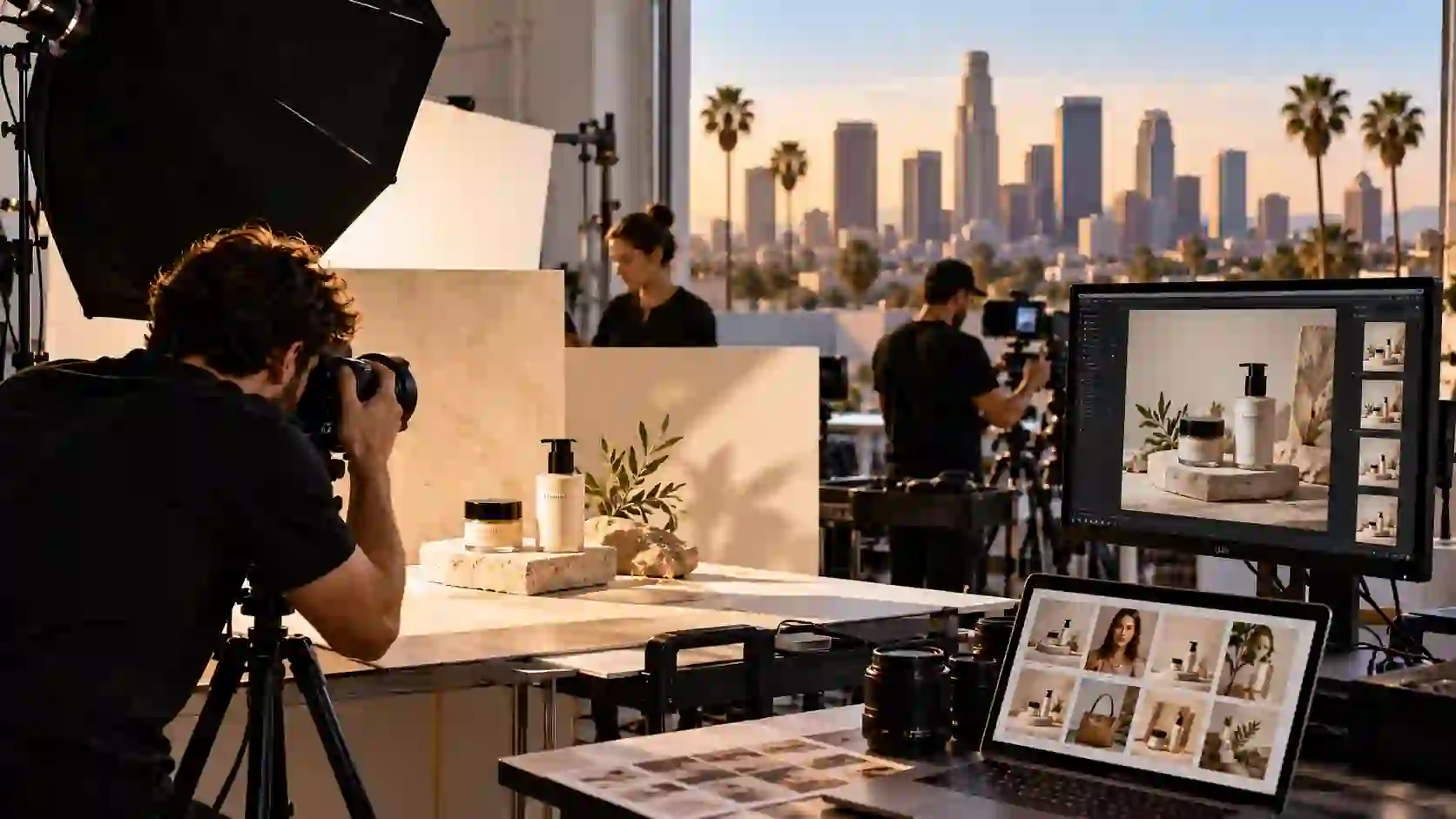
For ecommerce brands, a product can be excellent and still struggle to sell because the photos fail to communicate its value. A skincare bottle may look ordinary against a plain background. A clothing collection may feel inconsistent across product pages. An ad campaign may stop converting because audiences have seen the same creative concept too many times.
These problems are familiar to US marketing teams, especially brands managing multiple products, seasonal launches, and paid advertising campaigns at the same time.
Working with a Los Angeles photography production company can help brands create commercial images that serve a clear business purpose. The work goes beyond making products look attractive. It involves planning concepts, selecting suitable locations, managing lighting, coordinating talent, and producing images that fit different marketing channels.
Los Angeles has a particularly active creative production environment, with access to photographers, studios, models, stylists, and production crews. For brands selling across the US, this makes the city a practical location for product campaigns, lifestyle shoots, and advertising content.
Brahvo AI approaches creative production from the perspective of modern digital marketing, where photography and video need to work together. The important question is not simply whether a photo looks good. It is whether the creative communicates the product's value to the right customer and supports the campaign in which it will appear.
Not every ecommerce brand needs the same type of photography. A direct-to-consumer skincare company has different requirements from a furniture retailer or an apparel brand launching a seasonal collection.
The difference becomes important when production budgets are limited and each image needs to serve a specific purpose.
DTC brands often need a mixture of clean product images, lifestyle photography, advertising assets, and visuals that explain product features. A supplement brand, for example, might need packaging photography for its product page, lifestyle images showing how the product fits into a daily routine, and campaign visuals that communicate convenience or product differentiation.
Retail brands usually have greater consistency requirements. They may manage hundreds of SKUs, several product variations, and images distributed across their website, marketplaces, email campaigns, and retail partner listings. A photography process that works for ten products may become difficult to manage when the catalog reaches several hundred.
Lifestyle brands rely heavily on context. Their customers are not always buying a product based on specifications alone. They want to understand how it fits into their home, wardrobe, routine, or personal identity. Photography needs to communicate that feeling without making the product itself difficult to see.
A Los Angeles photography production company may support these needs through different production setups.
The right mix depends on how customers make purchasing decisions. A premium home decor brand may benefit from detailed room scenes, while a small electronics brand might need close-up product shots that clearly demonstrate its design and functionality.
One mistake brands make is treating every photography request as a separate project. Without a shared creative direction, the website, social ads, and product launch materials can end up looking like they belong to different companies.
A consistent visual approach helps prevent that problem while leaving room for different campaign concepts.
Photography has a direct role in how customers respond to paid advertising. It influences what people notice, what they understand about a product, and whether they feel interested enough to learn more.
For a media buyer, this creates a practical challenge. The campaign needs fresh creative assets, but the creative team also needs to understand what each asset is supposed to communicate.
Consider a DTC skincare company spending $30,000 per month on Meta Ads. Its current campaign features a product bottle against a neutral background. The ads initially perform well, but click through rates begin to weaken after repeated exposure. The team decides to test new creative directions.
Instead of producing ten nearly identical product shots, the brand commissions several distinct concepts. One emphasizes the packaging and product texture. Another shows the product as part of a morning routine. A third focuses on the product's size, portability, and ease of use.
The company can now test different messages and visual approaches rather than simply changing the background color.
This example illustrates an important distinction. Creative variety is not the same as creative volume. Producing more images does not automatically create better advertising opportunities. Each asset should give the marketing team a meaningful reason to test it.
A Los Angeles photography production company can help plan these variations before the shoot begins. That preparation matters because lighting, props, product positioning, model selection, and camera angles all affect the final creative.
Photography can support paid campaigns in several ways.
First, it gives customers a clearer view of the product. This is particularly useful for products where material quality, size, finish, or packaging affects purchasing decisions.
Second, it provides visual variety for advertising tests. A campaign can compare close-up product imagery with lifestyle scenes or test different environments for the same product.
Third, it helps maintain consistency between the ad and the landing page. When a customer clicks an ad featuring a particular product color, setting, or use case, the destination page should make it easy to recognize the same product.
That last point is often overlooked. A strong ad can attract attention, but a confusing landing page may still lose the sale.
Photography alone will not solve rising customer acquisition costs. Pricing, offer quality, audience selection, landing page performance, and product demand all matter. Still, weak or repetitive creative can limit what a paid media team learns from its campaigns.
For Brahvo AI, the broader opportunity is to connect commercial photography with video advertising workflows, allowing brands to plan related visual assets around the same campaign concept.
A photography shoot becomes much harder to manage when the product catalog grows.
A brand launching three products may need only a handful of images for each item. A company launching thirty products across multiple colors and sizes faces a different situation. Each SKU may require specific angles, packaging details, lifestyle images, and campaign assets.
Without a clear production plan, teams often discover missing images after the shoot is complete. Rescheduling talent, recreating a location, or shipping products back to a studio can make small oversights expensive.
The planning process should begin with the intended use of the images, not the camera setup.
Define the required deliverables
Before booking a shoot, the team should identify where each image will appear. Product detail pages, paid social ads, email campaigns, organic social posts, and launch announcements may all have different requirements.
A single hero image may work well on a product page but provide little variety for advertising. Similarly, an attractive lifestyle image might not show enough detail for a customer comparing product specifications.
Create a deliverables list that includes the product, image concept, intended channel, dimensions, and any required variations.
This gives the production team a clear target.
Group products strategically
Products can often be grouped by packaging, color palette, size, or photography setup. This allows the team to maintain consistency and reduce unnecessary setup changes.
For instance, a cosmetics brand may photograph several products using the same lighting arrangement before moving to a separate setup for lifestyle scenes. The approach can reduce wasted production time, provided each product still receives the attention it needs.
Grouping should not become an excuse to make every product look identical. Different items may require different lighting, styling, or camera angles to communicate their features accurately.
Plan for advertising variations
Paid media teams should contribute to creative planning before production begins.
If the campaign will test convenience, product quality, and everyday use, those ideas should influence the shot list. The team can then capture distinct visual treatments rather than trying to create every variation after the shoot.
It is also worth planning crops and formats in advance. A photograph intended for a vertical social placement may need a different composition from one designed for a wide website banner.
Establish a review process
The people approving the photography should agree on quality standards before production starts. These may include product accuracy, color consistency, image sharpness, branding, and the acceptable amount of retouching.
A shared review process helps avoid late feedback such as requests to reshoot products because the packaging color is inaccurate or an important product detail is hidden.
A Los Angeles photography production company that understands ecommerce requirements can help coordinate these decisions across creative, production, and marketing teams.
The goal is not to make the planning process complicated. It is to prevent avoidable production problems from consuming the time and budget needed for the next campaign.
Even well-funded brands encounter production problems. Some begin before the camera is switched on. Others appear when the images reach the marketing team.
One common issue is unclear creative direction. A founder may ask for premium photography, while the paid media team wants direct response assets that show the product clearly and communicate a specific benefit. Both requests can be reasonable, but they are not necessarily asking for the same visual treatment.
The team needs to establish which images serve brand building and which are intended to support immediate advertising objectives.
Another problem is inconsistent product presentation. This can happen when different photographers work on separate launches or when product packaging changes between production dates. The differences may seem minor individually, but a collection of inconsistent images can make an ecommerce store feel less cohesive.
Scheduling is another pressure point. Product samples may arrive late, a model may become unavailable, or a location may not be ready when expected. If the shoot covers multiple SKUs and campaign concepts, one delay can affect the entire production schedule.
There is also the challenge of producing enough fresh creative without increasing costs unnecessarily. Marketing teams often request additional variations because previous ads have started losing effectiveness. But a rushed production process may create several assets that differ only slightly and offer little new information for testing.
A more useful approach is to separate production requirements into three categories.
Essential assets are the images needed for product pages, core campaign launches, and required product details.
Testing assets explore different creative concepts, customer situations, visual hooks, or product benefits.
Supporting assets include secondary crops, email visuals, social content, and other materials that can be created from the planned shoot where appropriate.
This distinction helps teams prioritize the work that must be completed first while keeping room for creative experiments.
AI driven creative production can also play a role in how brands extend their content after the main shoot. Brahvo AI focuses on AI video production and related creative workflows that can support ecommerce advertising needs. Such workflows may help teams develop additional video concepts from approved product assets, depending on the source material and the production requirements.
They do not remove the need for accurate product photography, particularly when customers need to see genuine packaging, material details, or physical product features.
The practical decision is about where production time creates the most value. Some assets need a carefully controlled studio shoot. Others may be better suited to adaptation into different campaign formats.
A team that makes that distinction early is less likely to spend its entire creative budget producing variations that look different but communicate the same thing.
For ecommerce teams, creative testing often breaks down because production cannot keep pace with the advertising calendar. The media buyer wants to test a new product angle this week, the brand team is preparing a launch for next month, and the existing photography library contains plenty of images but very few that fit the new campaign.
This is where combining commercial photography with AI video production can be useful.
A Los Angeles photography production company can capture the original product visuals, lifestyle scenes, and campaign assets. Those approved assets can then serve as source material for additional creative formats, depending on their quality and the capabilities of the production workflow.
For example, a DTC home goods brand might photograph a lamp in a studio and in a furnished living room. The studio image can support the product page, while the lifestyle image can establish a more emotional connection in paid social advertising. The same campaign may also need short videos demonstrating the lamp's appearance in different settings.
AI video production can help develop some of those additional formats without requiring a completely new physical shoot for every variation. The exact possibilities depend on the original images, product complexity, motion requirements, and how accurately the final output must represent the physical item.
Test concepts, not just image variations
There is a meaningful difference between testing creative concepts and changing minor visual details.
A brand could create five versions of the same product image with slightly different backgrounds. That might reveal a preference, but it does not necessarily tell the marketing team much about customer motivations.
A more useful test might compare three distinct approaches:
Each approach gives the paid media team a different hypothesis to evaluate.
On Meta Ads and TikTok Ads, teams can use these concepts to test different opening visuals, messages, and creative formats. However, results still depend on audience composition, budget, campaign settings, offer quality, and landing page experience.
AI production can make it easier to prepare additional creative versions, but faster output is not the same as better testing. If every variation communicates the same idea, the team may generate more files without learning much.
Keep product accuracy under control
AI generated visuals require particular care when the product itself is central to the purchase decision.
Packaging text, logos, product dimensions, colors, and physical details can change unintentionally during image or video generation. These errors may be especially noticeable in cosmetics, electronics, furniture, and other products where customers rely on visual accuracy.
A sensible workflow keeps approved product imagery as the reference point and reviews generated content before publication. Any claims shown in the creative should also match the product's actual capabilities.
For brands investing in a Los Angeles photography production company, this means the original shoot still matters. Strong source imagery gives subsequent production work a more reliable foundation.
The best use of AI is not to make every campaign look more elaborate. It is to help the team explore worthwhile creative ideas without rebuilding the entire production process each time.
Ecommerce production works best when the creative brief reflects how the content will actually be used.
A brand may request a photography campaign because it needs new product images. Once the project begins, the team may also need paid social assets, short product videos, launch announcements, and visual variations for different customer segments. If those needs are not discussed early, the final deliverables may not match the marketing team's expectations.
Brahvo AI focuses on AI video production and creative workflows for ecommerce and digital advertising. Its role in this process is best understood alongside the requirements of commercial photography, rather than as a replacement for every part of a traditional shoot.
The workflow begins with the campaign objective. Is the brand launching a new product, refreshing an existing catalog, testing a new advertising angle, or creating content for a seasonal promotion? Each objective calls for different source material and creative priorities.
For a product launch, accurate product photography may be essential. For a campaign exploring several customer situations, the production team may need a wider range of lifestyle imagery and related video concepts.
The next consideration is asset planning. The brand and production team should agree on the deliverables, formats, visual direction, and approval requirements before production begins. This helps avoid the familiar problem of finishing a shoot only to discover that important advertising assets are missing.
Once approved source material is available, suitable images can be used within AI video production workflows to develop additional creative formats. These might include short advertising videos, alternative visual treatments, or content adapted for different placements. The available options depend on the campaign brief and the source assets.
Quality control remains important throughout the process. Product appearance, brand consistency, on-screen text, and claims all need review before the creative is released.
For brands evaluating a Los Angeles photography production company, the larger question is how well the production process fits the marketing operation. A beautiful image library has limited commercial value if it arrives too late for a product launch or lacks the formats the advertising team needs.
Brahvo AI's creative production perspective centers on connecting visual content with practical campaign requirements. The aim is to help teams plan assets with their intended use in mind, while recognizing that some projects still require dedicated photography, physical sets, specialist styling, or other traditional production work.
That distinction matters for brands that want more content without losing control over how their products are represented.
Photography budgets are difficult to manage when the scope is unclear. A quote may cover the shoot itself but leave important questions about retouching, usage rights, additional formats, reshoots, and delivery dates unanswered.
For a US ecommerce brand, the total production cost can include more than the photographer's fee. Studio rental, equipment, models, props, styling, product shipping, crew, postproduction, and project management may all affect the final amount.
A Los Angeles photography production company should be evaluated against the actual requirements of the campaign, not simply the initial estimate.
Identify the costs that affect the final budget
The production brief should distinguish between essential expenses and optional creative additions.
For instance, a product catalog shoot with consistent lighting and a fixed shot list may be relatively straightforward to scope. A lifestyle campaign requiring multiple locations, models, elaborate set design, and several creative concepts will involve different planning and production demands.
The number of final deliverables matters as well. Capturing 100 images does not necessarily mean receiving 100 fully retouched, approved assets. The contract should specify how many final images are included, what editing is covered, and how additional work is priced.
Usage rights deserve attention too. Brands should confirm where and for how long they can use the images, including paid advertising, ecommerce websites, social channels, and other commercial placements.
Build a timeline around approvals
A realistic production schedule accounts for more than the shoot date.
Product samples must arrive on time. The creative direction needs approval. Talent and locations may need to be confirmed. After the shoot, the team still needs to review proofs, request edits, and approve the final files.
One practical approach is to assign a single decision maker for creative approvals. When several stakeholders send conflicting feedback, revisions can stretch across days or weeks.
A shared shot list and a defined revision process also help prevent disagreements about what was originally commissioned.
Decide where flexibility is worth paying for
Not every image needs the same level of production investment.
A hero image for a major product launch may justify a more elaborate set and detailed retouching. A secondary image used for a limited advertising test may not need the same treatment.
This is where photography and AI video production can work together. A carefully planned shoot can capture the essential source material, while suitable assets can support additional creative formats where technically appropriate.
The tradeoff is that generated content still requires review, and certain product demonstrations or physical interactions may be better captured on camera.
There is no universal percentage by which AI workflows will reduce production costs. Savings depend on the original production scope, the type of content required, revision demands, and the amount of human review involved.
For budgeting purposes, brands should compare the total cost of approved, usable deliverables rather than the number of images or videos produced. An asset that cannot be published because of product inaccuracies or licensing restrictions is not a useful saving.
Measuring the Business Value of Commercial Photography
Commercial photography is often evaluated through subjective feedback. The founder likes the images, the creative director approves the styling, and the marketing team considers the shoot successful.
Those opinions matter, but they do not establish whether the photography is helping the business meet its objectives.
A more useful evaluation connects creative production to the role each asset plays in the customer journey.
For product pages, the team may examine conversion rate, add-to-cart rate, and the performance of pages before and after a visual refresh. For paid advertising, it may compare click-through rate, cost per landing page view, conversion rate, and customer acquisition cost.
These measures need context. A higher click-through rate does not necessarily mean a more profitable campaign. An image may attract attention but bring in visitors who are less likely to purchase.
Use controlled comparisons where possible
Suppose a footwear brand replaces basic product imagery with a combination of close-up photography and lifestyle images. If the brand also changes pricing, page layout, and promotional offers at the same time, it becomes difficult to determine which change influenced the results.
A controlled test can provide clearer evidence. The brand might compare two creative approaches while keeping the offer and other campaign conditions as consistent as practical.
Even then, results can vary with audience size, seasonality, inventory, and other factors. Small tests should not be treated as definitive proof.
Measure production efficiency as well
Advertising performance is only part of the picture.
A marketing team may also want to know how long it takes to move from a creative brief to approved assets, how many deliverables require substantial revision, and how much of the completed library is actually used.
These measures can reveal operational problems. If a company spends heavily on photography but most images never make it into campaigns, the issue may be poor planning rather than weak creative quality.
Brands can also track how quickly they can produce assets for new SKUs or seasonal launches. This is particularly useful for companies managing frequent product releases.
For Brahvo AI, this connection between source content, creative production, and advertising use is important. AI video production should be assessed by whether it supplies useful campaign assets and fits the team's workflow, not simply by how many variations it can generate.
The same principle applies when choosing a Los Angeles photography production company. Strong production is not measured by visual appeal alone. It is measured by the quality of the assets, their suitability for the intended channels, and the value they contribute to the business over time.
1. What does a Los Angeles photography production company do?
A Los Angeles photography production company coordinates commercial photography projects for brands and businesses. Services may include creative planning, studio rental, product styling, model coordination, lighting, photography, retouching, and final asset delivery. The exact scope depends on the production brief.
2. How much does commercial photography cost in Los Angeles?
Pricing varies based on the photographer, crew, studio, talent, number of products, production complexity, editing requirements, and usage rights. A simple product shoot and a multi-location lifestyle campaign can have very different budgets. Request an itemized estimate based on your required deliverables.
3. Is professional product photography worth it for ecommerce brands?
It can be, particularly when customers need to evaluate product quality, materials, packaging, dimensions, or appearance before purchasing. Its value depends on the product, existing imagery, customer expectations, and how the images are used across product pages and campaigns.
4. Can commercial photography assets be used for Meta Ads and TikTok Ads?
Yes. Product and lifestyle images can support paid social advertising, subject to each placement's creative specifications and the applicable usage rights. Some campaigns benefit from static images, while others require video or a combination of formats.
5. How many photos should a brand order for a product launch?
There is no fixed number. A launch involving one product may need a hero image, detailed product shots, lifestyle images, and several advertising concepts. A larger catalog may require a more standardized set of images for every SKU, with additional campaign assets for selected products.
6. Can AI video production reduce the need for new photography shoots?
In some situations, yes. Existing approved images may provide source material for additional video formats or creative variations. However, AI cannot reliably replace every physical product demonstration, complex interaction, or image requiring exact visual accuracy. The decision depends on what the campaign needs to show.
7. What should brands include in a photography production brief?
Include the campaign objective, target audience, product details, visual references, shot list, required formats, delivery dates, usage rights, budget, and approval process. If the content will support paid advertising, identify the creative concepts the media team wants to test.
8. How long does a commercial photography project take?
A straightforward studio shoot may be completed in a short production window, while planning, editing, and approvals can take considerably longer. Projects involving models, locations, complex styling, or multiple products generally require more coordination. Confirm the schedule before booking.
9. How does Brahvo AI fit into ecommerce creative production?
Brahvo AI focuses on AI video production and related creative workflows for ecommerce and digital advertising. These workflows can support the development of video assets from suitable source material. Brands should define their photography needs, intended deliverables, and quality requirements before deciding which parts of a campaign can use AI generated content.
10. What should brands check before hiring a Los Angeles photography production company?
Review relevant portfolio work, production experience, itemized pricing, delivery timelines, revision policies, usage rights, and the company's ability to manage your product category. Ask how it handles delays, product changes, and missing deliverables. The most suitable partner is one whose production process fits your campaign requirements and internal approval schedule.