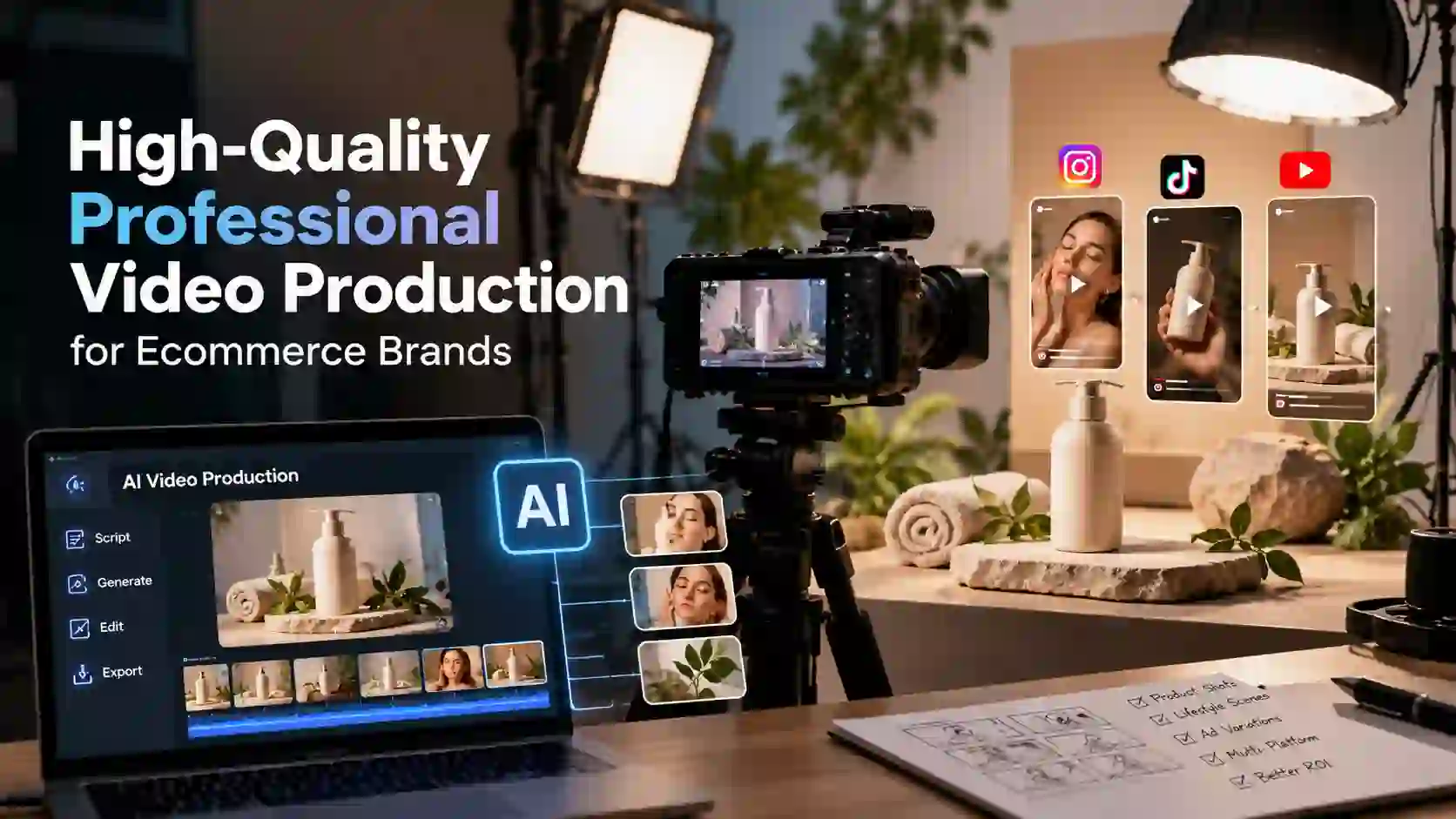
High-quality professional video production for ecommerce brands, with AI video workflows, creative testing, and paid ad strategies.
An ecommerce ad can get plenty of impressions and still struggle to generate sales. The product might be good, the offer might be competitive, and the audience might be relevant, yet shoppers keep scrolling. Often, the problem is how the product is presented and how quickly the video gives people a reason to care.
For US ecommerce and direct to consumer brands, high-quality professional video production plays a practical role in turning product features into something customers can understand, trust, and remember. That does not always mean expensive sets, large production crews, or cinematic shots. It means producing videos that make the product look credible, communicate its value, and fit the expectations of the audience.
Consider a skincare brand launching a new moisturizer. A basic product shot may show the packaging clearly, but it might not explain the texture, application, ingredients, or place in a daily routine. A well-produced video can communicate those details through close-up shots, demonstrations, captions, and a clear narrative. The customer gets a better sense of what they are buying before visiting the product page.
This matters even more when brands rely on paid social advertising. On Meta Ads and TikTok Ads, viewers make quick decisions about whether a video deserves their attention. Poor lighting, unclear framing, inconsistent audio, or an unconvincing product demonstration can create friction before the message has a chance to land.
However, production quality alone does not guarantee conversions. A beautifully shot video with a weak opening or an unclear offer can underperform a simpler creative that addresses a real customer problem. The goal is to combine visual quality with a message that gives shoppers a reason to keep watching.
High-quality professional video production also becomes more valuable as a brand expands its product catalog. When a company manages multiple SKUs, seasonal offers, and product launches, maintaining consistent visual standards can become difficult. Each new product needs its own selling points, demonstrations, and creative angles without making the entire advertising account feel disconnected.
For growing ecommerce businesses, the real question is not whether every video should look expensive. It is whether each video communicates the product clearly enough to support the next marketing decision.
A common mistake is judging a video almost entirely by its visual appearance. Sharp footage and attractive color grading matter, but paid advertising has a different job from a brand film shown at an event or on a company homepage.
High-quality professional video production for advertising combines technical execution, persuasive communication, and the ability to deliver a message within a limited amount of time.
Several elements deserve attention.
Visual clarity. The product should be easy to identify, even on a small mobile screen. Important details should not disappear because of poor lighting, excessive background activity, or awkward camera angles. For products such as apparel, cosmetics, kitchen accessories, and fitness equipment, showing the item in use can be more useful than relying on packaging shots.
A clear opening. The first few seconds should establish why the video is relevant. That could mean showing a common frustration, demonstrating a product feature, presenting an unexpected use case, or putting the product directly into action. A long logo animation often consumes valuable attention without answering the viewer's first question.
Credible demonstrations. Customers want to see what a product actually does. A video for a storage product might show how much it holds. A portable blender ad might demonstrate its size, operation, and cleanup process. The footage should make the product's value understandable rather than relying on unsupported claims.
Sound and pacing. Dialogue should be intelligible, music should support the message, and cuts should help viewers follow the demonstration. Fast editing is not automatically better. If every shot changes before the viewer understands what is happening, the video may feel energetic without being persuasive.
A coherent message. One creative should usually communicate a central reason to buy. Trying to explain every feature, discount, testimonial, and brand value in 20 seconds can leave viewers remembering none of them.
These elements also affect how teams evaluate creative performance. If a video has strong visuals but weak product communication, changing the lighting will probably not solve the underlying issue. If the message is compelling but the product is difficult to see, better framing could help.
Brahvo AI can approach high-quality professional video production around this distinction between appearance and advertising function. The production process should begin with the intended customer, the product's strongest selling point, and the action the viewer should take. Creative execution follows those decisions, rather than trying to make an attractive video carry an undefined message.
That distinction is important because paid media teams do not need beautiful footage in isolation. They need creative assets that can compete for attention and communicate a reason to purchase.
Creative testing creates an uncomfortable tradeoff for many ecommerce teams. They want polished videos that represent the brand well, but they also need enough variations to learn which messages resonate with customers.
Traditional production workflows can make that difficult. A new concept may require scripting, approvals, filming, editing, revisions, and final exports for different placements. If every test follows a lengthy production cycle, the media buying team may spend several weeks waiting for new assets while existing ads lose performance.
At the same time, producing dozens of rushed videos is not necessarily a better approach. Low-quality variations can make results difficult to interpret because the product presentation, audio, message, and editing may all change at once.
The more useful approach is to separate the parts of production that require careful attention from those that can be repeated efficiently.
Start with the creative hypothesis. For example, a home fitness brand might believe its resistance bands sell better when positioned around convenient workouts rather than affordability. The team can develop two creative directions based on those different motivations while maintaining consistent product visibility, technical quality, and offer information.
Once the initial results come in, the team can decide which direction deserves further testing. The next round might examine different opening shots, demonstrations, voiceovers, or calls to action within the stronger concept.
This creates a more manageable production process. Instead of requesting a completely new video every time an ad needs attention, the team can develop reusable footage, modular editing templates, and variations built around specific questions.
AI video production can support this workflow by helping teams produce alternate versions, adapt approved assets, and prepare creative variations with less manual work. Its usefulness depends on the product, footage available, quality requirements, and the amount of human review involved.
There is a limit, though. A synthetic product demonstration that misrepresents how an item works can damage trust. Products with complex physical interactions, precise visual details, or strict compliance requirements may need authentic footage and more direct production oversight.
I might be wrong here, but some brands spend too much time debating whether a video looks premium enough before confirming whether its message is worth testing. The better sequence is to establish a credible quality standard, test meaningful creative ideas, and invest additional production effort where the evidence supports it.
For Brahvo AI, high-quality professional video production can be organised around that balance. Creative teams still need judgment and clear briefs. Faster production is valuable when it creates more opportunities to learn, not when it simply increases the number of files in a shared folder.
Customer acquisition cost, or CAC, is the amount a business spends to acquire a customer. Video production influences this figure indirectly through the performance of the advertising and sales process.
A video does not reduce CAC simply because it looks more professional. Its impact depends on whether it attracts relevant shoppers, communicates value, supports conversion, and generates enough profitable orders to justify the cost of production and media.
Imagine a US DTC brand selling premium insulated water bottles. The company spends $4,000 producing a campaign with several product demonstrations and lifestyle videos. It then spends $20,000 distributing those ads.
If the campaign generates 400 new customers, the media acquisition cost is $50 per customer. If production expenses are included in the calculation, the combined cost is $60 per customer, assuming all 400 customers are attributable to the campaign and no other costs are included.
Now suppose a simpler campaign costs $1,000 to produce and generates 350 customers from the same $20,000 media spend. Its media acquisition cost is approximately $57.14 per customer, while the combined cost is about $60 per customer.
The more expensive campaign performs better on media efficiency, but its total cost per acquired customer is almost identical in this example. The business would need to examine customer lifetime value, repeat purchases, contribution margin, and the period over which the creative assets remain useful before deciding which approach makes more financial sense.
This is why production budgets should not be assessed separately from media budgets.
Several factors influence the relationship between video production and CAC:
Media buyers should also avoid attributing every change in CAC to video quality. Audience saturation, pricing, promotions, landing page performance, seasonality, and auction competition can all affect results.
The practical objective is to find a production approach that gives the advertising team enough strong creative to test without making the economics of customer acquisition harder to sustain.
A video that performs well in one advertising placement may not work equally well in another. Each platform has different viewing habits, creative conventions, and placement requirements. Reusing the same master video everywhere can save time, but it should not mean distributing an unchanged edit across every channel.
Meta Ads
On Facebook and Instagram, ecommerce advertisers may run a mix of product demonstrations, creator-style testimonials, lifestyle footage, problem-and-solution concepts, and offer-led ads. The right format depends on the audience and the product.
A skincare brand, for example, might use a close-up application demonstration for one creative and a customer-problem narrative for another. Both can communicate the same core product benefit, but they give the media buying team different angles to test.
The opening should establish relevance quickly. Captions are useful when people watch without sound, and product details need to remain readable on mobile devices. Teams should also check the final crop rather than assuming that a single export will display every important detail correctly across placements.
TikTok Ads
TikTok often rewards creative that feels native to the viewing experience. This does not mean every ad needs shaky footage, informal language, or a creator speaking directly to the camera. It means the video should give viewers a clear reason to watch without feeling like a conventional commercial that has been inserted into a feed.
A DTC kitchenware brand might demonstrate a frustrating cooking task, show the product solving that problem, and finish with a practical use case. The product should appear early enough to establish context, but the creative does not need to reveal every detail immediately.
Creator-style footage, voiceovers, demonstrations, and customer questions can all provide useful starting points. Brands should keep testimonials authentic and obtain the necessary permissions for creator content.
YouTube Ads
YouTube offers a different set of viewing contexts, from skippable in-stream placements to Shorts. Some placements give advertisers only a brief opportunity to establish interest, while others support longer demonstrations and more detailed product stories.
A premium electronics brand might use a short product-focused ad to establish a specific benefit, then test a longer demonstration that explains performance, compatibility, or setup. The message needs to suit the placement rather than simply inherit the length of the original edit.
Technical specifications also matter. Aspect ratios, safe areas, captions, audio levels, and export settings should be checked against the current requirements for each placement.
One campaign, several creative versions
Consider a DTC brand launching a travel backpack. The central selling point is convenient organisation for short trips.
For Meta Ads, the team could test a polished packing demonstration against a lifestyle-led creative. On TikTok, it could test a fast, practical packing scenario with a conversational voiceover. On YouTube, it could use a longer demonstration showing the bag's compartments and capacity.
The product positioning remains consistent, but the execution changes to fit the viewing context. The team can then compare results within each placement, accounting for differences in audience, campaign objective, and delivery.
This is where high-quality professional video production becomes a repeatable business process rather than a series of disconnected projects. Brahvo AI can support the creation and adaptation of video assets around the needs of ecommerce advertising teams, while each final version should be reviewed for message accuracy, visual consistency, and platform suitability.
The goal is not to create three identical ads in three aspect ratios. It is to give each platform a version that has a fair chance of communicating the product's value to the people watching it.
When an ecommerce brand needs 20 new ad variations before a major promotion, the challenge is rarely coming up with 20 ideas. The difficult part is turning those ideas into usable videos without exhausting the creative team, delaying campaign launches, or letting quality slip.
AI video production can help address this workload, particularly when a brand already has product footage, approved messaging, customer testimonials, and a clear understanding of its audience. Rather than treating every new creative as a separate production project, teams can use AI assisted workflows to create variations from existing material and test different ways of presenting the same product.
Consider a US based direct to consumer brand selling premium pet accessories. The company has several products, including harnesses, travel carriers, and washable beds. Its marketing team wants to test different customer motivations, such as convenience, comfort, durability, and ease of cleaning.
Producing a separate video shoot for every product and message would consume considerable time. An AI supported workflow could help the team adapt approved footage, develop alternate voiceovers, revise opening sequences, generate captions, and prepare different edits for paid social placements.
The key is to make each variation answer a meaningful question.
Changing a headline from "Built for everyday adventures" to "Ready for every weekend trip" may be worth testing if the wording reflects a different customer motivation. Changing the background music while keeping everything else identical may be less informative unless sound is the specific variable being evaluated.
High-quality professional video production still requires editorial judgment. AI can help produce assets more efficiently, but it cannot automatically determine whether a claim is accurate, a product demonstration is convincing, or an advertising concept fits the intended customer.
Where AI can save production time
AI supported production can be useful for several recurring tasks.
These tasks are particularly useful for brands managing frequent promotions or large product catalogs. A team launching several new SKUs each month can reuse suitable production assets without making every launch dependent on a completely new shoot.
However, synthetic visuals need careful review. If an AI generated scene changes the appearance, dimensions, packaging, or operation of a product, the resulting ad could mislead customers. This is especially important for products where fit, material, size, or physical performance influences purchasing decisions.
There is also a difference between producing many variations and learning from them. If 30 videos all communicate essentially the same message, the team may have a large creative library without gaining much new information.
For Brahvo AI, the useful role of AI video production is to help ecommerce teams move from an approved concept to multiple reviewable assets while keeping creative direction, factual accuracy, and performance evaluation under human oversight.
The real measure of success is not how quickly a team can produce 100 videos. It is how quickly the team can identify which creative ideas deserve more attention and which ones should be left behind.
Creative production delays are often blamed on editing, but editing is only one part of the problem. In many ecommerce workflows, delays begin before the editor opens a project.
A media buyer may request a video around a new customer objection. The brief reaches the creative team without a clear audience, supporting footage, approved product claims, or a specific testing objective. The first edit comes back, the marketing director asks for a different message, and the media buyer then requests another opening because the original concept does not match the campaign.
The project moves through several rounds of revisions without anyone changing the underlying brief.
Unclear creative briefs
A brief should explain what the video needs to communicate, who it is intended for, what the viewer should understand, and how success will be assessed. It should also identify any claims that require approval and the product details that must remain accurate.
A request such as "make a high converting product video" is not enough. A better brief might specify that the video should show how a compact vacuum fits into a small apartment, address concerns about storage, and test convenience against cleaning performance.
The second brief gives the production team a clear direction without prescribing every edit.
Slow feedback and approval cycles
When several people review the same video independently, conflicting comments can create unnecessary work. One stakeholder may prefer a premium brand aesthetic while another wants a faster, creator led style. Both opinions may be reasonable, but the team needs an agreed objective before making changes.
A central reviewer, consolidated feedback, and defined approval responsibilities can help prevent repeated revisions. Product claims, legal requirements, and brand consistency should be reviewed before final delivery rather than being left until a campaign is ready to launch.
Poor asset management
Ecommerce teams often accumulate footage across product launches, creator partnerships, seasonal campaigns, and internal shoots. If the source files are difficult to locate, even a small edit can require unnecessary work.
An organised asset library should identify the product, creative concept, usage permissions, approval status, and available formats. Teams should also distinguish between footage that can be reused freely and assets with restrictions on how or where they can appear.
Too many low value variations
Producing multiple edits without a testing hypothesis can create more work for media buyers. Each variation needs to be uploaded, reviewed, monitored, and compared with other creative assets.
A better process prioritises variations that address different customer motivations, objections, demonstrations, or offers. The number of assets should reflect the team's capacity to evaluate them properly.
Unclear responsibility between production and paid media
Production teams may judge a video by visual quality, while media buyers focus on acquisition costs and campaign performance. If these groups communicate only when an ad fails, they miss opportunities to learn from the results.
Regular feedback should connect creative observations with advertising data. For example, if viewers watch a product demonstration but rarely click, the team might investigate whether the offer or next step is clear. If viewers leave early, the opening may need attention, although placement, audience, and delivery conditions also matter.
These problems rarely disappear just because a brand adopts AI. Faster editing can actually expose approval delays and unclear decision making more quickly. A workable production process needs defined responsibilities, reliable source assets, and a clear reason for every major revision.
For ecommerce brands, high-quality professional video production should begin with the commercial problem rather than the camera setup or editing style.
A new product launch, a declining Meta Ads campaign, and a seasonal promotion have different requirements. A launch may need educational demonstrations because customers do not yet understand the product. An established campaign may need fresh creative angles because the existing message has reached its limits. A seasonal promotion may require faster turnaround and strict consistency across several product categories.
Brahvo AI can frame production around those different needs, with the workflow organised around the following priorities.
Understanding the campaign objective. The starting point is the job the video needs to perform. Is the team trying to introduce an unfamiliar product, address a purchase objection, communicate an offer, or test a new customer motivation? A clear objective makes creative decisions easier to evaluate.
Establishing the creative direction. The next step is to determine the main message, visual approach, product demonstration, and intended audience. A premium home goods brand may need restrained visuals and detailed product shots, while a low cost impulse purchase may benefit from a direct demonstration and a more immediate opening. Neither style is universally better.
Producing the required assets. Production can combine suitable footage, editing, motion graphics, captions, voiceovers, and AI assisted elements according to the campaign's needs. The goal is to create assets that communicate the intended message without misrepresenting the product.
Preparing platform specific versions. The team can adapt approved creative for Meta Ads, TikTok Ads, YouTube placements, and other relevant channels. These adaptations should account for aspect ratios, viewing behaviour, caption readability, and the amount of information each version needs to communicate.
Reviewing creative quality. Before delivery, the team should check product accuracy, audio, visual consistency, spelling, offer details, usage permissions, and any relevant advertising restrictions. AI generated elements deserve the same scrutiny as conventional footage, and sometimes more.
Connecting production with testing. Once assets enter campaigns, performance feedback can inform the next production cycle. If a particular product benefit consistently attracts qualified shoppers, the team may develop more creative around that message. If a concept generates attention without meaningful purchases, it may need a different offer, clearer positioning, or no further investment.
This approach recognises that high-quality professional video production is not simply the creation of finished files. It is part of the working relationship between creative development, media buying, and commercial decision making.
The process also needs room for judgment. Not every campaign requires AI generated scenes, and not every successful ad needs a complete visual overhaul. Some products need authentic demonstrations, while others benefit from carefully edited footage and concise messaging.
For Brahvo AI, the priority should be producing video assets that meet the brand's quality requirements while fitting the pace and practical demands of ecommerce advertising. The exact production mix should depend on the product, budget, creative volume, and campaign objective rather than a fixed formula.
A video with 100,000 views is not necessarily more valuable than one with 10,000 views. If the smaller campaign attracts more qualified shoppers and generates profitable orders, it may be the better business investment.
Ecommerce teams need to assess video performance according to the role the creative plays in the customer acquisition process. Views and engagement can explain how people interact with content, but they do not tell the whole commercial story.
Watch time and early retention
Video retention metrics help teams understand whether viewers continue watching or leave shortly after the video begins. A sharp drop early in the video may indicate that the opening lacks relevance, although audience quality, placement, and delivery can also affect retention.
Comparing similar creatives within the same placement is generally more useful than comparing unrelated videos across different channels.
Click through rate and landing page behaviour
Click through rate, or CTR, measures the proportion of impressions that result in clicks. It can indicate whether a creative encourages viewers to take the next step, but a high CTR does not guarantee purchase intent.
If a video attracts clicks but visitors leave the product page quickly, the message may be creating expectations that the landing page does not fulfil. The product page, price, shipping information, and offer should align with the ad.
Conversion rate and customer acquisition cost
Conversion rate shows how effectively visitors complete the desired action. For ecommerce advertising, that often means making a purchase. Customer acquisition cost helps the team evaluate how much it spends to acquire new customers.
These metrics should be considered alongside average order value, contribution margin, return rates, and repeat purchasing behaviour. A video that sells a low margin product at a discount may generate orders without producing an attractive financial outcome.
Creative fatigue and performance over time
A strong video can lose effectiveness as the audience sees it repeatedly or as market conditions change. Teams should monitor performance over time rather than assuming an initial winner will remain effective indefinitely.
However, declining results do not automatically mean the video needs to be replaced. Changes in budget, audience saturation, pricing, competition, and conversion conditions can also explain the decline.
A practical creative review
Suppose an ecommerce brand tests two ads for the same product under comparable campaign conditions.
Metric
Video A
Video B
Impressions
100,000
100,000
Click through rate
1.2%
1.6%
Clicks
1,200
1,600
Purchase conversion rate
2.5%
2.0%
Purchases
30
32
Video B attracts more clicks and generates slightly more purchases, but its conversion rate is lower. The team should not automatically declare it the winner. It needs to examine media spend, acquisition costs, order value, contribution margin, and the reliability of the results.
The example also illustrates why creative testing should not rely on one metric. A video can attract attention without attracting the right customers, and a small difference in purchases may not be meaningful when the sample is limited.
For Brahvo AI, the value of high-quality professional video production should ultimately be evaluated in the context of the client's advertising objectives. A production team does not control every factor that determines sales, but it can help create assets that give media buyers useful creative options and clearer opportunities to test their assumptions.
1. What is high-quality professional video production?
High-quality professional video production combines clear visuals, good audio, deliberate editing, accurate product presentation, and a message suited to the intended audience. For ecommerce advertising, the video also needs to communicate value quickly and support a specific marketing objective.
2. How much does professional ecommerce video production cost?
Costs vary according to the number of videos, filming requirements, locations, talent, editing complexity, licensing, and turnaround time. AI assisted workflows may reduce the effort required for certain tasks, but they do not eliminate every production expense. Brands should evaluate the cost per usable asset alongside the quality and expected lifespan of the creative.
3. Is AI video production suitable for ecommerce brands?
Yes, particularly for producing alternate edits, captions, voiceovers, placement specific versions, and creative variations from approved assets. Products that require precise physical demonstrations may still need authentic footage and close review of any generated elements.
4. How many video ads should an ecommerce brand test each month?
There is no universal number. A brand with a large media budget and an established testing process may be able to evaluate more creative than a smaller business with limited traffic. The appropriate volume depends on spend, campaign stability, audience size, and the team's ability to interpret results.
5. Does expensive video production always generate better advertising results?
No. Expensive production may be justified for a complex product demonstration, premium brand campaign, or reusable library of product footage. A simple video can perform just as well or better when its message, opening, and offer are more relevant to the audience.
6. How long should an ecommerce video ad be?
The appropriate length depends on the platform, placement, product complexity, and message. Some products can be demonstrated effectively in a short video, while others need more time to explain their features. The aim is to communicate enough information to support the next action without adding unnecessary footage.
7. Can one video be used for Meta Ads, TikTok Ads, and YouTube?
A master video can provide the foundation, but each platform may need a different edit. Opening sequences, aspect ratios, pacing, captions, and calls to action should reflect the intended placement and viewing context.
8. How does video production affect customer acquisition cost?
Video production can influence customer acquisition cost by affecting ad engagement, conversion quality, and the availability of effective creative. However, CAC also depends on media spend, pricing, landing page performance, audience conditions, and other commercial factors. Production cost should be included when assessing the full economics of a campaign.
9. What should brands look for when choosing a video production partner?
Brands should assess creative quality, communication, turnaround expectations, revision processes, asset ownership, licensing, product accuracy, and the ability to support their actual advertising requirements. For ongoing campaigns, a reliable process for handling feedback and preparing multiple usable assets may matter as much as the quality of a single finished video.
10. How can Brahvo AI support high-quality professional video production?
Brahvo AI can support ecommerce video workflows through creative development, AI assisted production, editing, and the preparation of advertising assets suited to different campaign needs. Brands should confirm the specific deliverables, revision terms, licensing arrangements, and quality review process before committing to a production scope.